
Turnover Chess
Turnover Chess is a two-player abstract strategy game and chess variant invented in 2018 by Brazilian game designer Lúcio José Patrocínio Filho. It combines elements of chess movement with the "flipping" mechanic of Reversi (Othello), where pieces decompose into rings and can "turn over" opponents' pieces rather than simply capturing them.
The game has been discussed in online chess variant communities and is available for play on digital platforms, including AI opponents, e. g. Dagaz Project, Mindsports and BoardGameGeek.
Category: Abstract Strategy
Mechanism: Grid Movement, Pattern Movement, Square Grid, Static Capture, Tile Placement
Family:
Gameplay: In Turnover Chess, the pieces are composite structures made of up to three concentric rings of different diameters, referred to (from innermost/smallest to outermost/largest) as T (Tower), F (Fort), and W (Wall).
Pieces generally decompose during a move: only the outermost ring travels to the destination square, while any inner rings remain in place. If the piece consisted of more than one ring, this results in it splitting into two pieces of the same color.
There are six valid combinations of one or more rings; the only invalid one is T+W, as the rings do not seamlessly connect visually.
The movements of these combinations are inspired by the six orthodox chess pieces:
Rings |
Piece |
Move |
|---|---|---|
T+F+W |
Castle |
King (one square in any direction); additionally, two squares forward from anywhere if the path is clear. |
T+F |
Citadel |
Queen (any number of squares orthogonally or diagonally). |
F+W |
Fortress |
Knight (L-shape: two squares in one direction, then one perpendicular). |
F |
Fort |
Bishop (any number of squares diagonally). |
T |
Tower |
Rook (any number of squares orthogonally). |
W |
Wall |
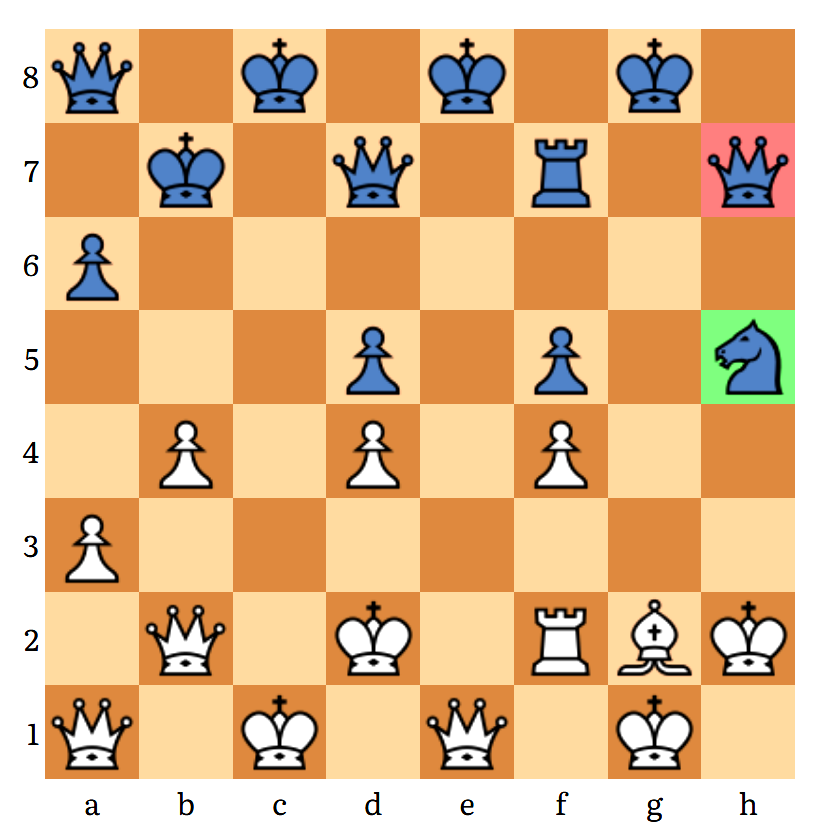
Pawn Only to an adjacent square on the rank immediately in front (straight ahead or either diagonal); however, it cannot move to an empty diagonal square and cannot "capture" straight ahead — these moves are only possible if a turnover occurs on an occupied square. |
Turnover Mechanic
If the destination square is occupied, the arriving ring interacts with the stack there:
- If they form a valid combination, the arriving ring **absorbs** the existing rings, forming a new piece; any enemy rings are turned over (flipped to the opponent's color, akin to Othello/Reversi).
- Otherwise (e.g., duplicate rings), the destination must be an enemy piece/stack, which is replaced (standard capture).
Setup and Objective
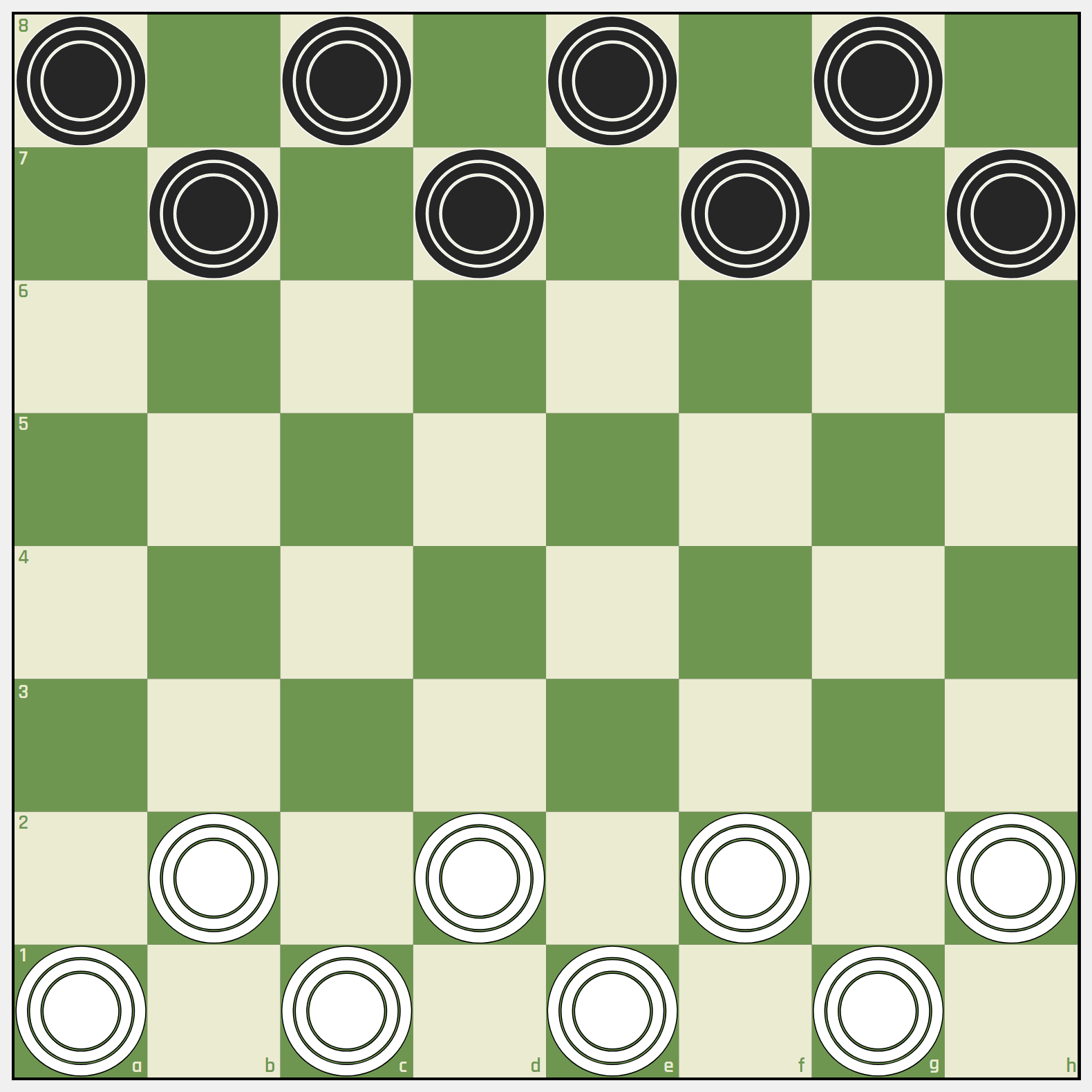
Each player begins with eight Castles (T+F+W) on their first two ranks: White on dark squares (a2–h1 alternating), Black on light squares (a8–h7). Castles cannot occupy the opponent's last rank.
The objective is to checkmate **all** of the opponent's Castles (i.e., leave them with none after your move, before promotion). Stalemate (no legal moves) also loses. Draws occur by threefold repetition or 50 moves without a capture or turnover.
Promotion
Walls (W) and Castles promote to Citadel (T+F) upon reaching the opponent's last rank.
Siege
In Turnover Chess, a stalemate is considered a siege, so the game will NEVER end with a stalemate draw. It's considered that the "King" is in siege inside his Castle, and in this case the player must move, even to a square under attack.
Objective of the game: Leave Your Opponent Without Castles.
Draw
Threefold Repetition: A draw can be claimed if the same exact position is repeated three times during a game. This includes the same pieces on the same squares, with the same possible moves available, and the same player having the turn. The draw is only official if the player whose turn it is requests it, often used strategically to avoid a loss.
50-Move Rule: A draw can be claimed if 50 consecutive moves are made by both players without any piece takes or turns over an opponent's piece. This rule helps avoid overly prolonged games where no ProgresS is being made.
Mutual Agreement: The game ends in a draw if both players agree to it. To initiate a draw, one player must propose it and the other must accept. If the proposal is declined, the game continues.
The Chess Variant Pages