
T.S. Leander
Training Ship LEANDER'' (TSLeander'') is a unit in the Sea Cadet Corps
History
The SCC traces its roots back to 1929 when the first open Sea Cadet unit was formed in Christchurch, by the Canterbury Navy League. Units formed in the four main centres and were controlled nationally by the Canterbury branch of the League.
Organisation
Command Structure
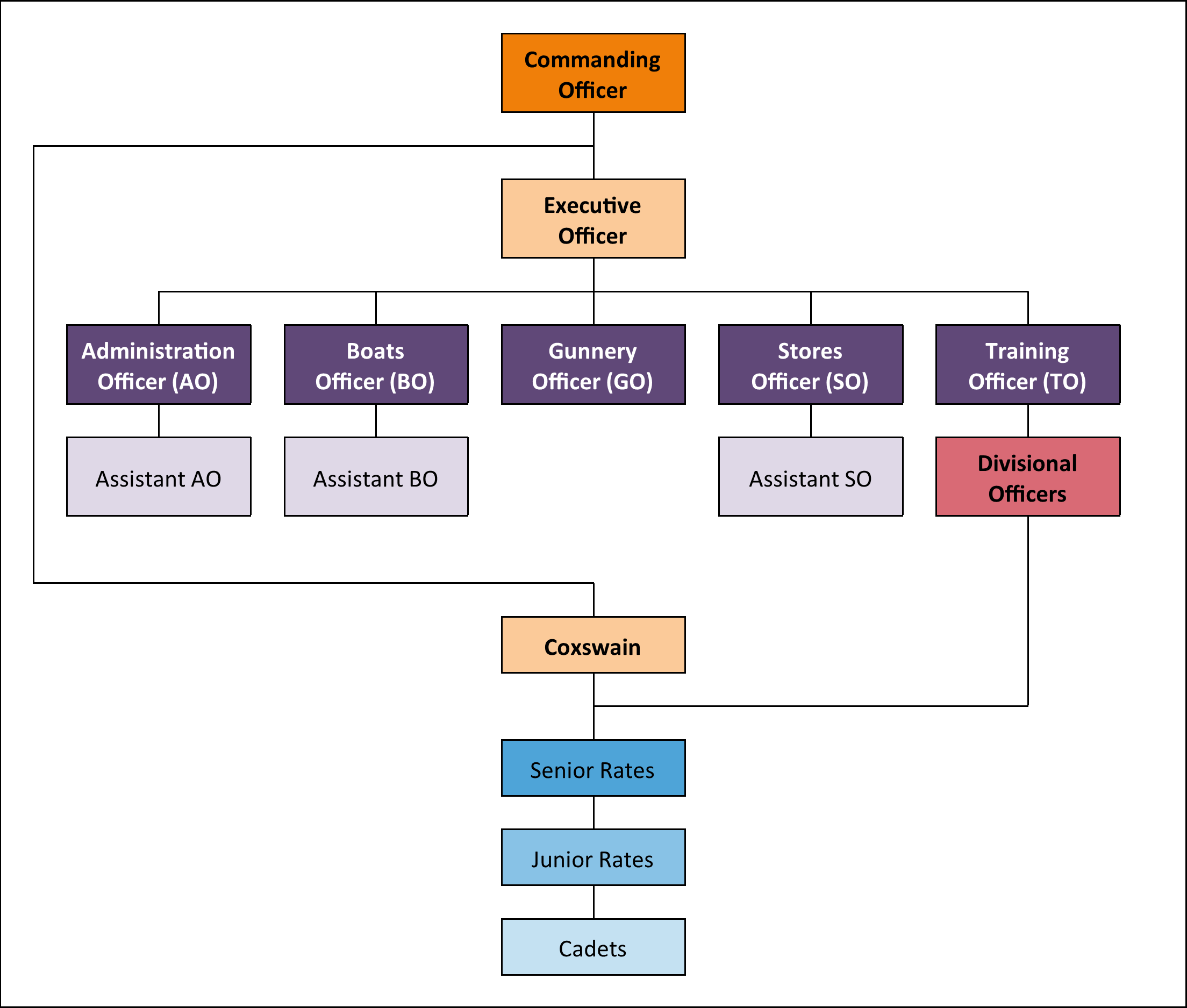
Rank Structure
Commissioned Officers
Officers are commissioned into the New Zealand Cadet Forces, with the post-nominal letters NZCF, after completing the necessary training and service.
Rank |
Abbreviation |
Notes |
|---|---|---|
Commander, NZCF |
CDR |
This rank is held only by the Assistant Commandant, New Zealand Cadet Forces |
Lieutenant Commander, NZCF |
LTCDR |
This rank is available only to Unit Commanders |
Lieutenant, NZCF |
LT |
- |
Sub-Lieutenant, NZCF |
SLT |
- |
Ensign, NZCF |
ENS |
- |
Cadet Ranks
Cadets may in time be promoted to Non-commissioned officer (NCO) ranks, which are based on the rank structure of the Royal New Zealand Navy. New members are referred to by the rank of "New Entrant", before progressing to "Ordinary Cadet", then "Able Cadet", which are awarded following the completion of a test administered by the unit. Ranks above this are only awarded after the completion of joint training courses held with other units of the Sea Cadets, as well as the Air Training Corps and New Zealand Cadet Corps. Cadet ranks are often abbreviated by omitting the "Cadet" suffix.
Rank |
Abbreviation |
Type |
Notes |
|---|---|---|---|
Under Officer |
UO |
Non-Commissioned Officer |
Equivalent to a Midshipman |
Warrant Officer Cadet |
WOCDT |
Senior Rate or SNCO |
Highest rank a cadet can obtain. |
Chief Petty Officer Cadet |
CPOCDT |
Senior Rate or SNCO |
- |
Petty Officer Cadet |
POCDT |
Senior Rate or SNCO |
- |
Leading Cadet |
LCDT |
Junior Rate or JNCO |
- |
Able Cadet |
ACDT |
- |
- |
Ordinary Cadet |
OCDT |
- |
- |
New Entrant |
NECDT |
- |
- |
Membership
Cadet Members
Cadets can join if they are between the ages of thirteen and eighteen. The units provide uniforms, but may hold bonds to ensure that they are returned. Unit fees are set by each unit annually, but are normally between NZ$10–$20 per term.
Cadets may in time be promoted to Non-commissioned officer (NCO) ranks, which are based on the rank structure of the Royal New Zealand Navy.
Adult Members
Adult Members can serve in two capacities: Commissioned Officers or Civilian Instructors. Officers are commissioned into the New Zealand Cadet Forces, at the rank of Ensign, and can be promoted to Sub-Lieutenant and Lieutenant, after completing the necessary training and service. The highest rank attainable is Lieutenant Commander, which is available only to Unit Commanders. Civilian Instructors are civilians who help train cadets. They do not wear uniform, but they are generally treated similarly to officers by cadets.
Activities
Parade Nights
TS Leander holds Parade Nights from 1830 to 2115 (06.30 pm to 09.15 pm) every Wednesday during school terms. Each parade night begins with colours and ends with a sunset parade, and liberty men. The starting parade is used to inspect uniforms, and to inform the cadets on the parade night's activities. The final parade to inform the cadets on upcoming events in the unit. Between the parades, the cadets undergo classroom, or practical instruction.
Boating

 Develop and maintain safe seamanship skills in power, sail, oar, and paddle craft, and learn the correct way to utilise ropes and pulleys. Sea Cadets Learn boatwork in a Navy Crown, and a RS Feva
Sailing
Not only learning how to sail, cadets learn points of sail, boat balance and boat trim. The cadets also participate in various regattas.
Navy Crown |
RS Feva |
|
|---|---|---|
Crew |
2-6 members |
2 |
Size (LOA) |
12 ft 0 in (3.66 m) |
|
Use |
Long Distance Sail |
For experienced cadets |
Sea Survival Skills
Cadets learn a multitude of skills required to man the boats we sail.
These include:
- Basic sailing techniques,
- Advanced racing techniques,
- Anchor a boat,
- Recover a Man Overboard,
- Come up to a mooring buoy,
- Come alongside a jetty,
- Recover a capsized (overturned) boat.
Power Boat Experience
Cadets often have the opportunity to have experience driving various types of power craft. Although cadets will mostly pilot 'Tiller-Driven' power boats, cadets may drive a 'Center-Console' type of power craft.
Pulling
 In Jack-speak (Navy terminology), to go 'Pulling' means to go rowing (i.e. to 'pull' the boat across the water).
Life Skills
Discipline
- Following the Navy, Sea Cadets have a similar discipline value, this is promulgated through the rank structure.
Leadership
- As part of the curriculum, cadets are taught different aspects of leadership in theory and then are put into practice during activities.
Team building
- One of the first thing Cadets learn: Team Building. This is elemental in most activities Sea Cadets do.
First Aid
- Cadets learn the basics of First Aid.
- The syllabus covers basic first aid including:
- minor injuries,
- being calm, and
- ensuring that emergency services have been notified.
Ropework
- Cadets learn several useful bends, hitches, and knots.
- In addition to this, cadets learn how to correctly store and stow rope.
Skills from the Navy
Firearm Safety and Shooting
- Cadet Forces is the only youth organisation allowed to own and use firearms.
- Leander conducts regular range training with smallbore rifles.
- Cadets must pass a TOETS (Test of Elementary Training Skills) before being allowed on the range.
- Not only do they actually fire bullets, but they also learn
- rifle safety,
- correct rifle maintenance, and
- the laws of ownership.
- Each year the Smitt Trophy shooting competition is held between all the Sea Cadet Units in New Zealand.
Sea Navigation
- Cadets learn how to plot a sailing course, to draw a three-point fix and read charts.
Ships Husbandry
- Also known as Boat Maintenance: Develop skills in maintaining sail craft, as well as inboard and outboard motors.
Ceremonial Drill
- Following our Navy's drill standard, cadets learn commands of drill and how to use them in appropriate ceremonies.
- There are multiple uniforms for different parades and activities.
Other Activities
- History of RNZN
- Dress and bearing
- Radio procedures
Competitions
Navy League Regatta
In term four TS Leander competes against the other Auckland Sea Cadet Units (TS Achilles, TS Bellona, and TS Gambia ). This regatta involves four activities: Crown fleet sailing, Feva fleet sailing, Tug of war, and Heaving line.
Northern Area Regattas
Every year TS Leander competes against the six other Sea Cadet Unit in the Northern Area: TS Achilles, TS Bellona, TS Chatham, TS Diomede, TS Gambia and TS Rangiriri. Together the seven units compete in a variety of fields.
Water Activities |
Land Activities |
|---|---|
Pulling |
Rifle Handling Drills |
Crown Sailing |
Range Shoot |
Feva Sailing |
Rope Work |
Cadet Seamanship |
First Aid |
Seamanship Evolution:
|
|
Mast Construction |
|
Drill |
Year |
Place |
№ of teams |
Winner |
Host |
Notes |
|---|---|---|---|---|---|
2017 |
6th |
6 |
TS Bellona |
TS Bellona |
Location: TS Chatham |
2016 |
1st |
7 |
TS Leander |
TS Achilles |
Participated in the National Regatta |
2015 |
1st |
7 |
TS Leander |
TS Rangiriri |
Participated in the National Regatta |
2014 |
2nd |
7 |
TS Bellona |
TS Leander |
- |
2013 |
Unknown |
7 |
Unknown |
TS Gambia |
- |
National Regatta
The three area winners from Northern, Central and Southern Area come together to compete for the National title. The three teams compete against each other in the same activities as the Area Regattas, plus a Mystery event.
Year |
Place |
Winner |
2nd runner up |
3rd runner up |
Host |
Notes |
|---|---|---|---|---|---|---|
2016 |
=2nd |
TS Talisman |
TS Leander =2nd |
TS Taupo =2nd |
Whangaparoa, Auckland |
No 3rd runner up |
2015 |
2nd |
TS Taupo |
TS Leander |
TS Talisman |
TS Amokoura, Wellington |
- |
NZCF Courses
Promotional Courses
- Junior Non-Commissioned Officer (JNCO) Course - Equivalent of NZDF Junior NCO Course. Cadets attend this course to be promoted to the rank of Leading Cadet (LCDT), and become a JNCO.
- Senior Non-Commissioned Officer (SNCO) Course - Equivalent of NZDF Senior NCO Course. JNCOs' attend this course to be promoted to the rank of Petty Officer Cadet (POCDT), and above, thus becoming a Senior Rate, or SNCO.
Sea Cadet Courses
- Cadet Coxswains Course - This is a sational course, reserved for Sea Cadets. The cadets are assesed on their ability to anchor a boat, recover a Man Overboard, mooring to buoy, coming alongside a jetty, recovering a capsized boat and more.
National NZCF Courses
- Cadet Bushcraft Course - Intermediate level bushcraft, survival, SAR and outdoor first aid course. Cadets from the Cadet Corps (Army cadets), and the ATC (Air Cadets) usually attend this course.
- Under Officers' Course - Not required, but useful for promotion to Warrant Officer (WOCDT) and Under Officer (UO) ranks. This course trains senior cadets on roles which an Under Officer, and Commissioned Officer fulfills.
Officer Courses
- Officer Commissioning Course - The course where officer cadets learn how to become commissioned officers. Officers undergo formal training in risk management. This course includes NZQA risk management unit standards.
Once officers are commissioned they may attend the following courses:
- Marine Safety Officer (MSO) Course - Officer who pass this course are allowed to take cadets out on the water for water activities.
- Officer Bushcraft Course - Officers are trained to lead unit expeditions, and tramps.
- Officer Instructional Technique and Training Management (ITTM) Course - Course for Officers to learn teaching skills.
- Shooting Coaching Course - Training for senior rates and Officers in shooting coaching technique.
- Ranfe Safety Officer (RSO) Course - Required training for Officers to become a Range Safety Officer on unit range shoots.
- Officer Command Course - Training for Officers to become a Unit Commander.
History
Leander Name
Origns
The name Leander comes from the Greek myth: Hero and Leander. The myth is about the story of Hero, a priestess of Aphrodite (the goodess of love) who dwelt in a tower in Sestos on the European side of the Hellespont (today's Dardanelles), and Leander, a young man from Abydos on the opposite side of the strait. Leander fell in love with Hero and would swim every night across the Hellespont to be with her. Hero would light a lamp at the top of her tower to guide his way.
Succumbing to Leander's soft words and to his argument that Aphrodite, as the goddess of love, would scorn the worship of a virgin, Hero allowed him to make love to her. These trysts lasted through the warm summer. But one stormy winter night, the waves tossed Leander in the sea and the breezes blew out Hero's light; Leander lost his way and was drowned. When Hero saw his dead body, she threw herself over the edge of the tower to her death to be with him.
Past Uses
Six ships of the Royal Navy, have been named HMS Leander:
was a 52-gun fourth rate launched in 1780. She was captured by the French in 1798, but was recaptured by the Russians in 1799 and returned. She was renamed HMS Hygeia in 1813 while being used as a medical depot, and was sold in 1817.
was a 58-gun fourth rate launched in 1813 and broken up in 1830.
was a 50-gun fourth rate launched in 1848. She was converted to screw propulsion in 1861 and was sold in 1867.
was a protected cruiser launched in 1882. She became a depot ship in 1904 and was sold in 1920.
- HMS Leander (1931) was a light cruiser launched in 1931. She was transferred to the New Zealand Navy in 1937, returned in 1945 and scrapped in 1949.
was a launched in 1961 and expended as a target in 1989.
See also , a number of steamships with this name
Heraldic Data
To many people, Heraldry can be a fascinating subject, with each emblem or crest steeped in history, family or national. Such is the case with ship's crests. They have a story to tell of famous ships, some whose names are no longer in use, some whose names are still proudly borne by ship's of present-day navies.
The Leander crest was that of Sir Thomas Boulden Thompson, who was Captain on the fourth rate (32 guns) at the Battle of the Nile, fought in Aboukir Bay, Egypt, on the 1st and 2 August 1798, under the command of Admiral Sir Horatio Nelson. The crest depicts the waters of the River Nile with the peculiar long stemmed lotus lilies found there. The pike represents all that remained on which to hoist the Ensign after all three masts had been shot away during the action with the French ship GENEREUX (80 guns).
The circumstances are, that after the battle, Captain Thompson was ordered by Nelson to carry home Captain Edward Berry with his dispatches, but near the western end of Crete, on August 18, they fell in with the French ship GENEREUX. After a brilliant defence, in which Captains Thompson and Berry were severely wounded and the ship badly damaged, they were captured and taken to Corfu.
After a time they were allowed to return, overland, to England. Captain Thompson was tried by court martial for the loss of his ship, and was specially commended for the gallant and unprecedented defence of the Leander against the far superior force of the GENEREUX. On his acquittal, Captain Thompson was knighted, and subsequently chose for his coat of arms that which is now part of the Leander crest.
See also
Sea Cadets
- International Sea Cadet Association
- United Kingdom Sea Cadet Corps
- Other nations' Sea Cadet Corps
Navy League
- Navy League of New Zealand
References
External links
- Training Ship Leander Web Site
- New Zealand Cadet Forces Web Site
- International Sea Cadet Association