
Truncated triangular pyramid number
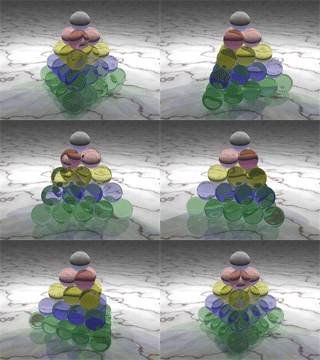 A truncated triangular pyramid number is found by removing (truncating) some smaller tetrahedral number (or triangular pyramidal number) from each of the vertices of a bigger tetrahedral number.
The number to be removed (truncated) May Be same or different from each of the vertices.
Every tetrahedral number or triangular pyramidal number relates at least to the closest lesser number in truncated triangular pyramid number series by such symmetric or asymmetric removals / partitions / truncations of smaller tetrahedral numbers from each of the vertices - unless the difference between the tetrahedral number and its closest lesser truncated triangular pyramid number is part of the special Pollock tetrahedral numbers conjecture series which includes numbers that are not a sum of at most 4 tetrahedral numbers.
Properties
A truncated number is not the same as the volume or area of the truncated shape.
Instead numbers relate more to the problem of how densely given solid objects can pack in space. Dense packing of convex objects is related to problems like the arrangement of molecules in condensed states of matter and to the best way to transmit encoded messages over a noisy channel. Kepler's conjecture, which postulated that the densest packings of congruent spheres in 3-dimensional space have packing density (fraction of space covered by the spheres) = $\pi / \sqrt{18}$ = 74.048% was proved by variants of the face-centered cubic (FCC) lattice packing.
It is hypothesized that a regular tetrahedron might possibly be the convex body having the smallest possible packing density. In contrast to this, the densest known packing of truncated tetrahedra can have an exceptionally high packing fraction φ = 207/208 = 0.995192...
Truncated numbers are also relevant to cluster science in inorganic chemistry. Central to the chemical and physical study of clusters is an understanding of their molecular and electronic structures which is determined by the number of atoms in a cluster of given size and shape and their arrangement or disposition. Semiconductors are one of the most active areas of cluster research.
Examples
Tetrahedral number 35 yields truncated triangular pyramid number 19 by truncating tetrahedral number (or triangular pyramidal number) 4 from each of the vertices.
Tetrahedral number 286 yields truncated triangular pyramid number 273 by truncating tetrahedral number (or triangular pyramidal number) 4,4,4 and 1 from its vertices.
Tetrahedral number 560 can also yield truncated triangular pyramid number 273 by truncating tetrahedral number (or triangular pyramidal number) 84,84,84 and 35 from its vertices OR its corresponding closest lesser truncated triangular pyramid number series number 451 also by truncating tetrahedral number (or triangular pyramidal number) 35,35,35 and 4 from its vertices.
Tetrahedral number 969 yields truncated triangular pyramid number 833 by truncating tetrahedral number (or triangular pyramidal number) 56,35,35 and 10 from its vertices.
However, tetrahedral number 3276 does not yield its corresponding closest lesser truncated triangular pyramid number series number 3059 by truncating any combination of symmetric or asymmetric smaller tetrahedral number (or triangular pyramidal number) from its vertices - because the difference between 3276 and 3059 = 217 which is part of Pollock tetrahedral numbers conjecture series of numbers which are a sum of more than 4 tetrahedral numbers .
Again, tetrahedral number 5984 does not yield its corresponding closest lesser truncated triangular pyramid number series number 5713 by truncating any combination of symmetric or asymmetric smaller tetrahedral number (or triangular pyramidal number) from its vertices - because the difference between 5984 and 5713 = 271 which is again part of Pollock tetrahedral numbers conjecture series of numbers which are a sum of more than 4 tetrahedral numbers .
But other tetrahedral numbers - whether in-between or above/below such known exceptions - again yield corresponding closest lesser truncated triangular pyramid number series number - like 5456 yields truncated triangular pyramid number 5194 by truncating tetrahedral number (or triangular pyramidal number) 84,84,84 and 10 from its vertices OR 11480 yields truncated triangular pyramid number 11137 by truncating tetrahedral number (or triangular pyramidal number) 220,84,35 and 4 from its vertices.
And so on.
Related numbers
Certain truncated triangular pyramid numbers possess other characteristics:
273 (number) is also a sphenic number and an idoneal number
204 (number) is also a square pyramidal number and a nonagonal number
In other fields
- Truncated triangular silver nanoplates synthesized in large quantities using a solution phase method
- Theoretical study of hydrogen storage in a truncated triangular pyramid molecule
- Packing and self-assembly of truncated triangular bipyramids