
Truncated 6-simplexes
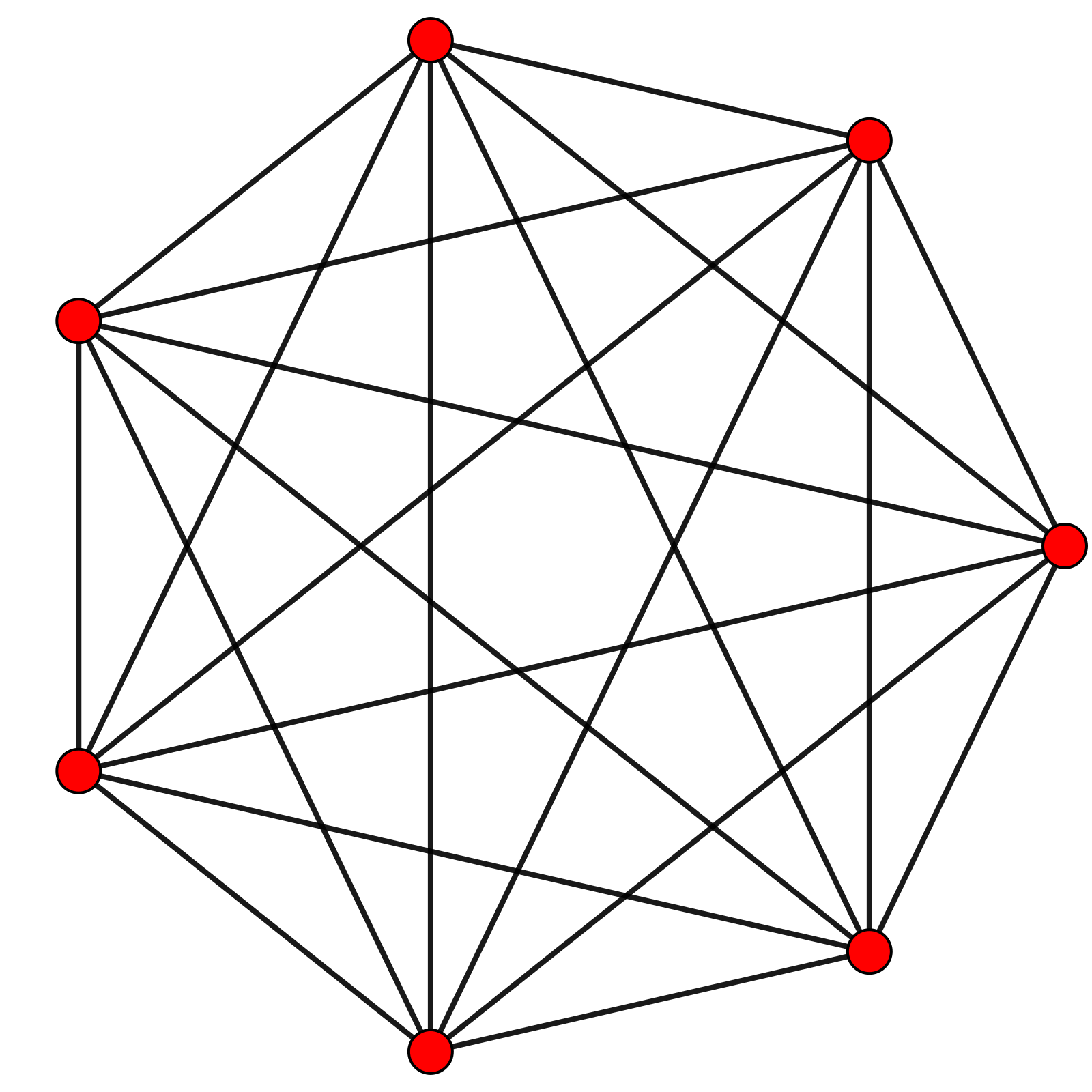
|
|
|
|
Orthogonal projections in A7 Coxeter plane |
|
In six-dimensional geometry, a truncated 6-simplex is a convex uniform 6-polytope, being a truncation of the regular 6-simplex.
There are unique 3 degrees of truncation. Vertices of the truncation 6-simplex are located as pairs on the edge of the 6-simplex. Vertices of the bitruncated 6-simplex are located on the triangular FACES of the 6-simplex. Vertices of the tritruncated 6-simplex are located inside the tetrahedral cells of the 6-simplex.
Truncated 6-simplex
Truncated 6-simplex |
|---|
Type |
Class |
Schläfli symbol |
Coxeter-Dynkin diagram |
5-faces |
4-faces |
Cells |
Faces |
Edges |
Vertices |
Vertex figure |
Coxeter group |
Dual |
Properties |
Alternate names
- Truncated heptapeton (Acronym: til) (Jonathan Bowers)
Coordinates
The vertices of the truncated 6-simplex can be most simply positioned in 7-space as permutations of (0,0,0,0,0,1,2). This construction is based on facets of the truncated 7-orthoplex.
Images
{{-}}
Bitruncated 6-simplex
Bitruncated 6-simplex |
|---|
Type |
Class |
Schläfli symbol |
Coxeter-Dynkin diagram |
5-faces |
4-faces |
Cells |
Faces |
Edges |
Vertices |
Vertex figure |
Coxeter group |
Properties |
Alternate names
- Bitruncated heptapeton (Acronym: batal) (Jonathan Bowers)
Coordinates
The vertices of the bitruncated 6-simplex can be most simply positioned in 7-space as permutations of (0,0,0,0,1,2,2). This construction is based on facets of the bitruncated 7-orthoplex.
Tritruncated 6-simplex
Tritruncated 6-simplex |
|---|
Type |
Class |
Schläfli symbol |
Coxeter-Dynkin diagram |
5-faces |
4-faces |
Cells |
Faces |
Edges |
Vertices |
Vertex figure |
Coxeter group |
Properties |
The tritruncated 6-simplex is an isotopic uniform polytope, with 14 identical bitruncated 5-simplex facets.
The tritruncated 6-simplex is the intersection of two 6-simplexes in dual configuration: and .
Alternate names
- Tetradecapeton (as a 14-facetted 6-polytope) (Acronym: fe) (Jonathan Bowers)
Coordinates
The vertices of the tritruncated 6-simplex can be most simply positioned in 7-space as permutations of (0,0,0,1,2,2,2). This construction is based on facets of the bitruncated 7-orthoplex. Alternately it can be centered on the origin as permutations of (-1,-1,-1,0,1,1,1).
Related uniform 6-polytopes
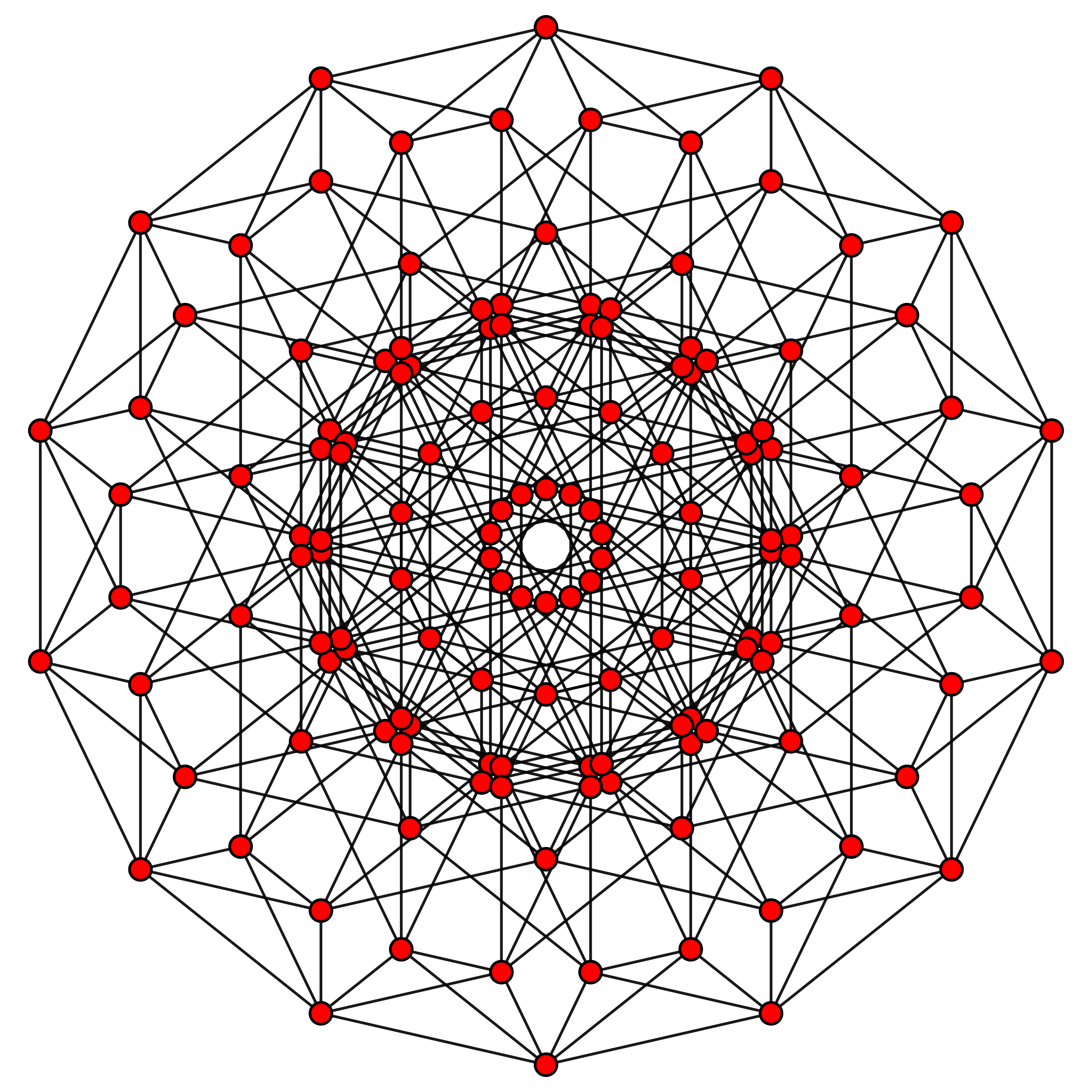
The truncated 6-simplex is one of 35 uniform 6-polytopes based on the [3,3,3,3,3] Coxeter group, all shown here in A6 Coxeter plane orthographic projections.


References
- H.S.M. Coxeter:
- H.S.M. Coxeter, Regular Polytopes, 3rd edition, Dover, New York, 1973
- Kaleidoscopes: Selected Writings of H.S.M. Coxeter, edited by F. Arthur Sherk, Peter McMullen, Anthony C. Thompson, Asia Ivić Weiss, Wiley-Interscience Publication, 1995, wiley.com,
- (Paper 22) H.S.M. Coxeter, Regular and Semi-Regular Polytopes I, [Math. Zeit. 46 (1940) 380–407, MR 2,10]
- (Paper 23) H.S.M. Coxeter, Regular and Semi-Regular Polytopes II, [Math. Zeit. 188 (1985) 559–591]
- (Paper 24) H.S.M. Coxeter, Regular and Semi-Regular Polytopes III, [Math. Zeit. 200 (1988) 3–45]
- Norman Johnson Uniform Polytopes, Manuscript (1991)
- N.W. Johnson: The Theory of Uniform Polytopes and Honeycombs, Ph.D.
o3x3o3o3o3o - til, o3x3x3o3o3o - batal, o3o3x3x3o3o - fe