
Titian Self Portrait (Drawing)
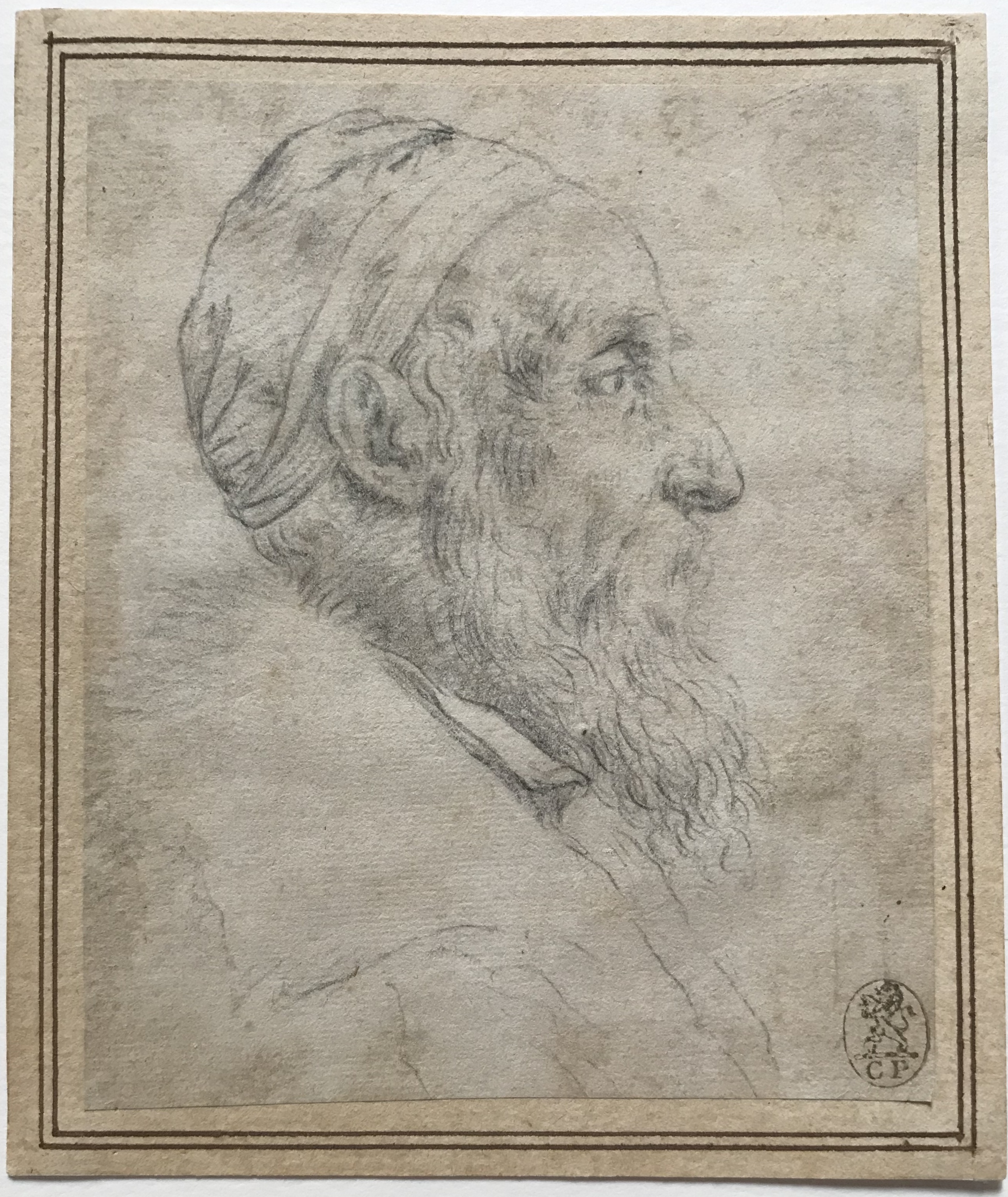
The drawing is clearly related to the profile self-portrait in the Prado, although in reverse, facing to the right. The self-portrait in profile was unusual in the sixteenth century, partly due to the difficult of setting up the various mirrors need to execute it, but the choice of this format wasn’t a casual one: the idea of immortality which was associated with the profile view. Established in ancient numismatic portraiture and revived in the renaissance medal, the profile carried with it implications of monumentality, of permanent commemoration, but also of the mythic origins of the art itself in the drawn outline.
By 1540s Titian himself had already been so figured in medals, his face cast in profile. Particularly intriguing is an image datable to the early 1560s, a profile portrait of the painter holding an image of his son Orazio, known in a medal attributed to Agostino Ardenti and in a richly ornamented colored wax medallion. Titian ,then, had often seen himself in profile; his aquiline nose and pointed beard had became public features of his persona.
One other aspect of the profile is the author portrait as a frontispiece of the printed book. Related to and inspired by the commemorative medals, a model for such effigies was actually established by Titian, who designed the woodcut portrait of Ludovico Ariosto that opened the definitive edition of the Orlando Furioso, published in 1532. It seems quite possible that the drawing served as a modello for the Prado self-portrait, for a medal or for a frontespice. This little self portrait, black chalk on ivory paper 120mm x 99mm, was drawn around 1562-1570.
The drawing, currently in a private collection, in 2007 was included in Belluno international exhibition Tiziano L’ultimo Atto as Titian self portrait.
In 2009 Professor David Rosand wrote an article on Artibus et Historiae, where he suggests that the drawing is indeed the work of the master himself.