
Timeline of healthcare in Germany
This is a timeline of healthcare in Germany, focusing on modern healthcare system first adopted in this country. Major events such as policies and organizations are included.
Big picture
Year/period |
Key developments |
|---|---|
<1883 |
Modern science-based medicine is shaped through endless scientific discoveries by German scientists. Some major events from early times concerning healthcare include the foundation of University Hospital Heidelberg (1388). |
1883–1911 |
Development of the first healthcare system of modern history, starting with policies of the introduced Otto von Bismarck's social legislation. |
1911–1933 |
After the Reich Insurance Code (RVO for Reichsversicherungsordnung) is introduced, health, pension and accident insurance are integrated under one set of laws. The RVO becomes the decisive legal basis for health insurance law. Compulsory insurance is extended to messengers, migrant workers, and those working in farming and forestry. |
1933–1945 |
Under the rule of National Socialism, the organization, financing and supervision of the health insurance funds are altered dramatically. Self-administration is abolished and state-approved directors are assigned to each fund. Among important reforms is the introduction of health insurance for pensioners in 1941. |
1945–1990 |
Two states period: The German Democratic Republic (GDR/East Germany) and the Federal Republic of Germany (FRG/West Germany). A socialist model healthcare system is adopted in East Germany, while self-administration is reinstated in West Germany in 1952. |
1990–present |
After German reunification, former East Germany assimilates to the FRG healthcare system. The unification treaty rules that federal German health insurance law is to apply to the new east German Länder. |
Full timeline
Year/period |
Type of event |
Event |
Location |
|---|---|---|---|
1388 |
Organization |
University Hospital Heidelberg is founded. It is the first one within the actual Federal Republic of Germany. |
Heidelberg |
1456 |
Organization |
Greifswald University Hospital is founded. |
Greifswald |
1457 |
Organization |
University Medical Center Freiburg, a hospital and research unit, is founded. |
Freiburg im Breisgau |
1710 |
Organization |
The Charité – Universitätsmedizin Berlin founded. |
Berlin |
1783 |
Organization |
University Hospital Bonn founded. |
Bonn |
1834 |
Organization |
Rechts der Isar Hospital founded. |
Munich |
1854 |
Policy |
First components of social security created for miners. |
|
1865 |
Organization |
Martin Gropius Krankenhaus, a neuro-psychiatric hospital, is founded. |
Eberswalde |
1867 |
Organization |
Bethel Institution founded. |
Bielefeld |
1871 |
Development |
German national unity is established. Workers begin to organize labor unions, fighting both industrial employers and the Prussian State. Under pressure, business leaders begin to conceive the idea of developing “sickness funds” to respond workers. |
|
1883 |
Policy/development |
Under the rule of Otto Von Bismarck, Health Insurance Act is adopted. Beginning of the national social health insurance, which is considered to be the first in history. An estimated 5% to 10% of the total population is initially covered. Coverage for blue-collar workers (in saltworks, processing plants, factories, metallurgical plants, railway companies, shipping companies, shipyards, building companies, trade companies, power plants), craftsmen, persons employed by lawyers, notaries, bailiffs, industrial cooperatives and insurance funds. |
|
1884 |
Policy |
Statutory Accident Insurance is established. |
|
1885 |
Policy |
Social health insurance in extended to transport workers. |
|
1888 |
Organization |
Berufsgenossenschaftliches Universitätsklinikum Bergmannsheil,a teaching hospital, is founded. |
Bochum |
1889 |
Policy |
Statutory pension insurance is established. |
|
1889 |
Organization |
University Medical Center Hamburg-Eppendorf founded. |
Hamburg |
1892 |
Policy |
Social health insurance in extended to commercial office workers. |
|
1894 |
Organization |
Berufsgenossenschaftliche Kliniken Bergmannstrost Halle, a teaching hospital, is founded. |
Halle |
1900 |
Organization |
The Bernhard Nocht Institute for Tropical Medicine, a research institute, is founded. |
Hamburg |
1910 |
Report |
37% of the population is covered by social health insurance. |
|
1911 |
Policy |
The Reich Insurance Code is launched, systematizing health, pension and accident insurance, integrating them under one set of laws. Social health insurance in extended to and forestry workers, Domestic servants and itinerant workers. |
|
1914 |
Policy |
The health insurance law set down in the Reich Insurance Code goes into effect. Health insurance in extended to civil servants. |
|
1917 |
Organization |
Max Planck Institute of Psychiatry, a research institute, is founded. |
Munich |
1917–1918 |
Policy |
|Social health insurance is extended to the unemployed. |
|
1919 |
Policy |
Social health insurance is extended to persons employed in public and private cooperatives, persons who are only partially capable of gainful employment and wives and daughters without own income. |
|
1927 |
Policy |
Seamen start to be covered by public health insurance. |
|
1930 |
Policy |
All dependents start to be covered by public health insurance. The national total covered population reaches 50%. |
|
1933 |
Policy |
Under [...] regime, health insurance becomes subject to total control by Berlin. Self-administration is abolished and state-approved directors are assigned to each fund. |
|
1938 |
Organization |
Bayreuth Medical Center, a teaching hospital, is founded. |
Bayreuth |
1938 |
Policy |
Social health insurance is extended to midwives and self-employed workers in nursing and child-care. |
|
1939 |
Crisis |
World War II starts with the German invasion of Poland. |
|
1941 |
Policy |
Legislation is passed allowing workers whose incomes have risen above the income ceiling for compulsory membership to continue their insurance on a voluntary basis. The same year, coverage is extended to all retired Germans. |
|
1945 |
German surrender. End of World War II in Europe. |
||
1947 |
Organization |
The Kaiser Wilhelm Institute for Medical Research is founded (later renamed Max Planck Institute for Experimental Medicine). |
Göttingen |
1949 |
Political change |
Creation of the German Democratic Republic (GDR/East Germany) and the Federal Republic of Germany (FRG/West Germany). Control over sickness funds in West Germany reverts to business and labor, while East Germany keeps a state-run delivery system. |
|
1950 |
Report |
70% of the population is covered by social health insurance. |
|
1952 |
Policy |
FRG: self-administration is reinstated. |
|
1953 |
Policy |
Social health insurance is extended to refugees, expellees and the seriously disabled. |
|
1957 |
Policy |
Social health insurance is extended to all the physically disabled. |
|
1964 |
Organization |
FRG: German Cancer Research Center is founded. |
Heidelberg |
1964 |
Organization |
FRG: Heidelberg University Faculty of Medicine in Mannheim is founded. |
Mannheim |
1965 |
Organization |
FRG: The Hannover Medical School is founded. |
Hannover |
1966 |
Organization |
FRG: Uniklinikum Aachen, a university hospital, is founded. |
Aachen |
1966 |
Policy |
FRG: Health insurance coverage is extended to salespeople. |
|
1969 |
Policy |
FRG: The Act on Continued Payment of Wages establishes that blue-collar and white-collar (salaried) workers are to be treated equally in terms of continued remuneration in case of illness. |
|
1972 |
Policy |
FRG: Health insurance coverage is extended to self-employed agricultural workers. |
|
1973 |
Organization |
FRG: The German National Library of Medicine is founded. |
Cologne |
1974 |
Policy |
The Improved Benefits Act and the Rehabilitation Act are incorporated. |
|
1975 |
Policy |
FRG: Social health insurance is extended to students and all disabled. |
|
1977 |
Policy |
FRG: Health Care Cost Containment Act is introduced in an effort to keep spiraling costs under control. |
|
1980 |
Organization |
FRG: Heart and Diabetes Center North Rhine-Westphalia founded. |
Bad Oeynhausen |
1975 |
Policy |
Social health insurance is extended to artists and publicists. |
|
1982 |
Policy |
Reform in the FRG. Hospital Cost Containment Act: Hospital expenditure, which was largely excluded from the 1977 Act, begins to be remedied in this reform. The common goal is to bring the growth of healthcare expenditures in line with growth of wages and salaries of sickness fund members. |
|
1982 |
Organization |
FRG: Augsburg Hospital is founded. |
Augsburg |
1983 |
Policy |
FRG: Cost containment law is reintroduced in order to control healthcare costs. |
|
1989 |
Policy |
FRG: Health Care Reform Act. Described as the most important statute on the statutory health insurance system since the Law of 1911. Aimed both at cost containment and at financing some selected improvements to benefits. |
|
1990 |
Political change |
German reunification. East Germany assimilates to the FRG healthcare system. |
|
1992 |
Organization |
Max Delbrück Center for Molecular Medicine in the Helmholtz Association is founded. |
Berlin |
1993 |
Policy |
Health Care Structure Act comes into effect. Coping with a US$5.7 billion deficit among third-party payers, the German parliament imposes mandatory global budgets to physician, hospital, dental and pharmaceutical services. |
|
1993 |
Organization |
Max Planck Institute for Infection Biology, a research institute, is founded. |
Berlin |
1995 |
Policy |
Statutory long-term care insurance is established. Germany introduces mandatory long-term care insurance to provide care for the elderly. |
|
1996 |
Policy |
Germany begins to allow citizens to choose from among sickness funds. |
|
2000 |
Report |
88% of the population is covered by social health insurance. |
|
2000 |
Organization |
The German Institute for Health Technology Assessment (DAHTA) is established. DAHTA produces reports on medical, economic, social, ethical and legal issues related to the German health system. DAHTA is also involved in developing standards. |
|
2001 |
Organization |
Max Planck Institute for Molecular Biomedicine, research institute, is founded. |
Münster |
2004 |
Organization |
The Institute for Quality and Efficiency in Healthcare (IQWiG) is established as an independent federal organization for the evaluation of medical efficiency, quality and effectiveness of drugs. |
|
2004 |
Policy |
Germany adapts the Australian diagnosis-related group (DRG) system as the sole system of paying for recurrent hospital expenditures, except for psychiatric care where per diem charges still apply. |
|
2006 |
Organization |
The Translational Centre for Regenerative Medicine is founded as a research institute. |
Leipzig |
2009 |
Policy |
A new health care reform act is established in order to redefine the hospital financial system. |
|
2010 |
Policy |
The CDU-FPD coalition passes the GKV-Finanzierungsgesetz for insurance reform and the Arzneimittelmarktneuordnungsgesetz (AMNOG) for pharmaceutical reform in order to contain rising costs resulting from a demographic transition toward an older population. |
|
2016 |
Report |
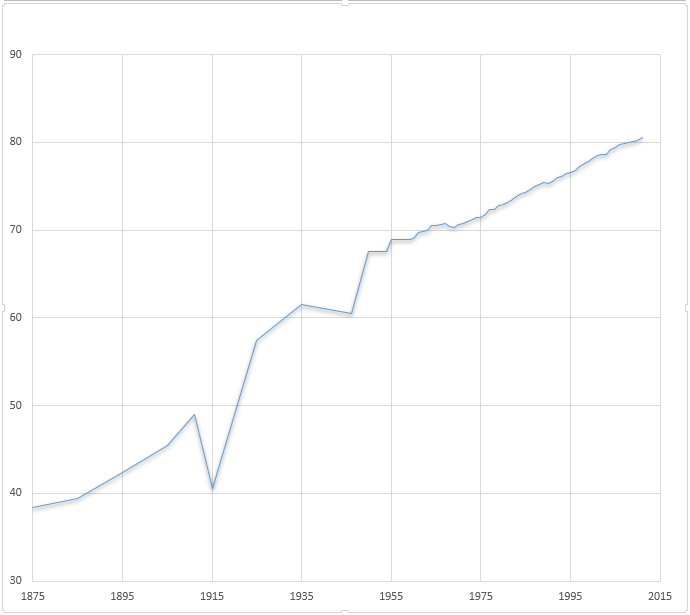
Life expectancy in Germany is estimated at 80.68 years, being ranked 28th out of 228 political subdivisions. |
|
See also
- Healthcare in Germany
- Timeline of global health