
Tiger versus lion
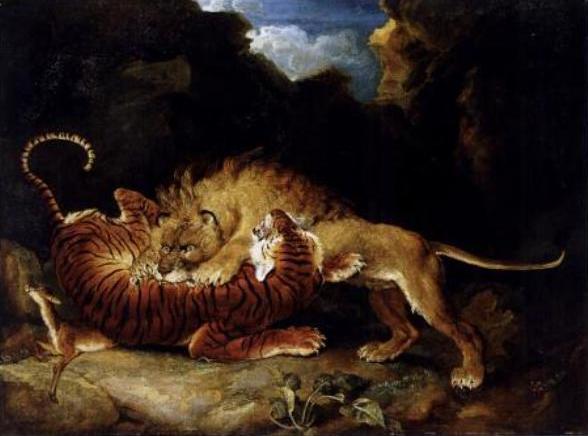 Historically, the comparative merits of the tiger versus the lion was a popular topic of discussion by hunters, naturalists, artists, and poets, and it continues to inspire the popular imagination in the present day.
History
In the circuses of Ancient Rome, exotic beasts were commonly pitted against each other. The contest of the lion against the tiger was a classic pairing and the betting usually favoured the tiger. A mosaic in the House of the Faun in Pompeii shows a fight between a lion and a tiger. The poet Martial, writing in the 1st century, stated that the tiger always killed the lion in the ampitheatre.
At the end of the 19th century, the Gaekwad of Baroda arranged a fight between a lion and tiger before an audience of thousands. The Gaekwad favoured the lion but it lost, costing the Gaekwad his wager of 37,000 rupees.
Competition in the wild
Both cats are apex predators and tend to dominate sympatric rivals such as leopards, sloth bears, wild dogs and hyenas. But historically the range of the tiger and the range of the lion did overlap from Eastern Anatolia to Central India. Very little is known AbOUT their interactions at this time though as this was before ecology and ethology became established sciences. Therefore their relative competitiveness as apex predators is a relevant ecological question in a historical perspective as lions and tigers would have offered each other peer competition to a greater extent than either has today from leopards, hyenas and bears. It is also relevant in a contemporary context as India is looking for a second national park to host wild lions and is considering a refuge, the Kuno Wildlife Refuge, that may have resident tigers. Gauging how lions and tigers, both critically endangered in India, would respond to each other, is critical to assessing the prospects of success if indeed tigers remain in Kuno Wildlife Refuge.
It is known that species can change behavior according to sympatric species including rivals, as has been seen with leopards in Indian national parks, that avoid the presence of tigers. However, with present knowledge we cannot say if the presence of the other would have made lions more pronounced plains cats and tigers more pronounced forest cats, respectively. Based on experience in captivity it seems unlikely that one would clearly have dominated the other (see below).
Physical comparison
Comparative size
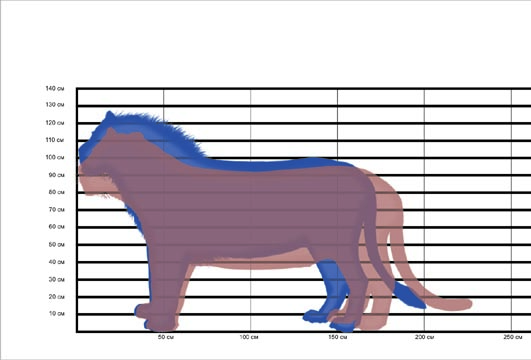 The general popular science assertion that tigers are bigger than lions is not well documented scientifically. Guinness Book of Animal Records lists the heaviest tiger shot in the wild, a Bengal male of 388 kg as significantly heavier than the heaviest lion shot in the wild, at 313 kg. But there is little reliable data available where several individuals have been weighed to determine a statistically significant difference. Skull measurements show that lions indisputably have the larger skulls but this cannot directly be interpreted as saying that they are also heavier overall. Other publications list the heaviest tiger recorded by scientists as weighing 272 kg, while the heaviest lion weighed 260kg.
Temperament
The tiger is a solitary hunter while the lion is a social animal, living and hunting in groups called prides. Though lions cooperate in hunting, the pride is very competitive during feeding. Weaker animals are pushed aside or chased off. The competitive nature of this social structure makes the lion more prone to fighting, especially males whose very lives depend (since the male isn't as specialized in hunting on the open plains) on getting a pride of their own. The tiger is significantly quicker than the lion and so keepers of captive tigers must take care to avoid a sudden attack.
Simulations and studies
Researchers at the University of Buffalo did experiments and produced a simulation called the Vertebrate Analyzer to study the fighting behavior of big cats. Their work was featured in an episode of Animal Face-Off that focused on a theoretical lion versus tiger conflict in which the lion won.
Accidental fights in captivity
In September 2010 a tiger at Ankara Zoo got into the lion enclosure and killed a lion. "The tiger severed the lion's jugular vein in a single stroke with its paw, leaving the animal dying in a pool of blood, officials said." That the jugular vein could be cut so fast suggests that the lion had no mane and so was presumably a youngster or a female although mane-less lions exist. In 2004, a lion defeated a tiger in a contest over access to a pool in a Chinese zoo, but did not kill the tiger. In 1951 in Milwaukee, a male lion killed a tigress. It is therefore safe to say that both cats have occasionally dominated the other when they have met in captivity.
Comparative advantages over one another
The mane of the lion is debated over offering extra protection from fatal bites and injuries, but GeneRally experts say it makes a difference, though not significantly. Both the big cats have their teeth and claws as main weapons for attacking each other. It is disputed whether they bring their hunting techniques to use in fight or not but when made to fight with each other; it is accepted that they bring into use their fighting skills more often, like attacking shoulders, limbs and face with their claws more often than going for direct throat bites. Both cats have been known to kill rivals in fights over territory and mating rights and it seems unlikely that one enjoys a significant advantage in fighting experience under natural circumstances.
The cranial capacity of the tiger is larger than that of the lion which suggests that tigers may have larger brains, but it does not necessarily mean that tigers are smarter.
The fighting techniques of the lion and tiger observed in the wild (as well as captivity) tend to be very different. Tigers favors a boxing technique, standing on hind legs and boxing with both paws. They also prefer to keep their distance, striking and then moving away. Lions general go for a grapple/tackle approach. Their aim it to bring their opponent down so they can attack the neck or the spine. When striking, lions typically hit with one paw, putting all their weight behind the swing. In all fights between the two captured on film, these techinques are evident. The lion usually is the one chasing the tiger, aiming to grapple. The tiger keeps his distance and strikes with both paws, typically landing several times more blows than the lion.
King of the Beasts
The lion is traditionally thought of as the King of the Beasts in English-speaking countries. But, in many Asian countries, such as China, India (where both big cats are present), Korea, and Japan, it is the tiger which holds this title.
Arts and literature
Art
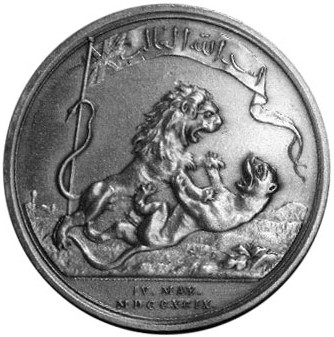 Battles between the two were painted in the 18th and 19th centuries by Eugene Delacroix, George Stubbs, and James Ward. Ward's paintings, which portrayed lion victories in accordance with the lion's symbolic value in Great Britain, have been described as less realistic than Stubbs'. The British Seringapatam medal shows a lion defeating a tiger in battle; an Arabic language banner on the medal displays the words "ASAD ALLAH AL-GHALIB" (the lion of God is the conqueror). The medal commemorated the British victory at the 1799 Battle of Seringapatam over Tipu Sultan - who used tigers as emblems - as opposed to the British emblematic use of lions.
Literature
English literature compared their battle strengths. The poets Edmund Spenser, Allan Ramsey, and Robert Southey described lion victories. In the view of a 19th-century literary critic, these contests established "sovereignty of the animal world".
External links
- Lion and tiger fights at Interspecies conflict site
- Tiger vs Lion historical encounters — numerous cuttings and other sources