
The South Asia Inscriptions Database

 Siddham or the South Asia Inscriptions Database is an open-access resource for the study of inscriptions from South, Central and South East Asia hosted at the British Museum, British Library and the School of Oriental and African Studies. Siddham was established by the European Research Council with start-up funding from the project Beyond Boundaries: Religion, Region, Language and the State. The first focus of Siddham is Sanskrit epigraphy, mainly of the fourth, fifth and sixth centuries CE, but the platform is designed to accommodate inscriptions from all periods. In South Asia alone, the estimated number of historic inscriptions is 90,000. In its next phases, Siddham will expand to include inscriptions in Tamil, Kannada, Prakrit, Tibetan, Burmese, Pyu and Mon.
SIDDHAṂ: the Name
In Sanskrit siddhaṃ means "success, accomplished, perfected." It was also symbolism and substitution for an "auspicious sign" found in the oldest inscriptions of the South Asia. In some cases, siddham is not spelled out, but indicated with a sign such as Om or a srivasta, and various scholars consider siddham in inscriptions to be equivalent to these signs.
This word, written out in characters (such as those shown in the Siddham logo) or represented by a symbol, often stands at the beginning of inscriptions in Indic languages. The term Siddham is also used as a short name for the Indian script known as siddhamātṛkā.
Technical background
The records in Siddham have been prepared in EpiDoc, a tool for structured markup of epigraphic documents in TEI XML.
Numbering system
Within Siddham, each item is listed firstly as an object -- such as a pillar, sculpture, copper-plate, stone slab and so forth. Each object may carry one or more inscriptions, thus each inscription has been assigned a separate Siddham number. A good example is the Allahabad pillar -- a single object -- which carries many inscriptions, among them those of Aśoka, Samudragupta and Jahāngīr. The inscription of Samdragupta appears in Siddham as IN00001. All material generated for SIDDHAṂ is archived in Zenodo.
The further example illustrated here is from Salihundam, Gara Mandal, Srikakulam district, Andhra Pradesh, India, a Buddhist place located approximately at 18°20'7"N 84°2'28"E. At this site, a series of five votive inscriptions are engraved on the semi-circular threshold of a ruined shrine. In Siddham, the semi-circular stone will carry an object number and each votive record an independent inscription number. The photograph of the inscriptions is archived as Zenodo. http://doi.org/10.5281/zenodo.557032. 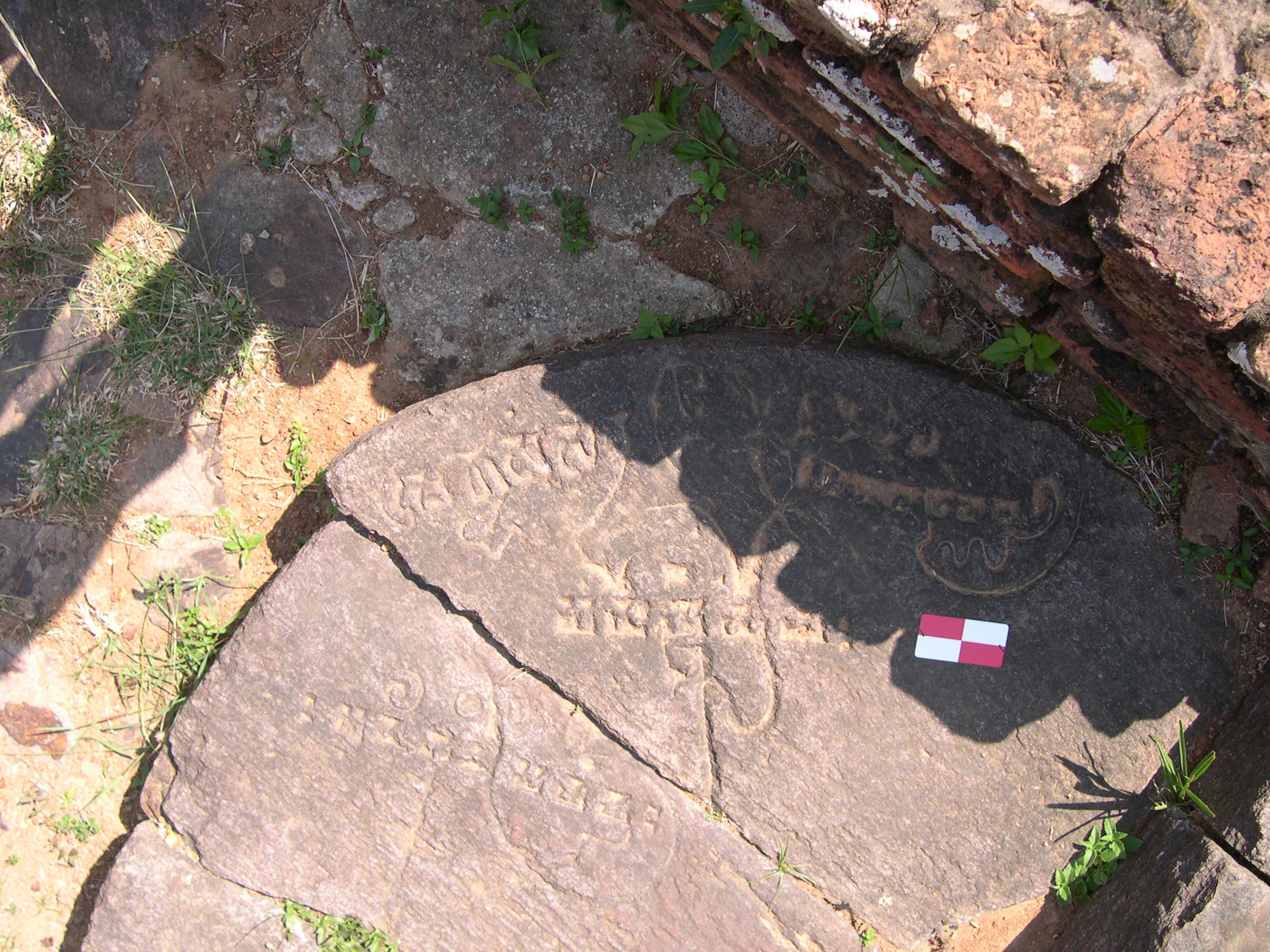
Translations
Translations of inscription texts into western languages appear separately in the community called SIDDHAṂ traductions in Zenodo. Each translation is numbered according to the inscription number assigned in Siddham.
Mapping
Epigraphic documentation involves mapping sites of key dynasties and their inscriptions, especially land-charters recording gifts of land. The mapping undertaken to date can be explored through these links:
External links
- Siddham : The South Asia Inscription Database
- ZENODO research archive : Religion, Region, Language and the State
- ZENODO research archive : SIDDHAṂ: The South Asia Inscriptions Database
- ZENODO research archive : SIDDHAṂ traductions
- ZENODO research archive : Pyu Epigraphy