
Texas Gulf Coast Passive Margin
The Texas Gulf Coast Passive Margin is a transition zone between the continental crust of Texas and the oceanic crust of the Gulf of Mexico. The formation of the region involves a series of collisions, erosion, and rifting. The structure of the passive margin is complicated by faults, foldbelts, and decollements. The region is rich in natural resources such as hydrocarbons and salt deposits.
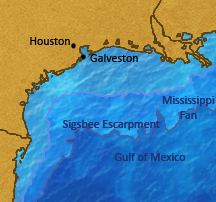
Formation
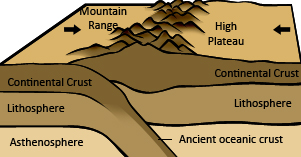
The crust of Texas and most of the central USA was created in the Proterozoic Eon, with most of the Texas crust being generated in the Mesoproterozoic age (1600-1000 Ma). The Gulf of Mexico formed later during the Jurassic Period of the Phanerozoic Eon, AbOUT 170 million years ago (Ma), when the basic structural and stratigraphic framework of the Gulf of Mexico was established. The Texas Gulf Coast Passive Margin was formed through a series of collisions and rifting. The first collision occurred ~1.1 Ga ago and is referred to as the Grenville Orogeny. This collision formed the supercontinent, Rodinia. This type of continent-continent collision resulted in an upper thrust of the Grenville Province over the Texas craton. The Grenville orogen encompasses much of central Texas, as far inland as north central Texas. Mesoproterozoic collision was followed by an extended period (~500 million years) of erosion. After this period of erosion, the first rifting episode occurred. During the Cambrian Period of the early Paleozoic Era, rifting of the southern margin of the ancient North American continent led to the development of a marine basin to the southeast, along with several failed rift basins, which are elongated troughs extending inland from the continental margin. The failed third arm of a triple junction rift zone encompassed the Southern Oklahoma Aulacogen. The other two arms produced a Paleozoic ocean that ultimately lasted for ~250 million years. As the Paleozoic ocean widened, the rifted continental margin subsided and shallow seas advanced landward (Hentz, 2009). This first passive margin existed ~540-300 Ma, forming rich gas deposits of the Barnett Shale. The Paleozoic ocean disappeared in late Pennsylvanian time, when Laurentia and Gondwana collided to form the supercontinent Pangea.
Pennsylvanian collision produced a fold-and-thrust belt known as the Ouachita orogen, which existed in the middle of the Pangean supercontinent. Pangea soon began to break apart, with rifting beginning in Triassic time, ~225 Ma. Triassic rift basins are nowhere exposed in Texas. In the early Jurassic Period, ~145Ma, Pangaea began to break up along two subparallel systems to form the present-day assemblage of continents. This break up resulted in a second rifting and uplift in the late Triassic Period, ~225Ma. Beginning in late Triassic time and continuing into the Jurassic, North American began to separate from South America and Africa. The North Atlantic and Gulf of Mexico opened together as the first stage in the break-up of Pangaea. Rifting of the Gulf of Mexico followed tectonic zones of weakness inherited from Cambrian rifting and the Late Paleozoic Ouachita Orogeny. Later, seafloor spreading in the North Atlantic and Gulf of Mexico began ~165Ma in the mid-Jurassic Period. Mesozoic continental rifting during the breakup of Pangea was just the last phase in the delineation of the southern margin of Laurentia. In common with the structures associated with Mesozoic rifting in the Gulf of Mexico, most of those precursor geotectonic elements of the southern Laurentian continental margin are buried under Mesozoic–Cenozoic sediment cover. (Dickinson, 2009)
Triassic and Jurassic rift basins are mainly filled with sediments and volcanic material at the base. These deposits are overlain by evaporites of the Louann Salt, which testify to seawater influx into a basin that was subject to frequent isolation from the larger ocean, allowing seawater to evaporate and deposit salt. Evaporites are overlain by normal marine sedimentary deposits, such as shale and limestone. This rifting was accomplished by thinning of the crust and mantle lithosphere, followed new oceanic crust being created at a mid-ocean ridge spreading ridge. Gulf of Mexico seafloor spreading ceased after ~25 million years.. This resulted in a passive margin along the Texas Gulf Coast, which continues to exist today. After rifting ceased, the margins of the Gulf of Mexico cooled and subsided during the Cretaceous, building carbonate banks that gave way to clastic deposition in Paleogene time.
In summary, the Texas Gulf Coast passive margin is composed of two types of crust; oceanic and continental. The physical properties of these two types of crust differ in density and thickness. The continental crust (Texas) is ~40 km thick, with a density of 2.7g/cc¬, whereas the oceanic crust (Gulf of Mexico) is ~6 km thick with a density of 3.3g/cc. The continental crust of Texas consists of several layers beginning with a lower mafic (basaltic) crust overlain with a granitic upper crust, age of ~1.4 Ga. This granitic layer is overlain with a layer of volcanic followed by a layer of Paleozoic sediments overlain with a layer of Cretaceous Sediments. The transition between these two crustal types is marked by a hinge zone. It lies beneath the continental slope, and overlies the transitional crust. The hinge zone separates the thin, shallow water sediments of the continental shelf from the thicker deep water sediments of the continental slope and rise.
Sedimentary Sequence
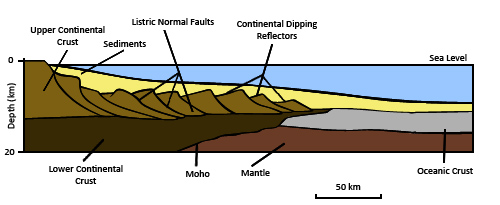
Texas was strongly uplifted in Late Triassic time prior to rifting of Yucatan away from Texas. Uplift may have been associated with a mantle hotspot track in the western Gulf of Mexico. Late Jurassic igneous activity may also have produced a volcanic rifted margin along the Texas coast. This contrasts with the northeastern Mexico margin, which appears o have formed as a transform fault. The Texas volcanic rifted margin changes strike into a transform boundary to the south, and gradationally changes to a nonvolcanic extensional boundary to the east along the Louisiana coast.
The stratigraphy of the Texas Gulf of Mexico passive margin can be divided into five major phases:
(1) Deposition of continental red beds during rifting and crustal.
(2) Deposition of the Louann Salt in late Jurassic (Callovian). The Callovian lasted between ~164.7 ± 4.0 Ma and ~161.2 ± 4.0Ma.
(3) Invasion of marine waters, retreat of the continental shelf edge and deposition of shallow-marine carbonates on the shelf and upper slopes while marl and shale were deposited in deeper water. This phase ended with a widespread unconformity evident in seismic data as the Mid-Cretaceous Sequence Boundary.
(4) Little sediment depletion over much of the northeastern Gulf while moderate thicknesses of carbonate and clastic sediments were deposited in the western Gulf. Clastic sediments prograde across the former shelves in the northwestern and north-central Gulf. This phase lasted througt part of the Late Cretaceous and all of the Paleogene.
(5) Neogene sediment flood in the northern Gulf of Mexico. Sedimentation rates increased and clastic turbidites reached well out into the center of the Gulf. Turbidites from the Mississippi delta lapped onto the continental rises of the southern Gulf. Excellent hydrocaron source rocks were deposited along with Jurassic, Lower Cretaceous and Upper Cretaceous carbonates. Additional source rocks were incorporated within Cenozoic shales. (Watkins, 1999)
Structure
The structure of the Texas Gulf passive margin has been examined by many industrial surveys and by COCORP seismic reflection profiling of the San Marcos Arch, which provides useful images of what lies below the surface. Underneath the Cenozoic sediments, an anticlinal structure can be found within the interior zone of the buried late Paleozoic Ouachita orogeny. This structure appears to consist of Precambrian Grenville basement, and the crest of this anticline coincides with the Cretaceous-Tertiary fault zone. Within this zone, some of the faults dip to the northwest, and appear to point towards the top of the anticline. This difference suggests that the Ouachita structure has been reactivated as a hingeline to the subsiding passive margin. Above the Paleozoic sequence, a graben that may be related to rifts can be found near the upper limit of Jurassic salt. Shelf edges of the major Tertiary sequences can be identified by growth faults and shale diapirs.
Igneous oceanic crust formed in the Gulf Coast Basin during the Late Jurassic; the boundary between oceanic and continental crust probably lies beneath the present-day Texas continental shelf or slope, but its exact location is unknown. Jurassic and Cretaceous deposits formed broad carbonate shelves that were periodically buried in places by delta sandstones and shales at the edge of the widening Gulf of Mexico. With increased accumulation of sediments above the Middle Jurassic salt, less dense salt became unstable and flowed upward, forming structures known as salt domes. These structures, which are prominent subsurface features of the Texas Gulf Coast, form significant oil and natural gas traps in the sedimentary rocks that surround them. (Hentz, 2009). Diapirs along the Gulf of Mexico, except for the diapirs on the lower continental slope, are considered to form above regions of thick salt deposited in Jurassic time.
Salt squeezed by accumulating sediments also moved basinward, towards the deep Gulf of Mexico. The detached salt was propelled basinward and upsection toward the Sigsbee Escarpment, leaving pinch-and-swell salt structure behind. Salt features that are located on the outer slopes of the Texas passive margin are not as well developed compared to those near the shelf because the sedimentation has been much less on the slope. The youngest salt features on the outer slopes are much larger than domes on the shelf. It is suggested by seismic data that from the outer slope salt dome growth in the area was initiated by southward salt flowage caused by sediment loading. The reason for their movement was determined to be due to seafloor spreading. (C. C. Humphris)
Growth faults developed upslope and are compensated down slope by toe folding and thrusting. (Claude Rangin, 2008)
Salt-cored foldbelts at the base of Texas Gulf Coast Passive Margin
Many passive margins have deepwater foldbelts formed by the lateral movement of salt or overpressured shale. A combination of gravity gliding above a basinward-dipping detachment and gravity spreading of a sedimentary wedge with a seaward-dipping seafloor, along with a proximal and distal shortening, can lead to downslope the appearance of a foldbelt at the base of the continental slope/rise. Continued is driven mostly by shelf and upper slope sedimentation, which squuezes the underying slat or shale more. This deposition maintains the bathymetric slope and the resulting gravitational potential. Deformation is halted by distal thickening of the overburden caused by the folding itself or by lower slope and abyssal sedimentation. Deformation mostly reflects gravity sliding, not shortening as is characteristic of foldbelts that form in mountain ranges as a result of tectonic forces. Any shortening is significantly less than any foldbelts that are created by either collision or accretion because the driving forces are weaker than the forces of global tectonic motions.
It is not however, the driving force that shapes the structural styles of a foldbelt. It is instead largely dependent on the nature of the décollement layer, the plane on which the migrating salt or shale moves. The décollement acts as a glide plane between the two masses and is a kind of thrust fault. Foldbelts that are detached from overpressured shale will usually show basinward thrust and associated folds. This is due to the relative strength and frictional behavior of the surrounding plastic shale. Until there is sufficient overburden and high fluid pressure, deformation will not occur. In comparison, salt is a viscous material with essentially no strength. This weakness leads to symmetrical detachment folds and allows deformation even when the overlying sediments are thin. Furthermore, the foldbelt slope can be reduced by subsidence into salt and inflation of salt. Most of this shortening can be possible by lateral squeezing of diapirs and salt massifs (Rowan, Peel and Vendeville, Gravity-Driven Foldbelts on Passive Margins). Structural styles in these deepwater foldbelts span range from symmetrical, unfaulted detachment folds to asymmetric and imbricated thrust fans.
The Perdido Fold Belt marks a salt-cored foldbelt at the base of the Texas passive margin, generated by squeezing out of the Louann salt due to sediment loading. Simplified models of the Gulf of Mexico show that toe-of-slope folding is a viable mechanism to develop diapirs in the deep salt basin and to delay folding of the distal overburden. The Perdido Fold Belt likely represents the terminal folding of a much larger, and deeply buried fold belt system.
Salt Deposits
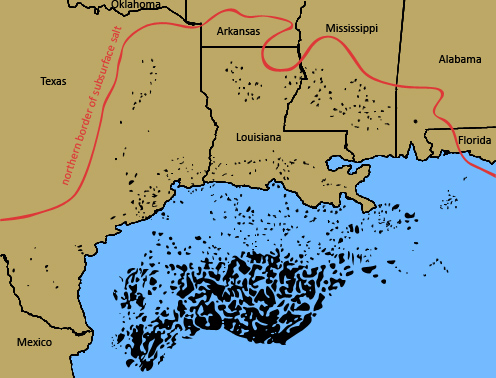
There are over 500 underground salt domes in the near shore Gulf Coast region. Salt domes originate as diapirs from the Louann Salt, as deep as ~4–5 miles below the surface. Salt is less dense than the surrounding sediments and flows easily. Consequently, diapirs of salt push their way up through the sedimentary layers almost to the surface, where salt can be mined, such as at Grand Saline and Avery Island.
Hydrocarbon Exploration
The Texas Gulf of Mexico region is a prolific producer of oil and gas. Deepwater folds have recently become one of the most exciting hydrocarbon exploration plays in the northern Gulf of Mexico. The combination of large structural traps, the possibility of excellent turbidite reservoirs and source-rock intervals, and improved deepwater drilling techniques, is leading companies to pursue the deepwater foldbelt potential on many passive margins, and a number of well penetrations and discoveries are expected to increase dramatically over the coming years. (Rowan, Peel and Vendeville, Gravity-Driven Foldbelts on Passive Margins)
Barrier Islands
The Texas Gulf coast has some of the best examples of barrier islands on Earth. These include Galveston, North and South Padre Island, and . They formed by reworking of Pleistocene sands.
References
- {{ cite book | last = Ramberg | first = H | title = Gravity, deformation and the Earth's crust in theory, experiments and geological application (2nd edition) | publisher = London: Academic Press | year = 1981 | pages = 452}}
- {{ cite journal | last = Schuster | first = D. C. | title = Deformaiton of allochthonous salt and evolution of related salt-structural systems, easter Louisiana Gulf Coast | publisher = Jackson, M. P. A., D. G. Roberts and S. Snelson | journal = Salt Tectonics: a Global Perspective: AAPG Memoir 65 | year = 1995 | pages = 177–198}}
See also
Passive Margin
Texas
Gulf of Mexico