
Tau'ri technology in Stargate
- This article provides a more exhaustive list of the fictional technologies used by the Tau'ri race in the Stargate universe.
- For a listing of their more prominent technologies see the main technology article.
In the Stargate universe the Tau'ri, or humans of Earth, have developed many technologies based on what SG teams have brought back from trips to other planets via the use of the Stargate on Earth. Whilst Earth's level of technology prior even to Stargate travel far supersedes the level found on most planets throughout the galaxy (and indeed others), Earth's technology still remains crude compared to the larger races that they do not surpass. However, recently, Asgard had provided all their technology and history to the Tau'ri, and thus the Asgard technology is now part of Tau'ri's despite the need to analyze the technology thoroughly.
Real or semi-real technology
The following are technologies that actually exist, or are very similar to ones that do.
Firearms
The standard weapons of humans and SG teams remain conventional firearms that, while technologically inferior to many alien weapons, have GeneRally proven to be tactically superior (as the character Thor puts it, "The Asgard would never invent a weapon that propels small weights of iron and carbon alloys, by igniting a powder of potassium nitrate, charcoal and sulfur.")
- AK-74M: Used by Russian SG teams, though their weapon differs in using what is possibly an aftermarket STOCK.
- M82 Barrett rifle: .50CAL heavy sniper rifle. Used by SGC marine combat teams.
- Beretta M9 pistol: pistol of the SG teams (including SG-1).
- Colt M4 carbine: Carbine version of the M16A2 rifle. Assault rifle used by SGC. Removable carrying handle and rail interface system allows many accessory options.
- Colt M16A2 rifle: rifle of SGC base security teams.
- Colt Automatic Rifle-15: Subcarbine version of the M16A1 rifle. Used mainly by gateroom defense teams.
- Dragunov SVD: sniper rifle used by Russian SG teams.
- Fabrique Nationale M240B Machinegun: A General Purpose Machinegun used for supporting fire. Mainly used by Cheyenne Mountain troops.
- Fabrique Nationale M249 Minimi light machine gun: light machine gun of SGC teams.
- Fabrique Nationale P90 PDW: FN P90 is till season 10 the favoured weapon of SG-1, replaced the HK MP5 in approximately Season 4 (year 2000; see ) and is also used by teams on Stargate Atlantis. It is a compact bullpup configuration submachine gun with a high rate of fire and large capacity magazine.
- Heckler & Koch G3SG/1 sniper rifle: Standard issue SGC sniper rifle. Based on Heckler & Koch (H&K) G3 Battle Rifle.
- Heckler & Koch G36K carbine: Carbine variant of the H&K G36 assault rifle. G36K is a rugged carbine rifle. Appears to be the favored weapon of Col. Reynolds & Lt. Col. Cameron Mitchell.
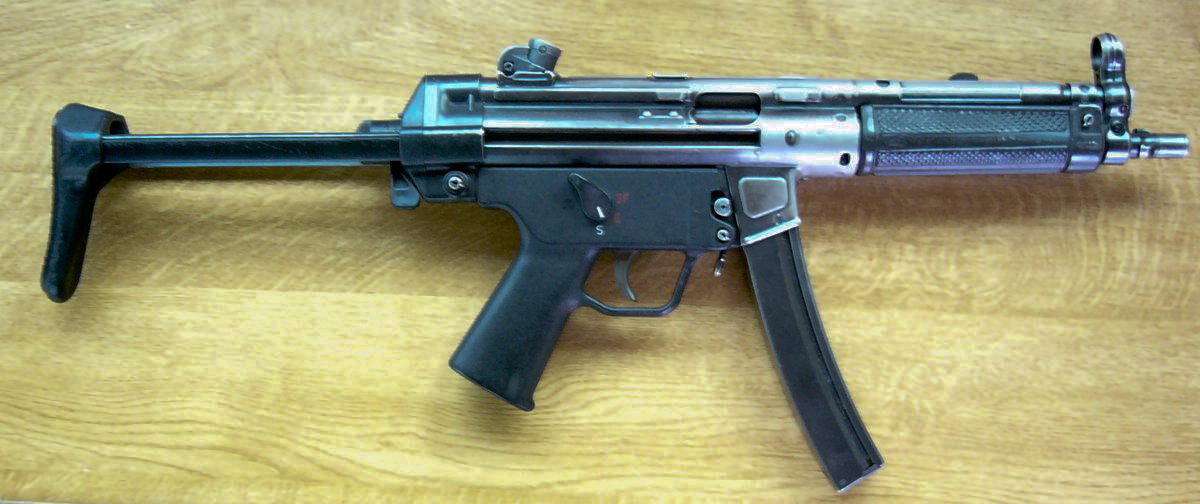
- Heckler & Koch MP5: submachine gun used by SGC teams and base security teams, made by H&K. Appears to have been the favored weapon of SG-1 until approximately Season 4 (2000), when the FN P90 (above) replaced it in most instances.
- Heckler & Koch MP7 PDW: A small machine-pistol style SMG with a small caliber high velocity round. Within the series, it replaced the FN P90 as the weapon used by SG-1 for one episode (), possibly because it was more easily concealed on SG-1's covert mission.
- M60E3 machine gun: Primary heavy support weapon of SG teams.
- M1911A1 Pistol: .45ACP sidearm for SGC marine combat teams. So far (Season 4) the favored weapon of Lt. Col. Sheppard.
- SPAS-12 Shotgun: Pump action and semi-automatic shotgun. An Italian manufactured 12-Gauge Dual Action Shotgun; used by SGC teams.
- USAS-12 Shotgun: A South-Korean 12-Gauge box magazine fed fully automatic shotgun; used by SGC teams. Preferred weapon to fight the Replicators.
- DAO-12: A South African semi-automatic drum fed shotgun. Seen in use by Jack O'Neill and Cameron Mitchell. Seen being used with explosive ammunition in the episode "Stronghold", presumably the Frag-12 shotgun-launched grenade round.
Explosives and pyrotechnic devices
- M136 Rocket Launcher: First seen in the Stargate SG1 season 3 episode Forever in a Day, used by Samantha Carter to blow up a Staff Cannon emplacement. Also seen in the SG1 season 7 finale The Lost City where it was used to take down a Death Glider. It is used regularly by the Atlantis mission to take down wraith darts.
- FIM-92 Stinger Missile: Seen in numerous occasions against Goa'uld Death Gliders, Surface-to-air missile.
- AN-M83 HC White Smoke Hand Grenade: Smoke-generating grenade
- C-4 Explosives: Plastic explosive used for general demolition work.
- M18A1 Claymore Antipersonnel Mine: A mine designed to fire steel balls (shrapnel) out to AbOUT 100 meters across a 60° arc in front of the device.
- M67 Fragmentation Grenade
- M84 Flashbang: Stun grenade that utilizes a combination of light and loud sound to blind and deafen enemy. Seen in the Stargate Atlantis episode The Brotherhood.
- Mk3A2 Concussion Grenade: Relies on concussion waves produced by the explosive filler alone.
Other
- AGM-65E Maverick Missile: A missile employed by the SGC to eliminate Goa'uld Stargate defenses and assassinate System Lords, including Moloc. Both ground troops and UAVs (see below) can "paint" a target with a laser designator to guide the missile. A custom twin-rail ground launcher is used to fire the normally air-launched missile through the Stargate.
- Deep Submergence Rescue Vehicle (DSRV): A submarine craft that was used to rescue members of SG-1 who were stranded on a crashed Ha'tak at the bottom of Earth's ocean.
- Unmanned Aerial Vehicle (UAV): A robotic remote-controlled 'plane' about 2-3 meters in diameter, designed by Samantha Carter and used as an extension of the probing that a MALP is capable of, often used to search for lost personnel. They are launched through an open Stargate using a catapult from within the SGC. The SGC has several types of UAVs at its disposal, each with a different set of attachments, including a rocket launcher, and a target designator that "paints" targets with a red laser beam, to guide Maverick-missile attacks launched from the SGC through the Stargate onto the correct target.
Fictional Technology
The following are technologies that do not exist in the real world; in some cases the new technology is an enhancement or modification of existing technology made possible by interstellar contact, whereas others are completely within the realm of fiction.
Anti-Prior device
A device invented by Samantha Carter and Bill Lee, it is a black disk containing a device that produces high-frequency sound when activated. Developed after the Khalek encounter, the device, when set to the proper frequency, can stop a Prior of the Ori from using his powers for a limited time.
The exact amount of time this takes is not entirely clear, as is if an immunity of some kind is built up over the short term afterwards once a Prior or other evolved human is able to overcome the device. A prior captured in The Fourth Horseman managed to overcome the device after a matter of hours, as did Daniel Jackson. Adria, the Orici over a time period of a day or more was exposed to the device, then a Goa'uld knockoff of the device which unlike the Earth device used some kind of EM energy to achieve the same effect.
Anti-Wraith Retrovirus
Though developed exclusively in Atlantis, this "virus" is actually a gene therapy developed by Dr. Carson Beckett that suppresses the Wraith, or Iratus bug, part of the Wraith genome, and leaves only the human genes active. It causes a Wraith to slowly become a human. Once the process is complete, the subject usually experiences memory loss, allowing him or her to then be fooled into thinking that they have always been human. This was what was done to Michael in the episode .
The invention of this process served as the catalyst for the exploration of a new theme in Stargate Atlantis, which began to explore the idea that maybe the Wraith are not any more "evil" than humans who breed and cull other animals to survive, as well as exploring the concept of identity. The Wraith Michael, though converted into a human genetically, was nevertheless still a Wraith (or so a select number of Atlantis personnel attested vigorously).
Unless given regular injections of the gene, a subject's Iratus Bug DNA will start to exert itself again.
However, the retrovirus does not always have to be injected. It can be transmitted through the air, and used to potentially infect an entire Wraith hive ship. In effect, it is an aerosol weaponised Biological Weapon.
Anti-Replicator Gun (ARG)
 A modified firearm first seen in The Return, they are designed by the SGC based on the replicator disruptor created by Jack O'Neill in New Order to use against the Asuran replicators. They seem to be loosely based on the H&K MP7 Personal Defence Weapon or XM8 compact carbine version. A much larger, planetary-scale Anti-Replicator Weapon is currently being developed, in an effort to eliminate the Asuran Replicators entirely. As of the season 4 episode Lifeline, the Asurans are immune to the effects of the ARG as resulted when Ronon fired his ARG at Oberoth. It is unknown when if ever the SGC and Atlantis will be able to get the ARG working again.
ATA Gene Therapy
Pioneered by Carson Beckett, this is a simple injection that will give humans the ATA gene expression required to use most Ancient technology. It is successful in just under 50% of subjects. It takes at least four hours for the therapy to kick in. However, the therapy is not always permanent and might cause diseases.
The therapy is achieved through the use of a modified mouse retrovirus (Dr. Beckett once joked that the side effects of the therapy included "dry mouth, craving for cheese and a desire to run in a little wheel".)
Chimera
Chimera is the code name of Earth's attempt at replicating holographic technology through the use of Asgard science. The development of the project was made to dissuade beliefs by certain individuals that 'aliens' were present on Earth. The technology was used to explain the appearance of an Asgard clone on Earth and was later revealed in the episode "Bounty" where it was used more extensively.
Dialling Computer
In the absence of a functioning Dial Home Device, the United States Air Force was forced to construct their own system for dialling the Stargate. This system employs several motors to physically move the inner ring of the Stargate in order to dial the desired address. This system has some advantages and disadvantages over a normal DHD. While it allows use of the Stargate to be secured using a palm scanner and addresses to be stored in a permanent database, it lacks several of the safety protocols provided by a DHD. The dialling computer is capable of interpreting some of the signals sent back by the Stargate, but also ignores many of them. The dialling computer is also slower at dialling addresses then a regular DHD.
The dialling computer software was upgraded by Jack O'Neill while his mind contained a complete download of an Ancient repository to allow eight chevron addresses to be dialled.
By the time of season 10 the dialing program and SGC understanding of the Ancient technology inside a Stargate has evolved to the point that a modern laptop computer in the field is capable of being loaded with the dialing program and, in the absence of a DHD, dialing a Stargate so long as a power supply is on hand (such as a portable Naquadah reactor).
Field Remote Expeditionary Device (FRED)
The Field Remote Expeditionary Device (FRED) is an eight-wheeled carrier for tools and supplies, and is mostly sent after the planet has been surveyed by a MALP, immediately before sending a SG team. Among the supplied carried by the FRED is a homing device, used by SG teams to locate the Stargate if they are lost. Occasionally, the FRED will be used as a place for cover if the team is fired upon.
Garage Door Opener (GDO)
The Garage Door Opener (GDO), transmits a coded radio signal containing an Iris Deactivation Code (IDC) to Stargate Command through the event horizon of the Stargate. If the correct IDC is transmitted, the Iris is opened to allow homecoming travellers. This system is unique to Earth and Atlantis. {{-}}
Goa'uld Buster
Naquadah enhanced nuclear weapon used in the episode The Serpent's Lair. It was developed at Area 51 by Col. Samuels and Col. Maybourne. It uses a Type 12A warhead, which is made with radar-absorbing material used on stealth aircraft. However, the material may be ineffective against Goa'uld sensors. Enhanced with Naquadah, it had a yield that exceeded 1000 megatons. Col. Samuels was quite confident that the Goa'uld Buster weapon would work, but it proved ineffective against Goa'uld shields.
Despite the failure of the Goa'uld Buster, the SGC continued to develop other Naquadah enhanced nuclear weapons.
Horizon Weapon Module
Horizon is the codename for a fictional experimental space-based weapon seen in Stargate: Atlantis, designed and constructed by the United States Air Force.
The Horizon contained six Mark IX "Gatebuster" Naquahdriah-enhanced nuclear weapons constructed in independent reentry vehicles, and four decoy vehicles. When launched from a Daedalus class battlecruiser, the Horizon would fly under its own power into the atmosphere of a target planet. At this point, the craft's heat shield would be detached, revealing the warheads and decoys. Upon entering the lower atmosphere, the MIRVs would be launched heading to their individual targets, detonating at optimum altitude, likely a few hundred meters off the ground. The whole engagement process, from launching of the platform to nuclear detonations takes a little over a minute.
In "First Strike", the discovery that the Asurans were constructing an armada of ships prompted the first deployment of the weapon. [[Daedalus_class_battlecruiser#Apollo|USS Apollo]] was dispatched to the Asuran homeworld with orders to use the weapon to destroy these ships. The mission itself was a complete success. Even though the first strike was to trigger an Asuran counter-attack against Atlantis, all of the primary targets and most of the secondary targets were destroyed.
Iris
Blocks incoming traffic through the Stargate when closed; developed to prevent other alien races from dialing Earth and invading. Can be deactivated by a GDO. There have been occasions when enemies breached the Iris; after these breaches the iris was replaced several times. Many of the breaches are detailed in the main article.
Kull disruptor
A weapon developed with the Tok'ra to fight Kull Warriors. Originally installed on a Transphase Eradication Rod, it has since been shrunk to fit as an attachment most SGC small arms such as the P90 and M249. As Kull Warriors seemed impervious to both energy weapons and standard force, the Kull Disruptor became the only thing capable of stopping them.
The disruptor technology is based on the same Ancient Healing Device that Anubis used to animate the super-soldiers. The prototype weapon was only partially effective, usually requiring at least two shots to bring down one of the super-soldiers, though it is evident that the technology had been refined later on. In more recent episodes, Kull Warriors have been brought down by just one disruptor shot.
Locator beacon
All SGC personnel are equipped with implanted locator beacons for use with beaming technology. Originally, the beacons were handheld devices or ankle bracelets, but after Dr. Daniel Jackson was taken hostage and separated from his beacon in the season 9 episode "Ethon," the devices were implanted under the skin and are therefore less detectable. Although on the episode "Memento Mori," the chip was removed from Vala in a van while she was being kidnapped by a Trust cell in full knowledge of the transponders' existence.
It also appears that anyone who travels off-world is fitted with the beacons. In the season 9 episode "The Scourge," SG-1 and members of an international diplomatic tour were stranded on the planet host to the Gamma Site after a carnivorous insect species overran it. Upon the arrival of the Odyssey, all of them were beamed to safety. Though it is possible that the international diplomats were picked up by their life signs.
Mark III Nuclear Missile
The Daedalus was equipped with these nuclear missiles though nothing else is known of their use; However it is possible this is the same type of warhead used to destroy Ra's mothership in the Stargate film as it was mentioned as being a Mark III.
Mark V Nuclear warhead
Was going to be used by the SGC to destroy Abydos in Children Of The Gods.
Mark VIII Tactical Missile
A primary offensive missile used against enemy capital ships, it is speculated that this device has a naquadah enhanced nuclear device and shield inhibitors to penetrate a ship's defenses and increase its destructive capability.
Mark IX "Gate-Buster" bomb
Developed by Samantha Carter at Area 51, the Mark IX is a naqahdriah-enhanced nuclear weapon "designed solely for the purpose of vaporizing Stargates and anything else within a 100 mile/160 kilometer radius." This is no small feat, as Stargates have proven extremely durable. (See note below.) The bomb creates a multi-gigaton detonation. It has built-in safeguards that prevent it from being deactivated by electromagnetic countermeasures or any form of tampering. When the bomb was first used, it failed to destroy the gate in question, which was being protected by an Ori Prior. The second time the weapon was used, against an Active Stargate in the Pegasus Galaxy connected to the Milky Way Supergate, the Gate was successfully destroyed and the wormhole disconnected.
A new variant (probably the production variant over the Beachhead 'prototype' version) of the Mark IX warhead was used in a prototype delivery system codenamed "Horizon". Six Mark IX Gatebusters in independent ballistic reentry vehicles made up the warhead load of a MIRV style orbit to surface weapons system deployed from the Daedalus class starship "Apollo", used in a First Strike against the Asuran home world shipyards. The warheads successfully deployed and detonated on their target, causing horrific damage on a planetary scale.
McKay-Carter Intergalactic Gate Bridge
Dr. McKay and Samantha Carter devised a plan to solve the problem of bi-directional transportation between the Pegasus and Milky Way galaxies without the need for ZPMs.
Using a total of 34 Stargates from both galaxies (17 from each), situated approximately 90000 Light years apart, Stargate Command has constructed an expansive chain of Stargates between the galaxies that would reduce the time to travel between Atlantis and Earth from three weeks to thirty minutes. With this Atlantis can resupply themselves and evacuate faster. Positioned halfway between either galaxy is the Midway Station. Currently, the Midway space station is capable of supporting life but is still in the process of being brought online. At least on the Milky Way Stargate side, there seems to be an iris on the gate as evidenced by the Gate diagnostic screens.
The beginning of Season 4 shows the Midway station capable of supporting life marking the functional completion of the bridge. "Adrift" {{-}}
Mobile Analytic Laboratory Probe (M.A.L.P.)
The Mobile Analytic Laboratory Probe (MALP) is a remote-controlled, wheeled, robotic probe, used to explore alien planets without endangering SGC personnel. MALPs contain equipment used to determine such things as the breathability of the atmosphere and the presence of a working DHD on a planet to be explored. Sensors include a high-resolution tiltable color video camera, laser range finder, spectrometer, a small directional microphone, a Geiger counter, sensors for detecting air pressure/temperature, atmospheric composition and even if the MALP is on its side. MALPs were first seen in the Stargate feature film. JPL loaned the production its "Hazbot III" for this purpose.
Infrared scanning was likely installed after "The Broca Divide" when the MALP's lights were broken in transit. They are used in dark situations, such as inspecting the Goa'uld structure in "Within the Serpent's Grasp" and the Lost City in Stargate Atlantis' pilot "Rising". The standard MALP is based on a sturdy six-wheeled chassis, similar to its eight-wheeled counterpart, FRED. However, because of its wheels, the MALP is not fit for all terrains , and is completely helpless in space.
MALPs are operated from Stargate Command's (SGC) Control Room by remote or on-site at a planet. From the SGC, communication is achieved via two-way digital transmissions sent through the Stargate's wormhole. Technicians can operate the MALP's robot arm by remote. The robot arm provides servo-precision motion and allows the operator to approach a target with millimeter accuracy. Due to the nature of a Stargate's one-way wormhole, an unattended MALP cannot return to Earth using the same wormhole it came through. MALP's are also capable of performing some tasks on their own, such as automatically surveying the area immediately around the Stargate, and collecting samples. Once a MALP has finished its duties, an SG team member or technician dials the gate on the other side and sends it back. As a result, MALPs sent to planets which are too hostile are abandoned.
Naqahdah generator
A naqahdah-powered generator that provides colossal amounts of clean energy. In spite of their small size (they appear to be no more than three-quarters of a meter long and can be moved around by hand) they likely produce a power output roughly comparable to several large nuclear power plants. Nonetheless, this is still nowhere near the astronomical power generated by a ZPM, one or more of which are necessary to power the shields that protect Ancient cities and outposts, such as the Antarctica base in Stargate SG-1 or Atlantis itself in Stargate Atlantis, although several naqahdah generators allow a fraction of Atlantis' systems to be operated.
The Earth version of the device was created by Samantha Carter, based on Orbanian designs. The Naqahdah generator has been used to power not only many Earth-based technologies but can be adapted to power other alien technology, including the Ancients'. A Naqahdah generator can also be converted into a devastating bomb,; several are set to be employed in this manner in Atlantis's self-destruct system. The device emits a powerful electromagnetic pulse when detonated, similar to those emitted by nuclear weapons.
The generators have been seen to power a handful of different Earth and Ancient Technology such as on Daedalus class ships. The generators were abandoned on the Odyssey for a ZPM and later, an Asgard computer core. At least one generator powered Prometheus before it was destroyed. A "Mini" Naqahdah generator was mounted to the X699 prototype plasma weapon that was presented to a technology conference by Dr Lee. The Mark II Naqahdah generator was later developed, and is able to operate stably at a state of barely controlled overload. This type of generator achieves 600% of the power output of a Mark I, producing sufficient power for two generators to operate the Ancient control chair for a short period, something which previously required a Zero Point Module. Nevertheless, it does not produce enough power to operate the Atlantis main shield, nor can it provide a Stargate with enough power to establish a long-lasting intergalactic wormhole. A pair of these devices were successful in powering the chair in Antarctica. Also, at least two Mark II generators are placed in the ZPM room in Atlantis as a back up power source on Atlantis.
Ori Mothership interface
A program made by Carter with the help of Daniel Jackson as a Prior, to fly an Ori ship with the Sangraal aboard to the Ori galaxy.
Portable Scanners
Hand-held devices that can detect/analyze electromagnetic energy and other objects. The original expedition to Abydos used scanners to analyze the local food and minerals. Samantha Carter used a scanner to analyze electromagnetic energy emanating from the crystal skull in the episode "Crystal Skull". She also used a similar device to detect electromagnetic energy emanating from the android Reese when SG-1 discovered her in an alien tomb in the episode "Menace". In the episode "The Quest" Carter used a hand held scanner to detect the time displacement field as the team navigate their way through ancient trials towards the Sangral.
Prior Plague Vaccine
A serum developed by the de-ascended Ancient Orlin. When the Prior plague was accidentally brought to Earth, SG-1 and 12 went back to Sodan and took samples of a Prior's blood to complete the formula. However it wasn't efficient. A Jaffa-turned-Prior, Gerak, used his powers to heal the infected in the base but burst into flames and died. Thanks to him, Dr. Lam isolated an antibody and with Orlin's work, they made a perfect cure. It saved Earth with total casualties of 3000.
In "Ripple Effect", Maj. Gen. Landry gave Alt-Fraiser the cure for her Earth.
Planetary Wide Anti-Replicator Weapon (PWARW)
The Planetary Wide Anti-Replicator Weapon is a satellite weapon based on the Anti-Replicator weapons produced for use against the Replicators. The weapon is similar to the satellite that the Asgard created for use against the Replicators. Area 51 is currently attempting to build a similar weapon for use against the Asurans. The weapon would work to produce the Anti-Replicator disruptor effect on a planetary scale to disrupt the nanite blocks from being held together and thus destroy the Asurans.
Railgun
A railgun is a type of electromagnetic launcher. The variety developed in the series by Earth as a weapon produces an initial bullet velocity of Mach 5 with a 250 mile/425 kilometer range. A standard magazine is capable of holding ten thousand rounds. The projectiles fired from these weapons are so powerful that they can quite easily eliminate the smaller gliders of hostile aliens such as the Wraith Dart and the Goa'uld Death Glider. They are not as effective against larger ships like motherships, but work on shuttles.
These railguns were effective in helping defend Atlantis from the Wraith "Dart" fighter ships in the Atlantis season 1 finale, "The Siege". They have also been installed on the Prometheus and the Daedalus-class battlecruisers.
In reality, the technology exists to build railguns; however, it is difficult to obtain sufficient power for them to be effective and to get the barrel of the gun in question to withstand the extreme temperatures and speeds of the projectile, wearing out the barrel with only a few uses. Presumably, the fictional explanation for the ability to make operational railguns would be the invention of the naqadah generator and the discovery of more durable materials, such as trinium.
Spacecraft
- X-301: The X-301 was the first attempt to reverse-engineer an alien spacecraft, the Goa'uld Death Glider. The effort failed when a built-in recall device was activated to retrieve the stolen Glider.
- X-302: The second experimental fighter jet, designed and built with Earth-based technology, and Earth's first attempt to create hyperspace-capable ships. The prototype was destroyed on a mission to save Earth from destruction by Anubis (the ship was used to cart a detonating Stargate into outer space).
- F-302: The production variant of the 302 fighter program. The F-302 became the standard interceptor used by U.S. Space Forces. It is space-capable and even hyperspace-capable for short distances. It carries modified air weapons. A large wing of these defended Earth against the fleets of Anubis in the season 7 finale, "Lost City". They are also stationed on Earths limited fleet of warships and at some off-world bases.
- BC-303 Prometheus Battlecruiser: The first experimental combatant ship produced as an Earth/Alien-hybrid, designed to combat Goa'uld motherships such as the Ha'tak. Originally classified as the X-303 and developed under code name Prometheus, this eventually became the name of the first ship of the class. The Prometheus uses missiles as primary weapons, but is also armed with the new railguns. Asgard shields added in season 6 and an Asgard Hyperdrive in season 8. This ship was also equipped with Asgard Beaming Technology, as seen in Season 9, where they were used to abandon the ship after it had been damaged by an Ori Satellite, and then destroyed, seconds after the crew beamed out. The Prometheus-class vessels have been discontinued in favor of the new Daedalus-class battlecruiser.
- 304 Daedalus-class Battlecruiser: Earth's second-generation line of battlecruisers; the first ship of its class was named the Daedalus after Daedalus, the engineer and architect of Ancient Greek mythology. The second ship of the class is named the Odyssey, after the Homeric poem of that name. This class of battle cruiser is a significant improvement over the Prometheus design. It has a sleeker shape and a larger, more powerful array of engines than its predecessor. Its weaponry includes rail guns, dorsal tube-launched missiles, tactical nuclear weapons, and a cargo bay capable of carrying large payloads and at least twice as many (16) F-302s than the Prometheus. The biggest difference in the 304's design is its abandonment of much of the Goa'uld technology in favor of Asgard technology, including Asgard shields, teleportation technology, and an Asgard hyperdrive engine. The third Daedalus-class vessel was given to the Russians as part of the Stargate loan agreement and was named Korolev, after Russian rocket engineer Sergey Korolyov.. A fourth vessel would appear for a surgical strike against the Asurans and was named the Apollo.
Unmanned Aerial Vehicles
The SGC also uses Unmanned aerial vehicles (UAV's) to check much larger areas of alien worlds. This miniature aeroplane can be manually controlled from the SGC control room. A UAV can run search patterns, drop supplies, and paint laser targets for the SGC's missile launching capabilities. Some UAV's are mounted with small missiles.
X-699
The X-699 is Earth's first directed energy weapon. It is a fully functioning hand held plasma rifle and appears to operate similarly to the Wraith stunners. It was first seen in the Stargate SG-1 episode "Bounty."