
Symphony CMS
{{ Infobox Software | name = Symphony CMS | screenshot = 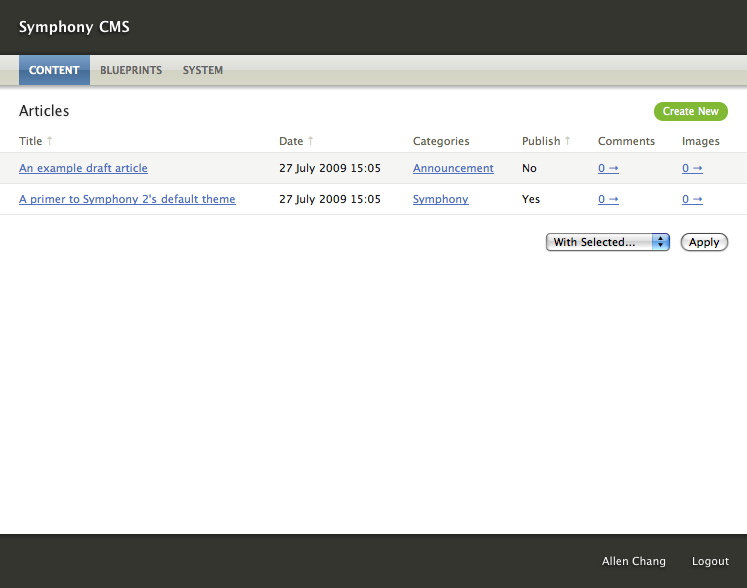 | caption = Symphony's Administrative Backend | latest_release_version = 2.0 | operating_system = Cross-platform | platform = PHP | genre = Content management system, Content management framework | license = MIT License | website = http://symphony-cms.com }}
Symphony is a free and open source content management system (CMS) used to build and manage many kinds of websites, from personal blogs and portfolios to major government and commercial websites. The CMS is widely used by Airlock (agency), a UK digital creative agency.
Technologies
Symphony is written in PHP and uses a MySQL database backend. On the frontend, Symphony works exclusively with XML and XSLT, open technologies developed by the World Wide Web Consortium.
History
Twenty One Degrees Pty. Ltd. formed a partnership with Michael Simmons to develop a Weblog software, called Typeworks on October 2004. The system combined the interface designed by Michael Simmons and the underlying system developed by Twenty One Degrees called, ModMatrix.
In March 2005, Typeworks officially changed its name to Symphony. At the same time, Symphony 0.9 was released as a commercial application for USD$49. The beta code was only made available to pre-order customers.
Since the release of version 1.0, Symphony has drastically changed its focus from a Weblog software into a developer oriented content management system.
Releases
- On December 2005, Symphony 1.0 was released.
- On 21 September 2006, Symphony 1.5 was released and changed its license to freeware.
- On 18 February 2007, Symphony 1.6 was released.
- On 22 March 2007, Symphony 1.7 was released.
- On 23 January 2008, Symphony 2.0 beta was released and changed its license to MIT Open Source.
- On 8th December 2008, Symphony 2.0 was released.
System Design
Symphony is a developer-oriented content management system. Based on MVC programming principles, the system's data and presentation layers are powered by the open standards XML and XSLT, respectively. Symphony provides complete separation between these layers, allowing developers full control over the system's outputs, whether they be XHTML, XML feeds, or any other kind of document.
Features
In direct comparisons of the systems core, Symphony may seem lacking in terms of features. This is due to the fact that Symphony adopts the philosophy of a content management framework whereby the system provides the building blocks for a developer to create the features they need but does not come pre-installed with any feature sets of its own. These building blocks are broken down to 4 types:
- Fields
- Sections
- Data Sources
- Events
Fields are atomic data types such as a person's name or a phone number. Sections are the logical container of fields. Data sources are snippets of XML drawn from the database, related and organised by a section. Events are actionable logic such as posting a comment or making an online purchase. Symphony enables the design and development of these building blocks through the system's web interface.
Though its core features are minimal, there are nearly a hundred extensions available for the system, and many articles demonstrating advanced functionalities.
Vulnerabilities
On 2 August 2008, a vulnerability was discovered that allowed malicious users to gain administration privileges.. A patch was released shortly after.
Criticisms
The developers of Symphony during the 1.0 release had openly stated that they will only support Standards-compliant web browsers, which excluded Internet Explorer 6. To this date, it is not fully compatible with Internet Explorer 7.
Symphony currently does not have comprehensive documentation and relies heavily on the community forum as its main resource for developers.
Reviews
Symphony is featured on many CMS review sites and resource lists.
External links
- Official Symphony Website
- Showcase of Symphony Sites
- Symphony Community Forum
- Symphony Development: source code repository
- Symphony Tutorial: Articles and Screencasts for Symphony 1.7 and prior