
Symbols and proto-writing of the Cucuteni–Trypillian culture
__TOC__ |
The study of the use of symbols and proto-writing of the Cucuteni-Trypillian culture has provided important insights into the early history of Europe. The Cucuteni-Trypillian culture, which existed in the present-day southeastern European nations of Moldova, Romania, and Ukraine during the Neolithic Age and Copper Age, from approximately 5500 BC to 2750 B.C., left behind thousands of settlement ruins containing a wealth of archaeological artifacts attesting to their cultural and technological characteristics. Refer to the main article for a general description of this culture; this article deals with the aspects regarding the possible use of proto-writing by its members.
The mainstream academic view holds that writing first appeared during the Sumerian civilization in southern Mesopotamia, around 3300-3200 B.C. in the form of the Cuneiform script. This first writing system did not suddenly appear out of nowhere, but gradually developed from less stylized pictographic systems that used ideographic and mnemonic symbols that contained meaning, but did not have the linguistic flexibility of the natural language writing system that the Sumerians first conceived. These earlier symbolic systems have been labeled as Proto-writing, examples of which have been discovered in a variety of places around the world, some dating back to the 7th millennium BC.
Vinča script
One such early example of a proto-writing system is the Vinča script, which is a set of symbols depicted on clay artifacts associated with the Vinča culture, which flourished along the Danube River in the Pannonian Plain, between 6000-4000 B.C. The first discovery of this script occurred at the archaeological site in the village of Turdaş, Romania (which was known at the time as Tordos), and consisted of a collection of artifacts that had what appeared to be an unknown system of writing. In 1908, more of these same kind of artifacts were discovered at a site near Vinča, outside of the city of Belgrade, Serbia. Scholars subsequently labeled this the "Vinča Script" or "Vinča-Tordos Script". There is a considerable amount of controversy surrounding the Vinča script as to how old it is, as well as whether it should be considered as an actual writing system, an example of proto-writing, or just a collection of meaningful symbols. Indeed, the entire subject regarding every aspect of the Vinča script is fraught with controversy.
As if all of this was not confusing enough, the Vinča script was also seized upon by the noted Lithuanian archaeologist Marija Gimbutas, who in the 1950s developed her theories that became collectively known as the Old European culture. Gimbutas claimed that these symbols represented an Old European Script that she said was a writing system that predated the Sumerian Cuneiform script. This theory reinforced her claims that the Neolithic civilizations of southeastern Europe were matriarchal, Mother Goddess worshippers, since the symbols were so often found on clay anthropomorphic female [...] figurines that are to be found in archaeological sites throughout the entire region. Her claims have largely been disproven by subsequent research and discoveries, but there are still scholars who support Gimbutas' theories. Further clouding the issue, there have been several people who have published theories about the Vinča script, including one that claims it is the ancient Etruscan alphabet; all of these theories have been disproven by scholars.
The Vinča script discoveries were most especially found etched or painted on the ubiquitous anthropomorphic female clay statues. These statues have markings on them that appear in roughly the same location (for instance, along the upper arms and shoulders), and are found in various archaeological sites scattered over a wide geographical area, indicating that there was a consistent standard that was being practiced in different locales. This seemed to indicate that these symbols were meant to convey some information, and that this information would be understood by different individuals in different communities. All of this goes to substantiate the claim that these symbols were either a form of early writing or proto-writing. However, there are some who still hold that they only represent a type of magical, mythological, or ritualistic concept, much the same as how certain symbols in our modern world do (the Christian cross, the Swastika, the pentagram, etc.).
Other discoveries
Beginning in 1875 up to the present, archaeologists have found than a thousand Neolithic era clay artifacts that have examples of symbols similar to the Vinča script scattered widely throughout south-eastern Europe. These include:
- The Tărtăria Tablets, discovered in 1961 in the village of Tărtăria, Săliştea, Alba County, Romania.
- The Gradeshnitsa Tablets, discovered in 1969 in Gradeshnitsa, Vratsa Province, Bulgaria.
- The Dispilio Tablet, discovered in 1994 in Dispilio, Kastoria Prefecture, Greece.
- The Cucuteni-Trypillian pintadera (or barter tokens)
There has been some controversy in the dating of some of these discoveries, especially the Tărtăria Tablets.
In 1981 archaeologists unearthed a remarkable discovery dating back to 4200 BC from the Precucuteni site of Poduri-Dealul, near the town of Ghindaru, Bacău County, Romania. Dubbed the "Council of Goddesses", it was a collection of 15 anthropomorphic female clay figurines, all of whom were seated, with 13 of them seated on accompanying clay chairs (or thrones), all of the figurines were placed so that they were facing inward in a circle (see photograph below). The archaeologists noted that some of these figurines had symbolic markings painted in red on their shoulders, almost identical to other clay female figurines found elsewhere.
- Looking below, the figure to the left has a symbol made of four lines that are connected to a perpendicular line (or bar) located on the right shoulder. Another female figurine found at a Precucuteni site near Târgu Frumos, in Iaşi County, Romania, has an identical symbol, including the placement of it on the figurine's right shoulder. Târgu Frumos is located a linear 88.5 km. (55 miles) from Ghindaru.
- The figurine on the right has a symbol of three lines connected to a bar and placed on the left shoulder, again identical to other Precucuteni female clay figurines found at sites near the villages of Isaiia, Iaşi County, Romania, and Sabatynivka, Ulianovskyi Raion, Kirovohrad Oblast, Ukraine. Isaiia is located 119 km. (74 miles), and Sabatynivka is 333 km (297 miles) from Ghindaru.
Both examples illustrated of these symbols, the three and four lines connected to a bar, are found in other archaeological artifacts from across the region, and are emblematic of the Vinča script. However, other researchers posit that these symbols are divinity identifiers, decorations, or generic symbols, rather than signs of a writing system.
{| border="1.5" align="none" cellpadding="2"
!width="400"|The full exhibit on display: !width="260"|Four lines joined by a bar: !width="260"|Three lines joined by a bar: |- |width="400" | 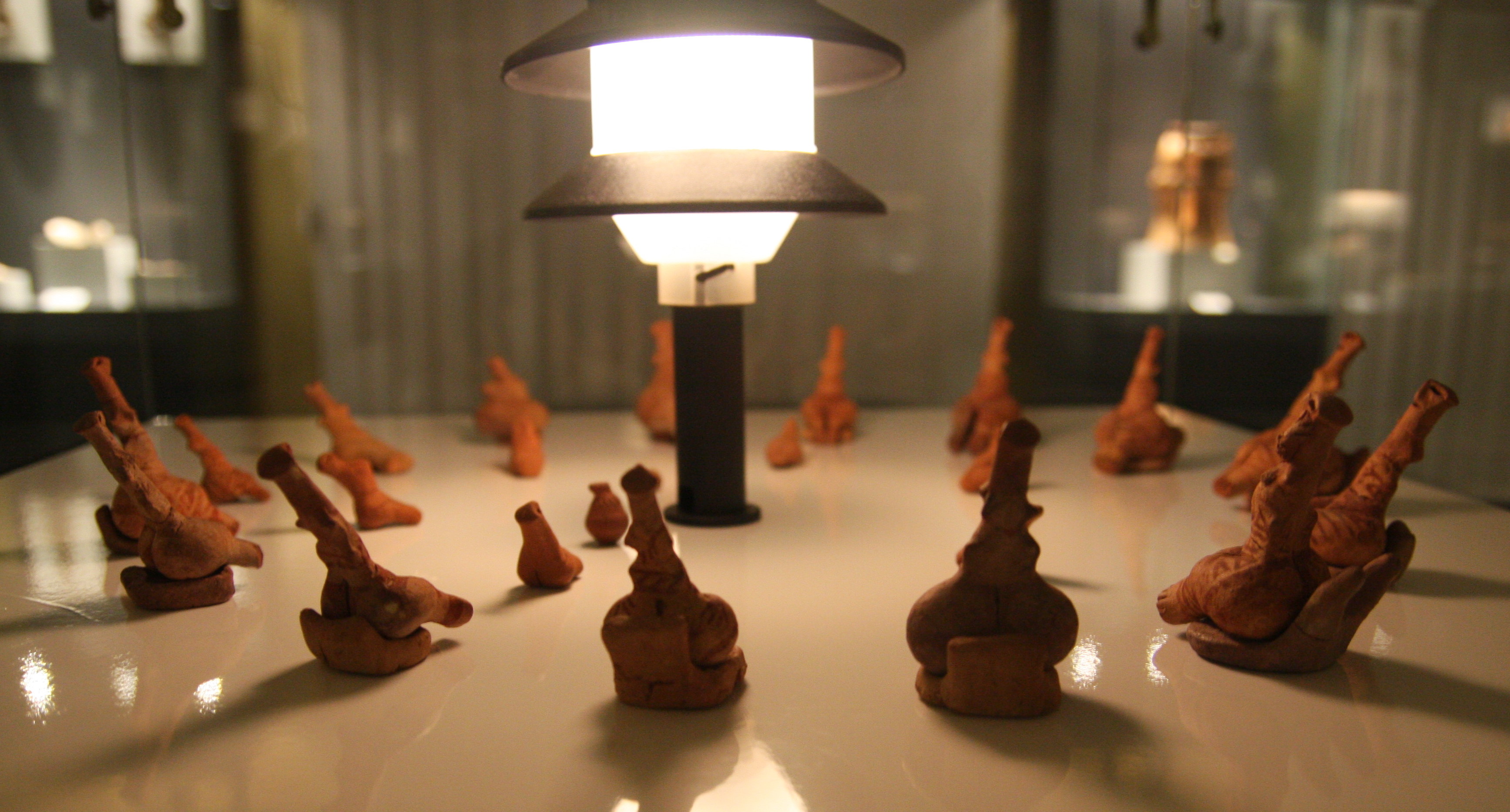 |width="260" |
 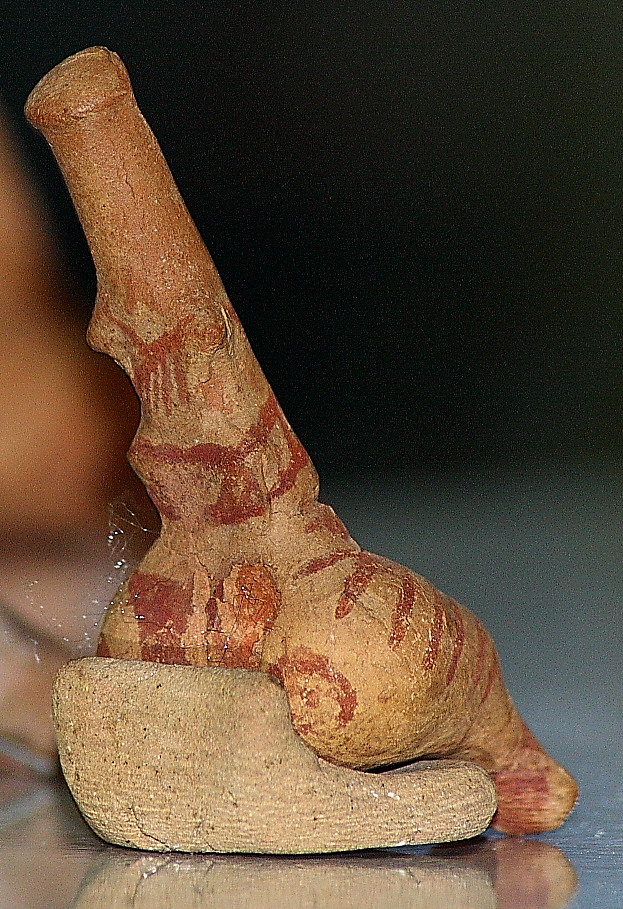 |width="260" |
 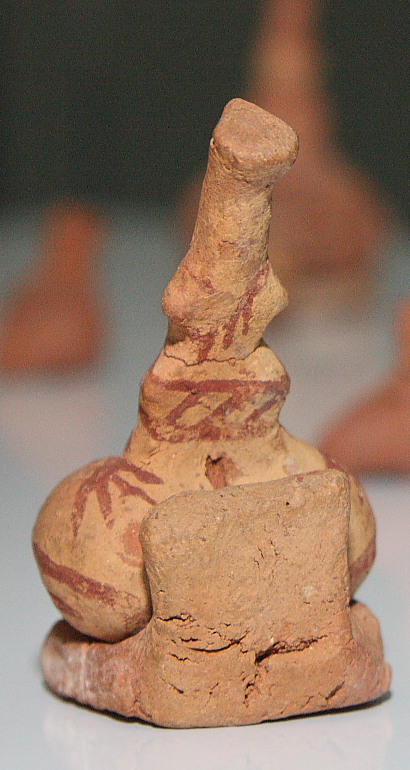 |- |width="400" valign="top"|The "Goddess Council" set of figurines on display at the Archaeology Museum Piatra Neamţ, Romania |width="260" valign="top"|Note the four lines on the shoulder of this member of the "Goddess Council" |width="260" valign="top"|Note the three lines on the shoulder of this member of the "Goddess Council |}
Thus it appears that the Vinča or Vinča-Tordos script is not restricted to just the region around Belgrade, which is where the Vinča culture existed, but that it was spread across most of southeastern Europe, and was used throughout the geographical region of the Cucuteni-Trypillian culture. This "Goddess Council" example is just one of many that supports the widespread use of these symbols among the Neolithic people of this entire area, and presents very compelling evidence to suggest that these symbols were understood by many individuals who lived in different areas, which lends support to the notion that they were indeed examples of proto-writing, if not a rudimentary writing system.
As a result of this widespread use of this set of symbolic representations, historian Marco Merlini has suggested that it be given a name other than the Vinča script, since this implies that it was only used among the Vinča culture around the Pannonian Plain, at the very western edge of the extensive area where examples of this symbolic system have been discovered. Merlini has proposed naming this system the Danube Script, which some scholars have begun to accept. However, even this name change would not be extensive enough, since it does not cover the region in Ukraine, as well as the Balkans, where examples of these symbols are also found. Whatever name is used, however (Vinča script, Vinča-Tordos script, Vinča symbols, Danube script, or Old European script), it is likely that it is the same system.
Hypotheses
These more recent discoveries have served to keep interest alive in this symbolic system, and has attracted interest of people from the entire spectrum of scholarship, from the emprirical-academic to the pseudo-scientific fringe. Mixed in-between the far ends of this spectrum are people who have developed theories about these symbols that are plausible and logical, but cannot be substantiated due to the fact that there is no existing "Rosetta Stone" that provides a definitive interpretation of what these symbols would signify, as well as the fact that the languages used by the Neolithic peoples of southeast Europe are unknown. As a result, any theory postulated regarding these symbols at this time would be based almost entirely on non-supportable deductions, which at best can only be regarded as hypotheses.
Championing the research from the academic community is the noted Italian historical-archaeologist Marco Merlini. He has written numerous books and articles, and presented many conference papers, on the subject of these Neolithic symbols of southeast Europe. His research in the area is excellent, and he effectively covers all aspects regarding the controversies surrounding this subject. Merlini has been working tirelessly to try to bring attention to this subject in the hope that more research will be done, and to eventually have his theory of the Danube script become accepted by the international academic community, thus substantiating the claim that the first form of writing to appear in history was not in Sumeria, but in southeast Europe, some 1000 years or so before Cuneiform writing first appeared in Mesopotamia.
See also
- History of writing
- History of communication
- Vinča symbols
- Barter tokens of the Cucuteni-Trypillian culture
- Prehistoric Romania
- History of Ukraine
- Prehistory of Southeastern Europe
- Neolithic Europe
- Chalcolithic Europe
External links
- Archaeological Park Cucuteni The website for the multi-institutional and international project entitled "Archaeological Park Cucuteni", which seeks to reconstruct the museum at Cucuteni, Romania, and to more effectively preserve this valuable heritage site (in English and Romanian).
- Cucuteni CultureThe French Government's Ministry of Culture's page on Cucuteni Culture (in English).
- Cucuteni CultureThe Romanian Dacian Museum page on Cucuteni Culture (in English).
- The Trypillia-USA-ProjectThe Trypillian Civilization Society homepage (in English).
- Трипільська культура в Україні з колекції «Платар» Ukrainian language page about the Ukrainian Platar Collection of Trypillian Culture.
- Trypillian Culture from Ukraine A page from the UK-based group "Arattagar" about Trypillian Culture, which has many great photographs of the group's trip to the Trypillian Museum in Trypillia, Ukraine (in English).
- The Institute of Archaeomythology The homepage for The Institute of Archaeomythology, an international organization of scholars dedicated to fostering an interdisciplinary approach to Cultural Research with particular emphasis on the beliefs, rituals, social structure and symbolism of ancient societies. Much of their focus covers topics that relate to the Cucuteni-Trypillian Culture (in English).
- The Vădastra Village Project A living history museum in Romania, supported by many international institutions.