
Swiss Jagdkommando
In the 1949 army reform, the concept of the Jagdkommando was taken up by the Swiss Army.
Swiss citizens that had volunteered for the Wehrmacht during the war and after serving prison sentences for foreign enlistment, where being employed as instructors for the Swiss Army and brought the idea with them, possibly from partisan hunter units. (See "Schweizer in Fremden Diensten" NZZ Verlag ISBN ISBN 3-03823-196-7)
Swiss Jagdkommando’s where supposed to counter subversive forces, partisans, foreign agents, saboteurs and enemy paratroopers. Interestingly these missions where outlined with a civilian backdrop in mind, meaning the Jagdkommandos would support and take over from police forces when dealing with counter insurgency scenarios. 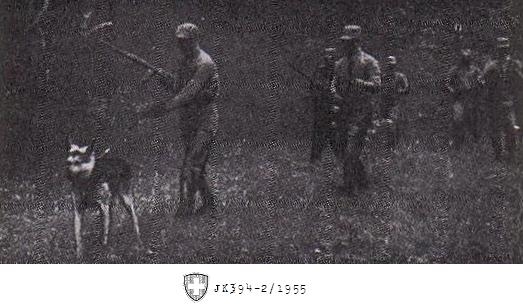 Uniquely Jagdkommando’s where formed on requirement out of regular Fusilier companies without any Spec Ops background or training, relying on the extensive outdoor and mountain skills of the Swiss citizen soldier of the day.
The Jagdkompanie was made up of a HQ platoon, a reconnaissance platoon, three Jagdzüge and a support platoon (Sniper, HMGs, 81mm mortars).
Each Jagdzug was made up of three Jagdkommandos.
A Jagdkommando had an establishment of one Corporal or Wachtmeister (Sergeant) and 2 fire teams of 3 men.
In the early ’50s their equipment would have been Mpi 41/44 and 43/44 (licence made Finnish Suomi submachinegun), K31 Rifle, LMG 25 and HG43 grenades.
Interestingly Thompson M1928 the famous "Tommy-gun" is listed in the "Automatische Waffen" (Militär Fachbuch 1939 von Curti, Verlag Huber Frauenfeld) under Swiss military weaponry. If they would have been employed is speculation as no photographic documents survive. The Major Hans von Dach "Total Resistance" book (German Version) does show Jagdkommandos with M1 Carbines in the mid 1950's. It is well possible this was a trial weapon at the time.
From 1958 onwards weapons would have been the SIG510/Stgw57, the LMG51 (updated version of the German MG42), HG43 grenades and rifle grenades 58.
Snipers drawn from the support platoon would have used the ZFK55 or K31 as a sniper rifle.
A Jagdkompanie worked a 15x15km area of operation, the distance between the independent Jagdzüge could be up to 10km.
Only the 1950s and ’60s manuals of Major Hans von Dach bare testimony to this forgotten type of formation that seems, with hindsight, ahead of its time. It serves as a wonderful example of how lessons learned from the war years were quickly recognized for their value and put in to service in record time with the available manpower. The Jagdkommando concept ceased existence latest with the Swiss Army reform of 1995.
Sadly even the Swiss are going in to denial over the existence of this concept now, as the sources are no more readily available to the average reader and the origins of the concept in connection with WW2 are unpleasant.
Sources: -"Total Resistance" by Major Hans von Dach (German and English versions are not identical on subject!) ISBN 978-087364-021-3 -"Gefechtstechnik Band 2 Teil 2", Major Hans von Dach ISBN 3-9521127-6-3 -"Schweizer in Fremden Diensten" NZZ Verlag ISBN ISBN 3-03823-196-7 -"Automatische Waffen Militär Fachbuch 1939", von Curti, Verlag Huber Frauenfeld