
Sinforoso Canavery
Sinforoso Canavery (1857-c.1938) was an Argentine jurist, who served as notary public and of government in the city of Buenos Aires and Buenos Aires Province. He had an ACTIVE participation in public contracts in the province of Buenos Aires, where he served for more than thirty years. Among his works as a government notary includes his participation in the DEEDS of the The Tramway Rural.
Biography
 Canavery was born in the neighborhood of Monserrat, Buenos Aires, son of Sinforoso Camilo Canaverys and Quintina Páez. His grandfather Manuel Canaverys, had been a Lieutenant in the Regiment of Patricians, and had participated in the donations for the First Upper Peru campaign in 1810.
Sinforoso Canavery completed his secondary education at National School of Buenos Aires, and obtained his title of Notary Public in the Colegio de Escribanos de la Ciudad de Buenos Aires. He began his career as notary of the Province of Buenos Aires in the government of Carlos Alfredo D'Amico. He served in the city of La Plata in 1886-1887-1889-1894. And from December 1, 1900, until his last performance as notary in that city on May 25, 1929, during the government of Valentín Vergara. In 1903, Canavery served for a brief period in the city of Navarro.
In 1885 The Sociedad Anónima Teatro Argentino purchased a plot of land from the Government of the Province of Buenos Aires, located in the city of La Plata (event carried out before the notary Sinforoso Canavery).
On October 7, 1887, Canavery had been present in the Ministry of Justice, calling for the creation of an Office of Registration of civil contracts. His request was approved by the Supreme Court of Argentina.
Among his performances as notary of Government include the contracts for sale of land of Claudio M. Joly to Federico Lacroze, owner of Buenos Aires Central Railway. Canavery also made the scriptures from the sale of 27,000 hectares of the Mallman Company to Zacarías Supisiche. In 1888, he had made the documents to transfer of ownership between Nicolás Levalle and Florencio Monteagudo. In 1890, Canavery performs the notarial deed of a field in the city of Las Heras between Juan Bossio and Máximo Paz. A failed sale that ended in a trial of Bossio against Máximo Paz (known politician and hacendado of Buenos Aires).
On August 23, 1902, Canavery made the scriptures by the sale of a farm in Pehuajó, property of Mirant Borde, known lawyer of French origin.
Canavery also performed the deeds of a mortgage between Francisco Cayol (1847-1920) and the Banco Español del Río de la Plata. Cayol was a landowner of French origin, son of Bartolomé Cayol, born in Toulon.
Sinforoso Canavery served as escribano de Registro (Notary of Registry) of the City of Buenos Aires between 1897 and 1900. And also had worked as public scribe in the city. He had its offices on the streets Rivadavia, Chacabuco, and in Avenida de Mayo, located in the exclusive neighborhood of Monserrat.
On September 15, 1900, by decree of President Julio Argentino Roca, was adscript Alejandro P. Ferrari as notary of Registro de Contratos Públicos N° 70 (Registration of Public Contracts No. 70) chaired by Canavery. He resigned his office on October 22, of the same year.
Sinforoso Canavery also served as Commissioner during the census of population, building, commerce and industries of the city of Buenos Aires in 1887.
In 1888, he participated as a witness in the contracts between the government of the province of Buenos Aires and the railway entrepreneur Rodolfo Giménez. In a failed project for the construction of a railway from La Plata to Veinticinco de Mayo, and that it would cross the towns of San Vicente, Cañuelas, Gral. Zapiola (Lobos), Chivilcoy. And a railway branch from Navarro to Mercedes and Carmen de Areco to finish its route in the town of Salto.
Sinforoso Canavery had been a colleague of Esteban F. Achinelly, a distant cousin, who served as notary of La Plata in 1888.
Family
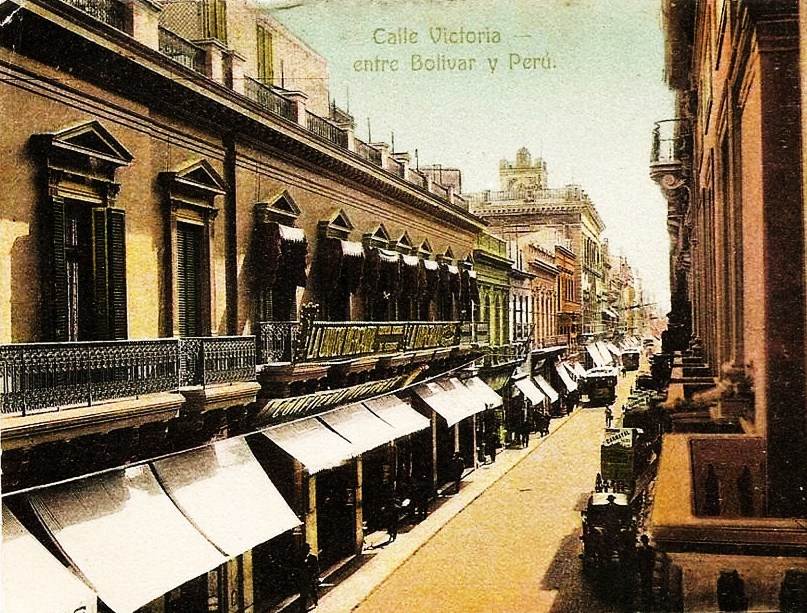
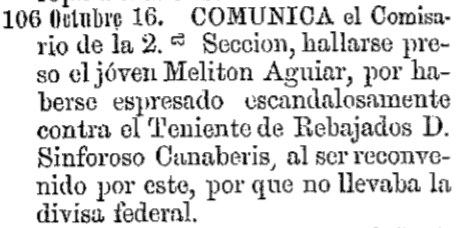 Máximo Sinforoso Canavery Páez was baptized in the Parish Nuestra Señora de Montserrat on March 10, 1858, being his godparents Ramón M. Contreras and Ruperta Canavery (his aunt). His father, Sinforoso Canaverys Rodríguez Calderón de la Barca (1808-1872), cited also as Canaberis, was a military man, who served as lieutenant in the Batallón de Voluntarios Rebajados de Buenos Aires, a military unit of the Federal Party, commanded by the Colonel Joaquín Ramiro. After his retirement from the army, Sinforoso Camilo was dedicated to trade, he was the owner of a barraca de frutos (fruit stalls) on Victoria Street, between Perú and Chacabuco, located in the vicinity of the Cabildo. His business was located where time later the store A la Ciudad de Londres was installed.
Sinforoso Camilo Canaverys resident in Exaltación de la Cruz and Luján towards 1830, was also dedicated to the leather supply of Buenos Aires. He is quoted in several publications of El Lucero, one of the main newspapers of the city.
Sinforoso Canaverys Rodríguez made frequent trips on board the ship Vapor Marquês de Olinda, that connected the Port of Buenos Aires with to Montevideo, Uruguay, place where he met his third wife Quintina Páez, belonging to an old Uruguayan family of Spanish and Portuguese roots. She deceased in Buenos Aires on July 9, 1881.
In 1894, Sinforoso Canavery was married in the Parish Nuestra Señora de Balvanera to Angélica Fortunata Andrade, daughter of Juan Manuel de Andrade and Domitila Alegre, belonging to a family of landowners dedicated to raising livestock in the area of San Vicente and Cañuelas in Buenos Aires Province.
Angélica Andrade was born on January 9, 1877, in Monserrat in a house located in the vicinity of the Manzana de las Luces. She was the granddaughter of Juan Francisco de Andrade, a Portuguese immigrant, born in Praça de Santo Ovídio, Porto, in the times of the Peninsular War, and who had arrived in Argentina during or after the Portuguese Civil War, and established in the Province of Buenos Aires by 1835, where he was dedicated to cattle breeding, being the owner of a hacienda, built of adobe and straw, located in the area of Cañuelas. He passed away on August 6, 1869 in Buenos Aires City (Argentina).
The ancestors of Angélica Fortunata de Andrade, had attended the foundation of Buenos Aires by Juan de Garay in 1580. Through her mother she was a great-granddaughter of Casimiro Alegre, a Captain of militias, who was a direct descendant of Flemish Conquistadores who arrived in the expedition of Pedro de Mendoza. She was related to the families of Monterroso-Rueda, Merlos, Soreyra and Belgrano, belonging to distinguished Creole and Spanish families of El Puerto de Santa María, Rosario and Buenos Aires. 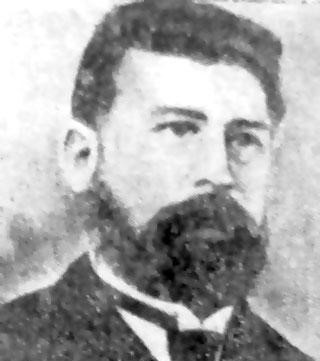 Sinforoso Canavery was politically linked to the families of Mallié, Rouquaud, Périchon and Crotto, belonging to the French society of Buenos Aires. Among his very distinguished ancestors who were dedicated to the legal profession were Don Juan Miguel de Esparza, Attorney General of the City of Buenos Aires in 1754, Don Miguel Gerónimo de Esparza, who served as perpetual alderman of Buenos Aires. And the Royal Notary Don Francisco Pérez de Burgos, born in 1558 in Jerez de la Frontera, who was notary of the Cabildo de Buenos Aires.
His wife's family was politically related to Juan Bourré Andrade, a lieutenant colonel who served in the 4th regiment of artillery of the Argentine Army, and Cross Thompson's, a landowner from London, England, who was settled in the area of Lobos (Buenos Aires Province) in 1840.
Sinforoso Canavery Páez had lived in the neighborhoods of Monserrat, San Nicolás, Balvanera, and in La Plata, Buenos Aires Province. At the beginning of 1900 Canavery established his residence in the town of Adrogué, where he lived until his death. Between 1870 and 1950 his relatives lived in the zones of Banfield, Lomas de Zamora, Llavallol, Temperley and Quilmes.
Canavery was a descendant and relative of distinguished Argentine military, politicians and revolutionaries, including his half brother, Isabelino Canaveris, who participated in the Uruguayan Civil War, and his brother Camilo Alejo Canavery, a lawyer who took part in the Revolution of the Park. His brother, Manuel Canaveri (1853-1900s) married to Luisa Alvarado Périchon, served in the first municipal council town of Olavarria.
External links
- www.colescba.org.ar
- www.colegio-escribanos.org.ar
- www.museonotarial.org.ar
- familysearch.org
- familysearch.org
- familysearch.org
- familysearch.org