
Răcăria, Rîșcani
Răcăria is a village in Rîșcani District, Moldova. It is the center of the Răcăria commune.
Early settlement
The village is easily found along the Copăceanca River, situated between Recea village and Rîșcani town. On village's land, you can see the outlines of 10 burial mounds, standing as historical evidence of invasions from the distant past by nomadic tribes from the Asian steppes.
Archaeologists have uncovered here the remains of a human settlement dating back over 23 centuries, with clay pottery from the Bronze Age (14th-12th century BC). "Another settlement," writes scholar Ion Hincu, "emerged in these places during the Roman period (2nd-4th century AD). Its inhabitants farmed the land, raised livestock, built spacious homes from wood and clay, and maintained trade relations with merchants from the cities of the Roman Empire."
In the medieval times, the area was generally understood as part of a wider frontier zone between the Carpathian–Prut region and the steppe influences of the Golden Horde.
Principality of Moldavia 14th–18th centuries
The territory of present-day Răcăria became part of the Principality of Moldavia following the formation and consolidation of the state in the mid-14th century, dated to 1359.
At the end of the 18th century, the modern day settlement was established on the banks of the Copăceanca River by immigrants from Austria-Hungary. Through the study of various archival sources, it was found that the original name of the village was Rychriya (from Latin "rych" - rich, "riya" - land by the river).
Records from 1810s indicate the territory of the village was sometimes referred to as the property of Prince Mihail Sturdza.
Răcăria as a part of the Russian Empire 1812–1917
After the Treaty of Bucharest 1812, the eastern half of Moldavia, including Răcăria, was annexed by the Russian Empire.
The first documented mention of the village of Răcăria dates back to 1809.
In 1859, the village elder was Mykhail Ivanovych Hutsul (born 1809). The National Archive preserved the 1859 Revision written by Mykhail Ivanovych.
With favorable natural conditions, Răcăria developed steadily. In 1870, it had 92 households, and by 1875 this number had increased to 101 households, with a population of 271 men and 265 women.
In 1876, 45 men from Răcăria participated in the construction of the Bălți–Hotin road, working with carts and wagons. Despite this, local farmers managed to sow 300 desiatinas of wheat, 150 desiatinas of rye, and 100 desiatinas of barley.
By 1894, the descendants of boyar Rîșcanu owned in Răcăria, Copăceanca and Nihoreni 6,860 des. of land, while the peasants of Răcăria had only 836 des. With its 774 people (all Eastern Christian), Răcăria entered the 1897 census in the catalog of Bessarabian settlements exceeding 500 souls.
The village was also informally referred to as Egorovka after the owner of the village boyer Gheorghe (Egor) Râșcanu, from the House of Râșcanu and Sturdza.
On October 15, 1905, the construction of the zemstvo school was completed and a group of students took their place at the desks. In the 1908-1909 school year, 40 children were studying here, taught by teacher Victoria Popovici.
By 1909, the Bălți-Zăbriceni telephone line had been extended to the village. Răcăria, had by 1910 about 190 peasant households (922 inhabitants), 50 students attended school, the teacher was Andrei Corotkii.
The rains of autumn 1912 caused landslides in Răcăria, several houses were moved or severely damaged. As the newspaper "Drug" wrote on September 10, 1913, for a whole year the requests of the sufferers for help "traveled" around, and the gubernial authorities rejected their pleas.
The Information Calendar, published in 1915, recorded that Egorovca-Răcăria had 469 men and 450 women. The First World War and the Bolshevik uprising disrupted the peace of the local population. The Country Council removed the Muscovite-guarded border along the Prut and redistributed land to those in need.
Răcăria as part of the Kingdom of Romania (1918–1940)
In September 1922, following the agrarian reform implemented by the Romanian Royal Crown, 296 peasants from Răcăria received ownership of 1,414 hectares of land taken from the Rîșcanu boyar estate. At that time, C. Bogulschi’s mill was producing more than 3,000 kilograms of flour per day.
A year later, in 1923, the Statistical Dictionary of Bessarabia recorded 297 households in Răcăria, with 750 men and 800 women, along with two steam mills, an elementary school, and two taverns.
The Statistical Dictionary of Bessarabia, published in 1923 in Chișinău recorded that the village of Răcăria appeared on the estate of the boyar Iordachi Rîșcanu. In 1835 there lived 49 peasant families (156 men and 112 women). The oldest people were Iacob Guțu (91 years old), Maxim Babin (85 years old), Nicolae Pascaru (82 years old).
Soviet Administration
On November 10, 1940, Soviet authorities conducted a census of Răcăria village in Rîșcani district, recording 1,710 residents – 289 Bessarabian Romanians, 1,419 Ukrainians, and 2 Russians. The new regime wasted no time targeting wealthy farmers and Jehovah's Witnesses for persecution.
Then came the war. In July 1941, Soviet forces withdrew across the Nistru River, taking some villagers with them, before returning to the Prut in spring 1944. The Romanian administration had allowed men to continue working their fields, but the Soviet commissariats conscripted them in massive numbers and sent them to the front lines. 89 people never came back from the fighting.
Famine of 1946-1947 was accompanied by epidemics, collectivization and deportations. Accused of "evading taxes" and labeled "kulaks," in 1949 several families were removed from their homes and sent to perish in Siberia. In 1951, several families were deported to the Tomsk region on religious grounds.
Climate
Răcăria experiences a temperate-continental climate with an average annual temperature of 10 °C (50 °F). The average temperature in July is 20 °C (68 °F), while in January it is around −5 °C (23 °F). The region receives annual rainfall ranging from 400 to 550 mm.
Summers are warm and winters are freezing, snowy, and windy. Temperature variations are typical of the northern Moldovan climate, typically varying from 22°F to 81°F (-6°C to 27°C) and rarely dropping below 6°F (-14°C) or exceeding 90°F (32°C).
The Kapachanka River, which flows through the village is part of the drainage system that ultimately flows toward the Dniester river and the Black Sea. 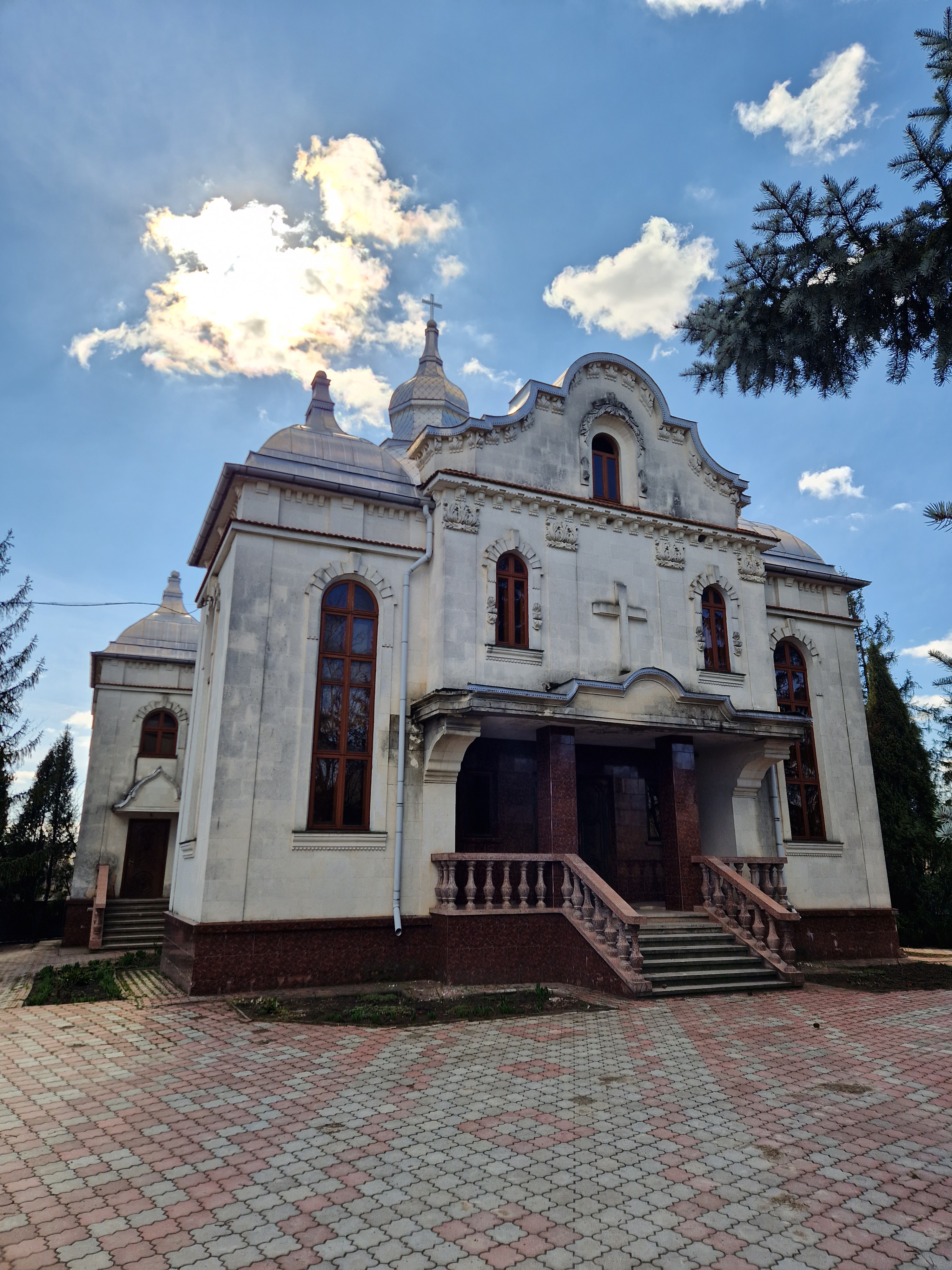
Demographics
Most settlers of Răcăria originated from the former Austria-Hungary, specifically from what is now western Ukraine. Historical records indicate that migration occurred from villages including Nova Ushytsia, Stara Ushytsia, Romankivtsi, Balkivtsi, Nedoboivtsi, and Vashkivtsi, among others.
The entire population of the village, as well as the surrounding villages, speaks the Pokutian-Bukovinian dialect of the Ukrainian language.
According to the last Soviet census in 1989, there were 714 men and 813 women.
Ethnic Composition
The ethnic composition of the village according to the 2004 population census:
Ethnic Group |
Population |
Percentage |
|---|---|---|
Ukrainians |
1,155 |
81.05% |
Moldovans / Romanians |
245 |
17.19% |
Russians |
21 |
1.47% |
Bulgarians |
1 |
0.07% |
Gagauz |
1 |
0.07% |
Others |
2 |
0.14% |
Total |
1,425 |
100% |
Religion
A wooden Orthodox church "Nativity of the Blessed Virgin Mary" in the village of Răcăria was built in 1902 with funds from the faithful. The church stored a highly valuable catapetasma and many gilded icons. In 1950, the church was closed, and all religious items were destroyed. The church reopened for worshippers in 1991 and was consecrated in 1992.
The church underwent restoration in 2017 and was consecrated by Bishop Vladimir, Metropolitan of Chișinău and All Moldova.
The village day is celebrated on September 21, on the Feast of the Nativity of the Blessed Virgin Mary.
Bibliography
Chicu, Ion (2003). Ancestral Homelands from the Republic of Moldova (7th ed.). Chisinau, Moldova.