
Radwan Dąbrowski-Żądło Family
Scions of the Radwan Dąbrowski-Żądło Family, an old patriotic Polish noble/gentry family , long served Poland in the struggle for Polish freedom and the right to exist as a sovereign nation. This family of ancient origin are connected to famous Polish-born English author Joseph Conrad and the fight for Polish independence. One branch of the family and the reasons forcing their migration to the U.S.A. in the face of Russian oppression reflects the fate of many noble Polish families.
Pronunciation of Radwan Dąbrowski-Żądło
Radwan Dąbrowski-Żądło is pronounced "Rodvon Dombrovski-Zhondwo".
Origins of the Radwan Dąbrowski-Żądło Family
From Mazowsza, Poland, the old szlachta/noble family Żądło Dąbrowski bearing the Polish Coat-of-Arms/Herb Radwan took their surname from the village/patrimony Dąbrówki/Dąbrówka under Piaseczno in the lands of Warszawa, where other members of the family settled predominantly in the lands of Różan. They were always nobility, belonging to the szlachta odwieczna or immemorial nobility, and in the armorials of Poland, documentation from the 15th century is used to note them. The original surname/przydomek they used was "Żądło" (the Sting), prior to establishing the fixed surname/cognomen Dąbrowski derived from their patrimony/inheritance Dąbrówki/Dąbrówka. .
In Polish "dąb" means "oak." "Dąbrowa" means "oak forest," and "Dąbrowka" means "little oak forest" (or grove). In antiquity, the nobility used topographic surnames to identify themselves. The expression z (from, of) plus the name of one's patrimony/estate carried the same prestige as de in French names such as de Châtellerault, and von or zu in German names such as von Weizsäcker or zu Rhein. In Polish z Dąbrowka and Dąbrowski mean the same thing: "of, from Dąbrowka." .
It is important to note this family were first and foremost members of the ancient Radwan gens/ród before they established a fixed surname/cognomen derived from their patrimony/inheritance (Dąbrówki/Dąbrówka). At least since the 17th century the surnames/cognomens of noble families became fixed and were inherited by following generations, remaining in that form until today. Prior to that time, a member of the family would be identified as "Jakób z Dąbrówki, herbu Radwan" (Jacob from Dąbrówki of the Clan Radwan Coat-of-Arms), or "Jakób z Dąbrówki, z przydomkiem Żądło, herbu Radwan" (Jacob from Dąbrówki with the distinguishing name/surname Żądło of the Clan Radwan Coat-of-Arms), or "Jakób Żądło, herbu Radwan".
Nomen (nomen gentile -- name of the gens or clan):
Radwan
Cognomen (name of the family [sept] within the gens):
Dąbrowski
Agnomen (a second cognomen added to make a distinction within the family):
Żądło (the Sting)
(See: Roman naming conventions.)
Members of meager means (dość uboga) always existed in this noble family, and wealth came to other members (Szlachta zamożna/bene natus possessionatus et dominus) in certain periods. The Żądło-Dąbrowski's never obtained very important offices or dignities, but in the years of the Polish-Lithuanian Commonwealth's existence (First Rzeczpospolita, or Rzeczpospolita szlachecka – Nobles' Commonwealth/Republic), they served in office as chamberlains (komornictwami/princeps nobilitatis - formerly the Judge in boundary disputes), treasurers (skarbnikostwem), seneschal (wojskostwem/tribunus), sword-bearers (miecznikostwem), and pantlers (stolnikostwem). (See: Offices in the Polish-Lithuanian Commonwealth - District Offices.) Nor were they absent from the clergy. Mainly due to marriages, the family began expanding to other regions of the Commonwealth. One particular branch of this family at the end of the XVIII-century domiciled/settled in Volhynia/Wołyniu (currently part of Ukraine). .
An Italian article written by Adriano Sofri and published by Arnoldo Mondadori Editore on their Web Site Panorama Online stating, "Il caso Sofri: Dopotutto 15 ottobre 1998" (The Sofri Case: Everything After October 15, 1998), mentions the Radwan Żądło-Dąbrowski's living in Warszawa as "una nobile famiglia di Varsavia" (one noble family of Warsaw).
Notable Scions of the Radwan Dąbrowski-Żądło Family
JAROSŁAW RADWAN DĄBROWSKI ŻĄDŁO (November 13 1836 – May 23 1871) was a Polish revolutionary Nationalist and general. He was an officer of the Russian Tsar's army, and he was imprisoned for participation in a plot against the Tsar's absolutism, functioning as military leader of the "Reds," which represented the democratic element of the Polish nation suppressed by Russia, and wanted open rebellion and an immediate call to arms. (See: January Uprising of 1863.) In 1871 he became the Commander-in-Chief of the French Paris Commune, a climax in revolutionary history. A revolutionary alliance ruled Paris for seventy-two days in the spring of 1871 in defiance of the Versailles-based government's modern centralized state. Jarosław Dąbrowski died heroically fighting on the barricades as General of the largest urban insurrection in the nineteenth century.
The Military Technical Academy in Warsaw, Poland, is named in memorial of him.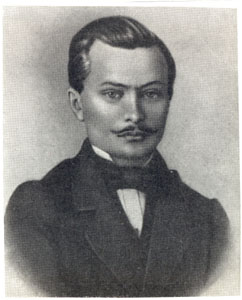
Connections to Joseph Conrad
Jarosław Dąbrowski's father was Wiktor Radwan Dąbrowski-Żądło. His mother was Zofia née Falkenhagen-Zaleska. Jarosław's maternal uncle was the valued economist Piotr Falkenhagen-Zaleski, and through Piotr's wife, Marię née Korzeniowska, the Żądło-Dąbrowski's became related to the famous Polish-born English writer Joseph Conrad (born - Teodor Józef Konrad: Nałęcz Korzeniowski) (1857 - 1924).
Joseph Conrad's father, "Apollo Nałęcz Korzeniowski" (1820 - 1869), along with Jarosław Radwan Dąbrowski-Żądło (see above), were two of the leading figures of a secret City Committee in Warsaw organized in October 1861 by the Radical 'Reds', whose purpose was to prepare an armed struggle for Polish national independence and social revolution. (See: January Uprising of 1863.)
In late 1861, Tsarist Russian authorities arrested Apollo Korzeniowski in Warsaw for helping organize what would become the January Uprising of 1863. He was exiled to Vologda, Russia, a city with a very harsh climate, approximately 300 miles north of Moscow, with his wife, Ewelina, and four-year-old son (Joseph Conrad).
In August 1862, Jarosław Radwan Dąbrowski-Żądło was arrested by the Russians and sent to Russia for trial. As the Russian authorities could not pin anything on Dąbrowski, the man intended to lead the January Uprising of 1863, he was sentenced to fifteen years' hard labor in Siberia. Passing through Moscow, Dąbrowski escaped from the prison convoy, evading the Tsarist police to make his way to Stockholm, and finally Paris.
Józef Klemens Piłsudski (5 December 1867 – 12 May 1935), Polish statesman, Field Marshal, first Chief of State (1918–1922), dictator (1926–1935) of the Second Polish Republic, and head of its armed forces, discussed with Bronisław Antoni Szwarce (1834 - 1904) the events leading to the January 1863 Uprising, a subject on which Piłsudski was an expert. Szwarce played an important part in the uprising. Piłsudski's works on the January Uprising are the standard form of introduction to the subject. Piłsudski himself was born into an impoverished noble family from Lithuania, his social origins the remains of the old Polish nobility, crushed by the repressions of imperial regimes.
Stefan Tytus Zygmunt Dąbrowski Bearing the Radwan Coat of Arms
Stefan Tytus Zygmunt Dąbrowski h. Radwan (1877 - 1947)
- Physician, physiologist, biochemist, and Polish politician."Stefan Tytus Dąbrowski", Wikipedii. Retrieved
on June 07, 2007.
- Rector: Adam Mickiewicz University - Poznań, Poland (1945 - 1946).
- Authored: "Walka o rekruta polskiego pod okupacją" ("Battle About the Polish Recruit Under Occupation") (Warszawa, 1922)
- Authored: "Zagadnienie obrony narodowej w wojnie nowoczesnej" ("The Issue of National Defense in Modern War") (Poznań, 1925)
Stefan Tytus Zygmunt Dąbrowski herbu Radwan was born on January 31, 1877, in Warsaw, Poland, into an intelligentsia family (Radwan Dąbrowski). Dąbrowski's family was a fundamental influence on his life, which included growing up in an atmosphere of patriotism in the environs of Warsaw at the end of the nineteenth century.
In January of 1919, Poland's Prime Minister and Minister of Foreign Affairs, Ignacy Jan Paderewski, made Dąbrowski Vice-Minister of Foreign Affairs.
On May 11, 1939, the Senate of Adam Mickiewicz University in Poznań chose Dąbrowski, a professor, for the position of rector, however, the explosion of war beginning with [...] Germany's invasion of Poland on September 1, 1939, made the accession of Dąbrowski's rectorial duties impossible. Dąbrowski had foreknowledge of events in 1939, and spent the duration of the war in many localities hiding from the Gestapo, [...] Germany's secret police. Under the [...]'s Generalplan Ost, more than 61,000 Polish activists, intelligentsia, nobles, actors, former officers, etc. (all those deemed capable of rousing the Polish people to defense and patriotic action), were to be interned or shot. (See: Operation Tannenberg, Operation Sonderaktion Krakau, and Massacre of Lwów professors.)
Radwan Dąbrowski Descendants of Prince Adam Kazimierz Czartoryski
Jadwiga Dąbrowska h. Radwan
Jadwiga "Jadzia" DĄBROWSKA h. Radwan
Some Twentieth-Century Scions of the Radwan Dąbrowski-Żądło Family in the U.S.A.
After the national uprisings of 1831 and 1863 (November Uprising, January Uprising), particularly in the Polish realms annexed by the Russian Empire after the three partitions of Poland (1792-1795), which ended the Polish-Lithuanian Commonwealth's political existence, the nobility faced ever increasing pressure from the Tsar in the form of persecutions, deportations to Siberia, and denationalization of Poles, a disaster for social development. Under these conditions, these Poles became what Tsar Alexander II liked to call "noble rabble." The nobility saw emigration to the U.S.A. as their best option.
PATRICIA HELEN FORD GETZ NÉE RADWAN DĄBROWSKI ŻĄDŁO
Born: 01 March 1935, in Wilmington, DELAWARE, U.S.A.
Died: 27 October 2005, in New York, NEW YORK, U.S.A.
JOSEPH WILLIAM I RADWAN DĄBROWSKI ŻĄDŁO
(Delaware's THE POLISH BARON)
Born: 19 December 1908, in Wilmington, DELAWARE, U.S.A.
Died: 20 June 1991, in Wilmington, DELAWARE, U.S.A.
Ancient Origins and History of the Seminal Radwan Gens/Clan
The Żądło Dąbrowski's were members of the ancient Radwan gens/ród before the fixation of their topographical name "Dąbrowski". Prior, the sole przydomek (surname) "Żądło" was used to distinguish the members of this branch of Radwan's (sept) from other Radwan's, and this continued for centuries. In 1727, a member of the family appears in the records as "Michal Żądło". Appearing in the records are also Adam Żądło and Kazimierz Żądło in the election of King Jan III Sobieski (1674).
Families of magnate status (możni/high nobility) bearing Radwan arms were the Babski's, and the Magnuszewski's and Uchański's (See: Jakub Uchański), parts of the Mazovian feudal elite, however, many branches of the Radwans never transcended the status of middle and lesser nobility.
"In Poland, the Radwanice were noted relatively early (1274) as the descendants of Radwan, a knight [more properly a "rycerz" {German "ritter"}] active a few decades earlier. ..."
Kasper Niesiecki S.J. (1682-1744) in his "Herbarz Polski" (with increased legal proofs and additions by Jan Nepomucen Bobrowicz [1805-1881] in the Leipzig editions, 1839-1846) writes:
"It [Radwan coat of arms] was awarded during the reign of King Boleslaw Smialy (1058-1079) on the occasion of a battle with Ruthenia; a captain named Radwan had been sent out on a foray with part of the army. He happened upon the enemy camp in such close quarters that they could neither protect themselves from a skirmish with the Ruthenians, nor fight with them, inasmuch as their numbers were so much smaller. But they all agreed it was better to fall dead on the spot than to encourage the enemy by fleeing. So with all their heart they sprang toward the Ruthenians, whose knights were daunted by this attack; but when they saw the small numbers against them, the Ruthenians grew bold, and not only took away their banner, but dispersed them as well. Captain Radwan, wishing to encourage his men to fight once more, rushed to a nearby church, where he seized the church’s banner; he then gathered his men and courageously attacked the enemy. The Ruthenians took this to mean a new army with fresh troops had joined the battle, and began to retreat and flee. So Radwan’s banner carried the day, and for this he received that church’s banner for his shield, as well as other gifts.
Paprocki, however, gives this as occurring during the rule of Bolesław Chrobry [992-1025] in 1021. He writes that Radwan was a royal chancellor, which information he is supposed to have taken from ancient royal grants. I conclude from this that either this clan sign is more ancient than the time of Bolesław Śmiały [1058-1079] and originated in the time of Bolesław Krzywousty [1102-1138], to whom some authors ascribe its conferment on that aforementioned Radwan; or else that before the time of Bolesław Śmiały [1058-1079] the Radwans used some other arms in their seal: for instance, that Radwan whom Paprocki gives as Bishop of Poznań in 1138. Długosz, in 'Vitae Episcop. Posnan. [Lives of the Bishops of Poznań]' does not include him under Radwan arms, but Sreniawa; there I, too, will speak of him."
From Little Poland, the Śreniawa family/gens was insignificant and financially modest;; however, King Kazimierz the Great (1310 - 1370) supported them in Little Poland.
Bishop Radwan, Bishop of Poznań, assisted with the establishment of the first Commandery of the Knights of Saint John in Poznań circa 1187 or possibly May 6, 1170. The donation was made by Mieszko III Stary (1121? - 1202), High Duke of all Poland.
General Discussion on Early Formation of Polish Noble Clans (Ród's)
See: Szlachta: Origins.
References
- {{ Citation
| last=Auteurs Associés
| title=THE POLISH ARMORIAL POLONAIS
| place=Château-Thierry, FRANCE
| publisher=Bibliothéque Albi Corvi
| year=1988
| url=http://worldcat.org/oclc/60013548
| isbn=2907771000
}}.
- {{ Citation
| last=Billington
| first=James H.
| author-link=James H. Billington
| title=Fire in the Minds of Men: Origins of the Revolutionary Faith
| publisher=Basic Books
| place=New York, NEW YORK, U.S.A.
| year=1980
| url=http://worldcat.org/oclc/6087769
| isbn=046502405X
}}.
- {{ Citation
| last=Boniecki
| first=Adam
| title=HERBARZ POLSKI - CZĘŚĆ I.; WIADOMOŚCI HISTORYCZNO-GENEALOGICZNE O RODACH SZLACHECKICH.
| publisher=Skład główny Gebethner i Wolff w Warszawie
| place=Warszawa, POLSKA
| year=1901
| volume=IV
| url=http://worldcat.org/oclc/7877064
| id=OCLC: 7877064
}}.
- {{ Citation
| last=Davies
| first=Norman
| author-link=Norman Davies
| title=God's Playground: A History of Poland, Volume II - 1795 to the Present
| publisher=Columbia University Press
| place=New York, NEW YORK, U.S.A.
| year=1982
| url=http://worldcat.org/oclc/7652832
| isbn=0-231-05353-3
}}.
- {{ Citation
| last=Davies
| first=Norman
| author-link=Norman Davies
| title=Heart of Europe: A Short History of Poland
| publisher=Oxford University Press
| place=Oxford, ENGLAND; New York, NEW YORK, U.S.A.
| year=1986
| url=http://worldcat.org/oclc/12581773
| isbn=0192851527
}}.
- {{ Citation
| last=Gąsiorowski
| first=Antoni
| title=THE POLISH NOBILITY IN THE MIDDLE AGES: ANTHOLOGIES
| place=Wrocław, POLSKA
| publisher=Zakład Narodowy im. Ossolińskich
| year=1984
| url=http://worldcat.org/oclc/13121771
| isbn=8304017644
}}.
- {{ Citation
| last=Hoffman
| first=William F.
| title=Polish Surnames: Origins and Meanings
| publisher=POLISH GENEALOGICAL SOCIETY OF AMERICA
| place=Chicago, ILLINOIS, U.S.A.
| year=1993?
| url=http://worldcat.org/oclc/28492129
| isbn=0924207000
}}.
- {{ Citation
| last=Jędrzejewicz
| first=Wacław
| author-link=Wacław Jędrzejewicz
| title=Piłsudski: A Life for Poland
| publisher=Hippocrene Books
| place=New York, NEW YORK, U.S.A.
| year=1982
| url=http://worldcat.org/oclc/23230888
| isbn=0870527479
}}.
- {{ Citation
| last=Lerski
| first=George J.
| title=HISTORICAL DICTIONARY OF POLAND, 966-1945
| place=Westport, CONNECTICUT, U.S.A. * London, ENGLAND
| publisher=Greenwood Press
| year=1996
| url=http://worldcat.org/oclc/31754935
| isbn=0313260079
}}.
- {{ Citation
| last=Niesiecki S.J.
| first=Kasper
| last2=Bobrowicz
| first2=Jan Nepomucen
| title=HERBARZ POLSKI KASPRA NIESIECKIEGO S.J., POWIĘKSZONY DODATKAMI Z POŹNIEJSZYCH AUTORÓW, RĘKOPISMÓW, DOWODÓW URZĘDOWYCH I WYDANY PRZEZ JANA NEP. BOBROWICZA
| place=Leipzig, DEUTSCHLAND
| publisher=Breitkopf & Härtel
| year=1841
| url=http://worldcat.org/oclc/9261567
| id=OCLC: 9261567
}}.
- {{ Citation
| last=Piętka
| first=Jan
| title=MAZOWIECKA ELITA FEUDALNA PÓŹNEGO ŚREDNIOWIECZA
| publisher=Państwowe Wydawn. Naukowe
| place=Warszawa, POLSKA
| year=1975
| url=http://worldcat.org/oclc/2357377
| id=OCLC: 2357377
}}.
- {{ Citation
| last=Zamoyski
| first=Adam
| author-link=Adam Zamoyski
| title=HOLY MADNESS: ROMANTICS, PATRIOTS, AND REVOLUTIONARIES, 1776-1871
| place=New York, NEW YORK, U.S.A.
| publisher=Viking Penguin
| year=2000
| url=http://www.amazon.com/Holy-Madness-Romantics-Revolutionaries-1776-1871/dp/0141002239/ref=pd_bbs_sr_3/104-5517152-1725539?ie=UTF8&s=books&qid=1181278781&sr=1-3
| isbn=0-670-89271-8
}}.
- {{ Citation
| last=Zdrada
| first=Jerzy
| title=JAROSŁAW DĄBROWSKI: 1836 -- 1871
| publisher=Wydawnictwo Literackie
| place=Kraców, POLSKA
| year=1973
| url=http://worldcat.org/oclc/2674795
| id=OCLC: 2674795
}}.
External links
- The Library of Congress: James Hadley Billington
- Descendants of Prince Adam Kazimierz Czartoryski
- SIW ZNAK - Norman Davies
- Institute of History and Archival Sciences, UNC in Toruń
- The Knights Hospitallers in Poland
- John Leighton, F.S.A.
- Adam Mickiewicz University - Poznań, Poland
- IGNACY JAN PADEREWSKI
- POLISH GENEALOGICAL SOCIETY OF AMERICA
- Adam A. Pszczółkowski prezentuje
- Il caso Sofri, Bompressi e Pietrostefani
- Wojskowa Akademia Techniczna im. Jarosława Dąbrowskiego w Warszawie
- Adam Zamoyski
- Dr hab. Jerzy Zdrada, prof. UJ