
Qing and Yuan Dynasties debate
The Qing Dynasty(1662-1911) and Yuan Dynasty (1279-1368) dynasties in China were dynasties ruled by non-Han Chinese such as the Manchu and Mongols. Although traditional views accepted them as legitimate dynasties in China, this view has been challenged by those believe that the Manchu and Mongols were barbarians that [...] China's ProgresS towards modernity and caused it to fall behind. They compared the Yuan dynasty and Qing dynasty to the barbarian takeover of the Western Roman Empire. This debate (Chinese:元清正统之争) influences how many Chinese view parts of their own history.
Traditional view
The Qing and Yuan dynasties attempted to justify themselves by claiming that they had merely taken the Mandate of Heaven from their predecessors. Supporters of this claim point to Qing and Yuan actions such as rebuilding Confucian temples and sponsoring scholars. They suggested that the Qing and Yuan dynasties were mere continuations of their Han Chinese predecessors.
Yuan Dynasty
Kublai Khan, the founder of the Yuan dynasty, is alleged to have admired Chinese culture and have modelled himself on Emperor Taizong of Tang, one of China's most successful Emperors.
Qing dynasty
The Qing dynasty is held by the traditional view as a naturalized dynasty. Supporters of this view point out the period of Kang-Qian, a period they consider to be very prosperous under Qing rule and surpassing that of the earlier Ming dynasty. They also point out to the work of the Si Qu Chuan Shu, a monumental encyclopedia compiled during the Qing, as an example of what they hold to be the Qing's embrace of traditional Chinese culture. However, detractors of that view observe that the compilation of the encyclopedia itself caused the burning and destruction of thousands of texts. Mass censorship has been practiced before the Qing and Yuan such as the burning of books and burying of scholars by the Qin dynasty.
Rule of Kang-Qian
Supporters argue that the prosperity in this period proved that the Qing had integrated with Chinese society, but skeptics believe it was just a brief recovery from the devastation of the Manchu invasion of China(1644-1683).
Contarian view
Detractors of the traditional view argue that the Qing and Yuan dynasties were a complete break with previous Chinese dynasties and were racially oppressive. They point to the mass burning of books under the Manchu Qing, also known as the "literary holocaust", and the banning of traditional Han Chinese dress, the Hanfu. In addition, they point out that the Manchu Qing dynasty committed many atrocities against the Han Chinese population, such as the Liaodong massacre, the Yangzhou massacre, and cut off China's foreign trade. The Manchu were also held to have suppressed Chinese technological progress for fear that the Han Chinese could with it throw off their yoke. Qing conquest of China reduced China's population by 25 million, or a sixth of China's population at the time, while the Mongol conquest of China reduced China's population by 20 million, or a fifth of China's population at the time..Detractors of the traditional view list several massacres below as evidence of their idea that the Manchu Qing and Mongol Yuan could not be called legitimate Chinese dynasties.
Manchu Qing dynasty
Nurhachi's booi-aha and the Liaodong Han Chinese
In the early 1600s Liaodong had an estimated population of three million Han Chinese. In 1618, Nurhachi increased the Jurchen state's population by 300,000 by taking of Fu-shun, and turning most of the war captives (Han Chinese, Koreans, and other ethnicity) into Booi-aha (Manchu term for household and field slaves). Between 1624-1625, large numbers of Han Chinese became private slaves of either Manchu military chiefs, or state agriculture- class-slaves of Later Jin.
Massacres of Han Chinese during the conquest of China proper
During Manchu's conquest of China proper by its military chief Dorgon, the numbers of massacres conducted by the Eight Banners soldiers towards the Han Chinese, were well documented by historians in great graphical details. The Manchu conquest of China were recorded to have killed 25 million people, a sixth or seventh of China's population at the time.
Liaodong massacre
There are many historical records on the Manchu's mass murders of ethnic Han Chinese in Liaodong before they entered Shanhaiguan, and the estimated murdered victims may be as high as 3 millions.
On the first month of the ninth year of Nurhachi(Chinese: 天命九年正月), nine royal decrees were issued to eliminate 'poor people'(Chinese:無穀之人, translation: people who possessed no grains). Specific orders were issued:
# All Eight Banners soldiers were to treat 'poor people' as enemies.
- Arrest them and send them to me(Nurhachi)
- Kill all the arrested 'poor people'(Han Chinese)
Yangzhou massacre
The Yangzhou massacre was a massacre of mainly Han Chinese in 1645 when Manchu invaders led by Prince Dodo conducted mass killings of the residents of Yangzhou. The atrocity lasted for ten days and the alleged number of victims was close to 800,000 (though some scholars doubt its accuracy).
The alleged reasons for the massacre were:
- To punish the residents because of resistance efforts led by Ming officials Shi Kefa.
- To warn the rest of the population of the consequences of resisting the invaders.
Destruction of Chinese culture
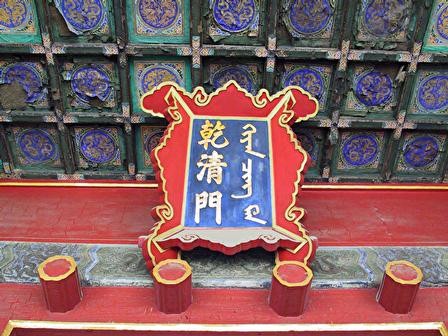 Manchu Qing were alleged to have destroyed large numbers of ancient Han Chinese books in their literary holocaust. In addition, the Qing launched the "Wen zhi yue"(文字獄 translation:Word prison) in which thousands of scholars were executed for poems or literary compositions which were deemed to even suggest the Qing rule was bad (the punishments went as far as mutilation of coprses excavated from old grave yards). In addition, thousands of ancient texts were burned or changed and research on Ming topics and science in general was prohibited. Traditional Han dress, the Hanfu, was banned. All men who were not bald had to wear the Manchu queue.
Anti-miscegenation edicts banned marriages between Manchus and Mongols to the Han Chinese with the exception of those in the Eight Banners. In 1822, all Manchu men were given the right to marry Han women. The edict prohibiting miscegenation was thoroughly repealed on February 1, 1902.
Mongol Yuan
The Mongol Yuan dynasty (1279-1368) is also believed to have committed similar atrocities; during the Yuan, the Mongols set up a system in which Mongols were at the top and the Han Chinese were at the bottom. Different punishments were given to Mongols and Han Chinese for the same crime. It is also a popular rumor in China that the Mongols practiced the Droit de seigneur (Chinese:初夜權) on Han Chinese women, though it is in fact not true. The Mongol conquest of the Song dynasty was alleged to have reduced China's population from 100 to 80 million, a fifth of China's population at the time.. Genghis Khan, the founder of the Mongol Empire, himself despised China and did not consider himself a Chinese, as shown in this quote:
Heaven has abandoned China owing to its haughtiness and extravagant luxury. But I, living in the northern wilderness, have not inordinate passions. I hate luxury and exercise moderation. I have only one coat and one food. I eat the same food and am dressed in the same tatters as my humble herdsmen. I consider the people my children, and take an interest in talented men as if they were my brothers. We always agree in our principles, and we are always united by mutual affection. At military exercises I am always in front, and in time of battle am never behind. In the space of seven years I have succeeded in accomplishing a great work, and uniting the whole world in one empire.
Export of Chinese technology
- Click here to read more on Marco Polo
Many Han Chinese technologies such as gunpowder spread to Europe during the rule of the Mongol Yuan. The Yuan was also the period in which Marco Polo visited China. Marco Polo stated AbOUT the Yuan:
The Great Khan had not succeeded to the dominion of Cathay by hereditary right but held it by conquest. Thus, having no confidence in the natives, he appointed Saracens, Christians and Tartars to the government, having no confidence in the natives. For this reason, all the Cathaians (Han Chinese) detested the Great Khan's rule.
Qing dynasty only
A variant of the traditional view believed the Mongol Yuan was a barbarian dynasty, but the Manchu Qing were a naturalized dynasty. This school has gradually diminished into the two camps
See also
- Conquest Dynasties of China
- Five Races Under One Union
- Zhonghua minzu
- Anti-Manchuism
Sources
- Du Zhebi, "On the repudiation of the Manchu Qing".
- In Chinese:《雍正王朝》是历史正剧吗? 作者:秦晖
- John E. Schrecker, The Chinese Revolution In historical Perspective, ISBN 0275974758, Greenwood Publishing Group.
- Li Bo, Zheng Yin, "5000 years of Chinese history", Inner Mongolian People's publishing corp , ISBN 7-204-04420-7, 2001.
- Yunnan Ethnic University social science paper, 正统论与黄宗羲的史学, <http://www.cqvip.com/QK/91327A/2006002/21376125.html>, 2006.
- Jia Qing, "On the reasons China fell behind the west", <http://gz-hanfu.cn/doc/The-Truth-of-History.pdf>.