
Project Cadillac
CADILLAC
The Threat Environment
- February 1944. In Europe the invasion of Italy is well underway and the Battle of Monte Casino engaged. Eisenhower establishes SHAFE headquarters in Britain. The RAF drops 2300 tons on Berlin, the 8th AF begins the “Big Week” bombing campaign and Soviet troops continue the offensive begin at Novgorod and Leningrad. In the Pacific US forces have landed and captured the Marshall Islands and have moved on to Eniwetok Atoll. In the south, MacArthur’s forces have begun Operation Brewer in the Admiralty Islands. The tide, ever so imperceptibly, is turning in favor of the Allies.
- In Japan, Commander Asaiki Tamai asked a group of 23 talented student pilots, whom he had personally trained, to volunteer for a special attack force. All of the pilots raised both of their hands, thereby volunteering to join the operation.
- In the US, the fruits of scientific research and technological prowess were starting to manifest – high altitude bombers, Essex-class carriers, jet engines, the beginnings of nuclear weapons. At the MIT-RL, proposals were forwarded for an ambitious program to develop an AEW system that would be deployed with the fast carrier forces in the Pacific. It was envisioned that the system would be in pace for the projected invasion of the Japanese homeland, slated for sometime in early 1946. Following a series of meetings with reps from the Navy’s Bureau of Ordnance (BuOrd) the Navy formally requested the National Defense Research Committee (NDRC) to establish the project. Ultimately, the project would include 9 of MIT-RL’s 11 laboratories, BuAer, BuShips, Naval Air Modification Center, Philadelphia, Naval Research Lab, several Navy contractors and Radiation Lab subcontractors and over 160 officers and men. The project was eventually given the code name of Cadillac, the name of the highest mountain in Maine and site of some of the developmental relay work.
CONCEPT OF OPERATIONS (CONOPS)
-
As originally envisioned, Cadillac would consist of two sections: one airborne and the other shipboard (see CONOPS illustration). The airborne unit would carry the APS-20 radar, IFF and VHF comms and relay equipment, acting as an airborne radar and relay platform for the ship. Back on the ship, the radar picture from the airborne unit would be relayed via a VHF video data link and displayed on a dedicated PPI (Plan Position Indicator) scope. Communications with far-flung fighter CAP would also be relayed through the airborne unit. Sorting out friend from foe would be via the newly developed IFF or Identification Friend Foe system which relied on an aircraft responding to electronic “challenge” signals with a coded pulse train. The airborne unit would also have the ability to display ownship’s radar picture and have a limited capability to control fighters, but this was planned to be a fall-back capability.

- Aircraft. The aircraft chosen was the only carrier-based aircraft large enough to accommodate the 8-foot radome and 2,300 lbs of associated equipment. Stripped of turret, armor, and armament, a TBM-3 Avenger served as the initial platform for Cadillac. Besides the Cadillac equipment, the XTBM-3W was modified to include an engine driven high power generator, additional tail stabilizers, addition of a crewman position in the aft fuselage and over 9 separate antennas on the fuselage, tail, and wings.
- Airborne System. The AN/APS-20, developed as part of the Cadillac program, was a 10cm set that had a peak power output of 1 megawatt and a 2m-second pulse. The design of the APS-20 radar was so sound that variations of this same radar would see use well into the 1960s on a variety of USN, USAF and allied AEW platforms, until it was ultimately replaced by the E-2’s APS-96/120 series among others. The IFF system was built around the AN/APX-13 with a very high power (2 kW) transmitter and one of the most sensitive receivers in this type application. It was designed to enable ID of targets on both the (then) Navy standard A and G bands at ranges comparable to the radar. To “pipe” this information back to the ship, the AN/ART-22 relay-radar transmitter, broadcast the picture back to the ship on a 300 mc frequency. The radar synchronizer also synchronized the IFF and relay signals, encoding their outputs to ensure reception even in an environment characterized by heavy enemy jamming and intrusion. Remote operation of the airborne system from the ship was made possible by the AN/ARW-35 receiver, AN/ARC-18 shipboard relay and the use of a modified flux gate valve to stabilize and orient the radar display to true North (ed. note – not altogether different from the system that was used in the E-2 almost 2 decades later). All this, of course, was in addition to the usual compliment of voice comm., IFF, and flight/navigation gear. Space, as one can see from the cutaway, was at a premium, even in the large-bodied Avenger.
- Shipboard System. The shipboard system primarily consisted of relay (which included omnidirectional or a horizontal diversity receiver), decoding, and shipboard signal distribution equipment. The signal was passed to 2-3 PPI scopes, located in CIC. In CIC, the picture was merged with that of the ship in a manner that eliminated motion induced by the AEW platform – in other words, a ground-stabilized picture oriented to true north. That picture could be expanded to a 20nm view for detailed examination of sectors of interest. When tied together with voice communications, the implications of this capability were astounding.
- Let us step back for a moment and review what the CONOP and “to be” Cadillac system would provide. Expanded radar coverage, in theory out to 200 nm. Positive identification of friendly aircraft in that volume of surveilled airspace. The ability to effect positive control of interceptors well closer to expected enemy marshalling points. Detect and track friendly and hostile surface units (including snorkeling submarines). Finally, the ability to bring all this information together and display it in CIC enabling informed decision-making from unit up to Fleet level. We who have been fortunate enough to have operated in the age of modern AEW aircraft, digital data links and automated detection and display systems take these for granted. It is not until one or more elements are removed that their intrinsic value is appreciated. This was something the Royal Navy painfully re-discovered during the war to reclaim the Falklands/Malvinas. That the concept, much less the hardware and integration of these many disparate elements was conceived and executed in a wartime situation says much about the technical verve and capabilities of this band of naval and civilian scientists, engineers and operators. The process of how this was brought to reality and IOC will be the subject of the next installment.
CADILLAC I
Development & Production
- Recognizing the importance of the Cadillac system, an early decision was made by the Navy to establish production coincident with its development. To be sure, this imparted significant risk to the program, but in light of its benefits this was deemed acceptable. Development was undertaken in earnest shortly after approval in May 1944. Using ground-based radar located atop Mt. Cadillac and operating at low power to simulate the APS-20, work on the airborne elements, particularly the relay equipment was well underway. This arrangement allowed prolonged simulation of the air- and ship-board environment, contributing significantly to the shortened development timeline.
- Progress was measured in the completion of each of the 5 developmental sets envisioned. The first set flew in August 1944 – barely 3 months after the approval to begin work was received. Each subsequent system saw incremental improvements over its predecessor with the improvements folded back into the earlier models. By October a full-fledged demonstration was flown for the benefit of USAAF and USN leaders. These demonstrations consisted of 2 aircraft and 1 shipboard set and were flown out of Bedford Airport, Massachusetts. By all accounts, the demonstration was extremely successful, which boded well for the production units, forty of which had been ordered by the Navy in July 1944.
- As additional developmental sets were completed, permanent sites were established in Bedford (2) and MIT (1 – originally scheduled for Brigantine, NJ). The latter was established at MIT for the purpose of evaluating the system in the heavy interference conditions expected in the operational environment. It was in this environment that the first major problem was uncovered as the system was found to jam itself – interference was so bad that rotational data as transmitted by the double-pulsed coding and passed over the relay link was virtually completely jammed. An extraordinary effort though on the part of the development team led to a triple pulse encoding scheme. With little time to fully test this new set-up (there was considerable rework in the synchronizers, relay receivers and decoders to be accomplished), the third set was packed off to formal Navy trials at the CIC Group Training Center, Brigantine, NJ that started in January 1945 – only two weeks behind schedule.
- In December, at the height of the crisis over finding a means to address the interference problem, DCNO(Air) disclosed to Cadillac team leaders the urgency by which their equipment was required to combat the rapidly growing kamikaze threat. Even though Cadillac was already at the top of the Navy’s electronics development requirements, with the increased need, the Navy made available substantial numbers of officers, technicians, draftsmen and even a special air transport system to facilitate delivery of parts and personnel.
- On the production side, a flexible system of generalized target dates were crystallized as designs firmed up permitting incorporation of changes as experience was gained with the development units. To be sure, there were likely gross inefficiencies induced, most in terms of cost, which would be unacceptable in today’s procurement climate. Additionally, anything less than the very high priority Cadillac carried would also have hampered successful completion. Nevertheless, a production schedule was agreed to in June with BuAer that would start deliveries of operational systems with two in February 1945. This was subsequently modified in November for initial delivery of 1 set in March 1945 followed by 4 in April and then 8 per month afterwards.
Operational Testing
- Not long after starting operational evaluations at Brigantine, more problems were discovered, centered primarily on interference issues in the shipboard environment. Again, most of us today are well aware of the hazards the witches’ brew of RF in the CV environment entails. Mixtures of high-powered radars operating at different frequencies overlaid with HF, VHF and UHF voice comms provide an extremely challenging environment to develop and deploy a new system, even with the benefit of fifty plus years of experience. Without the benefit of that experience, the roadblocks encountered are not surprising. More modifications were made to the shipboard system with filters to screen out the extraneous radiation. Additionally, as more experience was gained with the APS-20 radar, it was determined that anti-clutter filters were needed to reduce the effect of large clutter discretes from the sea’s surface in and around the immediate vicinity AEW platform (typically out to 20 nm from ownship).
- On the west coast, training in the TBM-3W for pilots and crewmen was undertaken by the Fleet Airborne Electronics Training Unit (FAETU) in preparation for deployment. In the meantime, the USS Ranger (CV-4), recently returned from delivering aircraft to allied forces in Casablanca, entered Norfolk Naval Shipyard 17 May 1945 for a six-week overhaul, during which a CIC and the Cadillac equipment were installed. Underway again in July, she arrived at North Island on July 25th where she loaded aboard her airwing. This airwing was different from the conventional wing in that it included several developmental concepts; among these were the Cadillac configured TBM-3Ws and the Night Air Combat Training Unit from Barber’s Point. By August 1945 she was in Hawaiian waters conducting final CQ prior to leaving for Japanese waters when the war ended.
- With the end of the war, Cadillac was almost, but not quite completed. While the carrier-based component did not have a chance to prove itself in combat, the utility of carrier-based AEW was so clear and its applications so far ranging in impact that further development and deployment would continue post-war, with deployments on Enterprise and Bunker Hill. In addition to the carrier-based component, a second development was begun under Cadillac II for a more robust airborne capability. That will be the subject for next week’s installment.
- TBM-3W Data
- Wing span: 54.2 ft
- Length: 41.0 ft
- Weight (empty): 11,893 lbs
- Weight (max): 14,798 lbs
- Max Speed: 260 mph @ 16,450 ft
- Cruise: 144 mph
- Svc ceiling: 28,500 ft
- Range (scout): 845 miles
CADILLAC II
Need For
- 21 February 1945. Bismarck Sea (CVE 95) is sunk by kamikaze attack off Iwo Jima. In the same action, USS Saratoga (CV-3) was removed from action for what would be the remainder of the war and USS Enterprise suffered significant damage.
- April-May 1945. Kamikazes are extracting a heavy price during the invasion of Okinawa. On the 16th of April, a massed-wave of 350 kamikazes hit the fleet; 20 alone attacked the destroyer USS Laffey and the heavy carrier, Franklin was severely damaged – only by the heroic efforts of her crew was the Franklin able to remain afloat, but the ship would be out of action for a long time. On subsequent days Enterprise suffered more damage, along with Hancock, Bunker Hill, Intrepid and a number of picket destroyers. As the run-up to the invasion of the Japanese homelands approached, leaders in theater and back in Washington were growing increasingly concerned over the threat kamikazes were presenting and what it portended for DOWNFALL. On the West Coast, USS Ranger was preparing to embark an airwing with several innovations, including the first operational TBM-3Ws in order to provide an organic AEW capability.
- As revolutionary as the TBM-3Ws were though, there were limitations to their capabilities. Chief amongst these was the fact that the -3W was not much more than an airborne radar antenna, relaying data back to the ship where targets were plotted and interceptors dispatched. Having that capability in an airborne platform would reduce time delays and reliance on what could be a problematic video link. In 1944, BuAer began examining candidates for this capability and narrowed the list down to three candidates – the B-24, C-54 and B-17. All were in production and available in sufficient numbers for use as a land-based platform.
- Because the plan was to use the same configuration as the TBM-3W (to save development time), the B-24 was the first eliminated from consideration because of its high-mounted wing and low ground clearance. The C-54 was considered a strong possibility because of the space its fuselage offered as a cargo aircraft along with a faster cruise speed than the B-17, but with the projected area of operations being a combat zone, the battle proven B-17 was the platform of choice.
CADILLAC II: Defined
- With two distinct branches – Cadillac I for the carrier-based AEW and Cadillac II for the shore-based variant, the Navy pressed ahead with the procurement of PB-1s (Navy designation for the B-17). Beginning with twenty license-built Douglas B-17s (1), originally planned for the Army Air Force, the PB-1s were sent to the Naval Aircraft Modification Unit, located at Johnsville, PA (2). There the conversion to the AEW variant would take place. The modifications began in late 1945 with the first operations in February 1946 (3). PB-1Ws were configured to one of two versions – a CIC version and a reconnaissance version. Both versions had an AN/APS-20 radar mounted in the sealed off bomb bay with the TBM-3Ws dome. The CIC version added installation of a CIC aft of the bomb bay that had three ground-stabilized radar consoles with 12 –inch displays, a vertical plotting and other status boards and communications and radio/navigation equipment (VHF/HF/LF comms, IFF, DF equipment, LORAN). The reconnaissance version was long-range replica of the TBM-3W with just two radar consoles. The cockpit saw a reconfigured instrument panel that provided dual sets of flight instruments and improved lighting. Early PB-1s also retained much of their original armament, though the top and chin turrets were disabled or removed. Provisions were made for carrying two x 300-gal drop tanks for ferry flights. The early PB-1Ws were left in a natural finish as it was thought this would help their range without the added weight of paint. As the aircraft went back through re-work they would be painted in the now-familiar dark-blue paint scheme.
- A few airframes were modified to move the radar antenna to the top of the fuselage to evaluate using the airframe to blank out large clutter discretes in the vicinity of the aircraft: These clutter discretes were the result of the position of the radar antenna and large returns generated by either ground- or sea-return along the aircraft’s flight path. This is particularly important when adding moving target indicators (MTI). MTI or Airborne MTI (AMTI) cancels this clutter, enabling the detection of airborne moving targets. In the case of the Cadillac radar, this clutter was severe enough to obscure aircraft at ranges out to 30-50 nm. The Cadillac AMTI-system was described in a 1946 National Defense Research Committee technical paper as follows:
- The Cadillac system was an S-band system that utilized a pulsed coherent Doppler principle for AMTI processing (ed: see diagram above). The transmitted r-f pulse form the magnetron beats with a stable local oscillator (STALO) and starts up the 30-mc coherent oscillator in a phase which depends upon the combination of the STALO and r-f phases. The returning echo beats with the STALO and produces an intermediate frequency (i-f) whose phase depends on the combination of the phases of STALO, r-f and phase due to the range of the target.
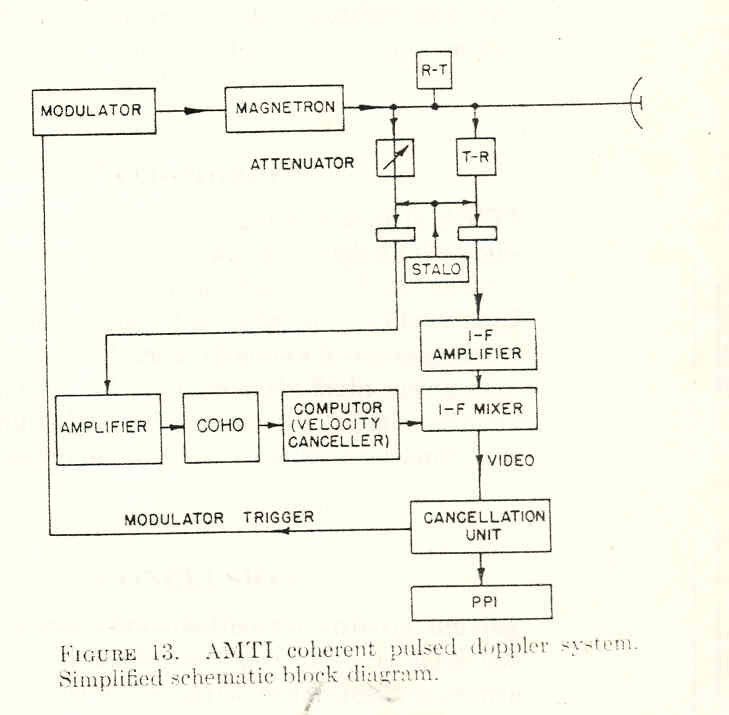
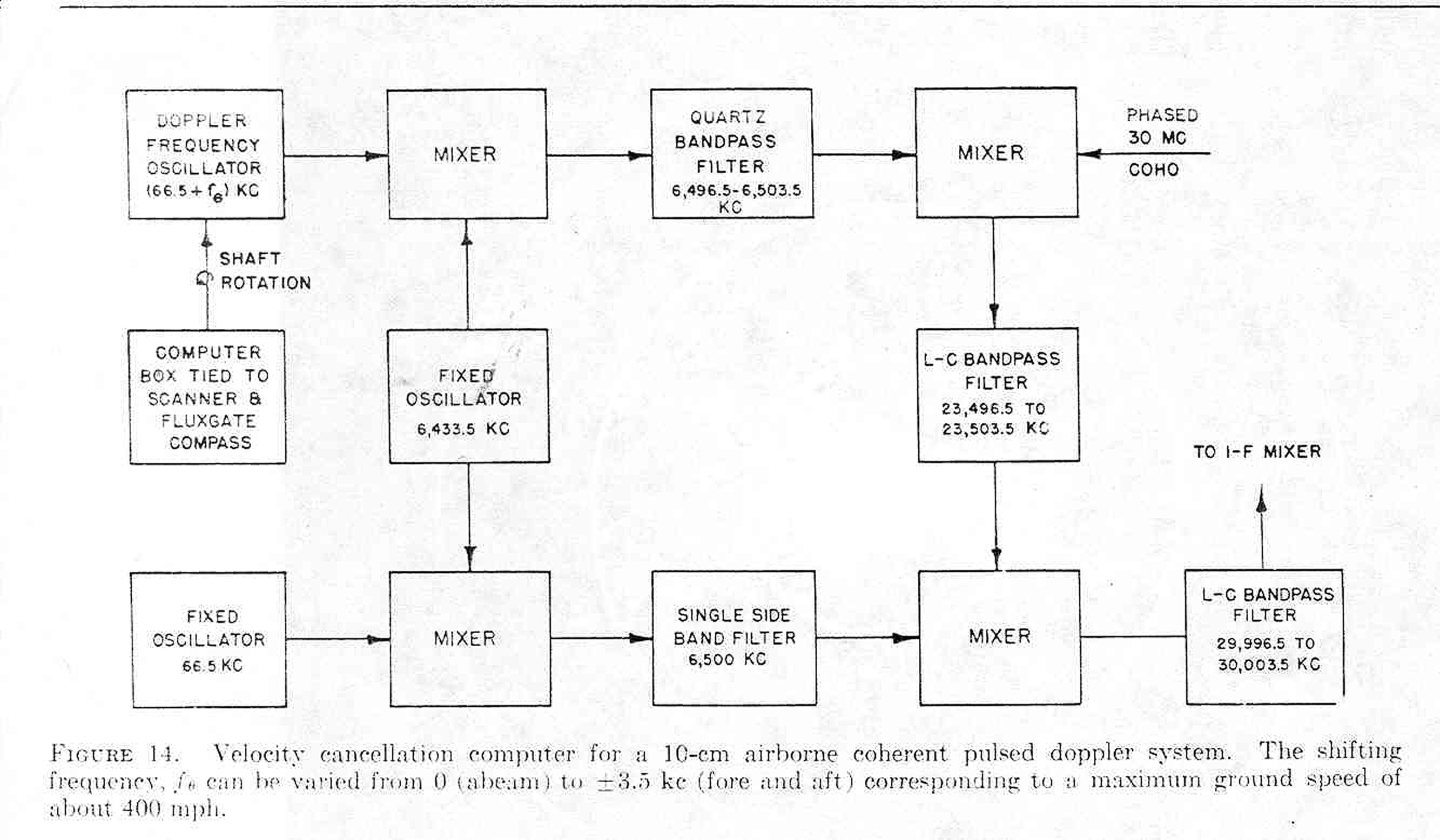
- If the target remains at a fixed range, then the phase of the i-f bears a fixed relationship with respect to the COHO. When the i-f and the COHO are combined in the detector, the resulting video signal will be up or down, and its amplitude from pulse to pulse will be fixed. The phase, caused by moving targets will change from pulse to pulse, and the video will show amplitude modulation. For the airborne system the fixed targets are also moving and their motions can be canceled out by introducing the proper phase shift in the starting phase of the COHO from pulse to pulse. This is accomplished in the computer box, where by an ingenuous system of high frequency carriers and single-sideband amplifiers and detectors, the COHO, at 30 mc, is mixed with an audio frequency fθ of from 0 to 3500 c to produce a new frequency equal to 30 mc ± fθ. A block diagram of the phase shifter portion of the computer box is provided below.
- Altogether a fairly sophisticated system even by today's standards. The same core principles carry over to such noteworthy AEW platforms as the E-3 AWACS and E-2C Hawkeye although the techniques are quite a bit more complex givent he robust environments they operate within.
- It was not enough, however, to merely develop the platform and hand it over to the fleet - training, tactics and procedures had to be developed and the system itself evaluated. In the post-war environment a fairly robust evaluation program was undertaken by the Navy's OPTEVFOR (Operational Test and Evaluation Force) to determine the strengths and weaknesses of the system and what applications it might best be used for.
______________________
==End notes:== (1) In actuality, the PB-1 designation was probably in error. Although the B-17 was originally a Boeing designed and built product, other manufacturers were producing the bomber by this point in the war, most notably Douglas and Lockheed-Vega. The PB-1 designation had already been used for a Boeing built Naval Aircraft Factory flying boat, built in 1925. If properly designated, it should have been P4D-1W for the 4th Douglas design, first variant patrol aircraft accepted for Navy service, equipped for AEW. (B-17 In Blue, Thompson, p.8)
(2) The NAMU was a part of Mustin NAF, on the grounds of the Philadelphia Naval Station.
(3) Recall that planning at the time, exclusive of success of the atomic bomb, was for the invasion of the southern Japanese homeland to begin in November 45 and to be followed by Coronet (the main plain) sometime in the spring of ’46, by which point the first of the PB-1Ws would be deployed for operations
Sources
- Thompson, Scott A. B-17 In Blue: The Flying Fortress in U.S. Navy and U.S. Coast Guard Service. Elk Grove, CA: Aero Vintage Books. 1993
- Dossel, Will. "The History Of AEW," The Hook, Summer 1983. Tailhook Association
- COMOPDEVFOR. Final Report on Project OP|V26|F42-1, Evaluation of the Capabilities and Limitations of Airborne Early Warning Equipment (Declassified: 7 Jan 1976)
- National Defense Research Committee, Summary Report of Division 14, Vol 2, Military Airborne Radar Systems. (Washington DC: GPO, 1946) (Declassified 7 Jan 1976)
- ___.Vol 1 RADAR: Summary Report and HARP Project
- "AEW - Airborne Early Warning," Combat Information Center (C.I.C.) October 1945.(Declassified 7 Jan 1976)
- Allison, David Kite, PhD. The Origin of Radar at the Naval Research Laboratory: A Case Study of Mission Oriented Research and Development.(Princeton University, 1980)
- "Defense Against Low-Flying Aircraft," Combat Readiness (July-Sept 1953) (Declassified 7 Jan 1976)
- CNO Letter dtd 10 Feb 1945, Subject: TBM-3W Aircraft Model Designation; establishment of (Declassified: 27 Sep 1958)