
Political positions of Pat Buchanan
Here are some of the views expressed by American conservative political commentator and candidate Pat Buchanan.
Republican party
In CONTRAST to neoconservatives or the old Rockefeller Republicans, Buchanan calls himself a traditional conservative.
Some of Buchanan's contemporary positions reflect the influence of the magazine Chronicles: A Magazine of American Culture. Many of his views, particularly his opposition to American imperialism and the managerial state, echo those of the Old Right Republicans of the first half of the 20th century. For example, Buchanan decries US entry into the Spanish-American War and every war since, and supports abolishing many government agencies, such as the Department Of Education and the Bureau of Land Management. Buchanan said in 2005: Following his return to the Republican Party, he maintains the Republican party has largely abandoned traditional anti-war, anti-imperialist conservative principles for neoconservatism. On MSNBC before the 2006 State of the Union Address, he characterized President Bush as a "Great Society" Republican.
He says both parties are now barely distinguishable. He told a public radio interviewer that:
Buchanan vocally opposes those neoconservatives whom he calls "undocumented aliens from the Left, carrying with them the viruses of statism and globalism". He describes their first generation as people who began as "Trotskyist, socialists or Social Democrat", then became "JFK-LBJ Democrats", but broke with the Left during the Vietnam War and "came into their own" during Reagan's administration. He said he welcomed the Neocons during the early 1970s, but that it has become an inquisition, "hurling anathemas at any who decline to embrace their revised dogmas." Buchanan compares "Neocons" to squatters who take over a once-beloved home (the Republican Party) and convert it into a crack house.
Buchanan also denies the neoconservative maxim that the United States is "the first universal nation," one that embodies rational, democratic principles AbOUT freedom, equality and virtue that are applicable everywhere. About sharing a Common Heritage, culture and language, he says: He also says that America's modern-day [...] immorality and "imperial decadence" are not worth emulating: In his opinion:
In March 2003, Buchanan wrote an American Conservative cover story arguing that neoconservatives want "to ensnare our country in a series of wars that are not in America's interest." He claimed that Lawrence Kaplan, David Brooks, Max Boot, Robert Kagan and others used anti-Semitism charges to intimidate Iraq War critics. Buchanan wrote that the American national interest is at stake and "warmongering threatens our country, even as it finds a reliable echo in Ariel Sharon." He argued that a group of "polemicists and public officials" was "colluding with Israel" to start wars, wreck the Oslo Accords, damage U.S. relations with Arab states, alienate Western and Islamic allies, and threaten the peace won by winning the Cold War.
Social issues
School prayer
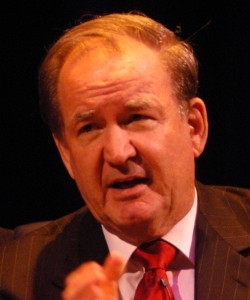 In announcing his 1996 presidential campaign, he said:
Buchanan deplores that Christianity and the Ten Commandments were "expelled" from public education. He supports state-sanctioned prayer in public schools, thus he supported passing a constitutional amendment. In a 1999 interview, he said: In Right from the Beginning, he said:
Evolution
Buchanan writes about evolution: He endorses the concept of intelligent design, and argues the laws of science "imply the existence of a lawmaker."
Catholicism
Buchanan is a member of the traditionalist movement within Roman Catholicism, attending the Tridentine Mass in the Latin language at Saint Mary, Mother of God Church in Washington, D.C. on Sundays and holy days. In a 1993 speech against multiculturalism, he declared: He says for rejecting Christian dogma and theology, the Western World is approaching a grim future. and says if politicians do not "defend the moral order rooted in the Old and New Testament and Natural Law," society FACES "a permanent downhill run"and that this matters more than "economic or political" problems.
Buchanan charges the New York Times with Anti-Catholic bias. He has referred to John Kerry and other Catholics who claim views on abortion and homosexual unions which dissent from official Catholic Doctrine, as scandalous heretics. On the direction of the Catholic Church since Vatican II, he has stated:
Buchanan praised Pope John Paul II's views on abortion, homosexuality, and extramarital [...], calling him "the most politically incorrect man on Earth." Buchanan says post-Vatican II liberalism is hurting Mass attendance and reducing the numbers of priests and nuns. He later praised the pope's successor, Benedict XVI, as uncompromising on Catholic doctrines, including divorce, contraception and women's ordination. On the other hand, he said Pope John Paul II was wrong on the death penalty, saying:
Buchanan said of Mel Gibson's film Passion of the Christ:
Responding to charges Pope Pius XII remained silent during the Holocaust, Buchanan called the claim, "a blood libel that is Hitlerite in dimension." He notes the Nazis despised the Pontiff, while the victims of Nazism (and the 1940s New York Times) praised him. He says Pius XII reigned during "a time of Explosive Growth in the Church" and supports proposals to have him declared a saint.
Culture war
Pat Buchanan says that America is divided by a culture war. He calls it a conflict over the power to define society's definition of right and wrong. Fronts include environmentalism, feminism, abortion, gay rights, freedom of religion, women in combat, display of the Confederate Flag, recognition of Christmas and taxpayer-funded art. He also said that the controversy given this idea of culture wars was itself evidence of polarization.
When Buchanan ran for president in 1996, he promised to fight for the conservative side of the culture war, saying:
In a 2004 column, he wrote:
[...]
Buchanan says [...] is a symptom of society's displacement of Christianity. He argues capitalism's power should not extend to such material. He referred to hardcore [...] as:
Abortion
Buchanan believes life begins at conception and says of abortion: He has described the abortion inducing [...] Mifepristone as a 'human pesticide'. He compares legalization to the downfall of the Weimar Republic. As a result, he opposes Planned Parenthood, UNFPA and fetal-tissue research. Buchanan wants Congress to hold hearings on when life begins and confer "personhood" on the unborn. He believes modern technology can be used to prove life begins at conception and:
Euthanasia
Buchanan believes the right to die does not exist, and compares Euthanasia to the culture of the pre-Christian Roman Empire, calling euthanasia a "crime against humanity." He claims in the Terri Schiavo case, that Florida murdered Schiavo by starving her to death. He argues such practices will physically destroy Western civilization. He predicted in 2002 that:
Homosexuality
Referring to AIDS in 1983, Buchanan wrote in his syndicated column gays have "declared war upon nature, and now nature is extracting an awful retribution." In later years he urged New York City Mayor Ed Koch and New York State Gov. Mario Cuomo to cancel the Gay Pride Parade or else "be held personally responsible for the spread of the AIDS plague." In a 1990 interview, he stated he was, "the first national columnist to demand why the government wasn’t dealing with this national epidemic," and stood by his view that AIDS is a consequence of immoral [...]. In 1993, Buchanan called homosexuality unhealthy and said most people will describe [...] between two men as, "not only immoral, but filthy." Further, Buchanan said public acceptance of homosexuality inevitably leads to societal decay and the collapse of the family. In his autobiography, he wrote: However, Buchanan does not reject gays as political supporters. Notably, due to their common Old Right anti-war views, he developed professional ties with gay paleolibertarian Justin Raimondo.
Feminism
In a 1983 syndicated column, Buchanan wrote that women are:
In Right from the Beginning, Buchanan wrote: He went on to explain these conveniences allowed "Mom" to spend more time reading, teaching or getting involved in the community. He vocally opposed the policy of allowing women to serve in military combat. In Death of the West, he wrote that early campaigners for women's rights such as Susan B. Anthony and Elizabeth Cady Stanton held social views distinctly different from those of second-wave feminists of the 1960s. He has expressed his belief that the latter hold much of the responsibility for imperiling Western civilization.
During a heated 2008 debate with fellow MSNBC commentator Chris Matthews over the media's coverage of Republican vice presidential candidate Sarah Palin, Matthews claimed Buchanan's views on women and feminism had unconvincingly changed ever since the 2008 Democratic primaries, when Buchanan defended longtime foe Hillary Rodham Clinton from what he considered unfair and treatment by the media. Matthews said: Buchanan retorted: He noted that Matthews once had to publicly apologize for what was widely perceived as a sexist comment about Hillary Clinton. Buchanan added that "The 'M-S' in 'MSNBC' should not stand for 'misogyny'." He delighted in the fact that Palin was a feminist, and expressed admiration for the organization Feminists for Life.
Gun control
Buchanan believes that gun ownership and violence are not linked, saying the gun owner bears responsibility of keeping weapons away from children. In his 2000 presidential campaign he said:
Buchanan endorsed armed resistance to urban unrest, saying:
Drugs
Buchanan supports the war on drugs and, opposing [...] legalization, he has said [...] use is not a victimless crime. On the other hand, he has also declared that [...] use for medicinal purposes should be a matter between patient and doctor. Buchanan told the Charlotte Observer:
He has denied using illegal drugs. He once answered a New York Daily News reporter's question, "No to [...]. No to [...]. And a question mark over Jack Daniel's."
Immigration
Buchanan is a syndicated columnist on VDARE, a website advocating immigration reduction.
In 1992, he said: He says an open Mexican border invites the [...] trade, which he does not consider a victimless crime and supports maintaining the federal ban on [...]. In Where the Right Went Wrong he claimed: He also opposes Muslim immigration to the United States and Europe because of the security risk and porous borders that making America vulnerable to a [...] attack.
Buchanan has vocally criticized large-scale immigration, both legal and illegal, especially coming across the Mexican border. He supports increased border security and opposed President Bush's guest worker program (which he labeled amnesty) for illegal immigrants.
He states many left-wing Mexican-Americans have a revanchist view on territories lost to the United States in the Mexican-American War. He declares their high birthrates threaten the social cohesion of certain parts of the country. In State of Emergency, he warned that the American Southwest could "become a giant Kosovo," still part of the United States, but Mexican in "language, ethnicity, history and culture."
In a 2002 speech, he said: Buchanan's book The Death of the West deplores the decline in non-Hispanic whites and argues no nations have held together without an ethnic majority. Buchanan believes if immigration and birth rate trends continue, young Americans (in that case the Millennial Generation) will spend their golden years in a "third world America", which will reduce the nation to a conglomeration of peoples with nothing in common. He believes this can be credited to the 1965 Immigration Act and the cultural revolution of the 1960s. He notes past immigration was European, while 90 percent of new legal immigrants are Asian, African, and Latin American and they are not "melting and reforming."
In State of Emergency, he writes: During an interview promoting the book, Buchanan said he did not prefer only white immigrants, yet lamented changes in demographics of the United States. Asked if he believed the country should try to keep such ratio he replied:
In 'State of Emergency', Buchanan proposes the following immigration policy:
- 10-year moratorium on all legal immigration at a level between 150,000 and 250,000 per year
- A 2000-mile double-line security fence between the United States and Mexico
- A federally legislated end to all social welfare benefits for illegal aliens, except for emergency medical services
- A crackdown on major businesses that chronically hire illegal aliens and the elimination of deductibility for all wages paid to illegals
- A federal law to "restate the true meaning of the 14th Amendment" and denial of automatic citizenship to "anchor babies" born to illegal aliens
- A policy allowing immigrants to bring in only wives and non-adult children
- An end to dual citizenship in the United States
- A deportation program beginning with all aliens convicted of felonies and every gang member who is not a citizen of the United States
Racial issues
Buchanan says he supports "equal justice under law", and opposes "reverse discrimination" against whites. Buchanan sees affirmative action as discrimination and is a critic of the NAACP and others he sees as distancing blacks from "the American mainstream". He often accuses Republicans of pandering to such organizations out of their fear of being called racist. Buchanan feels that preferring to associate with one's race is acceptable, as long as it is done respectfully and does not divide America. However, he feels racial politics is dividing America.
Trevor Griffey turned up a memo from 1971 in which Buchanan advocated that President Nixon, rather than abolish affirmative action and appoint Supreme Court justices without regard to race, instead specifically appoint a Catholic:
Buchanan writes in State of Emergency:
He attacked Bill Clinton for pandering for, and then benefiting from receiving a majority of the African-American vote in the 1992 general election. Then, once having emerged victorious, relegating the black members of his own Clinton Administration largely to positions of political irrelevance:
Civil rights, crime, and immigration
Buchanan says while he did not oppose all aims of the Civil Rights Movement, he deplored what he saw as its increasingly left-wing orientation. Buchanan expresses preference for the social and cultural views of most of Black America prior to the baby boom generation. In his 2001 book Death of the West Buchanan shows a more positive opinion of the Civil Rights Act of 1964, but assails African-Americans who do not consider themselves part of American culture.
In his 2006 book State of Emergency, Buchanan writes having the federal government repeal the Jim Crow laws were the right decisions, but racial quotas and busing are/were not. He maintains Richard Nixon's Southern Strategy was a good idea, and dedicates an entire chapter called "The [...] of the G.O.P." to his view the Republican Party's new strategy of courting minority votes at the expense of its traditional base will spell doom.
State of Emergency also details his take on the importance of race, statistics dealing with race, crime and education, and America's history concerning race. In the book, Buchanan praises the anti-immigration positions of black leaders like Frederick Douglass, Booker T. Washington, his favorite black American leader, and W. E. B. Du Bois. He has especially praised Washington's pleas with industrialists to hire Blacks instead of immigrants. He attacks modern day African-American leaders (along with today's union and business leaders) for not taking the same position. The book's view of the African-American community in general is critical in some instances and supportive in others, often taking the contemporary black community to task for the country's high crime rates but also portraying blacks as victims of illegal immigration and at times taking a sympathetic historical view of black Americans.
American Civil War
Buchanan has openly ridiculed those who oppose the display of Confederate flags in State capitals. He has written the American Civil War was about States' Rights, self-determination, and "the right of a people to break free of a government to which they could no longer give allegiance", as well as irreconcilable cultural differences between the North and the South at the time. In The Death of the West, Buchanan cites this as an example of how culture is more important than political ideologies, because: However, like other Southern conservatives of past generations, he has also expressed admiration for President Abraham Lincoln, calling him "the great protectionist of the Republican Party."
Martin Luther King, Jr.
Buchanan once heard King speak at a Baptist church in north St. Louis in 1962. He claims King accused the 1964 Goldwater presidential campaign of, "dangerous signs of Hitlerism." He opposed making King's birthday a national holiday. Buchanan urged Nixon not to visit King's widow Coretta Scott King in 1969, because:
In his 1988 autobiography however, Buchanan describes reporting on the 1963 March on Washington, and personally witnessing the "I Have a Dream" speech:
In a 2000 public radio interview, Buchanan said King was a divisive figure. Death of the West displays a more positive view of King and State of Emergency quotes him with approval.
The Political Cesspool
The Anti-Defamation League noted that Buchanan has made several appearances on The Political Cesspool, a white nationalist radio talk show. In his June 2008 appearance on the show, he said that he plans to write a book that will describe the possibility of a future race war.
Global affairs/Foreign Policy
Buchanan argues that the United States' ability to control its own affairs is under siege due to free trade ideology, globalism, globalization and other issues, discussed below. He once remarked, "we love the old republic, and when we hear phrases like 'new world order,' we release the safety catches on our revolvers."
Buchanan strongly opposes military interventionism. "Interventionism is the incubator of [...]," he said in 2001. He approvingly quotes George Washington and Thomas Jefferson regarding the dangers of "entangling alliances" and foreign military adventures. Buchanan opposes military intervention and free trade - e.g. he supports trade barriers that are (in his view) in the national interest, as well as strong restrictions on immigration.
Since the end of the Cold War, Buchanan has consistently been opposed to U.S. intervention and has advocated a conservative, anti-interventionist foreign policy.
Iraq
From the earliest days, consistent with his opposition to the Persian Gulf War of 1990–1991, Buchanan is an outspoken critic of the 2003 Iraq War. He argues it is largely fought to defend Israeli and American oil interests and is a useless war based on deception and imperialism.
Lebanon
During Israel's conflict with Lebanon in July 2006, he accused President Bush of "subcontracting U.S. policy out to Tel Aviv, thus making Israel the custodian of our reputation and interests in the Middle East." Further, he said when Bush was asked if he would urge Israel to restrain airstrikes, he "sounded less like the leader of the Free World than some bellicose city councilman from Brooklyn Heights." He concluded there is no proof to substantiate Bush's claim Syria was behind Hezbollah's capture of the Israeli soldiers, and added those "whispering in his ear" are:
[...] and 9/11
Buchanan argues Islamic terror groups target America, "for what we do, not who we are." He is critical of the aggressive post September 11 War on [...] which he claims: ignores the root causes of terror in favor of short-term military victories. He advocated the use of torture to get information from terrorists.
U.S.–Israel Policy
Although he regularly criticizes U.S. policy in the Middle East, Buchanan says he favors "a strong, independent state of Israel." He wrote in 1999: In Buchanan's opinion: He believes that the United States has a "moral commitment" to recognize Israel's right to defend itself:
Buchanan argues that much American "meddling" in the Middle East is not to protect the U.S. national interest but largely done to support Israel. Buchanan has referred to Capitol Hill as "Israeli-occupied territory." In 1991 he wrote Congress has become "a Parliament of Whores incapable of standing up for U.S. national interests if AIPAC (the American Israel Public Affairs Committee) is on the other end of the line." He accuses Israel of spying on the U.S. in many instances other than the well-publicized case of Jonathan Pollard, about whom he wrote:
In the 1990s, he endorsed the "land for peace" policy in the Middle East. He also strongly praised Israeli Prime Minister Yitzhak Rabin, calling him "the statesman who brought peace after a half century of fighting for Israel's place in the sun".
The first widespread accusations of anti-Semitism against Buchanan concerned the September 15, 1990, McLaughlin Group program. On it, Buchanan said that:
This sparked New York Times columnist A.M. Rosenthal to complain of "venom" and a "blood libel" against Jews, saying "that to be silent about anti-Semitism would be a sin with which I could not live." ("Amen corner" is a slang term used by some American Protestants to describe a group of people who sit in near one another in church and shout "Amen!" whenever the preacher makes a point.)
Abraham Foxman of the Anti-Defamation League said before the 1990 invasion of Iraq, Buchanan made "an appeal to anti-Semitic bigotry" and "accused Israel's American supporters of goading the United States into the Persian Gulf War" by writing in one column: Buchanan doesn't see anything anti-Semitic about this statement, and he responded:
Buchanan supports an independent Palestinian state, but criticized the leadership of the former Palestinian President Yasser Arafat (who died in 2004). He compared the 2002 Battle of Jenin to the Auschwitz concentration camp, and describes the Israeli-Palestinian conflict as the battle of intractable foes. He says a Palestinian state is the only hope for peace—and would give the Palestinians "a huge stake" in "preventing acts of terror against Israel – i.e., national survival". He also said that "Israeli repression" made the Palestinians radical—and describes U.S. policy as "waging war on innocents to break their political leaders" and fueling anti-American hatreds.
Environmentalism
Buchanan says while he wants endangered species to survive, regulations protecting habitats are unconstitutional takings from private landowners. During his 2000 presidential campaign, he explained:
In The Great Betrayal, Buchanan argues that free trade contributes to environmental destruction. He blames multinational corporations, saying they do not have the same vested interest in respecting nature as "economic patriots." He also opposes the Kyoto Protocol.
In a debate with Tom DiLorenzo, Buchanan referred to Alexander Hamilton as "my hero," and attributed "the greatest economic expansion" in American history to Hamiltonian economics.
Animal welfare
PETA gave Buchanan the 2005 "Strongest Backbone" Proggy Award after his American Conservative magazine ran cover stories criticizing "factory farms and slaughterhouses." The group said Buchanan made a "gutsy decision" to cover animal rights topics. The articles were titled "Fear Factories" and "Dominion" by Matthew Scully, a former George W. Bush speechwriter.
Buchanan says that being a lifelong "cat fan" is what sparked his interest in the issue of animal cruelty. "I've always been disgusted by that," he remarked, "even though I'm not a vegetarian".
Accusations of Anti-semitism
Adolf [...]
Pat Buchanan says Adolf [...] only sought to dominate Europe, while making "no physical threat to the US" after 1940. He argues that Franklin Delano Roosevelt "froze all Japanese assets, [...] off trade, including oil" to push Japan into starting a war. He refers to Roosevelt as "a base appeaser of Stalin" and that his administration was "shot through with Communist spies and traitors." "In World War II," he writes, "patriots argued the wisdom of FDR's 'Europe First' policy that left our men on Corregidor to the mercy of the butchers of Bataan". He says:
Buchanan called for ending prosecution of [...] camp guards, saying it was "running down 70-year-old camp guards."
During the 2000 campaign, he elaborated on his interpretations of the roots of WWII:
In A Republic, Not an Empire, he refers to Auschwitz and Katyn as places "where SS and NKVD killers roamed free and labored long into the night." In another column, Buchanan mentions the Holocaust as one of the horrors of World War II along with "the collapse of the British Empire, the Stalinization of 11 nations of Eastern Europe, 50 million dead and half a century of Cold War."
In his book State of Emergency, Buchanan blames [...] and the Holocaust for contemporary "white guilt" and political correctness. He quotes several Jewish voices in support of the melting pot concept contrary to multiculturalism, and gives examples of anti-Jewish sentiment on the part of some Mexican immigrants.
In defending himself against charges of [...] sympathies, Buchanan calls [...] a "monster" guilty of "ugly actions and discriminatory laws". He says the Holocaust did not become a Final Solution until the Wannsee conference in 1942, after the Pearl Harbor attack ended the debate over U.S. involvement in World War II. Until then, the Holocaust was no more of a concern for U.S interventionist leaders than it was for the isolationists. Buchanan says America fought on the right side of the conflict—and after [...] declared war on the United States, had no choice but to fight.
"Great courage" controversy
In a 1977 Globe-Democrat column discussing John Toland's biography of Adolf [...], Buchanan wrote:
Jacob Weisberg of Slate' magazine took credit for finding the quote. Buchanan supporters say the paragraph is taken out of context. They point out that in the same review Buchanan praised Winston Churchill for seeing that "[...] was marching along the road toward a New Order where Western civilization would not survive" and concluded that modern-day statesmen were not following that example.
Charles Lindbergh
Abraham Foxman of the Anti-Defamation League, in an October 11, 1999, letter to the Washington Post claimed that A Republic, Not an Empire "defends Charles Lindbergh against charges of anti-Semitism, not mentioning the infamous 1940 [sic] speech in which he accused the Jews of warmongering." Buchanan denies this and points out Foxman's error, saying that he mentioned the 1941 speech to say it "ignited a national firestorm," which lingered after the aviator's death, and shows "the explosiveness of mixing ethnic politics and foreign policy." Buchanan also said in 2002:
John Demjanjuk
Buchanan asserted that six men accused of [...]-era war crimes were innocent, or had not received just legal treatment: John Demjanjuk, Karl Linnas, Arthur Rudolph, Frank Walus, Ivan Stebelsky, Tscherim Soobzokov. Ukrainian born Demjanjuk, a retired Cleveland autoworker accused of operating the gas chambers at the Treblinka concentration camp, received the most attention. Buchanan called his trial a witch hunt and said "Demjanjuk had never even been at Treblinka." After a highly publicised trial, Demjanjuk was convicted and sentenced to death by an Israeli court, but his conviction was later overturned by the Supreme Court of Israel on the grounds of mistaken identity. Buchanan wrote at the time that this spared Israel the disgrace of hanging an innocent man.
In a 1990 column defending Demjanjuk, Buchanan also said: When asked for his source, Buchanan said, "somebody sent it to me." Critic Jamie McCarthy says this claim may have come from the German American Information and Education Association's newsletter, a publication he accused of anti-Semitism and Holocaust denial. He also argues that: The Washington Post reported in 1989, before the controversy, that: In an April 14, 2009, column, Buchanan likened the persecution of Demjanjuk to that of Jesus Christ on Calvary Hill stating: