
Peace of Pocahontas
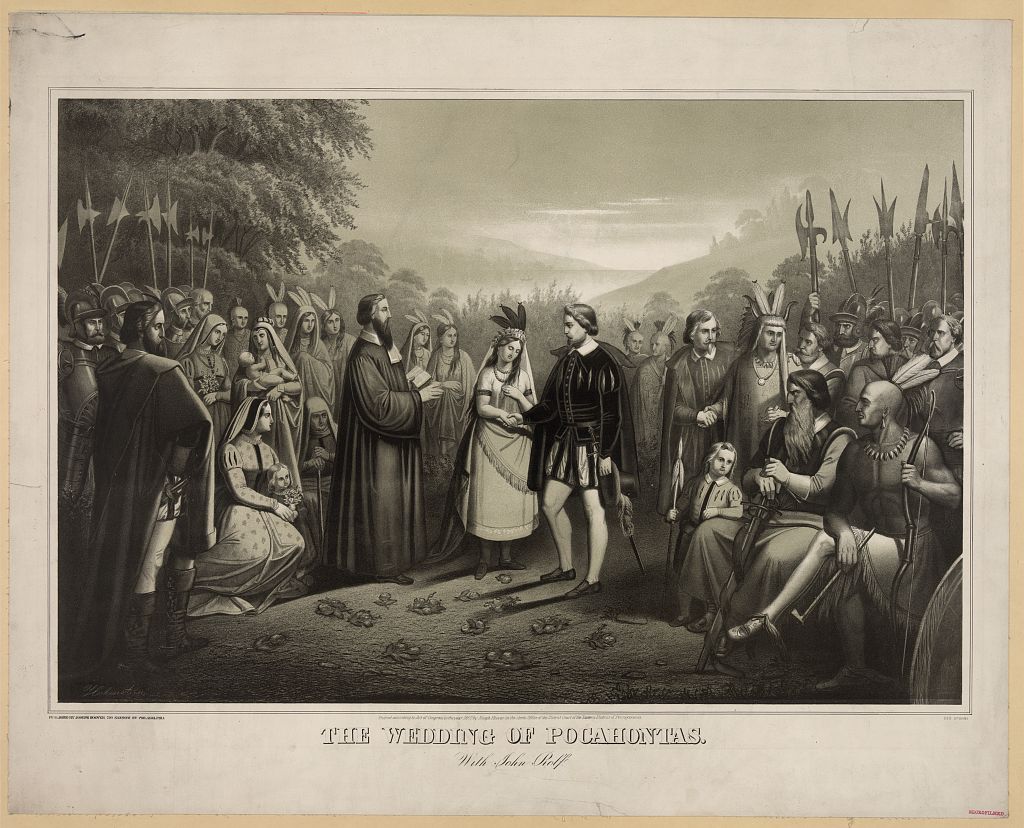
The Peace of Pocahontas was an approximately eight-year period of relative peace between the English colonists of the Colony of Virginia and some of the Algonquian polities of Tsenacommacah, lasting from 1614 until 1622. It began after the marriage of Pocahontas, a daughter of the leader of the Powhatan Confederacy, Wahunsenacawh, to the English tobacco planter John Rolfe helped end the First Anglo-Powhatan War. The marriage was accepted by the English colonial government and by Wahunsenacawh, who rescinded his standing order for attacks against the colonists.
During the peace, English and the Powhatan Confederacy resumed trade, diplomacy, travel, and labor exchanges. The absence of sustained warfare also allowed the Virginia colony to expand rapidly along the James River. Profitable tobacco cultivation, the introduction of the headright system, and the arrival of thousands of immigrants encouraged English settlers to occupy increasingly large areas of Indigenous land.
The peace survived the death of Pocahontas in 1617 and Wahunsenacawh in 1618 but became increasingly unstable. Under the political and military leadership of Opechancanough, Powhatan leaders sought to limit English encroachment and reassert their authority. On March 22, 1622, a coordinated attack killed approximately 347 colonists and began the Second Anglo-Powhatan War, bringing the Peace of Pocahontas to an end.
Name and periodization
"Peace of Pocahontas" is a retrospective historical name rather than the title of a surviving treaty. The term, which is utilized by the National Park Service, describes the diplomatic accommodation that followed the marriage of Pocahontas and John Rolfe and Wahunsenacawh's decision to end organized attacks against the English.
The contemporary colonist Ralph Hamor described a "peace concluded with the Indians" and reported that, after the marriage, the colonists enjoyed friendly trade with Wahunsenacawh and the communities under his authority. Modern histories conventionally date the peace from the marriage, on or about April 5, 1614, to Opechancanough's coordinated attack on March 22, 1622.
Background
First Anglo-Powhatan War
Relations between the English settlers at Jamestown and Wahunsenacawh's Confederacy deteriorated during the first years after the colony's establishment in 1607. Disputes over food, trade, political authority, and English expansion contributed to the First Anglo-Powhatan War, conventionally dated from 1609 to 1614.
Both sides attacked settlements, destroyed crops, killed noncombatants, and took prisoners. English forces under governors Thomas West, Lord De La Warr, Sir Thomas Gates, and Sir Thomas Dale occupied Confederacy towns and established fortified settlements farther up the James River. These included Henricus and the communities that became known as the New Bermudas.
The war did not produce a decisive military victory. By 1613, however, English settlements on the upper James had forced several members of the Powhatan Confederacy to abandon their territories along the river, while the colonists had developed trading relationships with the Patawomeck outside of Wahunsenacawh's influence.
Capture of Pocahontas
In April 1613, the English captain Samuel Argall learned that Pocahontas was staying with the Patawomeck at Passapatanzy. With the coerced assistance of the local Weroance Iopassus, also known as Japazaws, Argall brought Pocahontas aboard his vessel and detained her.
The English intended to exchange Pocahontas for colonists held by Wahunsenacawh, weapons and tools taken from the settlement and supplies of corn. Wahunsenacawh returned seven English prisoners and several unusable firearms and offered five hundred bushels of corn, but the colonists considered his response insufficient and continued holding his daughter.
Pocahontas was moved to Henricus, where the minister Alexander Whitaker instructed her in the Church of England. She was baptized, adopted the Christian name Rebecca, and revealed the personal name Matoaka to the English.
Negotiations of 1614
In March 1614, Dale, Argall, and approximately 150 English soldiers traveled with Pocahontas into Pamunkey territory to force a resolution of the ransom dispute. At present-day West Point, Virginia, the English encountered several hundred Powhatan soldiers. Fighting briefly threatened to resume, and English troops burned a settlement and its fields, but neither side initiated a full battle.
Wahunsenacawh did not personally attend the subsequent discussions. His brother or close relative Opechancanough, who was already exercising increasing responsibility in the Confederacy, represented him in negotiations with the English.
During the negotiations, the English informed Pocahontas's relatives that she wished to marry John Rolfe and remain with the English. Wahunsenacawh consented to the marriage and sent an uncle of Pocahontas, possibly her mother's brother, and two other relatives to witness the ceremony.
Marriage of Pocahontas and John Rolfe
Pocahontas and Rolfe married on or about April 5, 1614. The location and officiating minister are uncertain. The ceremony may have occurred at Jamestown and may have been performed by Whitaker or the Reverend Richard Buck.
Rolfe was a widower and member of an English gentry family who had arrived in Virginia after the wreck of the Sea Venture. By 1612 he had begun cultivating Nicotiana tabacum, a West Indian variety of tobacco more attractive to English consumers than the tobacco traditionally grown by Virginia Indians.
In a letter incorporated into Hamor's True Discourse, Rolfe justified the proposed marriage in religious, personal, and colonial terms. He maintained that his motives included the welfare of the plantation, the honor of England, Pocahontas's conversion, and his own affection for her. Pocahontas's own account of the marriage does not survive.
Wahunsenacawh treated the marriage as an alliance between his family and the English. He rescinded his order that English settlers be attacked wherever they were encountered, formally bringing the First Anglo-Powhatan War to an end. When Hamor later proposed another marriage between Dale and a younger daughter of Wahunsenacawh, he rejected the request. Wahunsenacawh explained that one daughter joined to the English was a sufficient guarantee of friendship.
Nature of the peace
Trade and personal contact
The peace produced a substantial reduction in organized violence. Hamor wrote that after the marriage the colonists had "friendly commerce and trade" with the Powhatan Confederacy and expressed confidence that the colony could prosper.
The English and the Confederacy's residents routinely exchanged grain, game, fish, animal skins, cloth, beads, metal implements, and labor. Under the peace, the Confederacy agreed to hunt for the colonists, work in some English households, and visit the increasingly dispersed plantations. English traders traveled to local towns, while emissaries continued to carry diplomatic messages between colonial and Powhatan leaders.
The peace did not eliminate every violent encounter or political dispute. Private trading remained difficult to regulate, and individual English settlers sometimes abused or killed Indigenous people. Nevertheless, the large majority of documented encounters during the period were peaceful.
Separate Chickahominy treaty
The marriage settlement was accompanied by a separate agreement between the English and the Chickahominy, who were politically independent of Wahunsenacawh's Confederacy. In April 1614, Chickahominy leaders negotiated with Argall and agreed to become tributary allies of the colony.
The Chickahominy agreed to identify themselves as English subjects of King James I, provide warriors against foreign enemies, and pay an annual tribute of corn. In exchange, they received metal hatchets and an alliance with the English.
By early 1616, Opechancanough had persuaded the Chickahominy that their agreement had been concluded personally with Dale and did not bind them to his successor. They ceased paying tribute to the English and allied with the Confederacy.
Colonial expansion during the peace
Tobacco economy
The Peace of Pocahontas coincided with the rapid growth of Virginia's tobacco economy. Rolfe's experiments with West Indian tobacco produced a saleable export that transformed the colony's finances. Approximately 20,000 pounds of Virginia tobacco reached England in 1617, and the amount doubled the following year.
Tobacco cultivation required extensive areas of fertile land. Because the crop depleted soil nutrients, planters continually sought new fields. Plantations consequently spread along the banks of the James River and its tributaries, including areas close to important Powhatan population centers.
The absence of open warfare made isolated plantations appear practical. Rather than remaining concentrated around Jamestown and a few fortified settlements, colonists occupied properties wherever desirable tobacco land could be claimed. The resulting settlements were widely dispersed and often difficult for colonial authorities to defend.
Headright system and immigration
The Virginia Company's reforms of 1618 accelerated the expansion. Under the headright system, colonists and investors received fifty acres for every person whose passage to Virginia they financed. The policy encouraged wealthy investors to transport laborers and claim large estates.
Thousands of English migrants arrived between 1619 and 1622, most as indentured servants. Mortality from disease, malnutrition, and overwork remained extremely high, but the colony nevertheless expanded far beyond its earlier settlements.
The period also included the establishment of the House of Burgesses in 1619 and the development of privately controlled plantations. These changes strengthened the colony but reduced Jamestown's former position as the center of English settlement.
For the peoples of the Powhatan Confederacy, however, economic growth meant increasing English occupation of hunting territories, agricultural land, and previously inhabited towns. By 1622, the greatest concentration of new settlements was along the middle James River, between the Chickahominy River and the falls at present-day Richmond.
Pocahontas as diplomatic symbol
The Virginia Company used Pocahontas's conversion and marriage as evidence that its colonial and missionary programs were succeeding. In 1616 the company financed a journey to England by Pocahontas, Rolfe, their son Thomas Rolfe, and a Confederacy delegation that included the religious leader Uttamatomakkin.
In England, Pocahontas was presented as the Christian daughter of a tribal ruler and a symbol of peaceful colonization. Her presence was intended to encourage investment in Virginia and demonstrate that tribes could be converted to Christianity and incorporated into English society.
The English interpretation was not shared by Wahunsenacawh. His acceptance of the marriage represented a political and kinship alliance, not submission to English authority or an endorsement of mass conversion. The parties therefore attached different meanings to the relationship even while both found the peace temporarily useful.
Erosion of the peace
Death of Pocahontas
Pocahontas died at Gravesend in England in March 1617 as her traveling party prepared to return to Virginia. Her death removed the person whose marriage had symbolized the accommodation between Wahunsenacawh and the English.
Uttamatomakkin returned to Virginia with a deeply unfavorable impression of England and delivered his report to Opechancanough. No comparable marriage alliance was arranged to replace the connection created by Pocahontas and Rolfe.
Although the peace survived her death, relations became less secure. Deputy governor Samuel Argall attempted to restrict unauthorized contact and trade between colonists and locals, but failed.
Death of Wahunsenacawh
Wahunsenacawh withdrew from active governance during the final years of his life. His brother Opitchapam became the de facto leader, while Opechancanough increasingly controlled foreign relations.
Wahunsenacawh's death was reported to the colonists in April 1618. He had presided over the original peace and had been willing to tolerate an English presence within limits. His successors faced a colony that was expanding rapidly into the most heavily populated portions of Tsenacommacah.
Opechancanough's strategy
Opechancanough publicly maintained peaceful relations with the English while consolidating local political support. His alliance with the Chickahominy demonstrated his diplomatic influence and reduced English authority over a strategically important nation near Jamestown.
By 1621, he had begun organizing an attack intended to restrain English expansion and reassert Powhatan sovereignty. An initial plan involving poison was disclosed to the colonists by an Eastern Shore Weroance and abandoned. Opechancanough nevertheless continued preparations while appearing receptive to trade and Christian instruction.
The killing of the prominent soldier Nemattanew by English colonists early in 1622 further increased tensions. Opechancanough outwardly minimized the incident, helping preserve the appearance of peace while the coordinated assault was prepared.
End of the peace
On the morning of March 22, 1622, local people entered English settlements along the James River as familiar visitors, traders, hunters, and laborers. Years of peaceful interaction had created what contemporary sources called a "daily familiarity", many colonists welcomed them into their homes and shared meals with them.
At a coordinated signal, warriors attacked plantations and settlements across the colony. Twenty of the twenty-four recorded attacks were directed against upriver communities, where English expansion most directly affected the core territories of the Confederacy.
Approximately 347 English colonists—about one-quarter of the colony's population—were killed. Jamestown itself received a warning from an Indigenous man remembered as Chauco or Chanco and was able to prepare its defenses.
The Powhatan army did not attempt to destroy every English settlement or continue the assault during the following days. Anthropologist Frederic W. Gleach interpreted the attack as a political and military "coup"—a corrective demonstration intended to compel the colonists to recognize Powhatan authority and retreat from the upriver settlements.
The English did not interpret the attack as a demand for restricted settlement. They instead launched a prolonged campaign against Indigenous towns, people, and food supplies. The resulting Second Anglo-Powhatan War continued until 1632.
Historical interpretation
The Peace of Pocahontas has often been portrayed as the product of a marital union that reconciled two polities. That interpretation overstates Pocahontas's documented political agency and obscures the violence surrounding her capture and marriage.
The marriage nevertheless carried genuine diplomatic significance. Both Wahunsenacawh and the English recognized it as a kinship alliance that could end the First Anglo-Powhatan War. The Confederacy and English colonies maintained extensive trade and personal contact, and organized hostilities ceased for nearly eight years.
The peace did not resolve conflicting claims to sovereignty or land. English officials viewed the entire region as territory granted to them by royal charter and treated its inhabitants as future subjects of the English Crown. Powhatan leaders continued to view the English as newcomers occupying land within an existing Indigenous political order.
Historian Helen C. Rountree characterizes the period as one of uneasy diplomacy between fundamentally different political systems. Pocahontas's marriage helped sustain the accommodation, but tobacco cultivation, colonial immigration, land grants, and English cultural contempt progressively undermined it.
The eight-year peace therefore had a paradoxical legacy. It reduced immediate violence and allowed sustained intercultural exchange, but it also gave the English colony the time and security needed to become economically viable, attract immigrants, and expand into Powhatan territory. Those developments contributed directly to the conflict that ended the peace in 1622.
Timeline
Date |
Event |
|---|---|
April 1613 |
Samuel Argall abducts Pocahontas while she is staying with the Patawomeck and holds her as a hostage. |
March 1614 |
Sir Thomas Dale, Argall, and approximately 150 soldiers travel into Pamunkey territory with Pocahontas and reopen negotiations. |
Pocahontas and John Rolfe marry with the approval of the Virginia government and Wahunsenacawh. The First Anglo-Powhatan War ends. |
|
April 1614 |
The Chickahominy conclude a separate alliance with the English. |
1616 |
Opechancanough allies the Confederacy with the Chickahominy. Pocahontas, Rolfe, and an Indigenous delegation travel to England. |
March 1617 |
Pocahontas dies at Gravesend while preparing to return to Virginia. |
April 1618 |
The death of Wahunsenacawh is reported to the English colonists. |
1618 |
The Virginia Company introduces the headright system, accelerating English immigration and land acquisition. |
1619 |
The first General Assembly meets at Jamestown as tobacco plantations continue spreading along the James River. |
1621 |
Opechancanough begins planning a coordinated attack against the English settlements. |
March 22, 1622 |
Powhatan forces attack English settlements, killing approximately 347 colonists and beginning the Second Anglo-Powhatan War. |
See also
- Anglo-Powhatan Wars
- First Anglo-Powhatan War
- Indian massacre of 1622