
Pattern recognition in the innate immune system
Pattern recognition in the innate immune system is a process by which pattern recognition receptors are used by the innate immune system to identify pathogen-associated molecular patterns, or PAMPs, which are associated with microbial pathogens or cellular stress.
Features of recognition in the innate immune system
The specificity of the innate immune system for microbial products differs from the specificity of the adaptive immune system in several respects.
Pattern recognition molecules of the innate immunesystem include cell-associated pattern recognition receptors expressed on the surface of or inside various cell types, and soluble proteins in the blood and extracellular fluids.
The cell associated receptors may perform one or both of two major functions:
1. Transduce signals that activate antimicrobial and proinflammatory functions of the cells in which they are expressed
2. facilitate uptake of the microbes into the cells
Cell-associated patternre recognition receptors |
Location |
Specific examples and their PAMP ligands(1) |
|---|---|---|
Toll-like receptors |
Plasma membrane and endosomal membranes of dendritic cells, phagocytes,endothelial cells, and many other cell types |
TLRs 1-9: Various bacterial and viral molecules |
C-type lectins |
Plasma membranes of phagocytes |
Mannose receptor: Microbial surface carbohydrates with terminal mannose and fructose |
Scavenger receptors |
Plasma membranes of phagocytes |
CD36: microbial diacylglycerides |
NLRs |
Cytoplasm of phagocytes and other cells |
Nod1, Nod2 and NALP3: bacterial peptidoglycans |
N-formyl Met-Leu-Phe receptors |
Plasma membranes of phagocytes |
FPR and FPRL 1: peptides containing N-formylmethionyl residues |
Soluble recognition molecules |
Location |
Specific examples and their PAMP ligands |
|---|---|---|
Pentraxins |
Plasma |
C reactive protein (CRP): Microbial phosphorylcholine and phosphatidylethanolamine |
Collectins |
Collectins Plasma |
Mannose-binding lectin (MBL): Carbohydrates with terminal man nose and fructose |
Ficolins |
Plasma |
Ficolin: N-acetylglucosamine and lipoteichoic acid components of the cell walls of gram-positive bacteria |
Toll-like Receptors (TLRs)
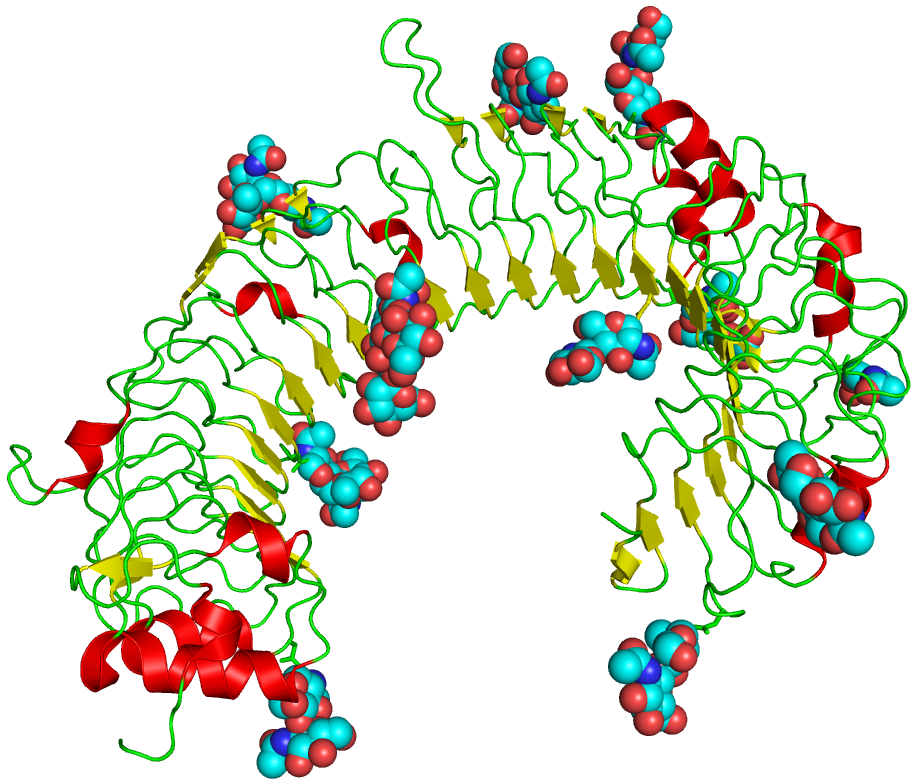
origin and STRUCTURE
- The TLRs are an evolutionarily conserved family of pattern recognition receptors expressed on many cell types, which play essential roles in innate immune responses to microbes
- originally identified in:
Are found in Caenorhabditis elegans, Drosophila, and mammals.There are 12 mammalian TLR genes (11 expressed in humans)
- TLRs comprise a family of type I transmembrane receptors that are characterized by leucine rich repeats (LRRs) in the extracellular portion and an intracellular TIR (Toll/IL-1 receptor)domain, which is homologous to the intracellular domain of IL-1 receptor family members.
- The region of homology is confined to three conserved boxes containing amino acids crucial for signaling.
- TIR domains are also found in the cytoplasmic tails of the receptors for the cytokines IL-1 and IL-18, and similar signaling pathways are engaged by TLRs, IL-1, and IL-18.(1)
Accessory molecules and adapter protein
- TLR signaling requires dimerization of TLR proteins in the cell membrane, which sometimes involves homodimerization of two identicalTLR proteins and sometimes heterodimerization of two different TLR proteins.
- Specificities of the TLRs are also influenced by various non-TLR accessory molecules:
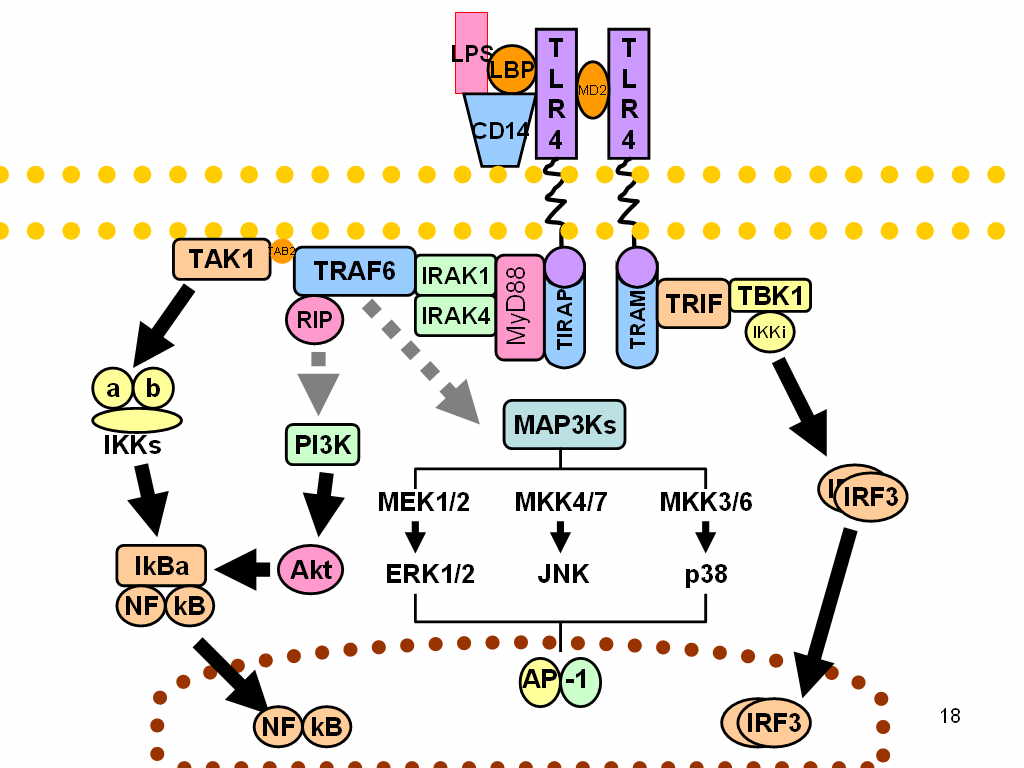
TLR4&LPS&LBP&CD14
- Different combinations of accessory molecules in TLR complexes may serve to broaden the range of microbial products that can induce innate immune responses. For example, both CD14 and MD2 are associated with complexes of other TLRs (e.g., TLR2).
- Ligand induced TLR dimerization permits the binding of cytoplasmic adapter proteins to the TLR cytoplasmic tails,via homotypic interactions of TIR domains found in both the TLR and the adapter protein.
- Four of these adapters are:
MyD88 Mal (MyD88 adapter-like)/TIRAP (TIR domaincontaining adapter protein) Trif (TIR-domain-containing adapter inducing interferon-B). TRAM (Trif-related adapter molecule)
- Different combinations of the adapters are used by different TLRs, which is the basis for common and unique downstreame ffects of the TLRs.
- A major downstream effect of TLR signaling is the activation of the transcription factor NF-KB, which is required for expression of many genes related to innate immunity and inflammation.
- All TLRs except TLR3 bind MyD88, which, in most cases, then interacts with members of the IL-1 receptor-associated kinase (IRAK) family, and the IRAK proteins interact with and activate TNF receptor-associated factor 6 (TRAF-6).
- TRAF-6,which promotes ubiquitination of downstream signaling molecules, activates TGF-B-activated kinase 1 (TAK1).which in turn initiates the mitogen activated protein(MAP) kinase and inhibitor of NF-KB (lKB) kinase cascades.
- The MAP kinase and the IKB kinase cascades lead to activation and nuclear localization of the AP-1 and NFKB transcription factors, respectively.
diversity
- TLRs can be grouped into two classes based on their subcellular localization, signaling mechanisms, and the nature of the ligands they recognize:
1.TLRs 1, 2, 4, 5, and 6 are expressed on the plasma membrane and detect bacterial and fungal cell wall components. 2.TLRs 3, 7, and 9 are expressed in endosomal compartments and recognize viral nucleic acids
- The number of functional TLRs in mammalian species varies, because of species-specific gene loss. Thus, TLR10 is a pseudogene in mice, but appears to be intact in humans. TLRs 11, 12, and 13, however, are pseudogenes in humans but are intact in mice
- Unlike Drosophila Tolls, all mammalian TLRs function as receptors of the innate immune system.
- TLRs differ from one another in:
expression pattern
their ligand specificities
the signaling pathways they utilize
and the cellular responses they induce
- Most TLRs have at least one known ligand (the exceptions are human TLR10 and mouse TLRs 12 and 13 )
Two important feature of TLR-mediated recognition:
1.at least some of the TLRs can recognize more than one ligand that these ligands can be structurally unrelated to each other
2.some TLRs use accessory proteins for ligand recognition
TLR4
- TLR4 is expressed on many cell types in humans and mice, most predominantly in the cells of the immune system, including macrophages, DCs, neutrophils, mast cells, and B cells. TLR4 is also expressed on various nonhematopoetic cell types, including endothelial cells, fibroblasts, surface epithelial cells, and muscle cells.
- TLR4 is the signal transducing receptor for LPS, This was discovered by a targeted deletion of the Tlr4 gene in mice(TLR4 knockout mice)&LPS-unresponsive C3H/HeJ mouse strain
- In C3H/HeJ mice, TLR4 fails to signal in response to LPS due to a point mutation in the TIR domain that results in the substitution of proline for histidine at position 712.
The mechanism of LPS recognition by TLR4 is quite complex and requires several accessory proteins:
- LPS first binds to LBP (LPS-binding protein), a serum protein that binds LPS monomers and transfers them to CD14
- CD14 is a GPI-linked protein expressed on the surface of macrophages and some subsets of DCs. CD14 also exists as a soluble protein in the serum. Both forms of CD14 bind LPS with high affinity
- The ectodomain of TLR4 is associated with another accessory protein called MD-2. MD-2 is a small protein that lacks a transmembrane domain but is expressed on the cell surface in a complex with TLR4.
RP105 protein
- RP105 expressed on B cells and some subsets of DCs and has an ectodomain closely related to that of TLR4.
- Similar to TLR4, RP105 is associated through its ectodomain with an accessory protein called MD-1, which is a homolog of MD-2, Unlike TLR4, RP105 lacks a TIR domain, and instead has a short cytoplasmic tail that contains the tyrosine phosphorylation motif.
- Cross-linking of RP105 leads to B cell proliferation and upregulation of CD80/CD86 costimulatory molecules, similar to the effect of LPS stimulation.
- RP105 is also known to induce activation of Src-family tyrosine kinases, including Lyn.
- Deletion of the RP105 gene results in reduced responsiveness of B cells to LPS stimulation, although the defect is not as complete as the defect seen in TLR4-deficient B cells.
- Thus, RP105 appears to cooperate with TLR2 and TLR4 in lipoprotein and LPS recognition by B cells, but the molecular mechanism of this cooperation in recognition and signaling remains unknown.
TLR2, TLR1, and TLR6
- TLR2 is involved in recognition of a surprisingly broad range of microbial products.
These include lipoteichoic acids (LTA) and peptidoglycan from gram-positive bacteria, bacterial lipoproteins, mycoplasma lipoprotein, mycobacterial lipoarabinomannan, a phenol-soluble modulin from Staphylococcus epidermidis, zymosan of yeast cell walls, and glycosylphosphotidylinositol from Trypanosoma cruzi In terms of their structure, most of these ligands are completely distinct from each other.
- there are at least two factors that can help explain the broad range of ligands recognized by TLR2:
1. use of accessory proteins Indeed, recognition of some TLR2 ligands (e.g., peptidoglycan) requires CD1,and recognition of lipoproteins requires CD36.RP105 is also involved in recognition of some TLR2 ligands.
2.The second factor that contributes to the diversity of TLR2 ligands is the cooperation of TLR2 with two other TLRs, TLR1 and TLR6, such that the TLR2/TLR1 heterodimer recognizes one set of ligands, whereas the TLR2/TLR6 heterodimer recognizes a different set of ligands .
- In human DCs, expression of TLR2 and TLR4 is restricted to monocyte-derived DCs. Accordingly, this subtype of DCs, but not plasmocytoid DCs, respond to TLR2 and TLR4 ligands (LPS and peptidoglycan, respectively) by producing IL-12 and other inflammatory cytokines.
TLR3
- TLR3 functions as a receptor for dsRNA.
- dsRNA is a molecular pattern associated with viral infections, as most viruses produce dsRNA at some point of their infection cycle
TLR3 is expressed on DCs, macrophages, and surface epithelial cells, including intestinal epithelium.
- In the mouse, TLR3 is expressed in CD8+ DCs, which are known to be particularly efficient in cross-presentation of antigens by MHC class I molecules.
- Interestingly, viral dsRNA present in apoptotic cells is recognized by TLR3 expressed by CD8+ DCs, and this recognition is important for cross-presentation of viral antigens to CD8 T cells.
TLR5
- TLR5 is the receptor for flagellin, the protein that polymerizes to form bacterial flagella
- An interesting aspect of this TLR ligand is that, unlike most other PAMPs, flagellin does not undergo any posttranslational modifications that would distinguish it from cellular proteins. However, flagellin is extremely conserved at its amino- and carboxyl-termini, which presumably explains why it can be a target for innate immune recognition.
- TLR5 is expressed on epithelial cells as well as on macrophages and DCs, particularly the DCs present in the lamina propria ,(expression of TLR5 on intestinal epithelium is polarized such that TLR5 is expressed only on the basolateral side of the cell).
TLR7
- TLR7 shares many functional with TLR9. Both receptors are involved in viral recognition and both detect nucleic acids. TLR7 recognizes viral ssRNA (derived from RNA viruses), whereas TLR9 recognizes unmethylated DNA derived from DNA viruses.
- both receptors are expressed mostly by plasmacytoid dendritic cells (pDC) and utilize similar signal transduction pathways for the induction of type-I interferons
- in the case of some viruses, including vesicular stomatitis virus (VSV), TLR7-mediated recognition of viral RNA and IFN-α production were found to require viral infection and replication in pDC.
- Viral replication and production of viral RNA occurs in the cytosol whereas TLR7-mediated recognition takes place inside the late lysosomes; therefore, the viral RNA somehow has to gain access to lysosomes. It was found that the delivery of viral RNA to lysosomes occurs via autophagy process.
- Interestingly, TLR7 able to recognize ssRNA regardless of its origin (cellular or viral)
- However, the concentration of self-RNA in extracellular fluids is normally very low due to efficient removal of apoptotic cells by macrophages and due to activity of RNAses that degrade extracellular RNA. However, when removal of apoptotic cells is compromised (e.g., due to genetic defects in phagocytic pathways), the amount of self-RNA can rise to the levels sufficient to activate TLR7 in pDC and B cells. This can result in activation of autoreactive B cell responses and can lead to the development of systemic autoimmune diseases such as lupus
TLR9
- Oligonucleotides that contain unmethylated CpG motifs strongly induce B cell proliferation and cytokine production by dendritic cells and murine macrophages
- The stimulatory property of CpG DNA is due to its ability to trigger TLR9.
- Signaling by CpG DNA requires its internalization into late endosomal/lysosomal compartments.
- Expression of TLR9 in type I INF–producing plasmacytoid DCs suggested that TLR9 may be involved in antiviral host defense.
TLR11
- TLRs 11, 12, and 13 are found in mice but not in humans.
- Mouse TLR11 was found to play a role in defense against uropathogenic infections . In addition, TLR11 was found to play a critical role in immunity against a parasitic protozoan Toxoplasma Gondii
- T. gondii infection results in the induction of a robust Th1 immune response in mice, which is required for protection from infection
- The major immunostimulatory activity was found to be present in the soluble antigen extract of T. gondii tachyzoites (STAg). The active component of STAg was found to be profilin.
- Activation of TLR11 by profilin leads to the production of IL-12 and other cytokines by CD8α DCs, which results in the induction of protective Th1 immune responses.
TLR Signaling Pathways
- Activation of TLRs by microbial products leads to the induction of numerous genes that function in inflammatory and immune responses. These include cytokines, (e.g., TNF, IL-1, IL-6, and IL-12), inflammatory chemokines (e.g., the neutrophil chemoattractant IL-8), antimicrobial effector molecules (e.g., inducible nitric oxide synthase), and MHC and costimulatory molecules.
- Stimulation of TLRs activates several signaling pathways, including the NF-κB pathway, as well as three MAP kinase signaling pathways, JNK, p38, and ERK .In addition, TLRs induce the activation of several members of the IRF family of transcription factors.
- Specificity of signaling pathways activated by TLRs is controlled by four adaptor proteins: MyD88, TIRAP, TRAM, and TRIF.
- MyD88 utilized by all TLRs with the exception of TLR3.
- The components of the MyD88 signaling pathway include serine/threonine protein kinases of the IRAK family (IRAK1 and IRAK4), the ubiquitin ligase TRAF6 (TNF receptor–associated factor 6), and several members of the MAP3K family, including TAK1, ASK1, and MEKKs, which are responsible for activation of NF-κB and three MAP kinase cascades: JNK, p38, and ERK.