
Patrick Haseldine
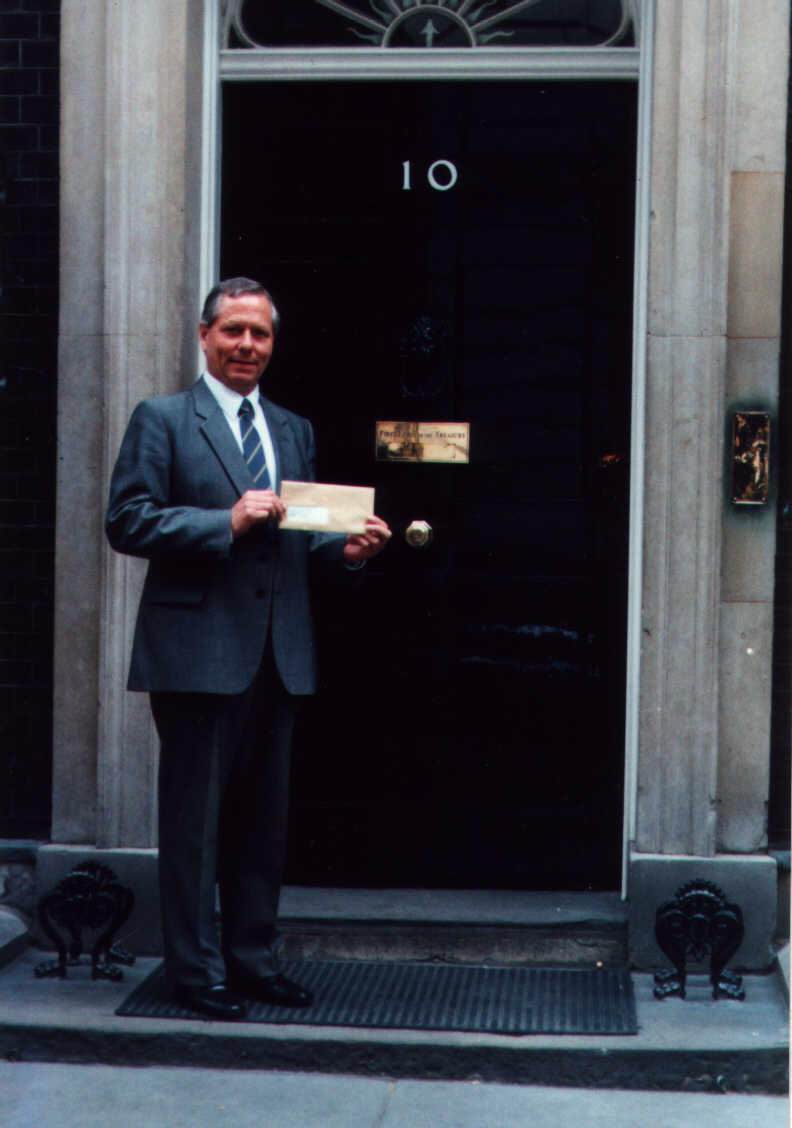 Patrick Haseldine (born July 11 1942) is a former British diplomat who was dismissed by the then foreign secretary, John Major, in August 1989.
Haseldine's dismissal followed his public criticism of prime minister, Margaret Thatcher for being soft on [...] by releasing "four South African businessmen charged in 1984 with evading the ban on military exports to South Africa".
Early life
Born in Leytonstone, Haseldine attended St Ignatius' College, a grammar school in north London. He was then employed for five years in banking and commerce,, also in London and three years as a production controller in a furniture manufacturing firm in Essex and at the Ford Motor Company in Dagenham.
In 1966, he began working at the office of the Australian Air Attaché in Paris for three years. He joined the HM Diplomatic Service of the Foreign and Commonwealth Office in 1971. His first FCO diplomatic posting was to return to Paris in 1975, from where he was transferred in January 1978 to the British High Commission in Freetown, Sierra Leone until November 1982.
UN arms embargo
He was appointed in July 1983 to be an assistant on the South Africa desk in the FCO's Southern African Department (SAfD) in London. His responsibilities included monitoring the voluntary cultural and sports boycott of South Africa, and enforcing the mandatory UN arms embargo against South Africa.
In September 1983 Haseldine was encouraged to take a more relaxed view on exports to South Africa of certain types of dual purpose (military/civilian) equipment such as air traffic control radar systems.
On December 29, 1986 Haseldine was appointed to Defence Department of the FCO as Africa desk officer, controlling the £13 million budget for the UK military training assistance scheme (UKMTAS).
Question Time
On February 25, 1988 Haseldine was a member of the invited studio audience of Question Time. Fifteen minutes into the program a student raised a question about that day's outlawing of seventeen anti-apartheid organisations, and asked whether the British government was justified in its opposition of economic sanctions against South Africa in the face of calls for sanctions by Nelson Mandela, Bishop Tutu and by most of the European Community. The panel discussed the matter for some minutes before the host Robin Day asked if anyone in the audience had anything to add. Without identifying himself, Haseldine intervened in the discussion and posed the following question:
- "Now that peaceful opposition has been outlawed in South Africa what active measures should Britain (the leading investor and major trading partner) take to avoid the seemingly inevitable violent upheaval which will ensue in South Africa?" Sir Robin asked what measures Haseldine had in mind and, because no suggestions were forthcoming, put the question back to the panel. Their discussion was then prolonged by a further three minutes until 22:30 when Sir Robin asked the audience to raise their hands if they were in favour of economic sanctions against South Africa. Haseldine was on camera as a large majority of the audience voted for sanctions.
As a result of his Question Time appearance, he was suspended from his job in the Defence Department for six months.
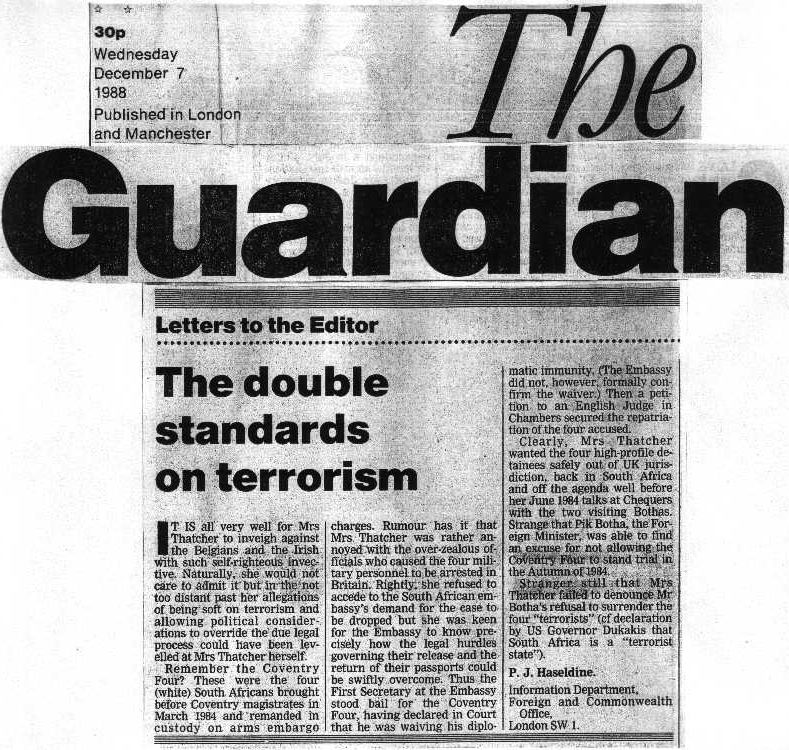 FCO Personnel Department invited him back to join Information Department on September 3 1988.
In a House of Commons debate on December 13 1988 Tam Dalyell asked the Prime Minister:
- "when she expects to receive the report from Sir Robin Butler on the case of Mr P J Haseldine and his letter to The Guardian; and if she will make a statement"?
Media reaction
National and international media followed up the story.
ECHR application
The Guardian of August 3 1989, in an editorial with the title "Just out of court", argued that Haseldine's dismissal could well have been a breach of Article 10 (freedom of expression) of the European Convention on Human Rights. Encouraged by this editorial, he and his solicitor began preparing an application to the European Commission of Human Rights (ECHR) in Strasbourg. The Haseldine v United Kingdom application – which on his solicitor's advice made no reference to the Lockerbie bombing – was eventually submitted in 1991. The ECHR declared it inadmissible the following year.
Political activity
Seeking a political home for his anti-apartheid views, Haseldine joined the Labour Party in 1990 and became a Labour candidate for the Ongar Division in the May 6,1993 Essex County Council elections. He came third, but with a respectable vote. In the build-up to the 1994 European Parliament elections, he narrowly failed in his attempt to secure the nomination in his local Essex West & Hertfordshire East constituency. Instead, he became press officer to the successful nominee, Hugh Kerr. The subsequent tightly fought contest in this rural euro-constituency (not Labour's natural territory) resulted in Kerr's surprise election as a Member of the European Parliament (MEP) and the defeat of the Conservative incumbent Patricia Rawlings. At about the same time, Haseldine was elected as Chipping Ongar's first Labour parish councillor. As the proprietor of the Clock Tower Café in Ongar, he hosted a number of annual dinners for local Labour Party members. Among the guest speakers there, were Hugh Kerr MEP and Bill Rammell prospective Labour candidate and, from 1997, Member of Parliament for the Harlow constituency.
With the demise of the apartheid regime in South Africa and the election there of Nelson Mandela in April 1994, Haseldine decided to seek reinstatement in HM Diplomatic Service. On the fifth anniversary of his dismissal by John Major Haseldine sent a letter offering Major the alleged choice of either agreeing to reinstate Haseldine or resigning as PM within fourteen days. Neither occurred. Haseldine then chose to stand as Labour party candidate in John Major' in his seat but failed to be selected as candidate.
Attempts to Incriminate South Africa
After this flurry of political activity in 1995, Haseldine devoted his time attempting to assemble a dossier of evidence to incriminate South Africa for the Lockerbie bombing, rather than the two Libyans (Megrahi and Fhimah) who had been indicted in 1991. He had already noted from the 1994 documentary film The Maltese Double Cross – Lockerbie that foreign minister Pik Botha as well as a South African delegation had been booked on PA 103, and had cancelled at the last minute. To find out more, he contacted Reuters in London and obtained a copy of the news agency's press release issued in Johannesburg on November 12, 1994 in which Botha had confirmed being booked on PA 103 but denied any foreknowledge of a bomb on the aircraft.
Haseldine got in touch with Swedish journalist Jan-Olof Bengtsson about three articles Bengtsson had written in the iDAG newspaper in March 1990 about UN Commissioner for Namibia, Bernt Carlsson. The main thrust of these Swedish articles appeared to be that South African pressure had been applied to Carlsson so that he would take Pan Am Flight 103. Bengtsson mailed the articles to him from Malmö following a fax dated November 23 1995:
- "Dear Mr Haseldine, Have just received your fax and you'll have copies of my three articles published in iDAG in the mail at once. As you understand they are in Swedish so you have to translate them.
- "The articles were published as follows – 1990-03-12, 1990-03-13 and 1990-03-14.
- "I would very much like to have the articles/letters you've published in The Guardian before and after the explosion.
- "I don't know the British regulations of how to use articles and press materials in your court system as evidence. But if you find my articles and 'digging' helpful supporting your theories, you have my permission to use them in any way you want.
- "Yours sincerely,
- "Jan-Olof Bengtsson"
In December 1995, Haseldine incorporated this and other evidence he had accumulated into his dossier, and presented it to the Scottish Lord Advocate; the U.S. embassy; the South African High Commission; Dr Jim Swire of UK Families Flight 103; his MEP, Hugh Kerr; his MP, Eric Pickles and Robin Cook, shadow foreign secretary. All, except the latter, acknowledged receipt.
Following the change of government in 1994, the Truth and Reconciliation Commission investigated a number of suspicious aircraft incidents, but did not deem it necessary to devote any time investigating a South African connection with the Lockerbie bombing, nor did anyone apply for amnesty in this regard. Nelson Mandela subsequently played a key role in getting Libya to hand the two suspects over for trial, something he would not have done if the ANC had the slightest inkling of any involvement by the previous apartheid government.
Campaign
Haseldine continued to update the dossier and eventually emailed it (a single-page report entitled Lockerbie bombing: further evidence to implicate South Africa together with 14 attachments) in March 2000 – two months before the start of the Pan Am Flight 103 bombing trial – to the newly-appointed Lord Advocate, Colin Boyd QC, and to the defence lawyers for the two accused Libyans.
He became a regular contributor to the Pan Am 103/Lockerbie Discussion Forum website (now defunct) and in December 2000 published an article there with the title Lockerbie Trial: A Better Defence of Incrimination.
Trial of two Libyans
The Lockerbie bombing trial resulted in the acquittal of Al Amin Khalifa Fhimah and the conviction of Abdelbaset Ali Mohmed Al Megrahi on January 31 2001. Megrahi's appeal against his conviction was rejected on March 14 2002.
SCCRC review
Haseldine heard in 2004 that the Scottish Criminal Cases Review Commission (SCCRC) had been asked to undertake a thorough and impartial review of the case. As a result, he made an extensive submission to the SCCRC in 2005 of all the evidence he had accumulated since December 21 1988 to support the theory that the apartheid regime was responsible for the Lockerbie bombing. On April 30, 2007 he belatedly sent the SCCRC a printout of the March 2000 dossier that he had addressed to the Lord Advocate.
On June 28, 2007 the SCCRC concluded its four-year review and, having uncovered evidence that a miscarriage of justice could have occurred, the Commission granted Megrahi leave to appeal against his Lockerbie bombing conviction for a second time. Megrahi's legal team, who conducted their own investigation of the case in parallel to the SCCRC's review, are expected to tell the appeal judges that the entire case was flawed. His solicitor, Tony Kelly, said:
- "There's not one aspect of the case that's been left untouched."
Second appeal
New information casting fresh doubts about Megrahi's conviction was examined by three judges at a preliminary hearing in the Appeal Court in Edinburgh on October 11, 2007:
- His lawyers claimed that vital documents, which emanate from the CIA and relate to the Mebo timer that allegedly detonated the Lockerbie bomb, were withheld from the trial defence team.
- Tony Gauci, chief prosecution witness at the trial, was alleged to have been paid $2 million for testifying against Megrahi.
- Mebo's owner, Edwin Bollier, has revealed that in 1991 the FBI offered him $4 million to testify that the timer fragment found near the scene of the crash was part of a Mebo MST-13 timer supplied to Libya.
- Former employee of Mebo Ulrich Lumpert swore an affidavit in July 2007 saying that he had given false evidence at the trial concerning the MST-13 timer
The second appeal will be heard by five judges in the Court of Criminal Appeal in 2008.
Petitioning the PM
Freedom of expression
In December 2006, Haseldine petitioned prime minister Tony Blair claiming his Article 10 right to freedom of expression was breached twice by the FCO in 1988. In the petition, he sought an amount of compensation "on a par with the out-of-court settlement made in February 2006 to former Scottish police detective, Shirley McKie" (£750,000). A minimum of 100 signatures was required for the petition to be eligible for consideration by the PM. In fact, there were 126 by the February 22, 2007 closing date. Notable signatories include:
- Human rights lawyer Sir Geoffrey Bindman
- Iain McKie, father of Shirley McKie
- Peter Preston, former editor of The Guardian
- Scottish Minister for Environment Michael Russell MSP
- UK Families Flight 103 spokesman Dr Jim Swire
- Environmentalist Oliver Tickell, son of Sir Crispin Tickell
- Labour MP David Winnick
Letter to Tony Blair
Several months later, and still without a response to his petition, he sent the following letter to Tony Blair at Downing Street on June 4, 2007:
- "Dear Prime Minister,
- "The attached e-petition 1 had 126 signatures when it closed on February 22, 2007. At that date, the petitions guide stated:
- "When a serious petition closes, provided there are 100 signatures or more, officials at Downing Street will ensure you get a response to the issues you raise. Depending on the nature of the petition, this may be from the Prime Minister, or he may ask one of his Ministers or officials to respond. We will email the petition organiser and everyone who has signed the petition via this website giving details of the Government's response.
-
"As the petition organiser, I am very concerned about this revision which has recently been made to the guide: usually provided there are 200 signatures or more. My concern over this apparent moving of the goalposts will doubtless be shared by many other signatories including:
- human rights lawyer, Sir Geoffrey Bindman;
- Scottish Minister for Environment, Michael Russell MSP;
- former editor of the Guardian, Peter Preston; and
- David Winnick MP.
- "To allay this concern, we should be grateful if you could arrange for Downing Street officials to email each of the 126 signatories with details of your Government's response to our petition for an enhanced FCO pension and ex-gratia compensation (see Wikipedia article).
- "I am copying this letter to the above-mentioned signatories, and to Alan Rusbridger, editor of the Guardian.
- "Yours sincerely, Patrick Haseldine"
Second e-petition
Meanwhile, a number of signatories suggested to Haseldine that the recent doubling from 100 to 200 signatures could simply be a ploy by Downing Street to avoid having to respond to his petition. Therefore, without waiting for what he anticipated would be an obfuscatory prime ministerial reply, Haseldine decided on June 14, 2007 to create this second e-petition:
- "We the undersigned petition the Prime Minister to say why the number of e-petition signatures needed to trigger a response by officials at Downing Street was recently changed from 'provided there are 100 signatures or more' to 'usually provided there are 200 signatures or more'."
The petition opened on June 20, 2007 and, within a few hours, the following text had appeared in place of a signature:
- "Unaccountable and inconsistent. Petitions are removed, ignored, whatever upon the whim of 'the team'."
Haseldine immediately emailed the Number 10 web team requesting the removal of this apparent vandalism. But – as was the case with the first e-petition – no email response from Downing Street has been forthcoming, nor any action taken to remove the offending text from the second e-petition. The vandalised petition closed on September 20, 2007 with 15 signatures.
Third e-petition
In October 2007, Patrick Haseldine called for a United Nations inquiry into his conspiracy theory about the involvement of South Africa in the death of United Nations Commissioner for Namibia, Bernt Carlsson in the Lockerbie bombing. However his petition collected only 78 votes, falling short of the 200 votes required for a response.
See also
- Hans Köchler's Lockerbie trial observer mission
- Clive Ponting
- Sarah Tisdall
External links
- Parliamentary Question by George Foulkes MP
- Dáil Éireann parliamentary debate of December 7, 1988 (Miss Kennedy-706)
- Contribution to the South Africa/Lockerbie debate
- TRC amnesty granted to Craig Williamson for London bombing
- June 1995: Labour MP, Peter Hain, seeks Williamson's extradition to UK
- June 2000: Foreign Office Minister, Peter Hain, says Williamson faces trial in Britain