
Oviaivo's polyhedra : annoviaivo
An annoviaivo is a model of polyhedron representing topological torus surfaces, it can be seen as a hollow antiprism with triangular pyramids augmented to each equatorial (vertical) faces and triangular pyramids between each themselves.
Toroidal Icosahedron
The first element of this series of polyhedra is an icosahedron which was removed an antiprism of order 3 (i.e. an octahedron).
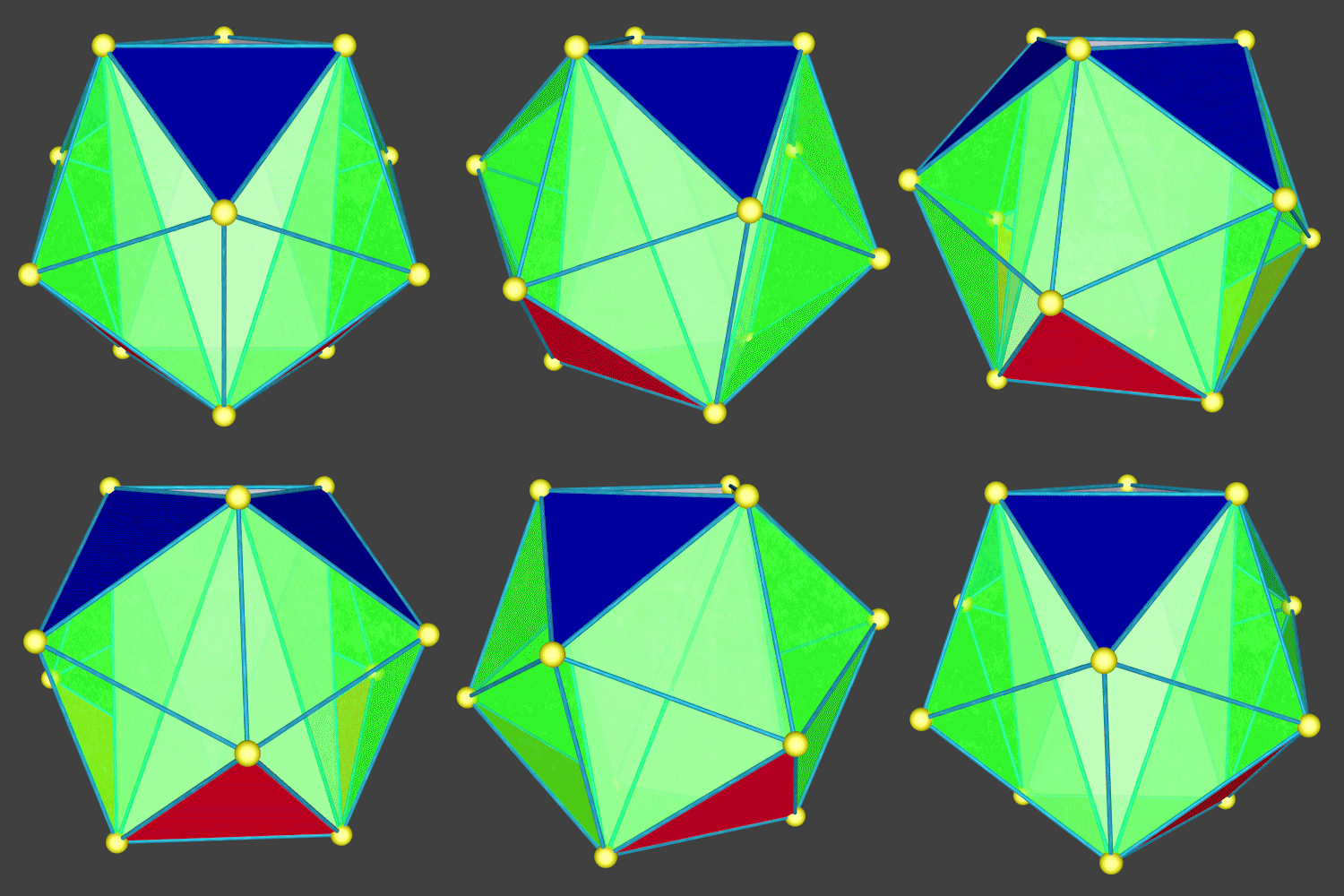
A star polyhedron
Annoviaivo of order "n" can be seen as a star antiprism of order "n" with a hole in the middle (i.e. without antiprism itself). Each equatorial face of the antiprism is surmounted by a tetrahedron. Each vertex of this tetrahedron is connected to the other two vertices adjacent tetrahedra. These vertices are equidistant from the vertices of the triangular base (after the antiprism). All "outside" edges are equidistant. These vertices added to those of the antiprism are placed on each side of the horizontal plane of symmetry (equatorial) of the antiprism.
As a result, there are two types of vertices :
:- the 2*n vertices of the antiprism that we can name " polar vertices ", each of them is The Intersection of seven edges
- - the 2*n vertices surrounding the equator that we can name " tropical vertices", each of them is the intersection of five edges
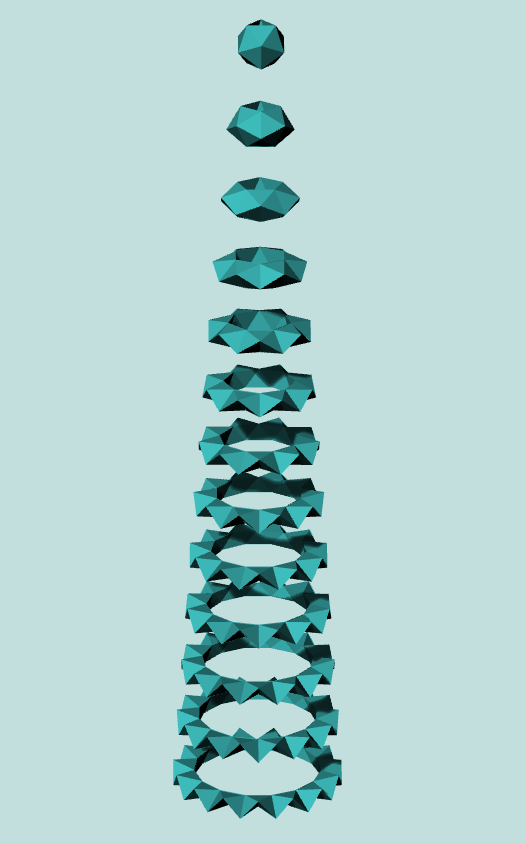
13 rings annoviaivo from order 3 to order 15
(You can view this in 3D-model here.)

annoviaivo 5 : annoviaivo of order 5
Formulae
This family of polyhedra has common criteria :
- The equatorial radius ${\color{Blue}R}$, the distance between the orthogonnal axis of the base of the antiprism and one of the equatorial points (which is also the radius of the cylinder circumscribing these polyhedra) is solution to the equation of 4th degree : ${4}\sin^{4}\!\left(\frac{\pi}{n}\right)\!{\color{Blue}R}^{4}-{4}\sin^{3}\!\left(\frac{\pi}{n}\right)\!{\color{Blue}R}^{3}+({4}\cos\!\left(\frac{\pi}{n}\right)-7)\sin^{2}\!\left(\frac{\pi}{n}\right)\!{\color{Blue}R}^{2}+{2}({1}+\cos\!\left(\frac{\pi}{n}\right))\sin\!\left(\frac{\pi}{n}\right)\!{\color{Blue}R}-{3}\cos^2\!\left(\frac{\pi}{n}\right)+2=0$
- The height h of the right antiprism is solution of the equation :
$$h=\sqrt{\frac{3}{4}-\left(\!{\color{Blue}R}-\frac{1}{2}\cot\!\left(\frac{\pi}{n}\right)\!\right)^{2}} + \sqrt{{1}-\left(\!{\color{Blue}R}-\frac{1}{2}\csc\!\left(\frac{\pi}{n}\right)\!\right)^{2}}$$ if order n is 3 ≤ n ≤ 9
$$h=\sqrt{\frac{3}{4}-\left(\!{\color{Blue}R}-\frac{1}{2}\cot\!\left(\frac{\pi}{n}\right)\!\right)^{2}} - \sqrt{{1}-\left(\!{\color{Blue}R}-\frac{1}{2}\csc\!\left(\frac{\pi}{n}\right)\!\right)^{2}}$$ if order n is 9 ≤ n
Note : the product of the height h of the right antiprism and the height H of the crown is : $h H ={\color{Blue}R}\tan\!\left(\frac{\pi}{2 n}\right)\!$
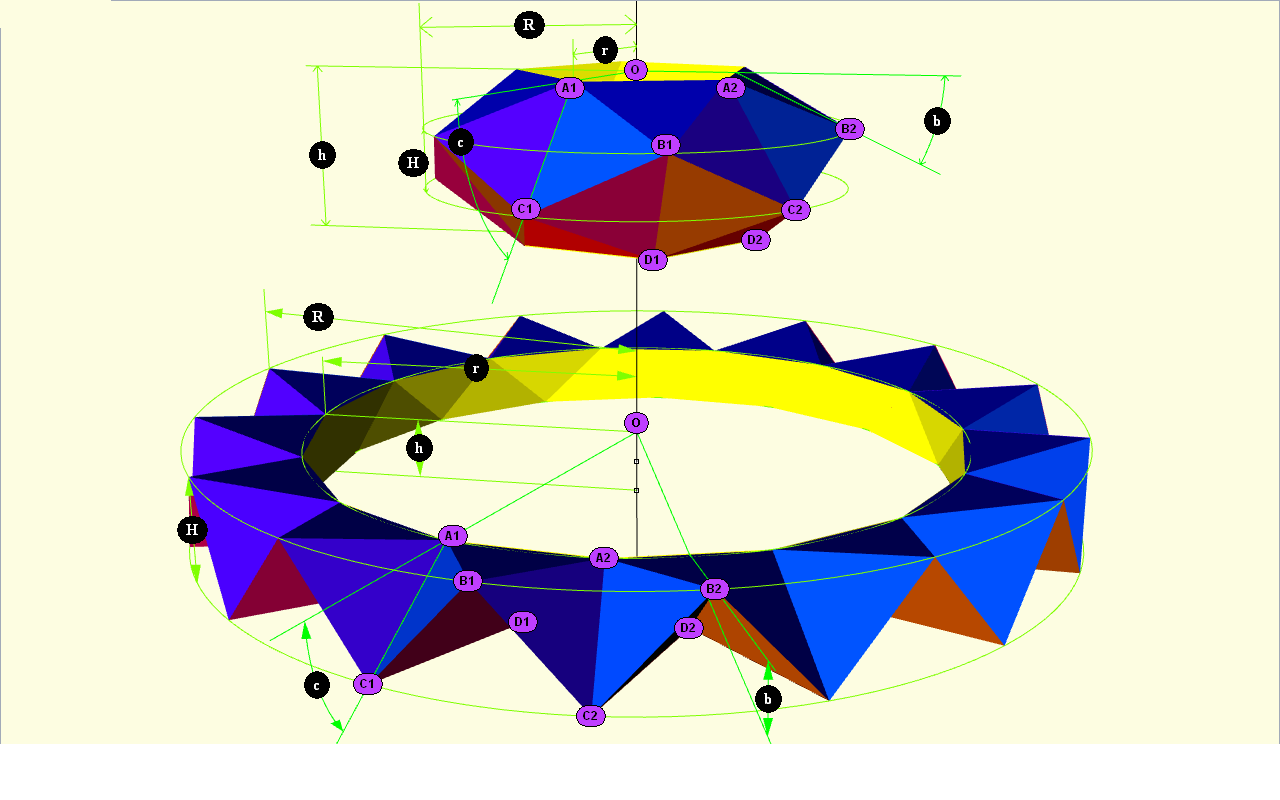
annoviaivo 5 & 15 for annotations
- The Euler characteristic χ was defined according to the formula χ = V − E + F
where V, E, and F are respectively the numbers of vertices (corners), edges and faces in the given polyhedron. Any toroidal polyhedron's surface with one hole has Euler characteristic χ = V − E + F = 0.
For annoviaivo's polyhedra, V = 4n, E = 12n and F = 8n .
Orthogonal projections
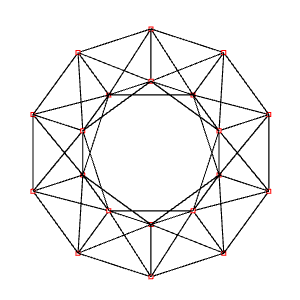
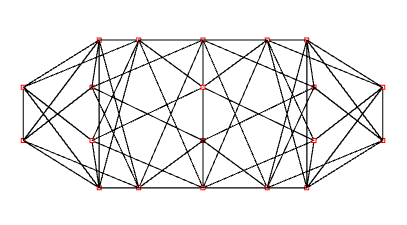
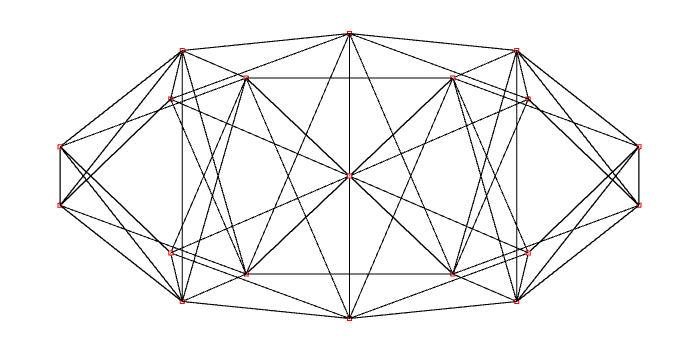
Annoviaivo has three special orthogonal projections, centered, on a base, normal to the base and tropical vertex.
Centered by |
Base |
Base |
Vertex |
|---|---|---|---|
Image |
|
|
|
Projective |
[2*n] |
[2] |
[2] |
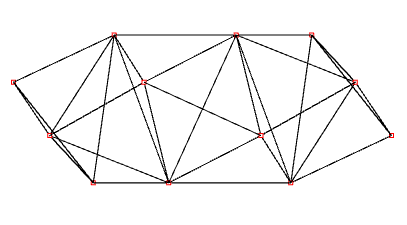
The following figure is the projection of annoviaivo 5 centered on the middle of equatorial edge.
See also
- Toroidal polyhedron
- Euler characteristic
- Spherical polyhedron
- Johnson solid – A set of convex polyhedra similar to the Stewart toroids
References
- B. M. Stewart, Adventures Among the Toroids (1970) ISBN 978-0-686-11936-4
External links
- A study with sagemath of these polyhedra is visible here
- oviaivo : a vision of Universe
- moroplogo's models