
Open Blue Sea Farms
Open Blue Sea Farms is a limited liability company incorporated in Delaware. Founded by Brian O'Hanlon, Open Blue Sea Farms is responding to the rapid global increase in demand for fish through development of deep sea aquaculture. By moving the aquaculture farms away from the shore, Open Blue is able to avoid many of the negative side effects associated with traditional aquaculture. Currently, Open Blue is focused solely on farming Cobia, but once the deep sea techniques are further developed, there is the desire to expand into the major global markets and bring the source closer to the demand.
Traditional aquaculture
Aquaculture is the farming of freshwater and saltwater organisms. It is the fastest growing segment of U.S. agriculture, and one of the fastest growing industries in the world.
Problems with traditional aquaculture
Aquaculture was seen as a way to create an endless supply of marketable fish, but massive growth in the demand for fish over the last decade has created unexpected problems. Marine species like salmon and are often grown in cages submerged in shallow, calm waters near shore. This protects the fish from the weather and makes the cages easily accessible for feeding and maintenance. Farmed fish often eat smaller fish that are ground up into meal; some of this food falls to the bottom of the pens and combines with fish excrement to suck oxygen out of the water, creating polluted dead zones. The cages have to be moved frequently in an attempt to keep the water clean and the fish healthy.
However, to meet the increased demand, an excessive number of fish are kept in the same cage. Raising fish in such close proximity contributes to the spread of disease, which the farmers attempt to PReVENT through the use of steroids. Because of the cage's close proximity to land and the use of antibiotics, fish often come to market with higher levels of antibiotics and pesticides that are recommended for human consumption.
Open water farming
By using innovative, deep ocean aquaculture, or "free-range fish farming" technology, Open Blue Sea Farms has been able to move fish farming far out into the open sea. Open Blue anchors its cages in deep water with strong currents. Deep water aquaculture promises cleaner and healthier techniques. Each pen contains 10,000 cobia, but the currents carry 500 million gallons of water through the pens each day. This washes away any sewage or excess food. Open ocean water keeps the fish free from methylmercury and other coastal contaminants, and the fish take on the flavor of the salt water. Open Blue raises its fish without hormones or the prophylactic use of antibiotics and other contaminants, such steroids and anti-parasitic agents. Open Blue compares its deep water fish farms to free-range beef, poultry and eggs as it provides a more humane and natural growing environment for the fish all while avoiding stakeholder impact. Open Blue only cultivates fish native to the environment. The fish are given plenty of room in very large, stress-free, deep water, open ocean net pens and submersible spheres. They are not crowded at high densities in small cages, tanks or ponds. This translates into guilt free, high quality, safe, healthy and sustainably cultivated seafood.
The open ocean technique also limits the environmental impact. The cages are away from the shoreline commonly used by traditional aquaculture which ensures the waste products do not disrupt sensitive coral ecosystems. Open Blue purposely avoids areas commonly used for artisanal fishing, recreation, conservation and navigation.
Increased consumption
The global demand for fish is expanding at an exorbitant rate. Since the 1960's the demand for fish has been climbing 3.6% per year (twice the growth rate of the American population). In 1970, humans grew 1.5 pounds of fish per capita, by 2006 it had increased to 17 pounds. Aquaculture now supplies 43% of the world's fish. Seafood demand in the United States is expected to double in the next decade and a half. The world market is growing even faster. The Food and Agriculture Organization of the United Nations predicts that by 2030, fish farmers will have to produce 40 million more tons of seafood just to maintain current consumption levels. With over 75% of world fish stocks fully or over-exploited, the global population is depleting the fish and other marine life that it eats faster than their populations can replenish. The demand for seafood is expected to soar in the coming decade. Seafood is the healthiest form of protein for humans and the most efficient form of protein production for the planet. As wild fish supplies began to plateau three decades ago, aquaculture grew to match rising demand. Today, aquaculture supplies almost 50% of the world’s seafood, but current forms of aquaculture are inadequate to match growing demand. In many parts of the world, suitable traditional farm sites are becoming more difficult to find and are increasingly competing with other stakeholders for resources. Ponds use valuable land and fresh water in sensitive estuarine ecosystems and raise fish in sub par conditions. Near shore net pens crowd fish in low energy environments close to shore leading to environmental impact and elevated disease risk. Recirculation systems are not practical to scale with rapidly growing market demand and at times require fish to be stocked at inhumane densities to be economically viable. The demand driven market for white fish is growing just as fast, but white fish supplies have been the hardest hit in the past few decades. Fish such as halibut, cod, Chilean sea bass, grouper and snapper have been some of the most sought after and yet the supplies remain unstable. Recent introductions of new farm raised fish such as tilapia, have demonstrated how new white fish products with effective marketing and distribution have gained rapid consumer acceptance.
Traditional forms of aquaculture are not adequate to meet future demand. Open Blue intends to exploit the potential embodied in the open ocean through the use of deep sea aquaculture.
Business model
Currently, Open Blue is focusing its operations in the waters off the coast of Panama. It moved operations to Panama in October 2009 after securing permits and leases to stock open ocean cages and land for its shore-based facilities. The move to Panama was facilitated by Open Blue's acquisition of Pristine Oceans, a Panamanian company, in 2009. The goal of the acquisition was to combine Pristine Oceans' substantial ground operations with Open Blue's [...] edge open-ocean production team. This acquisition created the most experienced aquaculture company in the region. Open Blue is structured as a vertically integrated business model. The Open Blue team will raise the cobia from hatchery and ocean growout through harvesting and processing operations. Open Blue currently has 50,000 fish in the water and another 200,000 going in the water over the next 12 months. The team also plans to engage in Company-driven brand marketing and sales. The goal of the corporation is to create value, control quality, and maintain full traceability through every step of the egg to plate cycle. Complete control over the egg to plate cycle has yielded success. In 2007, Open Blue cultivated and sold 50 tons of cobia to upscale, gourmet U.S. seafood restaurants, distributors and brokers. Open Blue's long term goal is to expand into other markets. The company's business model is scalable and portable. As the business matures, the plan is to diversify into new species and new markets. Open Blue hopes to first perfect the technology in Panama, and then expand its operations closer to major modern and third world global markets. By farming closer to the demand centers, Open Blue will greatly reduce its energy needs for transportation to market.
Cobia
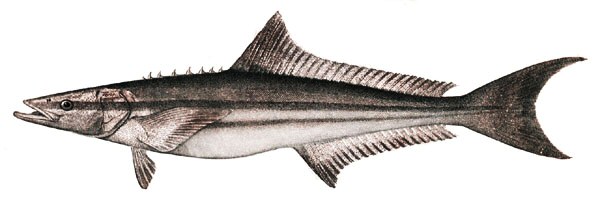
Open Blue has selected cobia, also known as black kingfish or black salmon, as its initial species. No targeted commercial fishery has ever developed this species before. Cobia is a very primitive species which makes it ideal for free-range fish farming. Cobia are unusual in the fact that they lack a swim bladder. Most fish specie have a small bladder of air internally that they can regulate to maintain neutral buoyancy. Without a swim bladder, Cobia are negatively buoyant, so if they stop swimming, they sink. In order to compensate for this, Cobia store more fat and omega-3 oils in their flesh. Specifically, Cobia has four attributes that are suited for a large scale aquaculture operation, making the fish a promising species for open ocean farming.