
North Queensland Soaring Centre
The [North Queensland Soaring Centre] began life back in the 1970's as the Burdekin Soaring Club based at Dalbeg and at one time was known as The Townsville Soaring Club. Over the years, the club has moved location and changed names. With a move from Woodstock to Ayr, Queensland some time ago, the name was changed to The North Queensland Soaring Centre. The club is now firmly established at Charters Towers Airport with a large hangar and many aircraft. NQSC is currently the only soaring club operating in North Queensland and consequently attracts members from as far north as Cairns.
Membership traditionally has been mostly from Townsville, but the move to Charters Towers attracted quite a few ACTIVE members from Charters Towers, such that a great portion of the membership resides in that city.
The club owns one 2-seater LET L-13 Blanik training aircraft and members own quite a fleet of aircraft, including two vintage gliders a Schneider ES-59 Arrow and a Shneider Long Wing Kookaburra ES52, built in Australia in the 1950's and 1960's. Other aircraft include a Schempp-Hirth Standard Cirrus a Glasflügel 206 Hornet , and two Blaniks.
See Gliding for a complete explanation of the sport.
North Queensland Soaring Centre Images
Vintage glider VH-GNK over Charters Towers. |
Student Pilot with Instructor |
Climbing in an Invisible Thermal |
Launching Gliders
The NQSC launches gliders via winch-launching. This type of launch utilises a very thin (3.5mm) cable of high tensile strength and great length (about 2 km). The cable is attached at one end to a high powered winch, driven in this case, by a V8 engine. The other end is attached to a belly hook under the belly of the glider. with this method, gliders can be launched to about 2000ft in 30 seconds. Winch launching is a very inexpensive method of launching compared to aerotow.
Learning to glide
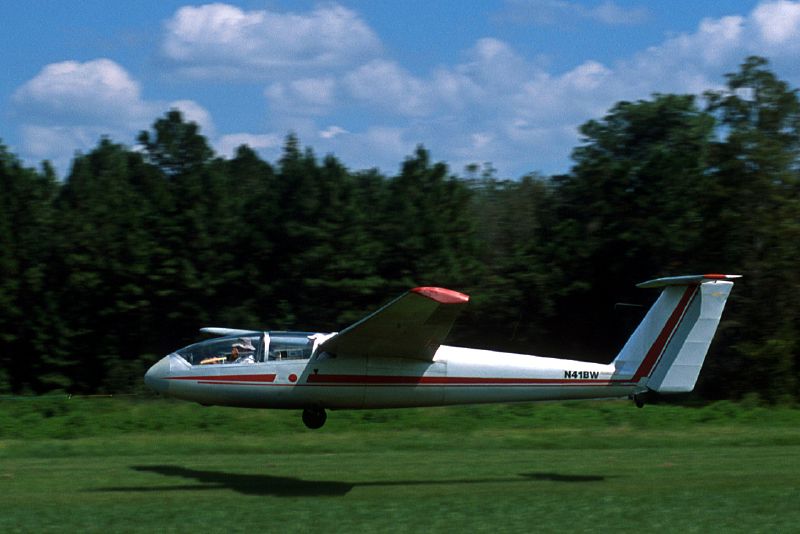 The NQSC offer trial lessons to people interested in learning to glide. Because most gliders are designed to the same specifications of safety, the upper weight limit for pilots, is usually 105-110 kg .People over 193cm (6’ 4’’) will also have problems. The student flies with an instructor in a two-seat glider fitted with dual controls. The instructor performs the first launches and landings, typically from the back seat, as the the student gains skill he or she manages more and more of the controls. It may take ab initios at least 50 training flights before they are deemed to have the skill and the airmanship necessary to fly solo.
The NQSC uses winches to launch gliders. This can mean that the cost of learning to glide is much less than that of learning to fly powered aircraft. Training using aerotow costs more than using winches, though fewer launches (as few as 30) might be needed.
After the first solo flight, further training with an instructor continues until the student is capable of taking a glider cross-country.
In Charters Towers cross country flying requires a high degree of skill, an intimate knowledge of the countryside, and excellent preparation.
External links
- North Queensland Soaring Centre at Charters Towers
- Charters Towers City Council - Official Website
|-