
Nile exploration by Roman emperor Nero
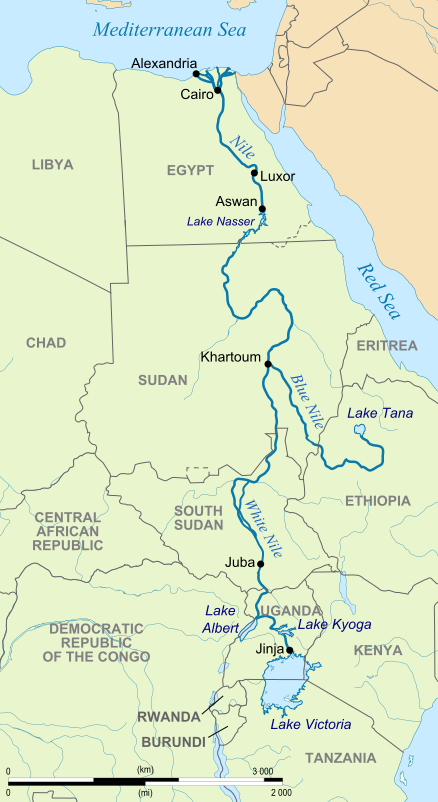 Nile exploration by Roman emperor Nero was a Roman expedition done around 61 AD, that wanted to reach the sources of the Nile river.
History
Emperor Nero around 61 AD sent a small group of praetorian guards to explore the sources of the Nile river in Africa. He did this in order to obtain information for a possible conquest of Ethiopia, as was called equatorial Africa by the Romans.
The Roman legionaries -navigating the Nile- from southern Egypt initially reached the city of Meroe and later moved to the Sudd, where they found huge difficulties to go further.
The small group of praetorian guards related -when back to Nero- that ‘We personally saw two rocks from which an immense quantity of water issued.’, according to Seneca. It is noteworthy to pinpoint that some historians -like Giovanni Vannini- argue that this place is the Murchison Falls in northern Uganda, meaning that the Romans reached equatorial Africa. The Nero expedition from Roman Egypt reached the area of Jinja in Uganda, according to Vannini: he believes that the legionaries were able to reach lake Victoria, based on the description of their discovery of huge water falls. Vannini noted that in the Seneca interview to the legionaries, they described a Nile falls that is very similar to the Murchison Falls.
Seneca wrote a book, De Nubibus in "Naturales Quaestiones", that gave details about a Nero expedition to the «caput mundi investigandum» (to explore the top of the world) in 61/62 AD. In this book he explained to have reported what two legionaries told him about their discovery of the «caput Nili» (the origin of the Nile river): «Ibi Vidimus duas Petras, ex quibus ingens vis fluminis excidebat…ex magno terrarum lacu ascendere…» (We saw two huge rocks, from which the power of the (Nile) river went out in a powerful way.....(The Nile river) comes from a very huge lake of the (african) lands).
Furthermore Seneca wrote that the legionaries told him that the water of the Nile river, that jumped through two huge rocks, was coming from a very big lake inside the African lands. This lake -according to Vannini and others- could only be the Victoria lake, the biggest African lake. And the only river that goes out from this huge lake is the White Nile (named "Victoria Nile" when exits the lake), that in Jinja (Uganda) goes north toward the "Murchison Falls".
Indeed "Murchison Falls" is a waterfall on the Nile, that breaks the Victoria Nile, which flows across northern Uganda from Lake Victoria to Lake Kyoga and then to the north end of Lake Albert in the western branch of the East African Rift. At the top of Murchison Falls, the Nile forces its way through a gap in the rocks, only 7 metres (23 ft) wide, and tumbles 43 metres (141 ft), then flows westward into Lake Albert.
The outlet of Lake Victoria sends around 300 cubic meters per second (11,000 ft³/s) of water over the falls, squeezed into a gorge less than ten metres (30 ft) wide: these falls are similar in shape to the ones described by the legionaries.
Vantini wrote in the magazine Nigrizia in 1996 that the legionaries did an explorative travel of more than 5,000 km from Meroe to Uganda: a remarkable achievement done using small boats in order to bypass the Sudd, a huge swamp full of dangerous Nile crocodiles.
Furthermore, another historian (David Braund) wrote in 2015 that probably Nero's expedition to the Nile's sources opened a new route toward the Indian Ocean, bypassing the dangers of piracy in the Red Sea area while allowing future Roman commerce toward India and Azania.
However the death of Nero prevented further explorations of the Nile as well as a possible Roman conquest south of their Roman Egypt.
See also
- Nero
- Sudd
- Murchison Falls
Bibliography
- Braund, David. ''Kings beyond the claustra. Nero’s Nubian Nile, India and the rubrum mare (Tacitus, Annals2.61) University of Exeter (UK), 2015 (1)
- Buckley Emma & Dinter Martin. A Companion to the Neronian Age. Publisher John Wiley & Sons. London, 2013 ISBN 1118316533
- Emberling, Geoff. Nubia: Ancient Kingdoms of Africa. Institute for the Study of the Ancient World. New York, 2011 ISBN 978-0-615-48102-9.
- Vantini, Giovanni. Nigrizia (article of 1996 edition); Comboniani editions. Roma, 1996 (2)