
Nanocore
NANOCORE is a 7th Framework Programme financed project. It was a two year EU FP7 project running from 2011 to 2013. It brought together 6 partners from research and development centres and small and medium enterprises from across the EU.

The overall objective of the project is to develop a novel, technology/procedure to modify an existing polymer foam core material by using modified nanoadditives in conjunction with synergistic non-toxic flame retardants, meeting the requirements of the SOLAS regulations and the European REACH legislation. The new foam also have enhanced stiffness, strength and toughness compared to existing materials for the same foam density due to the reinforcing effect of the chosen flame retardant system. A flow chart showing the various stages of the NANOCORE project is shown in the figure below.
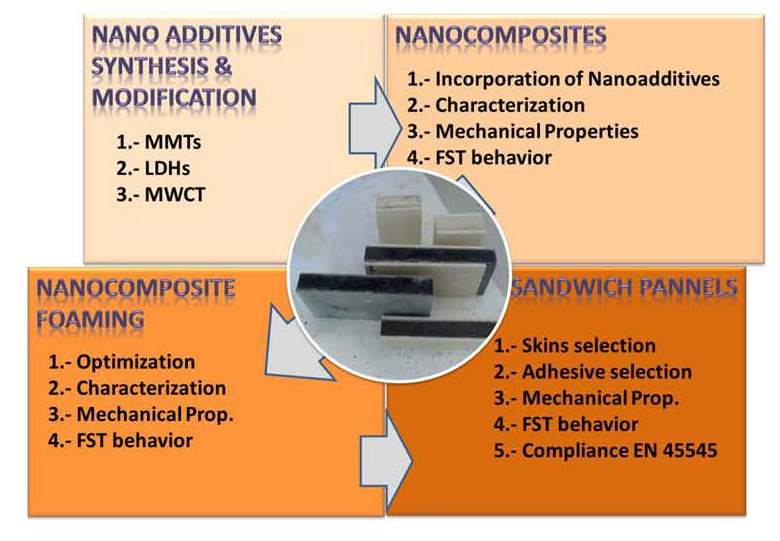
Its main scope is the development of a new and cost-effective production technology for sandwich structures foam cored materials, with non-toxic flame retardants and enhanced mechanical properties. The Primary reason for this new material development is to meet the current European requirements of the REACH legislation and achieve low fire, smoke and toxicity (FST) values, according to the International Convention for the Safety of Life at the Sea (SOLAS)regulation. Even the main objective is the application of this new technology to shipbuilding industry, it's not expected to be restricted to this specific end, as other end uses such as the ones in the building industry are also pursued.
Project summary
For a long time, the prescriptive rules of SOLAS regulations had excluded construction materials in commercial ferries and cruise ships other than "steel or equivalent", meaning that composite material could not be used in vessel construction parts such as superstructures, bulkheads, decks and deckhouses since they are combustible and release toxic fumes.
From 2002, a new rule in SOLAS allows construction with other materials than steel, since the can provide with same safety levels as if constructed according to the prescriptive rules for non-combustibility in steel. Further amendments were published in order to strengthen the fire protection arrangements of cabin balconies of passenger ships, entering into force on July 1, 2008. Fire safety has therefore been a central issue for the sector while developers of lightweight materials have been chasing the objective of improving fire resistance levels of composites compared to steel.
This new approach opens up the possibility of using lightweight composites materials for other marine applications than the military and those designed and operating under the High Speed Craft (HSC) Code, where composite materials have been used for more than 30 years in similar applications.
Most current flame retardant (FR) additive systems used in polymeric foams are not able to meet these new standards. Polymeric foam core materials for sandwich construction, used to produce lightweight and stiff structures will require a new generation of FR additive systems in order to allow them to reduce smoke toxicity ad enable fire resistance properties.
The NANOCORE consortium will, therefore, develop a new FR System for its use in PVC-based polymeric foams for sandwich core materials with low FST values and enhanced mechanical performance. Tasks needed to carry out these work were organized following the scheme below:

This new FR system will be based on a combination of nanoparticles modified with a phosphorous FR in order to provide a dual FR system which will have the following benefits:
- Reduce weight percentage of FR due to a reduction of phosphorous loss during processing and the efficiency of nanocomposites
- Enhanced foaming due to the action of nanocomposites as foam cell nucleation sites
- Increased foam mechanical properties due to nanocomposites reinforcement
- Achieving SOLAS regulations due to the combined FR functionality of composites and phosphorous-based FR
Members of the consortium
7TH Framework Programme requires a strong participation of small and medium sized enterprises (SME, and that they might come from at least 3 different countries. According to this specifications, members of the consortium, and their tasks on it are:
- Plásticos Karey S.A., a Spanish SME who works in the PVC compounding industry. Responsible for the compounding of surfaced treated nanocomposites with polymeric base that will be used to form the foam core material.
- Glonatech S.A., a Greek SME responsible for the supply of nanoparticles for the development of phosphorous-based surface treated nanocomposites.
- Acciona(Spain), acts as an RTD Performer that works on the development of the base PVC foam material. Also acts as the consortium coordinator.
- Instituto Tecnológico de Aragón (ITA) from Spain, acts as an RTD Performer which role is to develop the surface treatment of nanocomposites with phosphorous compounds.
- CGS (Italy), as experts in fire certification of materials will test the NANOCORE developed foam against current fire standards and seek certification for it.
- APM PAtrick et Murta, Portuguese SME specialized in polymer composites processing and application in the maritime market.
Scientific and technical objectives
The primary objective of this project is the development of a polymeric foam core material for its use in sandwich structures. The material to be developed will have to meet the fire, smoke and toxicity (FST) requirements of the current regulations, and also achieve improvements on specific mechanical properties such as strength and stiffness by at least 10%, through the secondary function of the FR additive acting as a particulate reinforcement. Also the introduction of this composite in ship building will help to lighten the weight of ferries, decreasing the consumption of fuel during their crossings.
The successful outcome of the NANOCORE project is dependent on achieving a set of scientific objectives to provide with the knowledge needed to develop the technology to meet the project´s goals. Specifically:
- The role of the surface chemistry of nanocomposites in determining their dispersion behaviour in thermoplastic polymers and establishing the required surface properties to prevent aggregation and agglomeration of nanoparticles
- The influence of surface modified nanoparticles on the foaming properties of thermoplastics
- The role of morphology in determining the flammability of nanocomposites containing polymers and polymer foams
- The synergistic flame retardant effects of combining organo phosphorous additives with nanoparticles in a thermoplastic foam polymer.
The specific technological objectives of project arising from the scientific objectives are:
- Development of nanoparticles with phosphorous-based compounds grafted onto the surface of the particles
- Development of a process where nanoparticles are dispersed in the polymer by mechanically mixing them into the molten polymer prior to foaming without affecting the ability to mould the polymer and where nanocomposite agglomeration is reduced to less than 5%
- Development of a PVC-based polymer containing modified nanoparticles which can be foamed using existing processing equipment; the viscosity of the PVC polymer containing nanoparticles prior to the foaming process won´t exceed a 10% of base polymer
- Development of a PVC-based foam incorporating less than 10% (w/w) of the developed nanocomposite particles with enhanced strength and stiffness at least 10% greater than the equivalent density of the unmodified foam
- Development of a PVC-based foam in which modified nanoparticles provide low FST values
The performance objectives for the production of NANOCORE new material are:
- The foam will be formed into the desired shape (even by extrusion or moulding)
- The production costs and end user costs have to be economically viable
- Repeatable product quality of ≤5% variation
- Reduction on energy consumption and CO2 emissions during foam production
Current status of the project
The first part of the project focused on the enhancement of scientific knowledge relevant to the developments that will take place during the rest of the work plan. In particular, scientific literature on the topic of surface modification of nanoparticles for its incorporation in polymer materials and current regulations and standards for the fire and mechanical procedures were reviewed.
In September 2013 NANOCORE project ended and all the ambitious objectives and milestones were successfully reached.
In order to reach these objectives, the consortium carried out important scientific improvements and innovations over existing PVC-based polymer foam core materials that involve:
- Improved compatibility of nanoparticles platelets with the polymer foam matrix.
- Improved distribution of phosphorous-based FR compounds within the foam.
- Reduce loss of phosphorous-based FR during processing.
- Lower weight percentage of FR in the foam.
- Refinement of the foam microstructure.
- Increased specific mechanical properties of the foam due to smaller cell size.
- Increased specific mechanical properties of the foam due to nanoparticles reinforcement.
- The improved thermal stability in polymer nanocomposites is due to the effect of nanoparticles platelets which hinder the diffusion of volatiles and assist the formation of char after thermal decomposition.
• Improved Fire Smoke and Toxicity properties due to synergistic effect of phosphorous-based FR materials and the FR properties of nanocomposites.*
- Flame retardancy and mechanical properties are both improved in clay-based polymer nanocomposites while the mechanical properties are always degraded in polymer composites with conventional flame retardants.
Now regarding NANOCORE foams:
- Fire-retardant properties were studied by means of cone calorimeter. The results obtained indicate that the observed enhanced FR performance of the NANOCORE foams with respect to neat PVC is mainly due to chemical and/or physical processes in the condensed phase instead of in the gas phase.
- Compared with PVC foams, the nanocomposite foams exhibit higher tensile modulus, improved fire retardance, and better barrier property. Combining PVC/nanoadditives and the extrusion foaming process provide a new technique for the design and control of cell structure in microcellular foams.
- Compared with PVC foams, the nanocomposite foams exhibit higher tensile modulus, improved fire retardance, and better barrier property. Combining PVC/nanoadditives and the extrusion foaming process provide a new technique for the design and control of cell structure in microcellular foams.
Finally obtained NANOCORE FOAMS fulfill the following requirements:
- The foam will be formed into the desired end shape by moulding.
- The production cost to be €25/kg and the end user cost €40/kg
- Repeatable product quality of < 5% variation
- Reduce energy consumption and CO2 emissions during foam production by 10%
Sectors that will benefit from the new sandwich material, which will be developed within Nanocore project, are transport, construction and in general structural material market. More specifically, any industry such as the shipbuilding industry where polymer sandwich core materials offer considerable advantages for its use in the construction of structural elements such as decks, bulkheads, etc.
The production of lighter components in turn will benefit the shipbuilding industry in two ways:
It would allow increased payload (by the full utilisation of double-deck capacity without exceeding load limits) and, secondly, by reducing the ship fuel costs (i.e. energy consumption). In fact, the Copenhagen climate change negotiations in December 2009 are likely to refocus attention on the energy performance of shipping, and in particular the greenhouse gases they emit. Industry acknowledges that technology to reduce emissions of such gases by up to one-third already exists, and so the European Commission will seek to get widespread commitment to schemes to introduce novel technologies and materials on new vessels and retro-fit them on vessels already in service. Very recently it has been showed that when two different hull concepts are compared (steels vs. composite) it was found that the CFRP sandwich version gave about 60% weight saving compared to the steel version. We expect to bring the technology developed during the project to market by the second year after the project completion date and we will begin licensing it to other manufacturers within the EU and internationally.
The results at Month 24 demonstrate the viability of the NANOCORE concept.
Project public website address: http://www.nanocore-project.eu/index.php
External links
- 1 International Convention for the Safety of Life at Sea (SOLAS) 1974
- 2 HSC Regulations 2004
- 3 REACH overview
- 4 Plasticos Karey
- 5 GLONATECH
- 6 ACCIONA
- 7 CGS
- 8 ITA