
N-day period
An “n-day period” is a period of n consecutive days, where n is some positive integer. For example, when n = 12, then it is a 12-day period. Appropriate calculation methods for finding the number of days when given the starting and ending date differ according to the case under consideration even if it is a familiar problem. In some cases, it may also be necessary to take into account such things as “business days”, “holidays,” etc. In cases where provisions stipulated by laws or judicial precedents need to be considered, multiple calculation methods may exist, and this situation may lead to lawsuits in some cases.
Calculating the number of days in arithmetic
The calculation method of "n-day period" is strongly related to the definition of “n days later” and “n days before”. So, we started this section from the introduction of the definition of “n days later” and “n days before”.
The definition of “n days later” and “n days before”

There are some different and unequal definitions for “n days later” and “n days before”. However, since calculation conventions for them are not the subject of this article, the following definitions are adopted for the purpose of this article.
Examples:
- “0 days later” and “0 days before”:
- Both 0 days later from Today and 0 days before from Today are Today.
- “n days later”, If the period does not extend to the next month:
- If your starting date is August 10, 2017, so that means that 3 days later would be August 13, 2017.
- The above value is the same as the value obtained by calculating "=DATE(2017,8,10)+3" using Excel.
- The date value is the same as the result of addition of day X and n-days (for example, day 10+3 days=day day 13).
- “n days before”, If the does not back to the previous month:
- If your ending date is August 7, 2017, so that means that 3 days before would be August 4, 2017.
- The above value is the same as the value obtained by calculating "=DATE(2017,8,13)-3" using Excel.
- The date value is the same as the result of addition of day-X and n-days (for example, day13 − 3 days = day 10).
Day count conventions in arithmetic
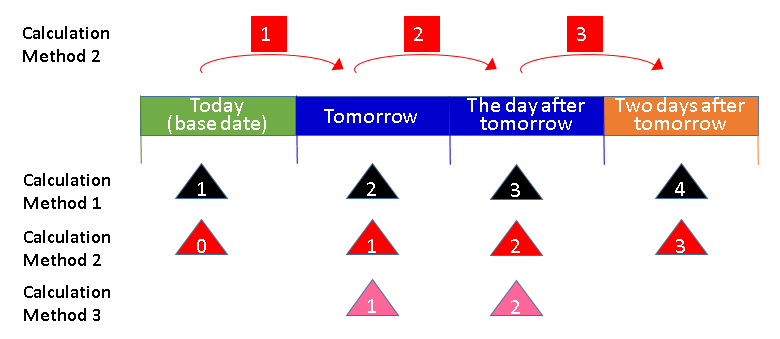
There are three primitive different and unequal methods of calculating the number of days between two specific dates as shown below. Even cases that require consideration of provisions by laws and judicial precedents will come down to the combination of the following primitive calculation methods and how to divide cases after all (though it may be concluded that multiple interpretations are possible.)
So, the relation of above-mentioned primitive methods is represented by following equation.
Extending calendar
Extending calendar is a virtual calendar using "extending the days of the month", that is dates after the number of the days of the next month to be counted is added to the number of the days of the months to be counted. It will be useful to calculate if the period extends long teams. The definitions of the "extending the days" are as follows. Extending calendar is familiarly known as "お化け日暦(Obake Hireki)" in Japan.
Following equations are satisfied.
Examples:
- (1).What is "August 32, 2017" in normal calendar?
-
In this case, M(0)=8 ,D(0) = 32, and
- {|
|- | 8/32 th || = 9/ 32 − (31; number of days in August) th |- | ||= 9 /1 th. |}
-
- "August 32, 2017" in extended calendar is "September 1, 2017" in normal calendar.
- (2).What is the "September −1 th, 2017" in the normal calendar"
-
In this case, M(0)=9 ,D(0) = −1, and "9/−1 th" = "8/ −1 (31; number of days in August) th" = "8 /29 th", so,
- "September −1 th, 2017" in extended calendar is "August 29, 2017" in normal calendar.
- (3).What is the "August 85, 2017" in normal calendar?
-
In this case, M(0) = 8, D(0) = 85, and
- {|
|- | 8/85 th || = 9/ 85th − (31; number of days in August)th |- | ||= 9 /54 th |- | ||= 10 /54 th − (30; number of days in September) |- | ||= 10 /24 th . |}
-
- Therefore, "August 85, 2017" in extended calendar is "October 24, 2017" in normal calendar.
- (4). What is "October −51, 2017" in normal calendar?
-
In this case, M(0) = 10, D(0) = −51, and
- {|
|- | 10/−51 th || = 9 / 9/ −51 +(30; number of days in September) th th |- | ||=9 /−21 th |- | ||= 8 /−21 + (31; number of days in August) th" |- | ||= 8 / 24 th. |}
-
- Therfore, "October −51, 2017" in extended calendar is "August 10, 2017" in normal calendar.
Advanced examples
In this section, we exemplify describe the calculation method, when the start date and the end date belong to different months.
Calculations of “n days later” and “n days before;
- (1).If your starting date is August 30, 2017, so that means that 3 days later would be September 2, 2017.
- The above value is the same as the value obtained by calculating "=DATE(2017,8,30)+3" using Excel.
- By using "extending the days of the month",
-
- Answer = "August 30 + 3, 2017" = "September 33 − (total number of days in September), 2017" = "September 2, 2017"
- (2).If your starting date is September 2, 2017, so that means that 3 days before would be August 30, 2017.
- The above value is the same as the value obtained by calculating "=DATE(20179,2)-3" using Excel.
- By using "extending the days of the month",
-
- Answer = "September 2–3, 2017" = "August −1 + (total number of days in August), 2017" = "August 31, 2017"
- (3).If your starting date is August 10, 2017, so that means that 75 days later would be October 24, 2017.
- The above value is the same as the value obtained by calculating "=DATE(2017,8,10)+75" using Excel.
- By using "extending the days of the month", 75 days later would be calculated by following steps.
::*Step 1: What "75 days later" is the date in August?
-
- →Answer = "August 10+75, 2017" = "August 85, 2017".
- (4)..If your ending date is October 24, 2017, so that means that 75 days before would be August 10, 2017.
- The above value is the same as the value obtained by calculating "=DATE(2017,10,24)-75" using Excel.
- By using “extending the days of the month", 75 days before would be calculated by following steps.
::*Step 1: What the "75 days before " is the date in October?
-
- →Answer = "October 24 − 75, 2017" = "October −51, 2017".
Calculations of numbers of dates between sstarting day and a specific date ending day. ;
- (1).If your starting date is August 30, 2017 and, ending date is September 2, 2017, so, the total number of days between above-mentioned date are 3 days in the [Calculation Method 2].
- The above value is the same as the value obtained by calculating "=DATE(2017,9,2)- DATE(2017,8,30)" using Excel.
- By using "extending the days of the month"(positive case),
-
- "September 2, 2017" =" August 33, 2017" therefore the answer is 33-30 =3 days.
- (2).If your starting date is August 10, 2017 and, ending date is October 24, 2017, so, the total number of days between above-mentioned date are 75 days in the [Calculation Method 2].
- The above value is the same as the value obtained by calculating "=DATE(2017,10,24)- DATE(2017,8,10)" using Excel.
- By using "extending the days of the month"(positive case),
-
- "October 24, 2017" = "August 85, 2017" therefore the answer is 85 − 10 = 75 days.