
Moretta–Cavallermaggiore Railway
The Moretta–Cavallermaggiore railway was a regional passenger railway line in operation from 1886 to 1959.
History
By law of 29 July 1879, the Airasca–Moretta–Cavallermaggiore line was included among the complementary railways to be built in Piedmont. It was initially classified as an "economic railway" and reclassified during the design phase as a second-category line, considering that it would "probably be operated with the rolling stock in use by the Administration of Upper Italy".
Construction was divided into the Airasca–Moretta and Moretta–Cavallermaggiore sections; the latter was put out to tender in January 1884. Work proceeded slowly, also due to some disputes between the municipalities involved, and was completed in May 1886.
Remaining almost unscathed by the events of the two world wars, but affected by low traffic due to the rural nature of the area crossed and the then unfavourable orientation towards the development of rail transport, the railway was closed to traffic on 14 September 1959, also requiring the termination at Bra of trains hauled by FS Class 640 locomotives, as Cavallermaggiore was not equipped with a turntable for turning them.
The line was definitively suppressed in 1961.
Characteristics
The line was standard gauge and non-electrified, predominantly flat with an average gradient of 1.9 per thousand. Its total length was 15.268 km.
Route
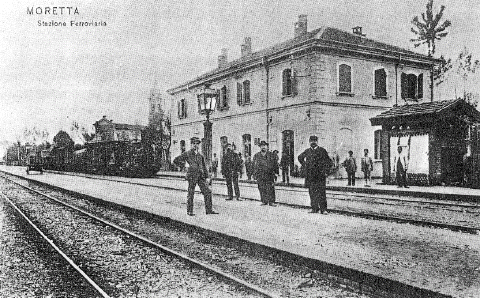
Along its route, it encountered Cavallerleone station and Murello halt, located a couple of kilometres from their respective town centres, and Villanova Solaro station (whose passenger buildings are now private residences). After crossing the Varaita stream on a three-span bridge – one of the two most important works of the short line, together with the previous one – it joined south of Moretta station with the Airasca–Saluzzo railway, near which the former Metalmeccanica Milanesio plant, specialised in railway vehicle repairs, is connected.
More than sixty years after closure, the trackbed has been almost completely dismantled to make way for cultivated fields and various buildings; the last remnants are the passenger buildings (converted into private homes), keeper's houses (many of which are in ruins), and various small bridges crossing irrigation ditches. The initial section in the built-up area of Moretta was used for the construction of a ring road.
See also
- List of tram and light rail transit systems
- History of rail transport in Italy
- Rete Mediterranea
- Airasca-Saluzzo railway line