
Mei Dajun
Mei Dajun (; September 14, 1908 – December 13, 1993) was a Chinese revolutionary, united front activist, and political figure. He participated successively in the Kuomintang, the Chinese Communist Party, and was among the early organizers of China's democratic parties. Mei played an important role in underground united front work during the Second Sino-Japanese War and the Chinese Civil War, and later served in senior administrative and consultative positions in Shanghai after the founding of the People's Republic of China.
Biography
Republic of China
Mei was born in Xuancheng, Anhui Province, in September 1908. At the age of fifteen, he enrolled in the affiliated secondary school of Soochow University in Suzhou, where he studied alongside fellow Anhui natives such as Zhao Puchu and Sun Qimeng. After graduating in 1932, he was recruited by Wu Zhongxin, then Chairman of the Anhui Provincial Government of the Kuomintang, to serve as his secretary. In 1933, Mei followed Wu to Guizhou after Wu's appointment as Chairman of the Guizhou Provincial Government, later serving as magistrate of Guiding County.
In 1934, Mei resigned from government office and turned to translating progressive works on political economy. Together with Zhao Puchu and others, he co-founded the Dazhong Publishing House, which secretly published revolutionary literature, including works by Zhu De, Marxist theoretical texts, and early collections of Mao Zedong’s writings. These publications played an important role in disseminating revolutionary thought in Nationalist-controlled areas.
In October 1939, Mei secretly joined the Chinese Communist Party and was assigned to conduct upper-level united front work in areas under Kuomintang rule. He organized financial assistance mechanisms for underground Communist members in Shanghai and worked to unite patriotic figures in the financial and industrial sectors. Later that year, amid intensified anti-Communist campaigns by the Nationalist government, Mei was dispatched to Langxi County under the direction of the Communist Party to conduct covert operations linking Communist forces in southern Anhui and southern Jiangsu.
Through Wu Zhongxin's recommendation, Mei was appointed County Magistrate of Langxi, using his official position as cover for underground activities. Prior to the New Fourth Army Incident in 1941, Mei successfully delayed and obstructed Nationalist arrest orders targeting local Communist cadres, enabling most of them to escape and thus preventing major losses. After the incident, he helped organize the safe evacuation of surviving New Fourth Army units before returning to Shanghai in 1942 to continue united front work.
In 1945, Mei served as general manager of the underground Communist enterprise Dongfang United Trading Company in Shanghai, using his public business persona to support covert activities and assist underground Party members financially. Acting under Party instructions, he worked to unite intellectuals and patriotic democrats in Shanghai. On December 30, 1945, Mei participated in the founding of the China Association for Promoting Democracy in Shanghai and was one of the original signatories.
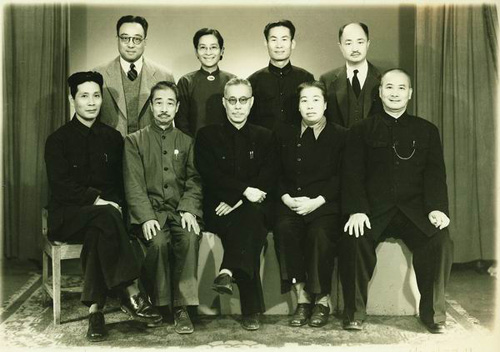 Following the establishment of the organization, Mei served in various leadership roles within the association, including director of the Liaison Department and member of its governing bodies. He also played a key role in the establishment of the Shanghai Federation of People's Organizations in 1946, serving as a director and later as secretary-general. In 1947, he traveled to Hong Kong under commercial cover to assist in the safe transfer of democratic leaders such as Ma Xulun, Wang Shao'ao, and Xu Guangping.
People's Republic of China
In February 1949, Mei returned to Shanghai to assist in preparations for the city's liberation. After the founding of the People's Republic of China, he served as deputy director of the Liaison Office of the Shanghai Military Control Commission and deputy director of the General Office of the Shanghai Municipal People's Government. In September 1949, he attended the First Plenary Session of the Chinese People's Political Consultative Conference as a representative of the China Association for Promoting Democracy, and on October 1 witnessed the founding ceremony of the People's Republic of China at Tiananmen Square.
In 1954, Mei was appointed Counselor at the Chinese Embassy in the Soviet Union. The following year, he was recalled to China for investigation in connection with the Pan Hannian case, although he was later cleared of all involvement. Despite this, his career was adversely affected. From 1956 onward, he served as deputy director of the Shanghai Ethnic Affairs Commission and later as Vice President of the Shanghai College of Finance and Economics.
During the Cultural Revolution, Mei was persecuted and subjected to political campaigns, forced labor, and investigation. He was rehabilitated in 1978 and subsequently served as an advisor to China Textile University until his retirement in 1984. Mei died on December 13, 1993.