
Maximum reported B-17 & B-24 bomb loads
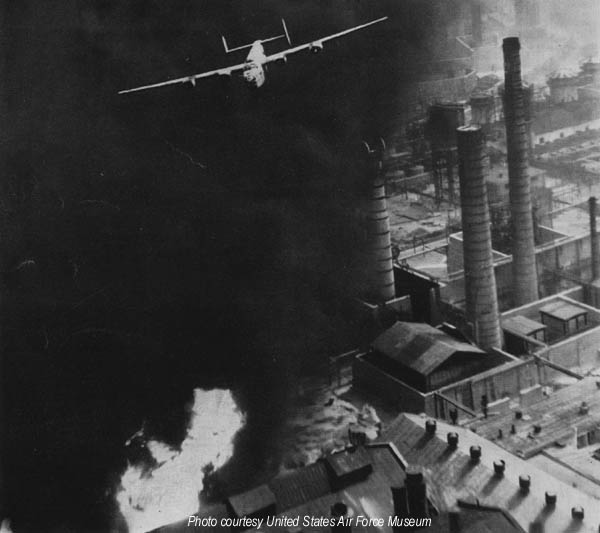 Maximum reported B-17 & B-24 bomb loads is a summary of compiled data from published mission reports of the United States Air Force in Europe during World War II of the heaviest bomb loads carried by the B-17 Flying Fortress and B-24 Liberator as well as the weight of bombs each carried to their most distant targets. The purpose is to tie information of the relative effectiveness of the two bombers to real data and actual practice.
B-17 design considerations
The B-17 had the reputation of being the steadier platform, better for flying in formation. This was an advantage where tight box formations provided the 8th Air Force its best defense early in the war against German fighter planes. The plane carried 13 machine guns compared to the B-24’s ten, and it had a reputation of being very rugged. A greater weight of bombs could be carried (B-17G: 17,600 lb) than was practicable.
B-24 design considerations
The B-24 wing provided the same lift as the B-17's but with less drag so it went faster under the same power and therefore farther with the same amount of fuel. This advantage was accomplished using the airfoil developed by David R. Davis along with Fowler flaps which gave necessary lift upon landing without adding drag during normal flight. Another advantage was the flexibility provided by the B-24's two bomb bays, each the size of the B-17’s one.
Auxiliary bomb bay fuel tanks
Both planes could gain more range by carrying auxiliary bomb bay fuel tanks, but the B-17 paid a heavier penalty on the number of bombs that could then be carried. It could carry a 410 US gal tank on either side of the bomb bay with bombs on the other side. Or it could carry two such tanks and no bombs. Auxiliary fuel tanks of approximately 400 U.S. gal (1,500 L) each could be carried on either side of the B-24's forward bomb bay leaving both sides of the aft bomb bay for bombs. Both designs were limited by their Maximum Takeoff Weight and any extra fuel carried was at the expense of the bomb load because fuel weighs about 6 lb/U.S. gal (0.7 kg/L). Tanks in the wings of late-model versions of both planes carried a total of about 2,800 U.S. gal (11,000 L) weighing about 17,000 lb (7,700 kg).
Effect of Axis fighter opposition
The air defenses over the Continent were so effective that daylight raiders had to allocate much of an aircraft's weight-lifting capacity to defenses.
The empty weight of a B-24J includes 3,654 lb (1657 kg) for armament provisions. This presumably would include offensive armament provisions such as bomb racks, bomb hoist, and shackles, and defensive provisions such as the turrets: nose, top, ball and tail. The weight of armament in the B-17 by 1945, including armor plate and glass plus the turrets, was 2,766 lb. The weight breakdown for B-17Fs flying across the Atlantic in Operation Bolero included the following: Machine guns: 11ea .50 cal (12.7 mm), totaling 869 lb (79 lb each). Ammunition: .50 cal, 2,200 rounds totaling 660 lb (4.8 oz or 0.3 lb per round). The recommended number of rounds to be taken on the second Schweinfurt mission, 14 October 1943, was 6,800 rounds weighing approximately 2,040 lb (using the .3 lb per round from above). “Luscious Lady”, a B-17F, actually carried 14,000 rounds weighing 4,200 lb (again using the .3 lb per round from above).
Consequently, the heavy defensive provisions against German fighter planes weighed approximately: turrets and armor (2,766 lb) + 11 machine guns (870 lb) + 6,800 rounds of ammunition (2,040 lb) + four gunners (700 lb) = 6,376 lb total.
In the China Burma India (CBI) theater, one RAF commander stripped his B-24’s of what he considered excess weight (including all centerline guns) and carried 8,000 lb bomb loads at night to Bangkok, a round trip of over 2,100 miles, and 12,000 lb to Rangoon, a round trip of over 1,400 miles. (See chart on right below).
Method
To find data for this comparison, crew members’ first-hand mission reports posted to the web, and accounts reported in books written about daylight bombing in Europe in World War II, were searched for greater-than-average bomb loads and extra long range targets. These data were sorted to find the heaviest loads carried and the most distant targets bombed. 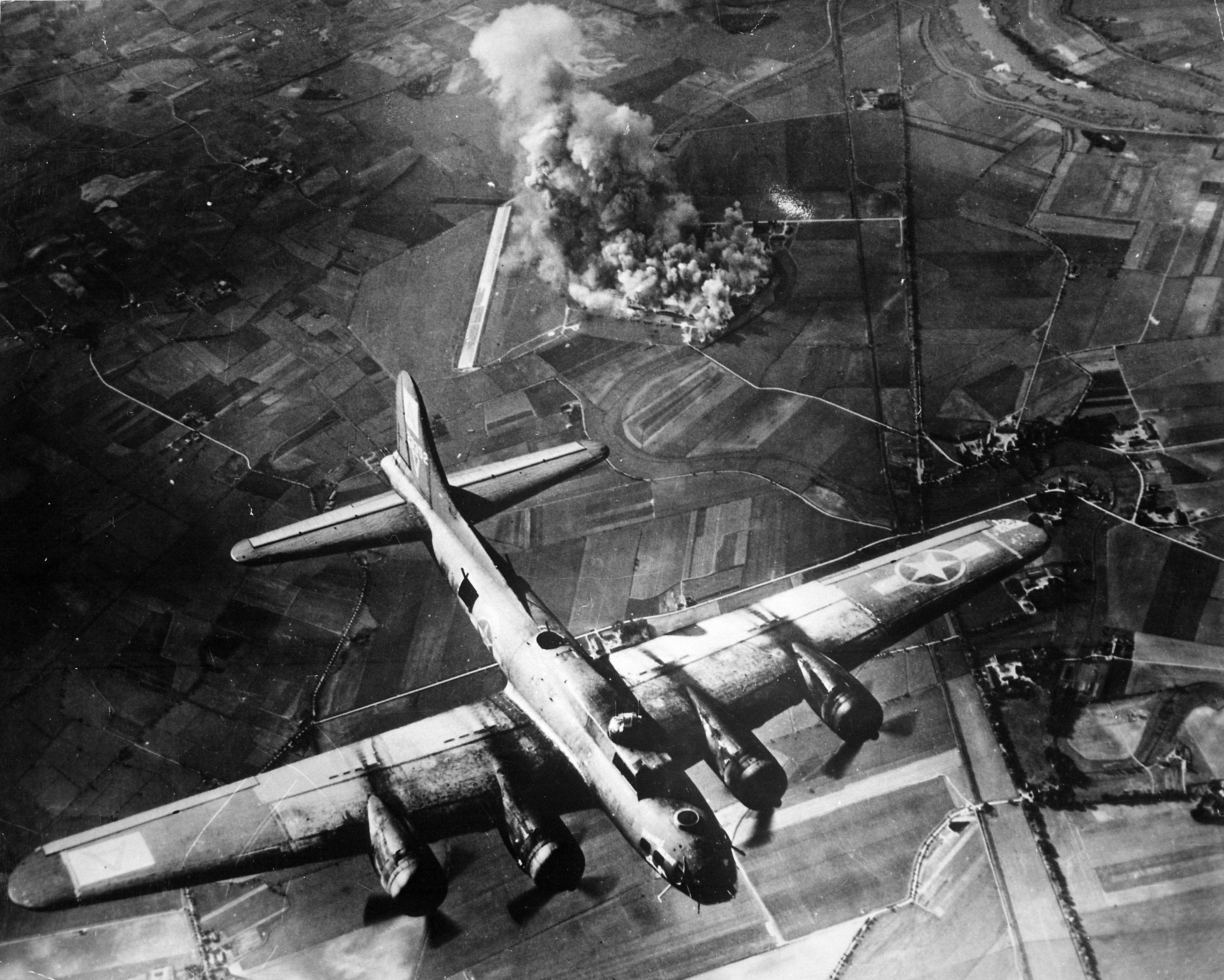
Boeing B-17 results
The heaviest bomb load carried by a B-17 was 8,000 lb and the farthest it was carried was to Nienburg, Germany.. The largest bomb load carried to its most distant target, Marienburg (now Malbork, Poland), was 4,540 lb. . These exceptional missions anchor the two ends of the maximum bomb-load line for the B-17. All other bomb loads carried by B-17s over the continent of Europe would lie below and to the left of the line. The average B-17 bomb load dropped in World War II was between 4,000 lb and 5,000 lb.
Consolidated B-24 results
The heaviest bomb load carried by a B-24 was also 8,000 lb and the farthest it was carried was to Karlsruhe. The largest bomb load carried to the most distant target, Ploieşti, Romania (flying from Benghazi) was 3,500 lb (Operation Tidal Wave). These anchor the ends of the maximum bomb-load line for the B-24. All other bomb loads carried by B-24s in Europe lie below and to the left of that line. In the 8th Air Force, the normal tactical bomb load of the B-24 was 5,000 lb.
Graphical comparison
The chart on the right below presents, for comparison purposes, the huge bomb loads carried at night by Royal Air Force Avro Lancasters over Europe, and B-24s in the CBI. The chart on the left graphs the results described above.
References
- Notes
- Bibliography
- Bowman, Martin W. Boeing B-17 Flying Fortress. Ramsbury, Marlborough, Wiltshire, United Kingdom: Crowood Press, 1998. ISBN 1-86126-170-5.
- Delve, Ken, Avro Lancaster. Ramsbury, Marlborough, Wiltshire, United Kingdom: Crowood Press, 1999. ISBN 1-86126-222-1.
- Dorr, Robert F. B-24 Liberator Units of the Eighth Air Force. Oxford, UK: Osprey Publishing Limited, 1999. ISBN 1-85532-901-8.
- Freeman, Roger A. The Mighty Eighth. London: Cassell & Co., 2000. ISBN 1-85409-531-5.
- Freeman, Roger A. The Mighty Eighth War Manual. London: Cassell & Co., 2001. ISBN 0-304-35846-0.
- Johnson, Frederick A. B-17 Flying Fortress: The Symbol of Second World War Air Power. New York: McGraw Hill, 2000. ISBN 0-07-134445-4.
- Johnson, Frederick A. B-24 Liberator: Rugged But Right. New York: McGraw Hill, 1999. ISBN 0-07-134448-9.
- Kuhl, George C. Wrong Place! Wrong Time! The 305th Bomb Group & the 2nd Schweinfurt Raid October 14 1943. Atglen, Pennsylvania: Schiffer Publishing, 1993. ISBN 0-88740-445-6.
- Mason, Francis K., The Avro Lancaster. Bourne End, Bucks, UK: Aston Publications Ltd, 1989. ISBN 0-946627-30-4.
- Middlebrook, Martin, The Schweinfurt-Regensburg Mission: American Raids on 17 August 1943. London: Cassell & Co., 2000. ISBN 0-304-35344-2.
- O’Neill, Brian D. Half A Wing, Three Engines And A Prayer. New York: McGraw-Hill, 1999. ISBN 0-07-134145-5.
- Redding, Robert and Yenne, Bill. Boeing Planemaker to the World. San Diego: Thunder Bay Press, 1983. ISBN 1-57145-045-9.
- Richards, Denis, The Hardest Victory. New York: W. W. Norton & Company, 1995. ISBN 0-393-03763-0.
- Salecker, Gene Eric. Fortress Against The Sun: The B-17 Flying Fortress in the Pacific. New York: Da Capo Press, 2001. ISBN 1-58097-049-4.