
Marsala (ship)
{|{{Infobox Ship Begin}}
{{Infobox Ship Image
|Ship image=
|Ship caption=
}}
{{Infobox Ship Characteristics
|Hide header=
|Header caption=
|Ship type=[[Liburnian]] "long ship"
|Ship displacement=
|Ship length=AbOUT 115 feet (35 meters)
|Ship beam=
|Ship draught=
|Ship draft=
|Ship propulsion=oared vessel <br />17 sweeps per side
|Ship speed=
|Ship range=
|Ship complement=
|Ship sensors=
|Ship EW=
|Ship armament=
|Ship armour=
|Ship armor=
|Ship aircraft=
|Ship aircraft facilities=
|Ship notes=
}}
|}
The '''Marsala Ship''' is the earliest warship known from [[archeological]] evidence.<ref> Anzovin, p. 275 item 4240 ''The first warship known from archeological evidence is the Marsala Ship, a wreck discovered in 1969 in the harbor of Marsala in western Sicily, Italy.''</ref> It is a wreck discovered in 1969 in an area called ''Punta Scario'' in the harbor of [[Marsala]] in western [[Sicily, Italy]], near the [[Aegadian Islands]].<ref name ="eurytos1"> {{cite web|url= http://www2.rgzm.de/navis/home/..%5CShips%5CShip056%5CNaveMarsalaEnglish.htm|title= The Marsala Punic Warship by Honor Frost|accessdate= 2008-09-07}}</ref> The Marsala Ship's "nationality" was painted on the sides with letters by its [[Punic]] builders from [[Carthage]]. <ref name ="frost1969"> {{cite web|url= http://www.saudiaramcoworld.com/issue/198606/the.punic.warship.htm|title= Saudi Aramco World magazine article -The Punic Warship|accessdate= 2008-09-07}}</ref>
==Ship==
Its architecture and contents show that it was not a merchant [[cargo ship]]. A merchant cargo ship made regular journeys and required large containers for storing water. It also needed [[Mill (grinding)|grinders]] and [[Mortar and pestle|mortars]] for dried food. It would normally carry large pots for communal cooking. It would also have fish-hooks for catching available Fresh fish.<ref name ="eurytos1"/>
[[Image:Liburna Rome BC31.jpg|thumb|left|Reconstruction of a Liburnian ship, as of ca. 31 BC]]
The Marsala Ship had only small cups and bowls for individual servings. Its wine, water, and other liquids were carried in [[amphorae]] of miscellaneous shapes. Food remains were fresh and perishable, such as various kinds of butchered meat. Bones of deer, horses, oxen, sheep, goats and pigs were all found. All this indicated it was intended as a warship and not as a merchant cargo vessel. The presence of [[ballast]] stones and lack of merchant cargo definitely indicate that it was a warship, probably used for scouting purposes or for ramming smaller boats. The remains of [...] stems — which may have been chewed by the oarsmen — were also found in the wreck.<ref name ="eurytos1"/>
It is believed to have been one of the [[Liburnian]] "long ships", an oared vessel with 17 sweeps per side used by ancient [[Carthage]] in the [[Battle of the Aegates Islands]] (241 BC).<ref name ="eurytos1"/> This was the last battle of the [[First Punic War]] between Carthage and the Roman Republic. [[Carbon-14]] tests on timbers and other materials determined a date of 235 BC.<ref name ="frost1969"/>
The vessel was determined to be approximately 115 feet (35 meters) long and 15.7 feet (4.8 meters) wide.<ref name ="frost1969"/>
==Excavation==
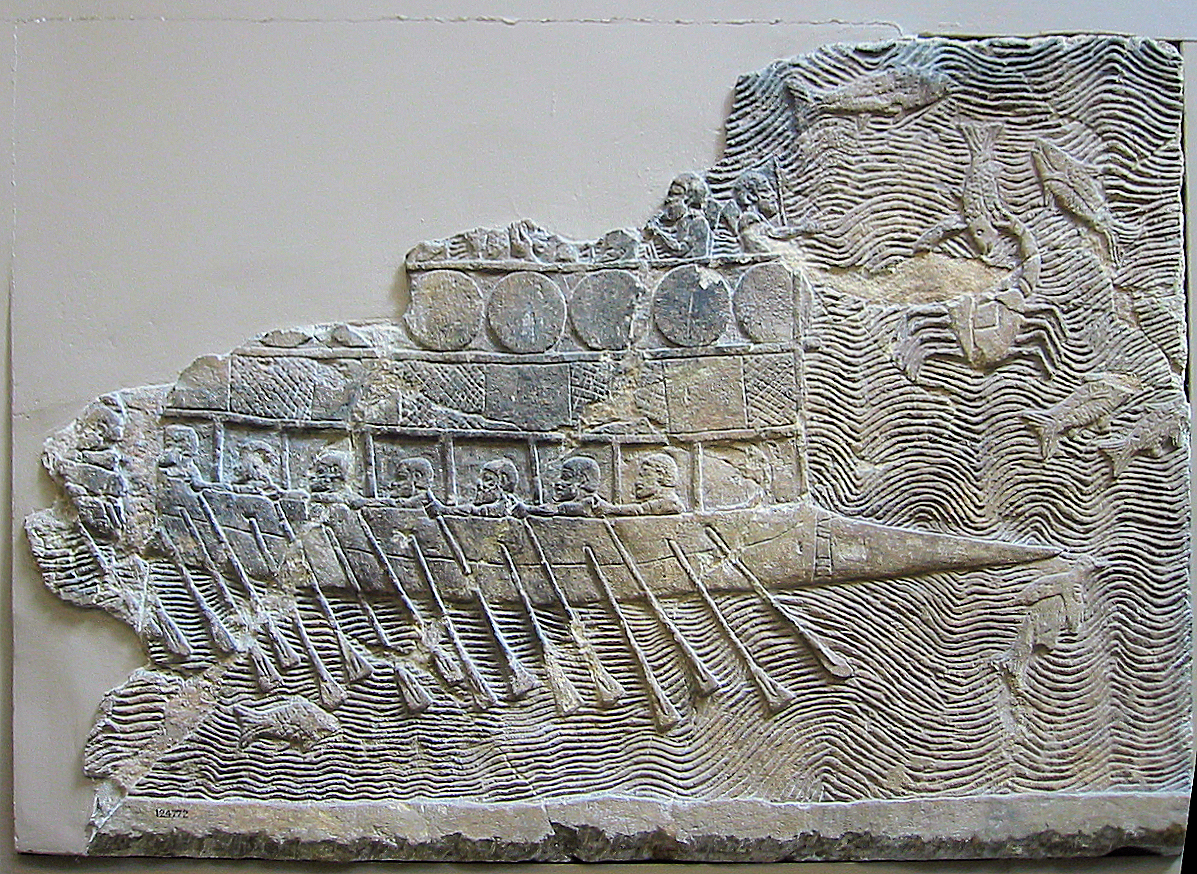
[[Image:AssyrianWarship.jpg|thumb|[[Phoenicia]]n warship, a [[bireme]] with pointed bow. 700 BC]]
It was in 1969 that a [[Captain (nautical)|captain]] of a commercial dredge digging sand for making glass discovered buried wood from ancient vessels in the area of ''Punta Scario''.<ref name ="eurytos1"/> In 1971 the movement of a [[sandbank]] exposed the "Punic Ship's" stern post with projecting timber.<ref name ="eurytos1"/> This endangered the [[shipwreck]], threatening the loss of the potential historical value of the information it revealed about the Phoenicians. Rescue excavation began in earnest and continued for the next four years.<ref name ="frost1969"/>
The Sicilian authorities and the [[British School at Rome]] appointed Honor Frost to direct the excavation. Frost and her international team of marine [[archeologist]]s excavated the site. Progress reports were published yearly in the ''International Journal of Nautical Archaeology'' (London and New York). When the field-work ended, a comprehensive report was published by the '[[Accademia Nazionale dei Lincei]] (Rome) as a Supplement to ''Notizie degli Scavi di Antichità,'' [...] (1976).<ref name ="eurytos1"/>
Some extremely rare finds amongst the shipwreck were a plaited basket, a piece of rope fashioned into a simple eye splice, a little brush, a knife blade, a spade, and a couple of toggles. Also found were parts of a human skeleton, possibly of a Carthaginian sailor trapped by the ship's ballast.<ref name ="frost1969"/>
==Notes==
{{reflist}}
==Bibliography==
*Anzovin, Steven et al., ''Famous First Facts International Edition'', H. W. Wilson Company (2000), ISBN 0-8242-0958-3
*Council for Nautical Archaeology (Great Britain) 1983, ''International Journal of Nautical Archaeology and Underwater Exploration'', Original at University of Michigan, Frost, Honor et al., 1981, ''Lilybaeum (Marsala) The Punic Ship: Final excavation report.''
*Delgado edition, ''Encyclopedia of Maritime and Underwater Archaeology'', Yale University Press (1998), ISBN 0-3000742-7-1
*Frost, Honor, ''How Carthage Lost the Sea: Off the Coast of Sicily, a Punic Warship Gives up its Secret,'' Natural History, December 1987; 58–67
*Paine, Lincoln P., ''Warships of the World to 1900'', Houghton Mifflin Books (2000), ISBN 0-3959841-4-9
*Research Reports — National Geographic Society 1973, page 261, pp. 151–166; also chapter 12 in 1981 report.
{{coord missing|Italy}}
[[Category:Shipwrecks]]
[[Category:Ancient shipwrecks]]
[[Category:Archaeology of shipwrecks]]
[[Category:Ships preserved in museums]]
[[Category:Treasure from shipwrecks]]
[[Category:Shipwrecks in Italy]]
[[Category:Shipwrecks in the Mediterranean]]