
Makhetha Mantsopa
The prophetess Makhetha Mantsopa, a renowned healer, rainmaker and diviner, was born around 1795, in a place called Likotsi or Ramakhetheng near present day Maseru. In 1851 she predicted that the BaSotho would triumph over colonial troops led by Major Warden.
Early life
Anna Mantsopa Makhetha was born in 1795. She was born Koena-li-Fule which translates to The crocodiles are feeding. Mantsopa was the daughter of Nkopane and Sesilone. As a child, she was taken captive for 6 months by an Nguni tribe called Amankowane. She managed to escape when some of her relatives came into the area for trading purposes. She lost her father to cannibalism during a time of famine for amaZulu and Basotho. She was to marry her cousin – Lekote – who was the son of Makhetha, but he died after paying Mahadi (also known as lobola). She then married Lekote’s older brother – Selatile – and became his sixth wife. They lived at Lekhalong-la-Bataung. She bore three daughters and one son: Ntsopa, Motsielehi, Ts’iu and Sesilane. It is customary in the Basotho culture for a mother to change her name after the birth of her first child by adding the prefix “Ma” to the name of the first child. This is how Koena-li-Fule became Mantsopa. It is however also believed that her name could have been derived from her pottery skills as Letsopa is clay. She also had great storytelling abilities, described as being remarkable in her power to hold people spellbound as she related what had appeared to her in dreams; she acquired an audience and was a great singer as well. The name of her first child was therefore derived from her talents.
Prophecies
In 1853, Mantsopa foretold the triumph over their old enemies – the Batlokwa under the leadership of Sekonyela; and in 1855, she predicted an extended period of peace and harmony for the Basotho. Before the Seqiti Wars of 1865, Mantsopa prophesied victory but this was not realised; and she alluded it to the failure of the troops to follow her guidance.
Mantsopa is also famous for foretelling the rinderpest epidemic after World War I, warning Africans against involvement. The sinking of the SS Mendi is also attributed to this warning. Her prophecies also included the coming of a motor car where she said that people will be travelling sitting down as well as the aeroplane where she said that birds would fly between the earth and the sky.
Conversion
Her role as an advisor to Moshoeshoe ended in 1868 when the British annexed Basotholand. That same year, she was baptised by a French missionary called Theophile Jousse and given the name Anna. Her move to Modderpoort happened when she joined Anglican missionaries not long after her baptism. Although she had been baptised as a Christian, Mantsopa continued to work with the spiritual world. She was stopped by missionaries from practicing this work as they deemed it black magic. This did not stop her from continuing to use herbs and have people come from far and wide to consult with her.
Death
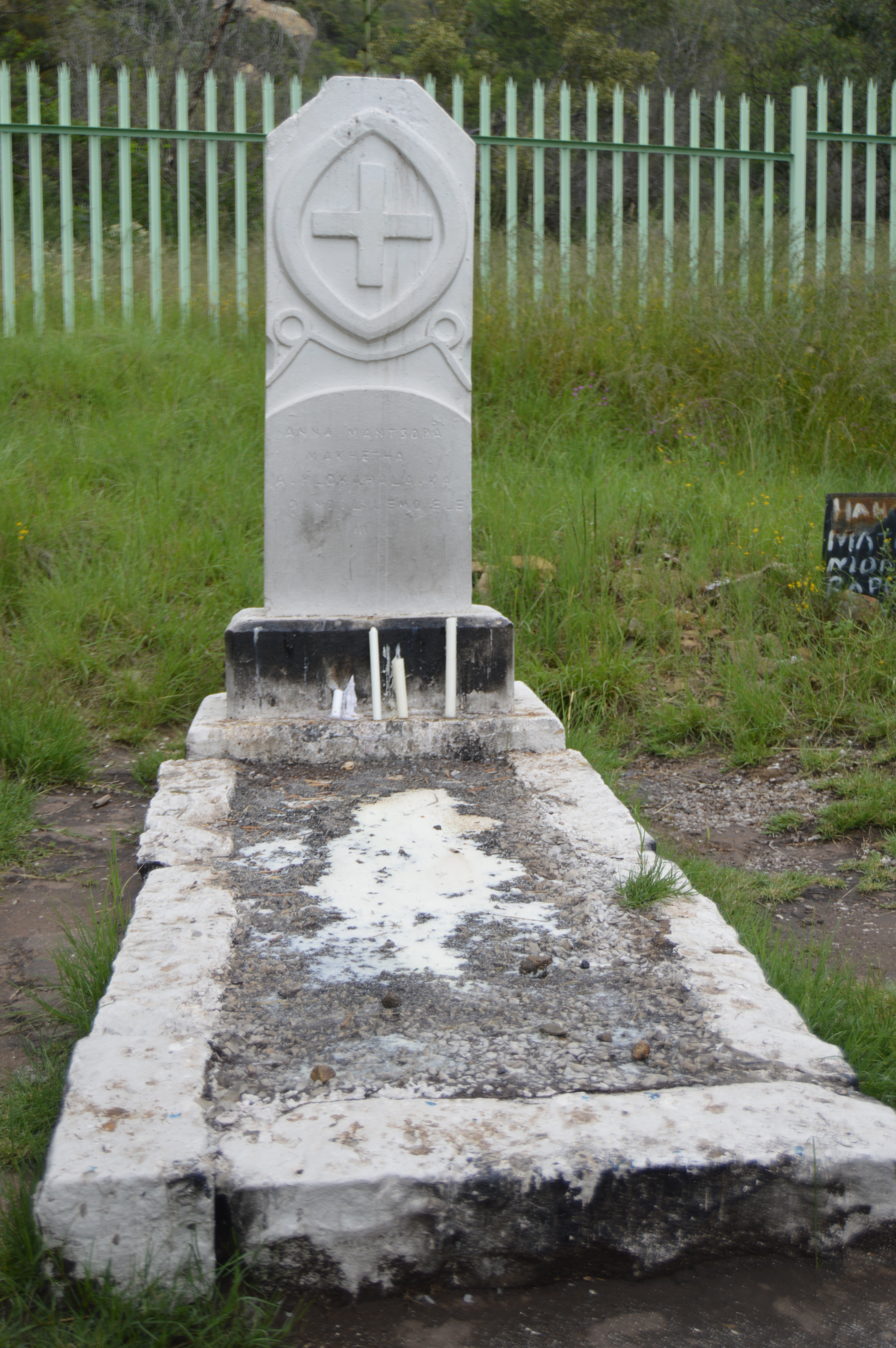 Mantsopa died at the age of 111. Her death was registered as 11 November 1906 in the burial records of the Bloemfontein Diocese of the Anglican Church which names Father Norton as having performed the funeral ceremony. She was buried with Christian rites in the Modderpoort cemetery, alongside the Brothers of the Society of St Augustine and the white residents of Modderpoort.
Legacy
At Modderpoort there are two sides strongly associated with Mantsopa’s legacy and are usually included in pilgrimage visits for either ritual performances or prayers. One is a freshwater spring, reputedly pointed out to Mantsopa as a source of ‘sacred’ water by her ancestors. The second one is the cave where Mantsopa prayed. The grave and cave have been declared as provincial heritage sites in the Free State by the Free State Provincial Heritage Resources Authority. To this day Pilgrims from all over Southern Africa, travel many miles to Modderpoort Mission to pay respects to the memory of their prophetess and to collect water from the sacred spring. The cave has become a pilgrimage chapel as homage to the local prophetess, Anna Mantsopa Makhetha.
External links
- http://wiredspace.wits.ac.za/bitstream/handle/10539/7953/Colman%20MA%20Modderpoort%20combined.pdf
- http://saintaugustines.co.za/wp/mantsopa-spring-water
- http://www.artefacts.co.za/main/Buildings/bldgframes.php?bldgid=7601
- http://www.heritagefreestate.co.za/
See also
- Modderpoort