
Majuli manuscript painting
Majuli manuscript painting is a traditional form of illustrated manuscript art originating in Majuli, a river island in the Indian state of Assam. Closely associated with the Neo-Vaishnavite cultural movement led by Srimanta Sankardeva, the art form involves painting religious narratives on handmade manuscripts, typically prepared from the bark of the Agarwood tree (Aquilaria malaccensis).
It represents a significant component of Assam's visual and literary heritage, combining calligraphy, illustration, and religious storytelling. In 2024, Majuli manuscript painting was granted Geographical Indication (GI) status, recognizing its cultural and historical importance.
History
The origins of manuscript painting in Majuli are linked to the Neo-Vaishnavite reform movement of the 15th–16th centuries led by Srimanta Sankardeva. He introduced illustrated manuscripts as a medium to disseminate religious teachings and devotional literature among the masses.
The art flourished within the Satras (Vaishnavite monasteries) of Majuli, where monks and artisans known as Khanikars created illustrated manuscripts depicting episodes from sacred texts such as the Bhagavata Purana. Over time, the Ahom rulers also patronised the art form, commissioning illustrated manuscripts to document religious and royal narratives.
Although manuscript painting traditions in Assam date back several centuries, the Majuli tradition became especially prominent due to its integration with Sattriya culture and devotional practices.
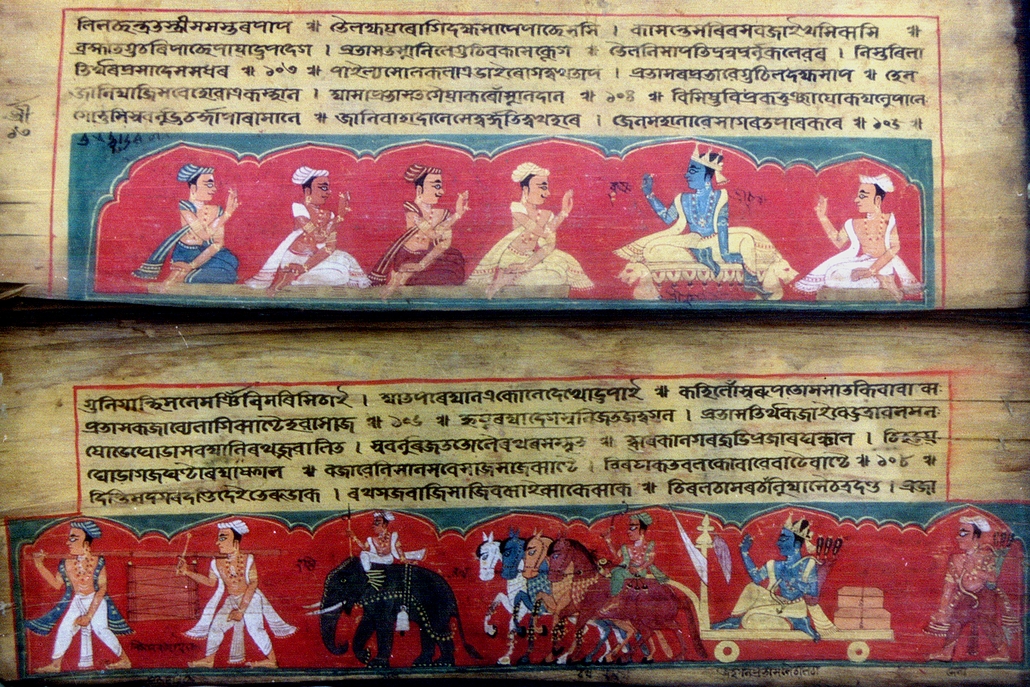
Materials and technique
Majuli manuscript paintings are traditionally created on Sanchipat, a writing surface made from the bark of the agarwood tree. The preparation of this material involves a labor-intensive process of drying, smoking, polishing, and smoothing to create a durable and moisture-resistant surface.
Artists employ natural pigments derived from minerals and plants, including Hengul (Vermilion) and Haital (yellow arsenic), along with soot-based ink. Bamboo pens and fine brushes are used to produce delicate lines and intricate details.
The manuscripts are often prepared using handmade paper treated with organic materials such as earth and cow dung to achieve a smooth painting surface.
Style and themes
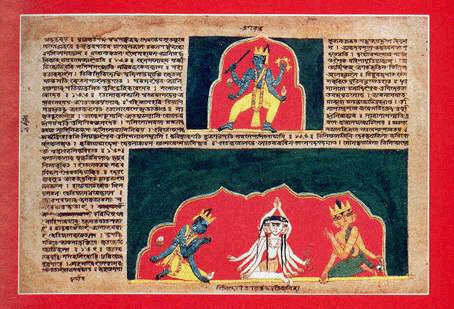
The style of Majuli manuscript painting is characterised by fine linear drawing, minimalistic compositions, and restrained use of colour. Many works are predominantly monochromatic, with occasional highlights in red, yellow, or blue.
Thematically, the paintings primarily depict episodes from Hindu religious texts, including the Ramayana, Mahabharata, and especially the Bhagavata Purana, with a strong emphasis on the life and legends of Krishna.
Figures are often stylised and expressive, reflecting influences from theatrical traditions such as Bhaona and Ankia Naat performances practiced in the satras.
See also
- Srimanta Sankardeva
- Majuli