
Magazin istoric pentru Dacia
Magazin istoric pentru Dacia (Romanian for "Historical Magazine for Dacia") was a Romanian historical journal founded in Bucharest in 1845 by August Treboniu Laurian and Nicolae Bălcescu. It has been described as the first Romanian periodical devoted exclusively to history.
The journal published chronicles, historical documents, inscriptions and historical studies, including several Wallachian and Moldavian chronicles that had previously circulated only in manuscript. Five volumes appeared in Bucharest between 1845 and 1848. Publication was interrupted by the Revolutions of 1848, in which both editors became involved. Laurian later attempted to continue the journal in Vienna.
History
Laurian and Bălcescu established Magazin istoric pentru Dacia as part of a broader effort to collect and publish sources relating to Romanian history. The journal followed earlier initiatives such as Mihail Kogălniceanu's Arhiva românească. In January 1845, Laurian wrote to George Bariț in Brașov about the planned publication and asked for his assistance in announcing and distributing it in Transylvania.
The first volume appeared in Bucharest on 1 July 1845. It opened with Bălcescu's Cuvânt preliminariu despre isvoarele istoriei românilor and Laurian's Discursu introductiv la istoria românilor, which presented the aims of the publication and discussed the study of Romanian history.
Bălcescu left for Paris in 1846, after which Laurian assumed most of the responsibility for editing the journal. In a letter to Vasile Alecsandri of 29 November 1847, Bălcescu referred to his inability to contribute regularly and sought additional material for the magazine.
The journal initially used the Romanian Cyrillic alphabet, while Laurian promoted the increasing use of the Latin script. He also sought to standardise spelling and terminology for readers in Wallachia, Moldavia and Transylvania.
Publication in Bucharest ceased during the revolutionary events of 1848. Laurian subsequently went to Vienna, where he continued collecting and publishing documents relating particularly to the Romanian movement in Transylvania during 1848–1849.
Editorial programme
The editors organised the journal's material into six principal sections:
- Cronicul românesc – Romanian chronicles and annals;
- Diplomaticul românesc – charters, decrees, treaties and other official documents;
- Memoratoriul dacian – references to Dacia and the Romanians in Greek, Latin, Byzantine and other historical sources;
- Inscriptoriul dacian – inscriptions and other epigraphic material;
- Disertatoriul istoric – studies of chronology, historical geography, ethnography and related subjects;
- Buletinul bibliografic și critic – notices and reviews of publications relating to Romanian history.
The journal combined the publication of primary sources with historical essays and editorial commentary.
Volumes
Volume I (1845)
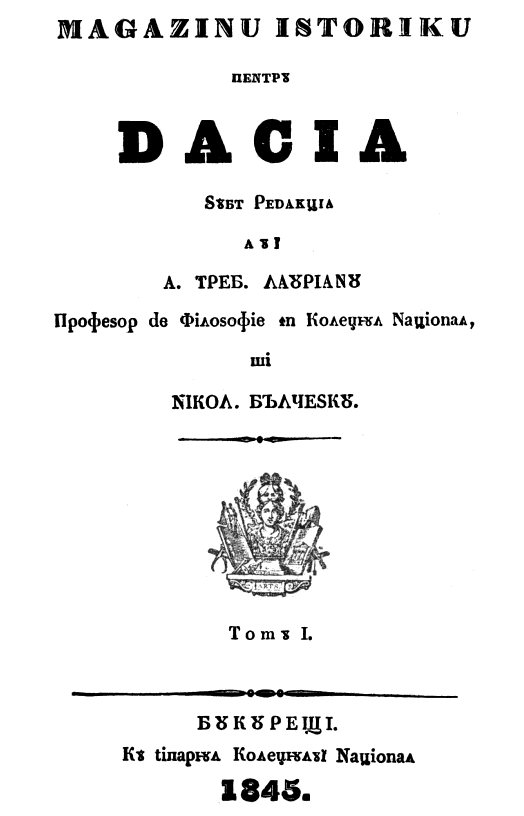
Volume I contained the introductory essays by Bălcescu and Laurian and a range of historical documents. Among them was a 1631 princely charter issued by Leon Tomșa, concerning measures taken against Greek office-holders in Wallachia.
The volume comprised approximately 410 pages.
Volume II (1846)
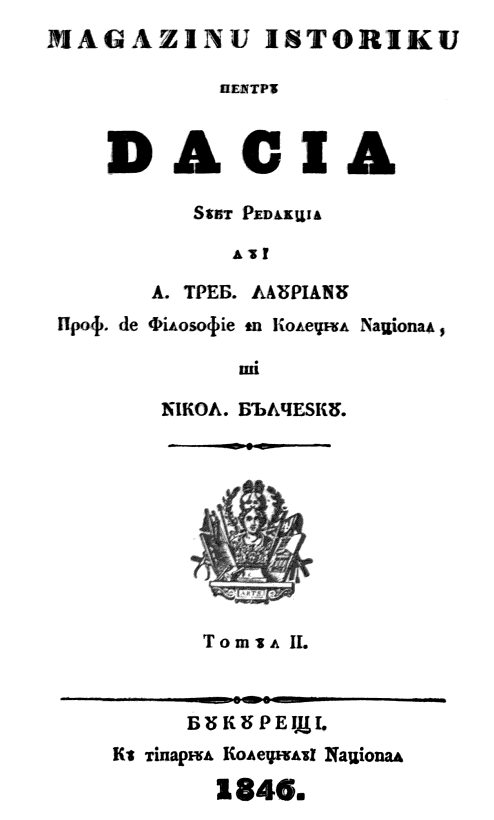
Volume II included the first printed edition of the chronicle of Radu Greceanu, concerning the reign of Constantin Brâncoveanu.
Bălcescu and Laurian worked from manuscript copies of Greceanu's text. According to Aurora Ilieș, Bălcescu compared manuscript versions when preparing the text for publication, although the resulting edition did not conform to later standards of critical editing.
The volume comprised approximately 386 pages.
Volumes III–V
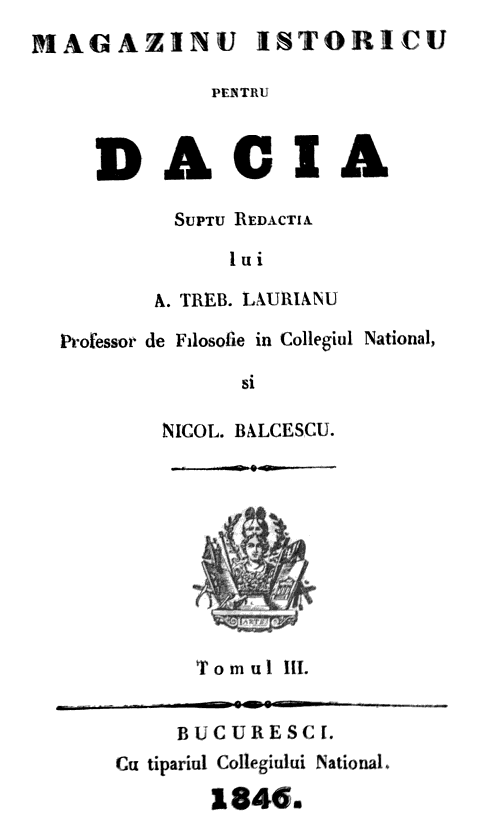
Volumes III–V continued the journal's publication of chronicles, documents, inscriptions and historical studies. Volume III appeared in 1846, Volume IV in 1847, and Volume V formed the final part of the journal's original Bucharest run.
The three volumes comprised approximately 382, 378 and 388 pages respectively.
The revolutionary events of 1848 interrupted further publication in Bucharest.
Vienna continuation
Laurian attempted to revive Magazin istoric pentru Dacia in Vienna after the revolutions of 1848. Evidence for this continuation was identified by Erhard Andree and Cornel I. Savu in a study published in 1967.
Volume VI
The publication history of Volume VI is uncertain. An announcement preserved with Volume VII stated that Volume VI was in press in Vienna in 1851. The planned volume concerned documents relating to the events of 1848–1849 in Transylvania.
Andree and Savu noted that the volume was absent from major contemporary and later bibliographies. The available evidence therefore confirms that Volume VI was prepared for publication, but does not clearly establish the extent to which it was printed or circulated.
Volume VII
A copy of the first fascicle of Volume VII was identified in 1966 in the library of an Orthodox church in Țichindeal, Transylvania. The fascicle was printed in Vienna in 1851 by the printing house of the widow of J. P. Sollinger.
Its contents consisted principally of petitions submitted by Transylvanian Romanian representatives to the imperial authorities in Vienna and to the Hungarian government during the revolutionary period, together with official responses.
Andree and Savu found that only a small proportion of these documents overlapped with other contemporary printed collections, making the surviving fascicle an additional source for the Romanian political activity of 1848–1849.
It is not known whether further fascicles of Volume VII were published.
Reception and legacy
Magazin istoric pentru Dacia played an early role in the systematic publication of sources for Romanian history. It brought medieval chronicles, archival documents and inscriptions into print and made material previously available principally in manuscripts accessible to a wider readership.
The journal was also associated with the development of Romanian national historiography during the decades preceding and following the Revolutions of 1848. Its title and editorial programme reflected the interest of Laurian and Bălcescu in the historical relationship between the Romanian-inhabited regions of Wallachia, Moldavia and Transylvania.
Nicolae Iorga later described Magazin istoric pentru Dacia as the first Romanian journal devoted exclusively to historical studies.
External links
- Magazin istoric pentru Dacia at Romanian Wikisource
- Volume I (1845) at Google Books
- Volume II (1846) at Google Books
- Volume III (1846) at Google Books
- Volume IV (1847) at Google Books
- Volume V at Google Books