
Lux Aeterna Theatre
Lux Aeterna Theater is a BLEND of art and entertainment with a unique self-created method. It is a theater of laser and sound, which presents new synthetic art forms for almost 40 years. Although the equipment Lux Aeterna Theater uses is meant for holographic ads, laser support of pop concerts and a variety of other shows, according to the founders of this method, their technique provides the ability to visualize the tone, harmony, tonality and nature of music, allowing to illustrate, emphasize and deepen the thematic development, and thus the whole dramaturgy of the performance.
Method
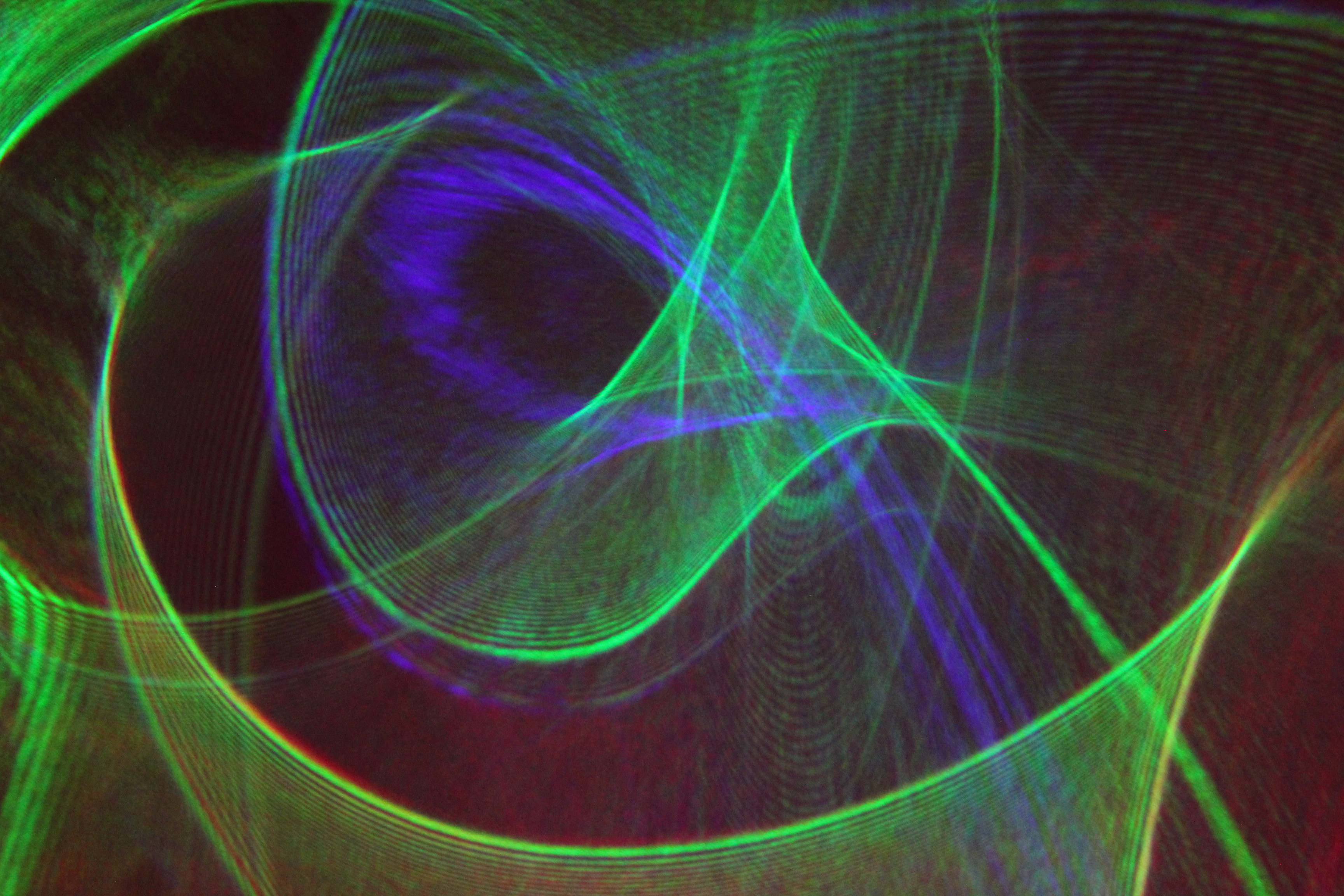
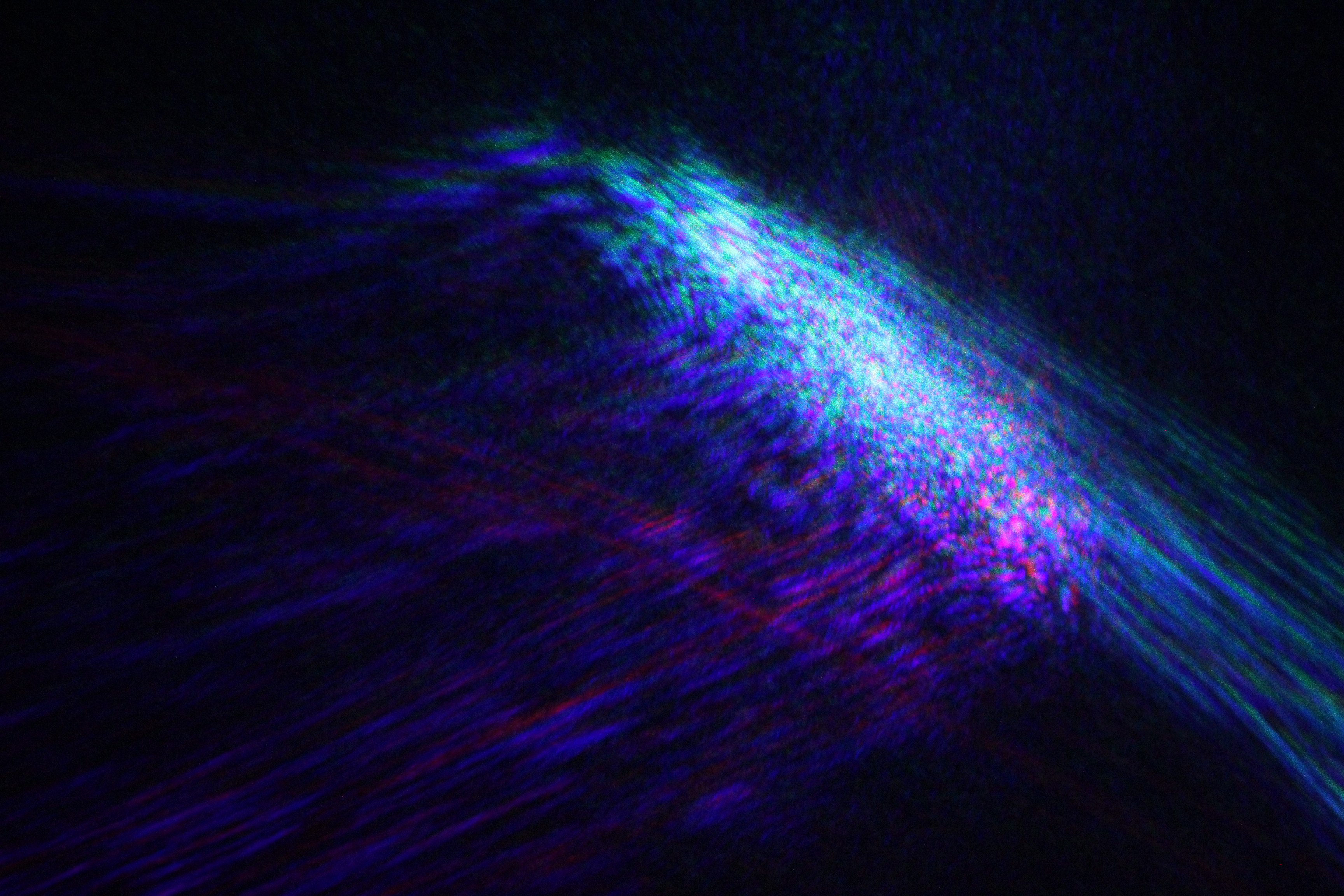
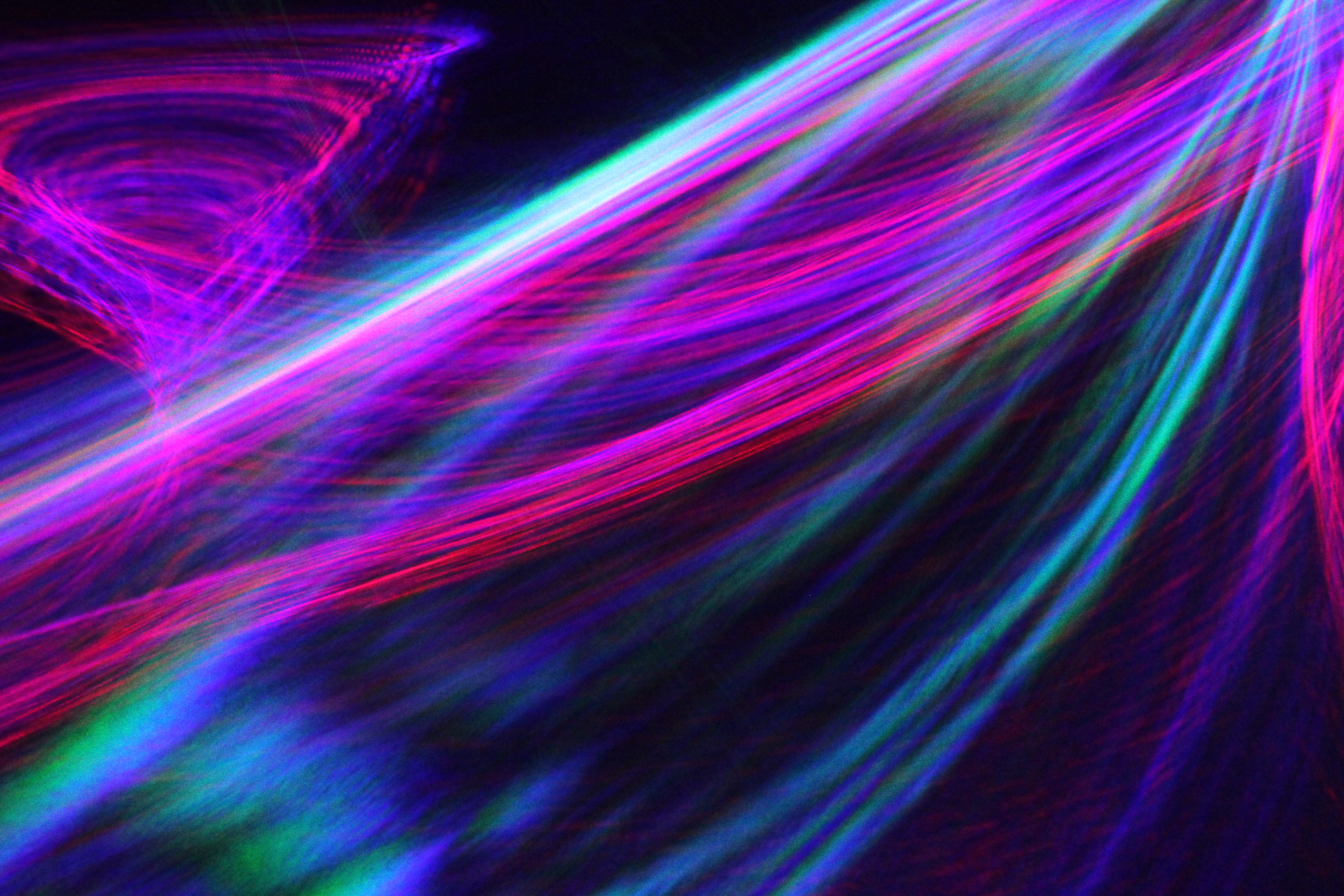
Lux Aeterna Theater has no stationary location and operates internationally; it can be easily assembled on various sites. The premises must include a projection surface (planetarium, dome hemisphere, panoramic projection screen, etc.), seats, and an optical pad behind the seats, projectors, and remote control. The optical pad is a metal plate with drilled holes in the grid and with threaded openings. The drives are positioning the optical elements into the beam or slow-acting control beam with a set of lines. Each line of the laser CREATES a separate image. The method, resulting in interference patterns on flat surfaces, is based on the use of accidental phase modulation, which occurs when a laser beam passing through optically heterogeneous mediums is refracted at different points and angles along its way, resulting in interference patterns projected on a screen that change in contour and texture with each change in medium. The medium is made of solid transparent matter (e.g. moving plates of non-uniform structure -usually round discs mounted in a revolving cassette. And as a result, a wide selection of visual character, image, shapes, effect appears on a screen. Or/and an additional lens is used to concentrate the light field. Or/and transfocators are mounted at the beam's point of exit. These form-building methods can be used in the same cassettes (to increase image possibilities) with diffraction gratings, curvilinear reflectors or a large moving lens (for the deformation of light imago). Lighting plot involves complex abstract light ductile movements. The projection tool allows receiving on-screen a very complex dynamics of light colorful shapes, to create a light accompaniment by colorful, graphic, structural visualization of thematic development, to unite music, MusicAL sounds, and musical noises with light content. It also allows the spatial separation and motion of different audio content, voices, melody and musical INSTRUMENTS.
History
Theater was founded in 1982 by Daniel Fridman, a professional theater lighting director and sound engineer, in Uzhhorod, Transcarpathia, former USSR and now territory of Ukraine. Under the roof of the local House of Culture, Lux Aeterna became an independent half state funded legal entity with Daniel Fridman as its first artistic director. The theater team consisted of Victor Schurov, chief designer and engineer, Vasiliy Makara, engineer, Ferenc Pejchy, lighting designer, Pavel Gladovskiy, engineer, Ihor Skalskiy, laser designer and engineer. The theater hall was divided into two parts. In one part there was a spectator room for 70 seats. In another - the so-called "light mine". The light mine is known to have a special space, the walls, the ceiling and the floor of which are painted to matte black color, so that there is not the slightest reflection of light as well as a set of light projection equipment. Various light, light-projecting devices, mirror surfaces of small and large formats, reflective films, a large set of glass and film color filters, transparent cuvettes with water, helium-neon and helium-cadmium lasers, an optical pad saturated with various optical elements and lenses of large sizes. With the help of these technical means, the theater's artists were able to create complex dynamic light images, shapes, characters on a special homemade projection screen made of film-tracing paper.
According to Daniel Fridman, the founder of the theater, the works of the Russian composer Alexander Scriabin, the art of Kazimir Malevich, the poetry of the early twentieth century poets were his sources of inspiration.
In the summer of 1985 Lux Aeterna Theater projected the rays of the most powerful at that time stage lasers (2,5 W krypton and 6,5 W argon) on the night clouds over the Moscow Dynamo stadium at the 12th World Festival of Youth and Students. This equipment had a couple of hundred kilograms of weight, a water cooling system with a bunch of inconveniences in tens of meters of hoses for supply and discharge of water. From 1987 The Light and Sound Theater operated in the Transcarpathian Regional Music and Drama Theater.
In 2003 the Lux Aeterna came to Kiev with a new concept to create a stationary light and sound theater under the cupola of the Kiev Planetarium. In Kiev Aleksandr Kasian, student physicist, and musician Yevhen Khalaf, joined their theater group. During 2003 to 2007 they premiered three acclaimed performances - Gravitation: Zero, Exhilaration of the Milky Ways and Night of the Longest Kiss. More than 600 séances were held during that period and the theater became one of the most visited sights in the city. Furthermore, Lux Aeterna introduced scent design to their performances, adding aromas and experimenting with affecting one more of the human senses - the sense of smell. In the beginning of June 2007 collaboration between Lux Aeterna and Theater of Voice (Duo Zikr band) called The Sound of Magic premiered at the Kiev Planetarium. Its creator’s united visual effects with wide range of live vocal techniques, like throat singing, in a show.
Present
In late spring 2017 Lux Aeterna takes part in the Tessart project, a center of art and immersive technologies in St. Petersburg, Russia. The theater group, joined by Nikolay Matveev, an associate professor of light design, creates a space called LuxAeterna 360°+ for the project. It is a mobile dome for 15 spectators, built for a real-time deep relaxation and visual art experience.
At the moment Lux Aeterna Theater is creating a medical approach to light and sound performances. The theater group, joined by a stress expert Vladimir Brody, are further developing the ralaxation effects their seances have on the spectators. The Vgoray Project is about eliminating stress and work-related health problems. Studies to determine the mechanisms of the theater's impact on the humans' psycho-emotional state and the development of methods for the formation of a restoring audio-visual environment are conducted at the Higher School of Light Design of the ITMO University, at the Department of General and Clinical Psychology of First Pavlov State Medical University of St. Petersburg and at the Medical Faculty of the University of Debrecen .
Premieres
Title and description |
Premiere |
|---|---|
First laser holographic stage decoration |
1975, Uzhhorod, University Cultural Center |
First dynamic laser TV backdrop |
1981, USSR’s State TV |
The first one-hour light and musical performance, built exclusively with the help of diffraction and interference laser shapes, images and characters |
1982, Uzhhorod, Regional Palace of Culture |
LaseRomantic laser music performance |
1983, March 10, Lux Aeterna Theater, Uzhhorod |
The first laser projection on the clouds performance |
1985, July, Moscow, Dynamo Stadium |
The first large-scale laser installation on football field |
1985, Moscow, August, Dynamo Stadium |
Tour |
1986, Prešov Theater |
Sunrise |
1988, Uzhhorod, Lux Aeterna Theater |
Tour |
1989, Budapest, Petőfi Concert Hall |
Joint tour with Kazan Prometheus Institute and Moscow Optical Theater |
1989, Budapest, The House of Soviet Culture |
Exhilaration of the Milky Ways |
2003, January, Kiev Planetarium |
Torches-Lampades-Candles-Story, a nighttime open-air performance in a castle |
2004, Mukachevo, Palanok Castle |
Gravitation: Zero |
2004, Kiev Planetarium |
Flights to [...] |
2004, June, Budapest Planetarium |
Voices, a joint performance with Duo Zikr and Theatre of Voices |
2005, Kiev Planetarium |
LuxAeterna 360° space for Tessart Project |
2017, Saint Petersburg |
References
- Lux Eterna — a theatre of sound and light
- http://day.kyiv.ua/uk/article/cuspilstvo/rozpakuyte-chorniy-kvadrat-malevicha
- http://day.kyiv.ua/ru/article/taym-aut/v-planetariy-vernulsya-svet-i-zvuk
- http://www.uzhnu.edu.ua/uk/anounce/340.htm
- https://topspb.tv/news/2017/03/31/v-peterburge-poyavilos-art-prostranstvo-so-specialnoj-kameroj-dlya-selfi/
External links