
Luis Suárez racial abuse incident
After an incident which occurred on 15 October 2011 during a game of football between fierce rivals Liverpool and Manchester United. Liverpool's Luis Suárez was charged with, and found guilty of, racially abusing United's Patrice Evra, and was fined £40,000 and banned for 8 games.
The incident was widely reported in the British media for months due to the nature of the incident and the controversial response of Liverpool and their manager Kenny Dalglish.
Background
Liverpool F.C. signed Luis Suárez for a club record fee of £22.8m in January 2011, while he was undergoing a ban in the Netherlands for biting PSV Eindhoven player Otman Bakkal during a match on 20 November 2010. The Dutch daily newspaper De Telegraaf branded Suárez the "Cannibal of Ajax". The KNVB increased Suárez's suspension to seven league matches.
Manchester United F.C. signed Patrice Evra in January 2006 for a fee of £5.5m. In March 2006, it was reported that Liverpool defender Steve Finnan had racially abused Evra in the match that had taken place between the two clubs on January 22. The abuse claims surfaced from two deaf television viewers lodging a police complaint. The viewers claimed to have lip-read Finnan abusing Evra during the televised match. Finnan denied the charge and, after an investigation, The Football Association (FA) decided against charging the player.
Prior to the start of the 2008–09 season, on 18 July 2008, Evra was charged with four separate counts of improper conduct by the FA. The charges were related to an incident that occurred during the 2007-08 season when Evra had an altercation with a Chelsea groundsman following a match on 26 April. The defender denied the charges and was supported by several members of the club’s staff who commented that the player had been racially abused by the groundsman prior to the confrontation. On 18 November 2008, the hearing date for the charges was set for 5 December. On the date of the hearing, Evra was handed a four-match ban—due to start on 22 December 2008—and a £15,000 fine after he was found guilty of improper conduct by the FA.
Based on these incidents, Liverpool and their lawyers claimed that Evra was "not credible" and that he likes to "play the race card", while Manchester United gave evidence to the contrary.
Incident and immediate reaction
During the game, with the game at 0–0, Suárez was being marked by Evra during a corner in the 62nd minute. It was at this point that the incident took place.
After the game, Evra accused Suárez of racially abusing him in an interview with French television station Canal+, and the FA opened up an investigation into the incident. Suárez wrote on his Twitter and Facebook pages that he was upset by the accusation and denied the claims. On 16 November, the FA announced it would charge Suárez with "abusive and/or insulting words and/or behaviour contrary to FA rules", including "a reference to the ethnic origin and/or colour and/or race of Patrice Evra." Liverpool later released a statement announcing Suárez would plead innocent, adding that they would "remain fully supportive" of him.
Liverpool and Suárez reaction to ban
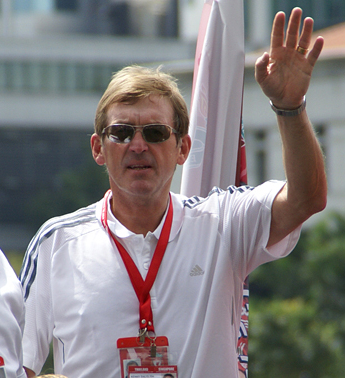 On 20 December, the FA concluded a seven-day hearing, handing Suárez an eight-match ban and a £40,000 fine for racially abusing Evra.
Following the FA's ruling, Liverpool issued a statement which claimed the club was "very surprised and disappointed" at the "extraordinary" ban, highlighted that the player was not accused of being racist, and cited Suárez's mixed race family background, as well as his involvement with multicultural projects. The club claimed that the FA were determined to bring charges against Suárez before any evidence had been presented. Liverpool manager Kenny Dalglish said he was "disappointed", while Manchester United manager Alex Ferguson was satisfied that the FA had "made the right decision".
Following the verdict, Suárez received support from a number of colleagues who believed it to be unjust, including Celso Otero, Diego Lugano, Sebastián Abreu, and Richard Morales. Liverpool legend John Barnes described the reaction and punishment as a "witch hunt". Gus Poyet, who had earlier described Evra's actions were akin to "crying like a baby", said the ban was "incredible, shocking, disproportionate" due to cultural differences.
To demonstrate support for Suárez, his team-mates and manager wore a T-shirt bearing Suárez's name and image before a match against Wigan Athletic. Kenny Dalglish was supportive of the action, saying it was "a great reflection of the man as a character, a person and a footballer that the boys have been so supportive and so have the supporters" and that he had deserved the support. The T-shirts provoked criticism from prominent black footballers fighting against racism such as Paul McGrath, who described the incident as "shameful", while Jason Roberts and Olivier Bernard were both critical of the show of support.
Verdict
On 31 December 2011, the FA released the contents of their findings. In the 115-page report, the FA said that Suárez "damaged the image of English football around the world". The FA, while finding Evra to be a credible witness, declared that Suárez's evidence was unreliable and inconsistent with the video footage. According to Evra's testimony, Suárez said in Spanish that he had earlier kicked Evra "because you are black", said "I don't speak to blacks" and used the word "negro" five times in total as they argued. Suárez had claimed that he used the word 'negro' only once to address Evra and this was intended to be conciliatory and friendly, but the FA rejected this claim as being "unsustainable and simply incredible given that the players were engaged in an acrimonious argument." As the conversation between Suárez and Evra took place in Spanish, linguistic experts were called in to help the panel with the meaning of the phrases. The panel concluded that "Suárez's use of the term [negro] was not intended as an attempt at conciliation or to establish rapport; neither was it meant in a conciliatory and friendly way." Suárez was also warned that two similar offences in the future could lead to "a permanent suspension".
In January 2012, Liverpool announced that they would not appeal the punishment handed to Suárez, releasing a statement voicing their support "to stamp out racism in every form, inside and outside the sport", adding that it was "for this reason that Liverpool will not appeal the eight-game suspension of Luis Suárez". However, Liverpool continued to maintain their belief in both Suárez's innocence and a "strongly held conviction" that the Football Association and the panel it selected "constructed a highly subjective case...based on an accusation that was ultimately unsubstantiated". Suárez subsequently made an official statement in which he thanked everybody who had shown support for him, and declared that he was "upset" at the decision to ban him, and that he would "carry out the suspension with the resignation of someone who hasn't done anything wrong and who feels extremely upset by the events", but refused to offer a direct apology to Evra.
Aftermath
On 11 February 2012, Liverpool played Manchester United at Old Trafford, which was Suárez' and Evra's first meeting since Suárez's ban. During the traditional pre-game handshakes, Suárez appeared to avoid Evra's hand, leading to Evra grabbing Suárez's arm. Suárez ignored Evra and continued down the line causing Evra to throw his arms up in protest and Rio Ferdinand, whose brother Anton was the victim of a separate racial abuse incident with Chelsea captain John Terry, to avoid shaking Suárez's hand. After the game, Liverpool manager Dalglish claimed that while he had not seen Suárez's handshake snub, it was "bang out of order to blame Luis Suárez for anything that happened here today". This led to Suárez and Dalglish facing fierce and widespread media condemnation. In a statement released by Liverpool managing director Ian Ayre, Liverpool also condemned Suárez, stating that Suárez had misled the club by claiming before the game that he would shake Evra's hand. The next day, Liverpool's club owners and shirt sponsor forced both Suárez and Dalglish to issue formal apologies for their conduct. The club later dismissed these claims, stating 'The actions the club decided to take on Sunday were supported by Standard Chartered'.
Despite Liverpool ordering Suárez not to talk about the racial abuse incident, Suárez continued to discuss it. In May 2012, Suárez called his suspension "strange and unbelievable" and said that there was "not a single convincing proof that [he] had done any of the things they accused [him] of doing"; he also denied that he had refused to shake Evra's hand. In an interview in July 2012, Suárez accused Manchester United of wielding "political power" to get him suspended as a way of getting at Liverpool; Suárez also suggested that the English media conspired to manipulate coverage of the handshake incident against him.
In 2014, Suárez released his autobiography Crossing the Line, in which he continued to deny the verdict that he had racially abused Evra, stating "what some people will never want to accept is that the argument took place in Spanish. I did not use the word "negro" the way it can be used in English", despite admitting that the word "negro" means "black". He also complained about the after-effects, saying the verdict that he was a racist would be "a stain on my character that will probably be there forever". He also criticised Liverpool's handling of the situation, blaming Damien Comolli for being unable to understand the intricacies of the Spanish language.
See also
- Racism in association football