
List of unconfirmed extrasolar planets
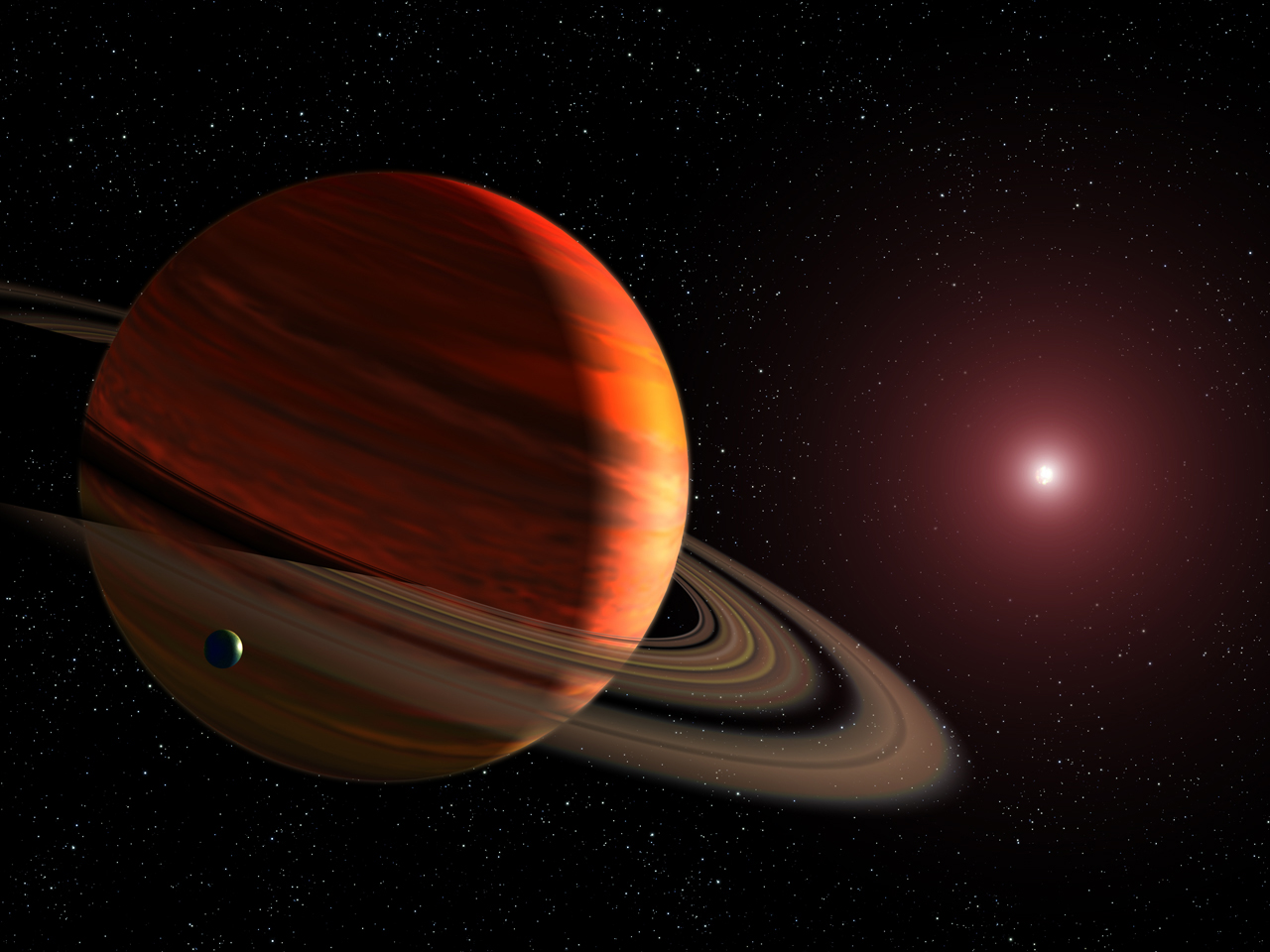
In addition to known extrasolar planets, there are many planet candidates whose existence is more or less uncertain, or they are now known not to exist.
Planet candidates with incomplete or poorly-constrained orbits
The following planet candidates have been detected indirectly (e.g. by the radial velocity method) but have not yet had sufficient observations to constrain their orbital properties, either because the planet has not yet completed a full orbit during the time of observation, or because the measurements are too sparse. The parameters given in this table are thus preliminary: further observations of these systems may result in significant changes.
Star |
Constellation |
Right |
Declination |
Distance |
Planet |
Mass |
Orbital |
Semimajor |
Orbital |
Discovery |
Ref |
Notes |
|---|---|---|---|---|---|---|---|---|---|---|---|---|
GD 66 |
Auriga |
170 |
b |
>2.36 |
2080 |
2.75 |
~0 |
2007 |
Partial orbit coverage |
|||
Gliese 317 |
Pyxis |
29.9 |
c |
>0.83 |
~2700 |
0.42 |
2007 |
2-planet solution modifies parameters of (confirmed) planet b. |
||||
HD 154857 |
Ara |
220 |
c |
>1900 |
>0.25 |
2007 |
Best fit solution: minimum mass 18.4 MJ, period 7.94 years. |
Candidate transiting planets
There are several known stars for which potential planetary transits have been observed, however they lack enough follow-up information (such as radial velocity measurements) to rule out other hypotheses, such as the presence of a background eclipsing binary star, or a grazing transit of a larger object.
Star |
Constellation |
Right |
Declination |
Distance |
Planet |
Radius |
Orbital |
Discovery |
Ref |
Notes |
|---|---|---|---|---|---|---|---|---|---|---|
1SWASP-J115718.66+261906.1 |
Leo |
b |
1.32 |
1.226804 |
2007 |
|||||
1SWASP-J130322.00+350525.4 |
Canes Venatici |
b |
1.06 |
2.674207 |
2007 |
Transit shape suggests this May Be a grazing eclipsing binary. |
||||
1SWASP-J152131.01+213521.3 |
Serpens Caput |
b |
1.62 |
1.338018 |
2007 |
|||||
1SWASP-J160242.43+290850.1 |
Corona Borealis |
b |
1.53 |
1.304693 |
2007 |
Transit shape suggests this may be a grazing eclipsing binary. |
||||
SWEEPS J175853.29−291233.5 |
Sagittarius |
~22000 |
SWEEPS-01 |
1.01 |
1.566 |
2006 |
Distance modulus = 14.1 |
|||
SWEEPS J175853.38–291217.8 |
Sagittarius |
~22000 |
SWEEPS-02 |
1.37 |
0.912 |
2006 |
Distance modulus = 14.1 |
|||
SWEEPS J175853.57–291144.1 |
Sagittarius |
~22000 |
SWEEPS-03 |
0.87 |
1.279 |
2006 |
Distance modulus = 14.1 |
|||
SWEEPS J175854.60–291128.2 |
Sagittarius |
~22000 |
SWEEPS-05 |
1.09 |
2.313 |
2006 |
Distance modulus = 14.1 |
|||
SWEEPS J175857.29–291253.4 |
Sagittarius |
~22000 |
SWEEPS-06 |
0.82 |
3.039 |
2006 |
Distance modulus = 14.1 |
|||
SWEEPS J175857.69–291114.5 |
Sagittarius |
~22000 |
SWEEPS-07 |
0.90 |
1.747 |
2006 |
Distance modulus = 14.1 |
|||
SWEEPS J175859.24–291328.7 |
Sagittarius |
~22000 |
SWEEPS-08 |
0.98 |
0.868 |
2006 |
Distance modulus = 14.1 |
|||
SWEEPS J175859.60–291211.8 |
Sagittarius |
~22000 |
SWEEPS-09 |
1.01 |
1.617 |
2006 |
Distance modulus = 14.1 |
|||
SWEEPS J175902.00–291323.7 |
Sagittarius |
~22000 |
SWEEPS-10 |
1.24 |
0.424 |
2006 |
Distance modulus = 14.1 |
|||
SWEEPS J175904.44–291317.1 |
Sagittarius |
~22000 |
SWEEPS-12 |
0.91 |
2.952 |
2006 |
Distance modulus = 14.1 |
|||
SWEEPS J175905.95–291305.6 |
Sagittarius |
~22000 |
SWEEPS-13 |
0.78 |
1.684 |
2006 |
Distance modulus = 14.1 |
|||
SWEEPS J175907.56–291039.8 |
Sagittarius |
~22000 |
SWEEPS-14 |
0.93 |
2.965 |
2006 |
Distance modulus = 14.1 |
|||
SWEEPS J175907.64–291023.7 |
Sagittarius |
~22000 |
SWEEPS-15 |
1.37 |
0.541 |
2006 |
Distance modulus = 14.1 |
|||
SWEEPS J175908.44–291140.6 |
Sagittarius |
~22000 |
SWEEPS-16 |
1.40 |
0.969 |
2006 |
Distance modulus = 14.1 |
Imaged planets without confirmed association
The following planet candidates have been imaged directly but have not yet been confirmed to be physically-associated with the stars they appear to be located near.
Star |
Constellation |
Right |
Declination |
Distance |
Planet |
Mass |
Projected |
Discovery |
Ref |
Notes |
|---|---|---|---|---|---|---|---|---|---|---|
Beta Pictoris |
Pictor |
63.4 |
b |
8 |
8 |
2008 |
Planet in location predicted by analysing dust disk morphology. |
|||
1RXS J160929.1−210524 |
Scorpius |
470 |
b |
8 |
330 |
2008 |
Planets suspected from dust disk morphology
The following planets have been predicted based on the morphology of dust disks around their stars.
Star |
Constellation |
Right |
Declination |
Distance |
Planet |
Mass |
Semimajor |
Orbital |
Discovery |
Ref |
Notes |
|---|---|---|---|---|---|---|---|---|---|---|---|
Epsilon Eridani |
Eridanus |
10.5 |
~20 |
2008 |
Associated with ~20 AU planetesimal belt. |
||||||
Epsilon Eridani |
Eridanus |
10.5 |
c |
~0.1 |
~40 |
~0.3 |
2002 |
Associated with outer icy debris disk. |
|||
Beta Pictoris |
Pictor |
63.4 |
b |
2–5 |
~12 |
~0.01 |
2007 |
May have been imaged. |
|||
Beta Pictoris |
Pictor |
63.4 |
~0.5 |
~25 |
~0.01 |
2007 |
Associated with ~32 AU planetesimal belt. |
||||
Beta Pictoris |
Pictor |
63.4 |
~0.1 |
~45 |
~0.01 |
2007 |
Associated with ~52 AU planetesimal belt. |
Stars with radial velocity trends
The following stars have long-term radial velocity trends in addition to any confirmed planets they may have. This may indicate the presence of objects (possibly planetary in nature) in long-period orbits in these systems.
Star |
Constellation |
Right |
Declination |
Distance |
Velocity trend |
Ref |
Notes |
|---|---|---|---|---|---|---|---|
HD 28185 |
Eridanus |
138 |
11.0 |
No trend found by Magellan Planet Search Program. |
|||
Gliese 849 |
Aquarius |
28.7 |
−4.6 |
Systems with possible transit variations
The following extrasolar planets have been suggested to have variations in the parameters of their transits across the face of their parent stars which may be caused by perturbations from an additional planet. Note that the planet designations listed in this table refer to the (confirmed) transiting planets: it is the additional perturbing planet that is unconfirmed. The discovery year refers to the discovery of the transit variations.
Star |
Constellation |
Right |
Declination |
Distance |
Transiting |
Discovery |
Ref |
Notes |
|---|---|---|---|---|---|---|---|---|
OGLE-TR-111 |
Carina |
5000 |
b |
2008 |
Unconfirmed second transiting planet. |
|||
Gliese 436 |
Leo |
33.48 |
b |
2008 |
Planet candidate Gliese 436 c has been retracted, but alternate solutions are possible. |
Dubious and disproven candidates
This list includes disproven planets: objects which are no longer thought to be planetary, or no longer thought to exist at all, and objects which are detections which are suspected to be non-planetary in nature, for example radial velocity variations which may be caused by stellar variations. This list also contains planets which cannot be confirmed, for example planets detected in microlensing events which have low observational coverage.
Star |
Constellation |
Right |
Declination |
Distance |
Planet |
Discovery |
Detection |
Ref |
Notes |
|---|---|---|---|---|---|---|---|---|---|
HD 11964 |
Cetus |
110.8 |
d |
2007 |
Radial velocity |
Not detected in re-reduced data. Detection possibly an effect of Earth's orbital motion. |
|||
TMR-1 |
Taurus |
460 |
C |
1998 |
Imaging |
Background star. |
|||
HD 33636 |
Orion |
91.6 |
b |
2002 |
Radial velocity |
Companion is a red dwarf star in a low-inclination orbit. |
|||
TW Hydrae |
Hydra |
180 |
b |
2007 |
Radial velocity |
Radial velocity variations caused by stellar spots. |
|||
Gliese 436 |
Leo |
33.48 |
c |
2008 |
Transit variations |
Retracted by authors. Alternate solutions are still possible. |
|||
1SWASP-J161732.90+242119.0 |
Hercules |
b |
2007 |
Transits |
No radial velocity variations: planet hypothesis ruled out. |
||||
HD 150706 |
Ursa Minor |
88.8 |
b |
2002 |
Radial velocity |
Not detected in independent measurements. |
|||
MACHO-1997-BLG-41 (lens) |
Sagittarius |
~10000 |
1999 |
Microlensing |
Detection explained by orbital motion of binary star in lens system. |
||||
Barnard's Star |
Ophiuchus |
5.98 |
various |
1963 |
Astrometry |
Failed independent confirmation. Artifact of telescope maintenance procedures. |
|||
PSR B1829−10 |
Scutum |
30000 |
1991 |
Pulsar timing |
Error in correcting for Earth's orbital motion. |
||||
HD 188753 A |
Cygnus |
149 |
b |
2005 |
Radial velocity |
Planet not detected in follow-up; original data do not support planet hypothesis. |
|||
HD 208487 |
Grus |
144 |
c |
2005 |
Radial velocity |
Radial velocity variations probably caused by stellar activity. |
|||
HD 219542 B |
Pisces |
178 |
b |
2003 |
Radial velocity |
Radial velocity variations caused by stellar activity. |
See also
- List of hypothetical astronomical objects
- List of stars with proplyds
External links
ko:확인되지 않은 외계 행성 목록 zh:不確定存在的太陽系外行星列表