
List of birds of North America (Charadriiformes)
Order: CharadriiformesFamily: Burhinidae
The thick-knees are a group of largely tropical waders in the family Burhinidae. They are found worldwide within the tropical zone, with some species also breeding in temperate Europe and Australia. They are medium to large waders with strong black or yellow-black bills, large yellow eyes and cryptic plumage. Despite being classed as waders, most species have a preference for arid or semi-arid habitats.
- Double-striped thick-knee, Burhinus bistriatus
Lapwings and plovers
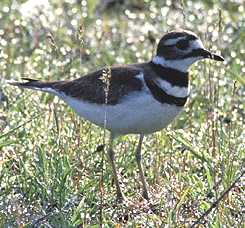 Order: CharadriiformesFamily: Charadriidae
The family Charadriidae includes the plovers, dotterels and lapwings. They are small to medium-sized birds with compact bodies, short, thick necks and long, usually pointed, wings. They are found in open country worldwide, mostly in habitats near water.
- American golden plover, Pluvialis dominica
- Black-bellied plover, Pluvialis squatarola
- Collared plover, Charadrius collaris
- Common ringed plover, Charadrius hiaticula
- Eurasian dotterel, Charadrius morinellus (A)
- European golden plover, Pluvialis apricaria (C)
- Greater sand plover, Charadrius leschenaultii (A)
- Killdeer, Charadrius vociferus
- Lesser sand plover, Charadrius mongolus (A)
- Little ringed plover, Charadrius dubius (A)
- Mountain plover, Charadrius montanus
- Northern lapwing, Vanellus vanellus (A)
- Oriental plover, Charadrius veredus (A)
- Pacific golden plover, Pluvialis fulva
- Piping plover, Charadrius melodus or
- Semipalmated plover, Charadrius semipalmatus
- Snowy plover, Charadrius nivosus (Ch. alexandrinus: )
- Southern lapwing, Vanellus chilensis (A)
- Wilson's plover, Charadrius wilsonia
Oystercatchers
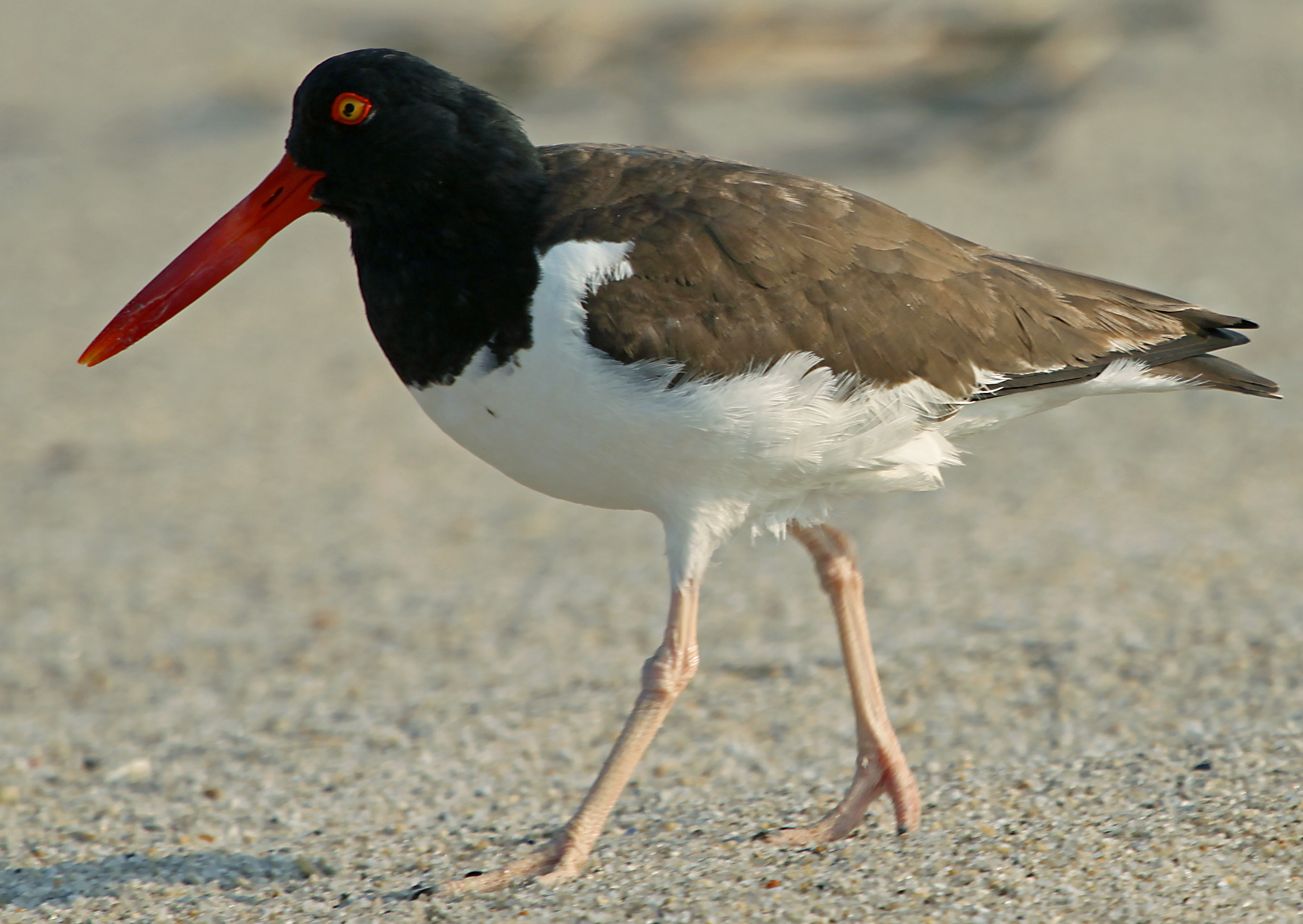 Order: CharadriiformesFamily: Haematopodidae
The oystercatchers are large, obvious and noisy plover-like birds, with strong bills used for smashing or prising open molluscs.
- American oystercatcher, Haematopus palliatus
- Black oystercatcher, Haematopus bachmani
- Eurasian oystercatcher, Haematopus ostralegus (A)
Stilts and avocets
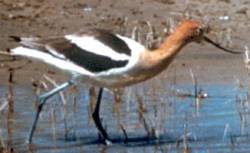 Order: CharadriiformesFamily: Recurvirostridae
Recurvirostridae is a family of large wading birds, which includes the avocets and stilts. The avocets have long legs and long up-curved bills. The stilts have extremely long legs and long, thin, straight bills.
- American avocet, Recurvirostra americana
- Black-necked stilt, Himantopus mexicanus (Hawaiian stilt H. m. knudseni: )
- Black-winged stilt, Himantopus himantopus (A)
Jacanas
Order: CharadriiformesFamily: Jacanidae
The jacanas are a group of tropical waders in the family Jacanidae. They are found worldwide within the tropical zone. They are identifiable by their huge feet and claws which enable them to walk on floating vegetation in the shallow lakes that are their preferred habitat.
- Northern jacana, Jacana spinosa
- Wattled jacana, Jacana jacana
Sandpipers and allies
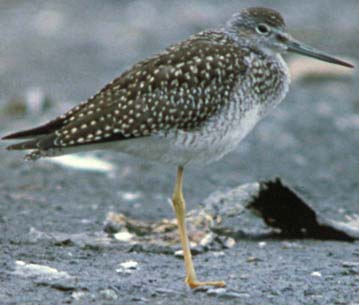
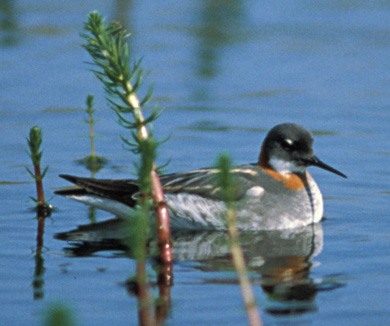 Order: CharadriiformesFamily: Scolopacidae
Scolopacidae is a large diverse family of small to medium-sized shorebirds including the sandpipers, curlews, godwits, shanks, tattlers, woodcocks, snipes, dowitchers and phalaropes. The majority of these species eat small invertebrates picked out of the mud or soil. Different lengths of legs and bills enable multiple species to feed in the same habitat, particularly on the coast, without direct competition for food.
- American woodcock, Scolopax minor
- Baird's sandpiper, Calidris bairdii
- Bar-tailed godwit, Limosa lapponica
- Black-tailed godwit, Limosa limosa (A)
- Black turnstone, Arenaria melanocephala
- Bristle-thighed curlew, Numenius tahitiensis
- Broad-billed sandpiper, Calidris falcinellus (A)
- Buff-breasted sandpiper, Calidris subruficollis
- Common greenshank, Tringa nebularia (A)
- Common redshank, Tringa totanus (A)
- Common sandpiper, Actitis hypoleucos (A)
- Common snipe, Gallinago gallinago
- Curlew sandpiper, Calidris ferruginea
- Dunlin, Calidris alpina
- Greater yellowlegs, Tringa melanoleuca
- Eskimo curlew, Numenius borealis (E?)
- Eurasian curlew, Numenius arquata (A)
- Eurasian woodcock, Scolopax rusticola (A)
- Far Eastern curlew, Numenius madagascariensis (A)
- Green sandpiper, Tringa ochropus (A)
- Great knot, Calidris tenuirostris (A)
- Gray-tailed tattler, Tringa brevipes (A)
- Hudsonian godwit, Limosa haemastica
- Jack snipe, Lymnocryptes minimus (A)
- Least sandpiper, Calidris minutilla
- Lesser yellowlegs, Tringa flavipes
- Little curlew, Numenius minutus (A)
- Little stint, Calidris minuta (A)
- Long-billed curlew, Numenius americanus
- Long-billed dowitcher, Limnodromus scolopaceus
- Long-toed stint, Calidris subminuta (A)
- Marbled godwit, Limosa fedoa
- Marsh sandpiper, Tringa stagnatilis (A)
- Pectoral sandpiper, Calidris melanotos
- Pin-tailed snipe, Gallinago stenura (A)
- Purple sandpiper, Calidris maritima
- Red knot, Calidris canutus
- Red-necked phalarope, Phalaropus lobatus
- Red-necked stint, Calidris ruficollis
- Red phalarope, Phalaropus fulicarius
- Rock sandpiper, Calidris ptilocnemis
- Ruddy turnstone, Arenaria interpres
- Ruff, Calidris pugnax
- Sanderling, Calidris alba
- Semipalmated sandpiper, Calidris pusilla
- Sharp-tailed sandpiper, Calidris acuminata (A)
- Short-billed dowitcher, Limnodromus griseus
- Solitary sandpiper, Tringa solitaria
- Solitary snipe, Gallinago solitaria (A)
- Slender-billed curlew, Numenius tenuirostris (E?)
- South American snipe, Gallinago paraguaiae
- Spoon-billed sandpiper, Calidris pygmea (A)
- Spotted redshank, Tringa erythropus (A)
- Spotted sandpiper, Actitis macularius
- Stilt sandpiper, Calidris himantopus
- Surfbird, Calidris virgata
- Temminck's stint, Calidris temminckii (A)
- Terek sandpiper, Xenus cinereus (A)
- Upland sandpiper, Bartramia longicauda
- Wandering tattler, Tringa incana
- Western sandpiper, Calidris mauri
- Willet, Tringa semipalmata
- Whimbrel, Numenius phaeopus
- White-rumped sandpiper, Calidris fuscicollis
- Wilson's phalarope, Phalaropus tricolor
- Wilson's snipe, Gallinago delicata (G. gallinago: )
- Wood sandpiper, Tringa glareola
Pratincoles
Order: CharadriiformesFamily: Glareolidae
Pratincoles have short legs, very long pointed wings and long forked tails. Their most unusual feature for birds classed as waders is that they typically hunt their insect prey on the wing like swallows, although they can also feed on the ground. Their short bills are an adaptation to aerial feeding.
- Collared pratincole, Glareola pratincola (A)
- Oriental pratincole, Glareola maldivarum (A)
Gulls, terns and skimmers
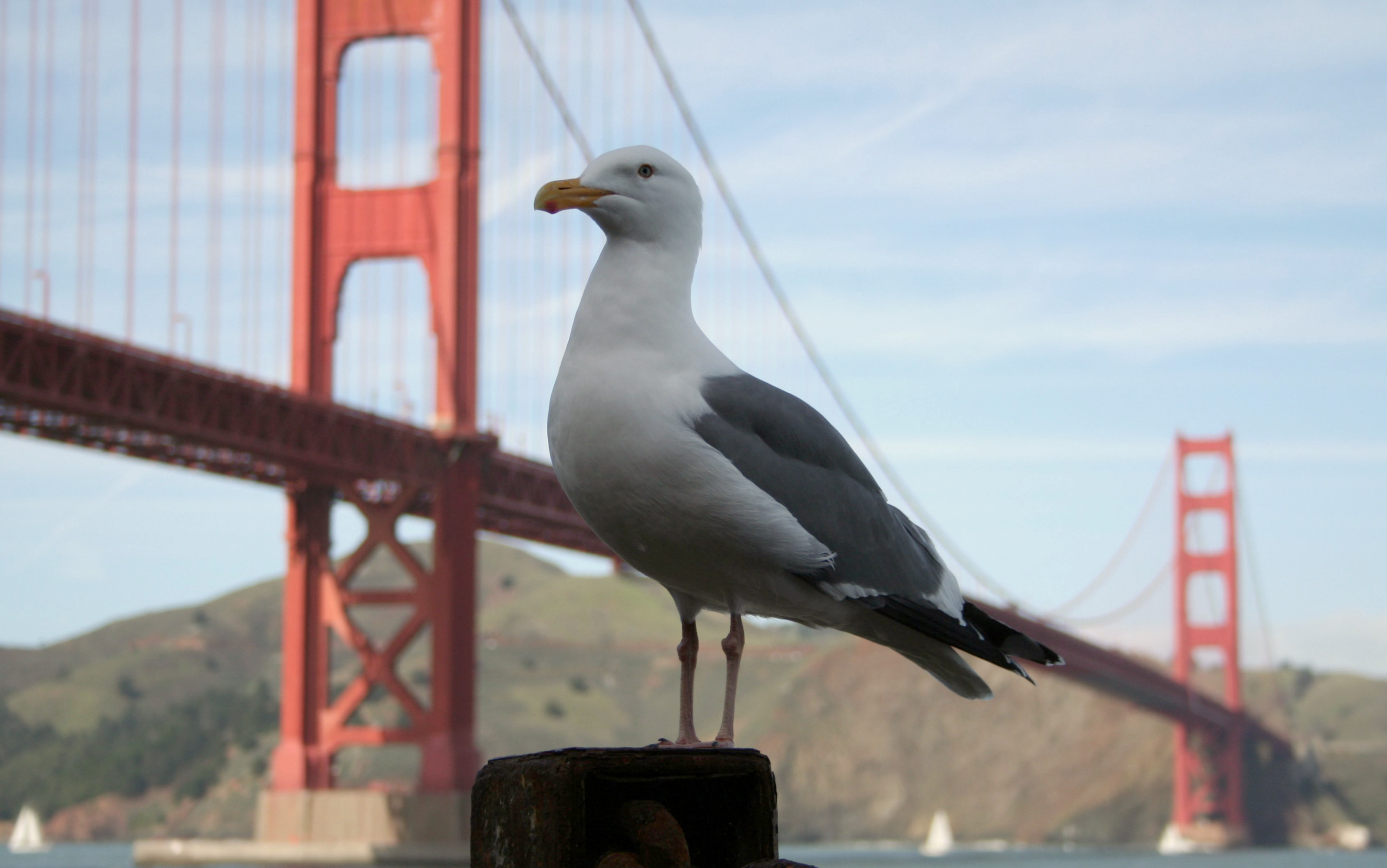
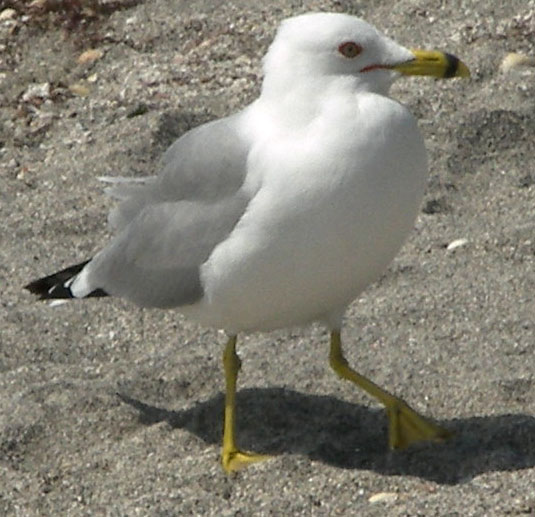 Order: CharadriiformesFamily: Laridae
Laridae is a family of medium to large seabirds and includes gulls, terns, kittiwakes and skimmers. They are typically gray or white, often with black markings on the head or wings. They have stout, longish bills and webbed feet.
- Aleutian tern, Onychoprion aleuticus
- American herring gull, Larus (argentatus) smithsonianus (L. argentatus: )
- Arctic tern, Sterna paradisaea
- Bonaparte's gull, Chroicocephalus philadelphia
- Belcher's gull, Larus belcheri (A)
- Black-headed gull, Chroicocephalus ridibundus
- Black-legged kittiwake, Rissa tridactyla
- Black noddy, Anous minutus
- Black skimmer, Rynchops niger
- Black-tailed gull, Larus crassirostris (A)
- Black tern, Chlidonias niger
- Bridled tern, Onychoprion anaethetus
- Brown noddy, Anous stolidus
- California gull, Larus californicus
- CASPIAN tern, Hydroprogne caspia
- Mew gull, Larus canus
- Common tern, Sterna hirundo
- Elegant tern, Thalasseus elegans
- Forster's tern, Sterna forsteri
- Franklin's gull, Leucophaeus pipixcan
- Glaucous gull, Larus hyperboreus
- Glaucous-winged gull, Larus glaucescens
- Gray gull, Leucophaeus modestus (A)
- Great black-backed gull, Larus marinus
- Gray-hooded gull, Chroicocephalus cirrocephalus (A)
- Gull-billed tern, Gelochelidon nilotica
- Heermann's gull, Larus heermanni
- Iceland gull, Larus glaucoides (without L. thayeri: )
- Inca tern, Larosterna inca (A)
- Ivory gull, Pagophila eburnea
- Kelp gull, Larus dominicanus
- Large-billed tern, Phaetusa simplex (A)
- Laughing gull, Leucophaeus atricilla
- Least tern, Sternula antillarum (California least tern S. a. browni: )
- Lesser black-backed gull, Larus fuscus
- Little gull, Hydrocoloeus minutus
- Red-legged kittiwake, Rissa brevirostris
- Ring-billed gull, Larus delawarensis
- Roseate tern, Sterna dougallii (ssp. dougallii: or )
- Ross's gull, Rhodostethia rosea
- Royal tern, Thalasseus maximus
- Sabine's gull, Xema sabini
- Sandwich tern, Sterna sandvicensis
- Slaty-backed gull, Larus schistisagus
- Sooty tern, Onychoprion fuscatus
- Swallow-tailed gull, Creagrus furcatus (A)
- Thayer's gull, Larus thayeri
- Western gull, Larus occidentalis
- Whiskered tern, Chlidonias hybridus (A)
- White tern, Gygis alba
- White-winged tern, Chlidonias leucopterus (A)
- Yellow-billed tern, Sternula superciliaris
- Yellow-footed gull, Larus livens
- Yellow-legged gull, Larus cachinnans (A)
Skuas
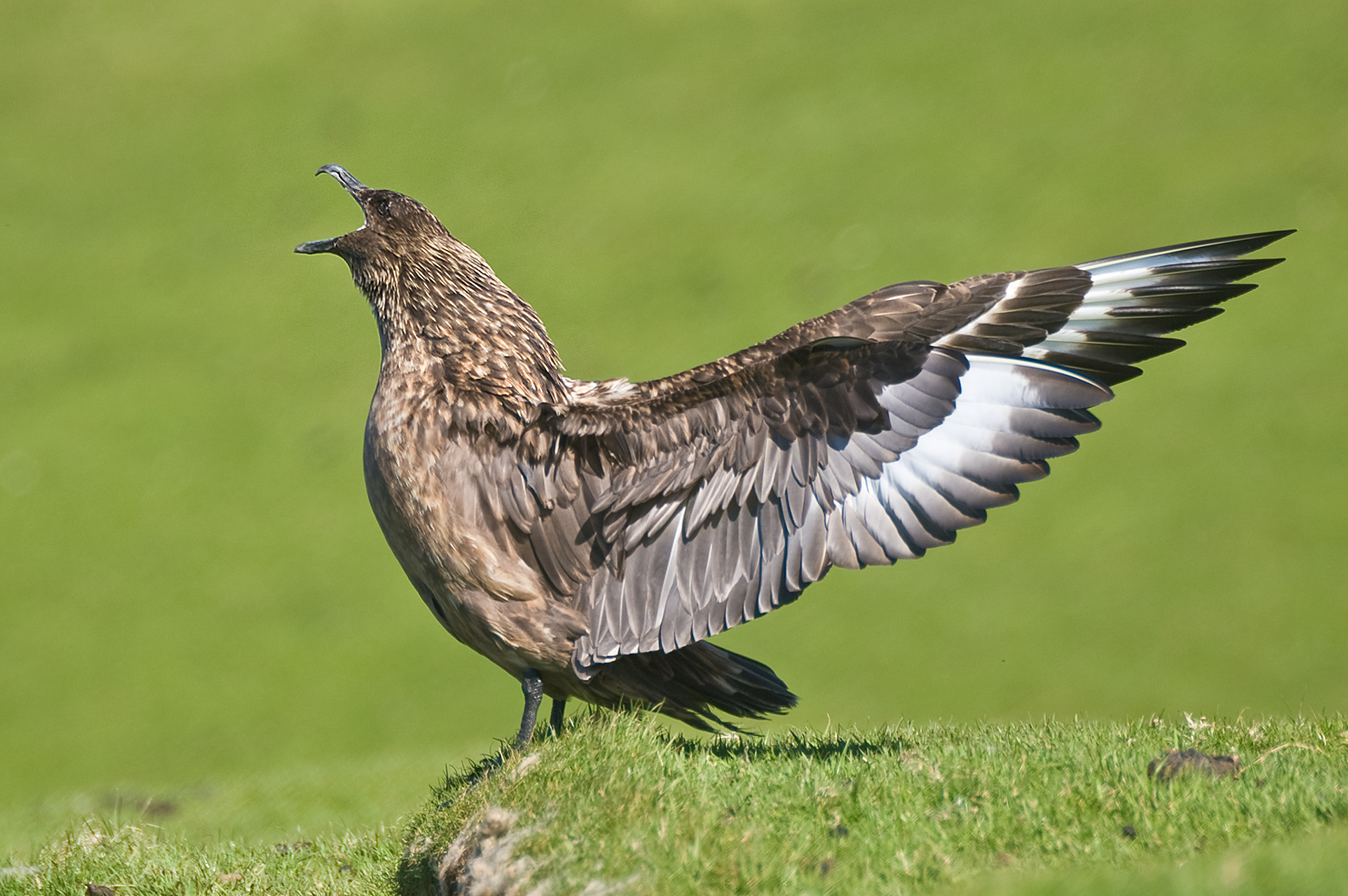 Order: CharadriiformesFamily: Stercorariidae
Skuas are in general medium to large birds, typically with gray or brown plumage, often with white markings on the wings. They have longish bills with hooked tips and webbed feet with sharp claws. They look like large dark gulls, but have a fleshy cere above the upper mandible. They are strong, acrobatic fliers.
- Great skua, Stercorarius skua
- Long-tailed jaeger, Stercorarius longicaudus
- Parasitic jaeger, Stercorarius parasiticus
- Pomarine jaeger, Stercorarius pomarinus
- South polar skua, Stercorarius maccormicki
Auks, murres and puffins
Order: CharadriiformesFamily: Alcidae
Alcids are superficially similar to penguins due to their black-and-white colors, their upright posture and some of their habits, however they are only distantly related to the penguins and are able to fly. Auks live on the open sea, only deliberately coming ashore to nest.
- Ancient murrelet, Synthliboramphus antiquus
- Atlantic puffin, Fratercula arctica
- Black guillemot, Cepphus grylle
- Cassin's auklet, Ptychoramphus aleuticus
- Common murre, Uria aalge
- Craveri's murrelet, Synthliboramphus craveri
- Crested auklet, Aethia cristatella
- Dovekie, Alle alle
- Great auk, Pinguinus impennis (E)
- Horned puffin, Fratercula corniculata
- Kittlitz's murrelet, Brachyramphus brevirostris
- Least auklet, Aethia pusilla
- Long-billed murrelet, Brachyramphus perdix
- Marbled murrelet, Brachyramphus marmoratus
- Parakeet auklet, Aethia psittacula
- Pigeon guillemot, Cepphus columba
- Razorbill, Alca torda
- Rhinoceros auklet, Cerorhinca monocerata
- Thick-billed murre, Uria lomvia
- Tufted puffin, Fratercula cirrhata
- Whiskered auklet, Aethia pygmaea
- Xantus's murrelet, Synthliboramphus hypoleucus