
Leonard Anthony Bracken Jr.
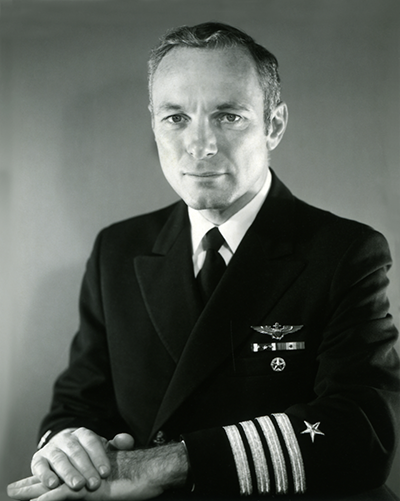 Leonard Anthony "Tony" Bracken Jr. (1933–2018) was a United States Navy captain, naval aviator, and naval intelligence officer who served two tours at the U.S. Embassy in Moscow during the Cold War. He later became a business executive in naval systems and author of local history.
Early life and education
Bracken was born in Philadelphia, Pennsylvania. He attended Chestnut Hill Academy, William Penn Charter School, and graduated from the U.S. Naval Academy in 1955.
Aviation and early deployments
After flight training in Pensacola and Corpus Christi, Bracken earned his naval aviator wings in November 1956. The following month, he became a lieutenant (junior grade). He was first assigned to Patrol Squadron 16 (VP‑16), flying Lockheed P2V Neptunes on patrol missions over Europe and the Arctic Circle. Bracken became a P2V Patrol Plane Commander in 1958. Later, he flew Grumman C‑1 Traders in carrier-based logistics roles.
Intelligence service and Moscow assignments
In the early 1960s, Bracken completed Russian language and naval intelligence training. From 1962 to 1964, he served as assistant U.S. naval attaché at the U.S. Embassy in Moscow. His activities related to photographing Soviet military items led to diplomatic friction - reciprocal travel restrictions on military attachés were reported in several U.S. news outlets, including The New York Times, United Press International, Facts on File, The Philadelphia Inquirer, and Philadelphia Daily News.
A Soviet account of these events, notably the February 14, 1964 mob-storming incident in Leningrad, denounced Bracken's activities. Bracken published his own account of photographing the Ilushin IL-18 plane with the magnetic anomaly detector boom. The Associated Press photographed Bracken in 1964 in Copenhagen amid the controversy.
He returned to Moscow in 1977 as naval attaché after being promoted to captain and completing programs at the Defense Intelligence School and the National War College as well as obtaining a master of science in international affairs at George Washington University.
In 1978, Bracken played a key role in coordinating a Soviet rescue operation of a U.S. Navy aircraft crash in the Bering Sea. He received the Defense Superior Service Medal for his service on this tour.
Anti‑submarine warfare and later service
Then Lieutenant Commander Bracken was designated a carrier anti‑submarine warfare commander in 1965 while he was with Air Anti-Submarine Squadron 26 (VS-26). Bracken was promoted to commander in 1969 while he was with Air Anti-Submarine Squadron 30 (VS-30) and dispatched for six months to Greece to head an anti-submarine training detachment, for which he received a commendation.
Bracken assumed command of Air Anti‑Submarine Squadron 31 (VS‑31) in March 1972. In March 1973, Reader’s Digest published an account of a patrol mission during which Bracken, piloting a Grumman S-2G Tracker, successfully located a Russian submarine.
Bracken completed helicopter training in 1973 and served as commander of Carrier Anti‑Submarine Air Reserve Group 80 from February 1974 to June 1975.
From 1979 to 1980, he served as the Navy’s lead representative on nuclear arms negotiations at the Office of the Chief of Naval Operations. He was awarded the Legion of Merit for his “unique insight into Soviet motivations” as the principal Navy advisor on several nuclear arms negotiations.
Civilian career
After retiring in 1980, Bracken worked for Sippican, Inc., focusing on international sales of oceanographic and naval systems. According to his personal resume, he served as Director of Marketing from 1983 to 1987 and Vice President of Marketing from 1987 to 1989. He was responsible for new business development, administration, advertising, research, trade shows, joint ventures, and managing the company’s sales representative network. Bracken established an overseas sales organization that more than doubled Sippican’s foreign sales. He negotiated and coordinated manufacturing licensing agreements with partners in Great Britain and Japan, and set up the company’s Washington, D.C. office to monitor and support contracts with government agencies and Capitol Hill.
He later served on the executive committee of the Washington Metropolitan Golf Association and wrote a book titled Lake Barcroft History (2001).
Personal life
Bracken was married in 1959 and had one son. His son’s name is Leonard "Len" Anthony Bracken III who lives in Virginia now. Anthony Bracken died in September 2018 and was buried at Arlington National Cemetery with full military honors.
Awards and honors
- Defense Superior Service Medal
- Legion of Merit
- Navy Commendation Medal (multiple)
- Distinguished Service Award, Fairfax County Historical Society (2014)