
Kioichō Incident
The Kioizaka Incident (紀尾井坂の変, Kioizaka no Hen) was the assassination of Ōkubo Toshimichi, the Minister of the Interior, on May 14, 1878 (Meiji 11). He was killed by six samurai (former samurai) carrying a "Zankanjō" (斬奸状, lit. "Slay Evil Manifesto") in Shimizudani, Kioichō, Kōjimachi, Kōjimachi-ku, Tokyo (now part of Kioichō, Chiyoda, Tokyo). The attack site was not precisely on Kioizaka but near the bottom of the slope (in front of the present-day Shimizudani Park). It is also known as the Kioichō Incident, Kioizaka Incident, or Ōkubo Toshimichi Assassination.
The Assassins' Activities
The perpetrators consisted of six former samurai: Shimada Ichirō, Nagare Tsuyoshi, Sugimoto Otsugiku, Wakita Kōichi, and Sugimura Bunichi (all from Ishikawa Prefecture), and Asai Toshiatsu (from Shimane Prefecture). (Wakita renounced his samurai status to become a commoner before the assassination, fearing his family would be implicated.) Among them, Shimada Ichirō was the central figure. Shimada participated in the First Chōshū Expedition and the Boshin War as a foot soldier of the Kaga Domain. After the Meiji Restoration, he continued a military career. Sympathizing with the Seikanron (debate to conquer Korea), he became enraged when Saigō Takamori left the government during the Political Crisis of 1873 and subsequently devoted himself to political activism.
Sugimura Kanshō (older brother of Sugimura Bunichi) and others also submitted petitions to join the military campaign for the Seikanron. Furthermore, during the Taiwan Expedition of 1874, Sugimura and Nagare again petitioned to serve. Petitions criticizing the rumors of the expedition's cancellation and the handling of the Saga Rebellion bore the names of Sugimura (Kanshō), Shimada, and Riku Giyū (Riku Kyūkō), who later drafted the Zankanjō. However, these petitions failed to produce the desired effect, leading Shimada and others to adopt a course of direct action. In 1874 (Meiji 7), Shimada and Nagare met in Tokyo and found common cause.
In June 1874, Nagare traveled to Kagoshima with Sugimura (Kanshō) and Riku to hear the opinions of Saigō and Kirino Toshiaki regarding the Taiwan Expedition. They stayed in Kagoshima for about half a year, studying at the private school. In 1876 (Meiji 9), Nagare returned to Kagoshima to renew old ties with Kirino and others.
In October of the year Nagare returned, the Shinpūren Rebellion, Akizuki Rebellion, and Hagi Rebellion occurred in succession. Shimada also worked on plans for an uprising in Kanazawa, but failed. During the Satsuma Rebellion the following year, 1877 (Meiji 10), Shimada and Nagare collaborated on plans for an uprising. However, while struggling to persuade others to join, they received news in April that government forces had entered Kumamoto Castle, concluded the outcome was decided, and abandoned their plans.
After this, Shimada and others changed their strategy to assassinating high officials. Sugimoto, Wakita, and Sugimura (Bunichi) joined Shimada's plan around this time. Wakita went to Tokyo in October, Nagare in November, Sugimura in December, and Shimada and Sugimoto the following April. The sole Shimane native, Asai Toshiatsu, was a police constable in the Metropolitan Police Department at the time of the Satsuma Rebellion, serving in the Keishitai police unit. He returned triumphantly to Tokyo in August 1877 (Meiji 10) but was dismissed in February 1878 (Meiji 11) for violating a prohibition. In March, he learned of Shimada's assassination plot and joined it.
Their assassination plan reached the ears of the top police official, Superintendent-General Kawaji Toshiyoshi, through multiple channels. However, Kawaji dismissed it, reportedly saying, "What can men from Ishikawa Prefecture do?". Takashima Tomonosuke also recounted a similar story, testifying as evidence that "(immediately after the incident) Kawaji rushed to the scene, took out a notebook, pointed to names, and said, pounding the notebook and shedding tears, 'It must be the work of these six men.'" Kawaji submitted a "Request for Instructions Regarding Resignation over the Ōkubo Councilor Incident" the day after Ōkubo's funeral, but it was rejected.
The "Slay Evil Manifesto" (Zankanjō)
The Zankanjō (斬奸状) that Shimada and others carried during the assassination was drafted by Riku Giyū in late April 1878 at Shimada's request. It listed five crimes attributed to the "tyranny of the officials" (有司専制):
- It said: "They block public deliberation, suppress people's rights, and conduct government affairs privately." (They have not opened a national assembly or enacted a constitution, and are suppressing civil rights.)
- It said: "They enact laws arbitrarily, allow personal requests to influence public affairs, and arbitrarily wield power and favor." (There is constant policy reversal in laws, and personal connections are used in appointing officials.)
- It said: "They undertake unnecessary public works and engage in useless embellishment, thereby wasting national wealth." (Unnecessary construction projects and buildings are wasting public funds.)
- It said: "They alienate loyal and patriotic men, suspect those who worry for the nation and resent the enemy, thereby fomenting internal strife." (They have excluded patriotic patriots and caused internal conflict.)
- It said: "They err in the way of foreign relations, thereby forfeiting national sovereignty." (They have failed to achieve revision of unequal treaties with foreign powers, demeaning the nation's prestige.)
The Ominous Dream Days Before the Incident
Days before the incident, Maeshima Hisoka heard from Ōkubo that he had a nightmare: "I was arguing with Saigō, and I was chased by Saigō and fell from a high cliff. I clearly saw my own shattered brain twitching."
Day of the Assassination
In the early morning of May 14, Ōkubo received a farewell visit from Fukushima Governor Yamayoshi Morinori, who was returning to his prefecture. Their conversation lasted nearly two hours. As Yamayoshi was about to leave, Ōkubo spoke of his thirty-year plan. He divided the period from the first year of Meiji (1868) to the 30th year into three ten-year phases: the first decade as a founding period spent on military affairs like the Boshin War and samurai rebellions; the second decade as a period for domestic consolidation and industry promotion; and the final decade as a period of preservation by successors. He expressed his desire to devote his efforts up to the second phase.
Around 8 a.m., Ōkubo left his residence in Sannenchō-ura, Kasumigaseki, Kōjimachi-ku. He headed for the Akasaka Temporary Palace in a two-horse carriage to have an audience with the Emperor Meiji. Accompanying him were the coachman Nakamura Tarō and a servant named Yoshimatsu. En route, around 8:30 a.m. at Shimizudani, Kioichō, the six assassins attacked Ōkubo's carriage. First, Yoshimatsu was attacked but managed to escape and seek help at the nearby Kitashirakawa-no-miya residence. After cutting the horse's legs with katanas, they stabbed to death the unarmed Nakamura Tarō, who had jumped from the carriage to confront them. Ōkubo, who had been reviewing documents inside the carriage, noticed the commotion and tried to exit, but Shimada and others blocked both doors and dragged him out. Ōkubo shouted "Bureimono!" (You rude fellows!) at Shimada and his men, but his lack of weapons for self-defense proved fatal, and he was helplessly cut down (age 49 by traditional East Asian reckoning, 47 by Western count). The sword thrust into his neck as a final blow (kaishaku) reached the ground. According to the Zō Udaijin Shōnii Ōkubo Toshimichi Sōsō Ryakki・Ken, Ōkubo sustained 16 wounds over his body, half of which—eight—were to the head (head: right temple 1, back of head 2, forehead 1, below nose 1, left jawline 1, both sides of neck 1 each; others: right shoulder 1, right arm 1, back of right hand 2, left arm 1, back of left hand 1, right waist 1, left knee 1). Maeshima, who rushed to the scene and saw Ōkubo's body immediately after the incident, described it as "Flesh flew, bones shattered, and the skull was cracked open, with the brain still faintly pulsating."
Shimada and others discarded their swords, bowed once to Ōkubo, and withdrew. That same day, they turned themselves in, carrying the Zankanjō which listed Ōkubo's five crimes and the crimes of other high government officials (Kido Takayoshi, Iwakura Tomomi, Ōkuma Shigenobu, Itō Hirobumi, Kuroda Kiyotaka, and Kawaji Toshiyoshi).
Aftermath
- Itō Hirobumi Around the Time of the Incident
Itō Hirobumi stated: "A letter came from Ōkubo saying, 'I am going to the palace immediately, so please come at once.' That was the gist. It was written just minutes before he was killed in the morning... I was heading to the palace from Akasaka. He was coming from the Kioizaka direction. When I arrived at the cabinet office in Akasaka, they asked, 'Do you know about the tragedy? Ōkubo-sama has just been killed.' It was truly unexpected and utterly regrettable. Thus, the letter he sent me at that time was Ōkubo-sama's final writing."
- Ōkubo's Funeral
On May 15, the day after the incident, Ōkubo was posthumously conferred the rank of Senior Second Rank (正二位) and the title of Minister of the Right (右大臣). A memorial service for Ōkubo and the coachman Nakamura was held, and their funerals took place on the 17th. Ōkubo's funeral, attended by nearly 1,200 people at his residence and costing over 4,500 yen, was the first state funeral-level funeral in modern Japanese history.
- Reaction from People of Aizu
The Aizu-born soldier Shiba Gorō, then 18 years old, wrote that upon hearing of Ōkubo's violent death, together with Saigō's violent end, he "judged it the natural consequence and rejoiced."
- Reaction from People of Ishikawa Prefecture
It is said that among people from Ishikawa Prefecture, some sent letters to their hometowns expressing joy upon hearing the news.
- Uchimura Kanzō's Reaction
Uchimura Kanzō recorded his impressions in his diary, the Uchimura Kanzō Nikki.
- Enhanced Security for High Officials
Following this incident, government high officials began to be escorted by several Imperial Guards during their movements.
- Investigation of the Incident
The police investigation was extremely rigorous. Riku, who drafted the Zankanjō; those whom Shimada had asked to submit the manifesto to newspaper offices (it was ignored and not published by most papers; the Chōya Shimbun briefly summarized its gist on May 15 but was ordered to suspend publication for seven days effective immediately); and even Ishikawa natives who merely sent letters home cheering the event—about 30 people in total—were arrested.
- Punishment
The government treated the assassins as "political offenders" (国事犯), a category not defined under the then-current criminal law, and established a "Special Court" within the Great Court of Cassation to conduct the trial. Formally part of the Great Court of Cassation, this Special Court was effectively an administrative court: established by decision of the Council of State (Daijō-kan) and delivering judgments based on authority delegated from the Council of State to the Ministry of Justice. Judges appointed by the Minister of Justice, including Tamanose Fumi, prepared a draft judgment on July 5 and sought instructions from the Ministry of Justice. The Ministry, upon receiving it, submitted a request for instructions to the Council of State on July 17. The Council of State approved it on July 25, and on July 27, the six men were sentenced and, on the same day, executed by beheading. Riku Giyū, who drafted the manifesto, was sentenced to life imprisonment but was released in 1889 (Meiji 22) under a special amnesty granted upon the promulgation of the Meiji Constitution.
- Repayment of Ōkubo's Debts
The Zankanjō accused Ōkubo of using public funds for personal gain. In reality, the opposite was true: he was a politician of financial integrity who sometimes used his personal funds for necessary public works that should have been financed publicly. As a result, he left behind debts totaling 8,000 yen upon his death. Considering it unbearable for the family of Ōkubo, one of the Three Great Nobles of the Restoration, to be left destitute, the government, after discussion, decided to retrieve 8,000 yen that Ōkubo had donated to the Kagoshima Prefecture Office for school expenses during his lifetime, and to raise an additional 8,000 yen through donations, using this 16,000 yen total to support his family.
- The Meiji Government's Division of Ishikawa Prefecture
Ishikawa Prefecture, the home of the perpetrators Shimada and others, was at the time of the incident a large prefecture encompassing the entire former Etchū Province and most of the former Echizen Province. Using this incident as a pretext, the Meiji government grew wary of Ishikawa as a difficult-to-govern prefecture due to its size and large number of disaffected former samurai. To reduce Ishikawa's power, they proceeded to split it: (roughly three years after the incident) in 1881, the former Echizen Province area was separated to form Fukui Prefecture, and in 1883, the former Etchū Province area was separated to form Toyama Prefecture.
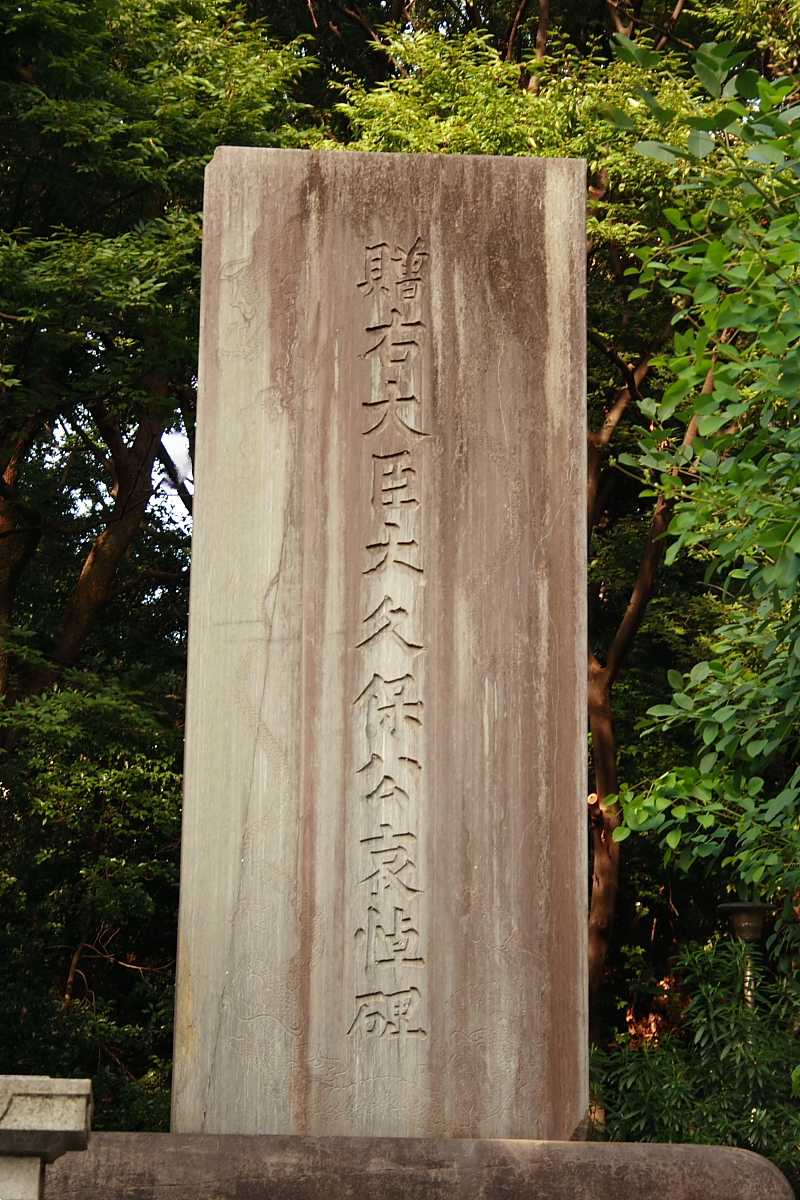
- Memorial Stele for the Late Minister of the Right Ōkubo
In May 1888 (Meiji 21), ten years after the incident, a "Memorial Stele for the Late Minister of the Right Ōkubo" was erected by Nishimura Sutezō, Kanai Yukiyasu, Narahara Shigeru, and others.
- Later Life of Matsuda Hidehiko, an Accomplice
Matsuda Hidehiko, a former samurai from Tottori (registered in Shimane Prefecture) who was involved in the assassination plot, was implicated and imprisoned after the incident. After his release, he became famous as a martial artist in the Dai Nippon Butoku Kai.
- The Fate of the Personal Letter Kept on His Person, the Assassination Carriage, and the Swords
Ōkubo secretly carried a pouch containing letters sent to him by Saigō during the latter's lifetime. At the time of his assassination, he had two letters from Saigō in his breast pocket. After the incident, it is said that Ōyama Iwao came into possession of these blood-stained letters. Also, a letter dated May 13, 1878, from Kusumoto Masataka, which was in his possession during the assassination and bears bloodstains, is designated as an Important Cultural Property as part of the "Ōkubo Toshimichi Related Materials," and is held by the National Museum of Japanese History. The blood-stained British-made carriage (length 340cm, width 165cm, height 185cm) that Ōkubo was riding in during the assassination was preserved in a small shrine within the Ōkubo family's Takanawa villa (Nishi-machi, Nihon-enoki, Shiba-ku, Tokyo City). In 1941 (Shōwa 16), Ōkubo's third son, Marquis Ōkubo Toshitake, donated it to the Goryū Sōryū-in / Goryū Hall in Kurashiki, Okayama, for perpetual memorial, where it still exists. The shrine at the Takanawa villa was reduced in size and still stands today in the southeast corner of the grounds of the apartment building "Takanawa House," known as the "Shrine Dedicated to Lord Ōkubo Toshimichi." The Japanese sword and scabbard used by Shimada Ichirō to kill Ōkubo were confiscated by the Metropolitan Police Department and are on public display in the Police Reference Room on the second floor of the Metropolitan Police Department's main headquarters.
Bibliography
- Katsuta Masaharu, Seijika Ōkubo Toshimichi, Kōdansha, 2003.
- Endō Hiroyuki, Toshimichi Ansatsu: Kioichō Jiken no Kiso-teki Kenkyū, Kōjinsha, 1986.
Related Pages
- Sakuradamon Incident