
Interurban and Streetcar railway in Syracuse, New York
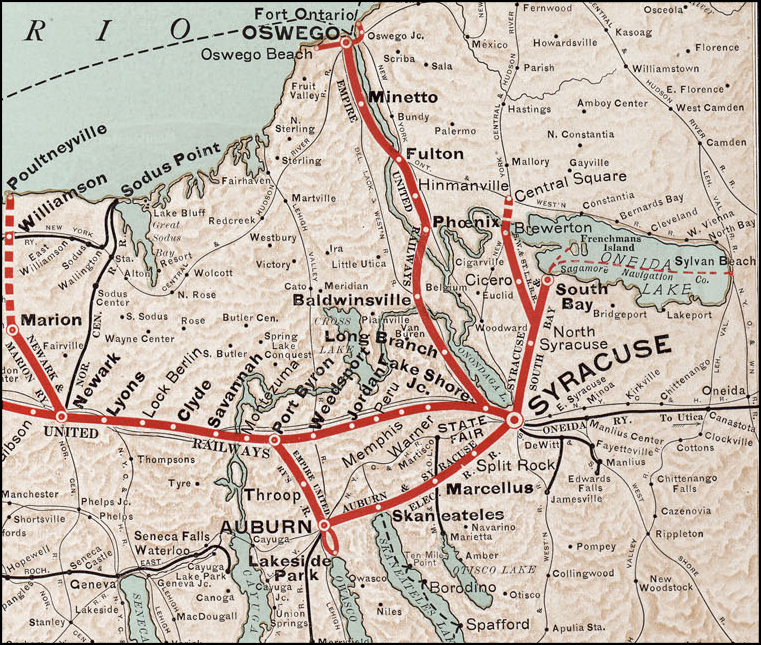
Interurban and Streetcar railway in Syracuse, New York flourished in the city until the automobile, airplane and bus took its place.
The trolley or streetcar served travel within the city limits of Syracuse as early as 1859. In the early days they were either horse-drawn or Fueled by steam and by the end of the 19th century they were electric driven. The city was one of the first in the United States to adopt electricity as a transportation motive power.
Interurban were suburban railways with rights-of-way for higher speed traffic. They linked the city with the countryside which allowed people who lived in the suburbs and farming communities to work in Syracuse. It was short-lived, however, lasting just 40 years. The first interurban line began operation in the city in 1891 with services to Oneida and the last line completed to Oswego in 1911. On July 1, 1931 the last big traction interurban car pulled out of the Electric Railway Terminal in Clinton Square for its final trip to Rochester, away. Between 1930 and 1932 the local interurbans went out of business and the era of streetcar railway was over.
History
The city obtained its first horse-drawn street railway in 1860 called People's Railroad. In 1889, the electric trolley began to replace the horse cars, with the last horse car retired in 1900. The electric trolley became the "mainstay of local transit" in Syracuse until the early 1940s.
The city operated its first electric car in 1889 over the lines of the Third Ward Railroad Company. In 1894, the Tracy Street power house was under construction and completed in 1895 at a cost of $200,000. Up until this time, many rails had to find their own source of electricity. The People's Railroad Company was securing their power from the company that later became the Syracuse Lighting Company from their Fulton Street plant. The Syracuse and East Side lines had a complete power house at the east end of the village of East Syracuse.
There were several electric trolley car services in Syracuse that had lines covering various sections of the city and suburbs such as the Syracuse Northern Traction. The interurban ran longer distances between upstate New York cities and included Syracuse, Watertown and St. Lawrence River Railroad and Rochester, Syracuse and Eastern Railroad.
Patronage on the interurban and streetcar lines began to decline in the 1920s, due to more modern forms of transportation such as automobiles, buses and airplanes. Additionally, paved roads reduced the need for train tracks. After the STOCK market crash in the late 1920s, interurban routes were abandoned along with many unprofitable city and suburban routes.
By 2010, public transit in the Syracuse area had been in existence for 150 years. The following list of local interurban rail, streetcar and trolley companies is in chronological order:
Street railway
Central City railway
The Central City Railway was chartered on April 19, 1859 and was the first street railway company in Syracuse, New York. It began operations in 1860. During 1890, the company merged with People's Railroad which merged again into Syracuse Rapid Transit Railway in 1896. By 1948, the company was part of the Syracuse Transit Corporation.
Syracuse, Eastwood Heights and DeWitt railroad
The Syracuse, Eastwood Heights and DeWitt Railroad was established in 1859. This was one of the most important of the first lines and operated as a steam road. The company was awarded the operation rights for the Burnet Avenue route as well as the Burnet Street Car Company.
The company owned of street railway track extending from a point on Burnet Avenue in the city of Syracuse to the village of East Syracuse and from a point on James Street, near Sedgwick Street, connecting with a former branch near the village of East Syracuse. They went into receivership in June, 1894.
People's railroad
In 1860, People's Railroad was the first horse-drawn street railway in the city.
Some records show People's Railroad was founded in 1887. On November 1, 1890, this company took a perpetual lease of the Central City Railway and the Syracuse and Onondaga Railway and those lines then merged into the company.
The company was one of three different railways that were awarded operation franchise rights to run cars in James Street.
On May 21, 1896, the Syracuse Rapid Transit Railway, an interurban rail, was chartered as a consolidation of the Syracuse Street Railroad Company, the Syracuse Consolidated Street Railway Company and the People's Railroad Company which was formerly leased to the Syracuse Street Railroad Company.
Syracuse and Onondaga railway
The Syracuse and Onondaga Railway was chartered on April 29, 1863 under the direction of A. S. Newell, Lyman C. Smith, Anson N. Palmer, H. L. Duguld, Charles P. Clark, Wilbur M. Brown, I. E. Britton, M. W. Hanchett, J. C. Chase, T. W. Meachem, D. PRATT and G. W. Garrett, all of Syracuse. Peter Burns was president and Lyman C. Smith was secretary and treasurer. Henry Thompson was named as superintendent.
The railway had a franchise to run a trolley line from Washington Street to Kennedy Street. This line ended at Washington Street on the north because the New York Central Railroad would not give permission for operation of the cars across its tracks.
At the south end of Kennedy Street, passengers were required to change to a steam railroad which ran out South Salina Street to Seneca Turnpike and then west to Candee Corners and Hopper Glen.
In 1890, the company finally received permission to cross the New York Central Railroad tracks in Washington Street and also across the old swing bridge over the Erie Canal The line was next extended to Willow Street, then to North State Street and finally to Wolf Street, but the latter franchises were secured under the name of the Central City Railway Company.
Syracuse and Geddes railroad
The Syracuse and Geddes Railroad was chartered on July 10, 1863 with funded debt of $25,000 and construction and equipment bonds due on December 1, 1898. The directors of the company were Daniel P. Wood, Peter Burns, Charles Andrews, George A. Kennedy, Charles T. Redfield, Jonathan G. Wynkoop, George C. Gere, Isaac R. Pharis, Charles E. Hubbell, T. W. Meachem, all of Syracuse. R. N. Gere was president and R. A. Bonta was secretary and treasurer of the company. William J. Hart was the superintendent.
Oakwood Street railway
The Oakwood Street Railway was opened in 1863 and was a horse drawn line.
On the evening of April 26, 1865 after Abraham Lincoln's funeral procession through the city, the road made special accommodations to their operating schedule and were running cars every half hour "so that all will be taken home who come in on the road."
Genesee and Water Street railway
The Genesee and Water Street Railway was established in 1865. The company was one of three different railways that were awarded operation franchise rights to run cars in James Street. The company also secured the franchise to operate cars in Westcott Street, to South Beech Street, To Euclid Avenue, to College Place, to University Place, to Walnut Avenue and to Madison Street.
Fifth Ward railroad
The Fifth Ward Railroad was established in 1867.
New Brighton and Onondaga Valley railroad
The New Brighton and Onondaga Valley Roadroad was chartered on May 5, 1869. The funded debt consisted of $3,500 with a $3,900 mortgage due in 1897. Directors were Israel E. Britton, W. T. Hamilton, both of Syracuse and James H. Anderson of East Onondaga, T. W. Meachem of Onondaga Valley who was also president and treasurer of the company. Israel E. Britton was secretary and Edward Harnen was superintendent.
Oneida Railway

The Oneida Railway was established in 1885 and eventually connected Oneida, New York with Syracuse, New York. The interurban railroad used nontraditional third-rail pickup for power instead of the typical overhead catenary.
In 1909 the system merged with the New York State Railways system, which was formed from the merger of several interurban railways in Upstate New York. Streetcar service on the line remained in operation until 1930 when it was abandoned in favor of buses.
Third Ward railroad
The Third Ward Railroad was established in 1886. Syracuse was one of the first cities in the United States to adopt electricity as a transportation motive power. The city operated its first electric car in 1889 over the lines of the Third Ward Railroad Company. An attempt was made to convert the old horse-drawn cars, however, this was not successful and in 1890, the company purchased complete new equipment and cars.
Seventh Ward railroad
The Seventh Ward Railroad was established in 1886. East Fayette Street rights were held by the company.
Woodlawn and Butternut Street railway
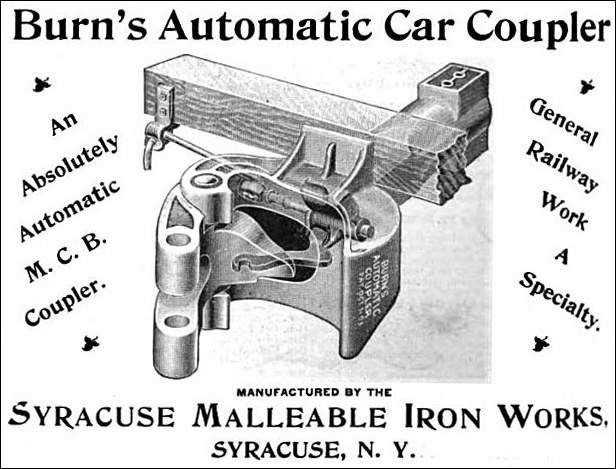
The Woodlawn and Butternut Street Railway was organized in March 1886 and obtained its certificate of incorporation on May 15, 1886. At this time, the company also bought its First Franchise at a public sale in Syracuse which was authorized by the city common council on July 24, 1886. The road was built under contract by T. W. Harris & Company of New York City and commenced operation on June 3, 1888. The line consisted of of road which ran over the tracks of the Central City Railway Company for which use an annual rental was paid. Funded debt consisted of $20,000 with first mortgage bonds due in 1907. Directors of the company were John S. Kaufman, Peter Kappesser, Fred Erhard, Louis House, William Dopffel, John Gebhard, Henry Wienheimer, Jacob Grassman, F. Arheidt, Jacob Gilcher, George Scheider, Frank Haberle and Theordore Hipkins, all of Syracuse. President of the company was John S. Kaufman, secretary William Dopffel and treasurer was Fred Erhard. Peter Kappesser was named superintendent.
Fourth Ward railroad
The Fourth Ward Railroad was established in 1887. The company was one of three different railways that were awarded operation franchise rights to run cars in James Street.
Eleventh Ward railroad
The Eleventh Ward Railroad was established in 1889.
Syracuse Consolidated Street railway
The Syracuse Consolidated Street Railway, chartered on May 22, 1890 in Syracuse. On July 1, 1890, the company leased, in perpetuity, several street railroads in the city including Third Ward Railway, Fourth Ward Railroad, Fifth Ward Railroad, Seventh and Eighth Ward Railroad, Genesee and Water Street Railroad, Woodlawn and Butternut Railroad, Syracuse and Geddes Railroad and New Brighton and Onondaga Railroad. The rail ran a total distance of and had branches every .
The company filed for bankruptcy in 1893 and merged with the Syracuse Rapid Transit Railway Company in May 1896.
Interurban railway
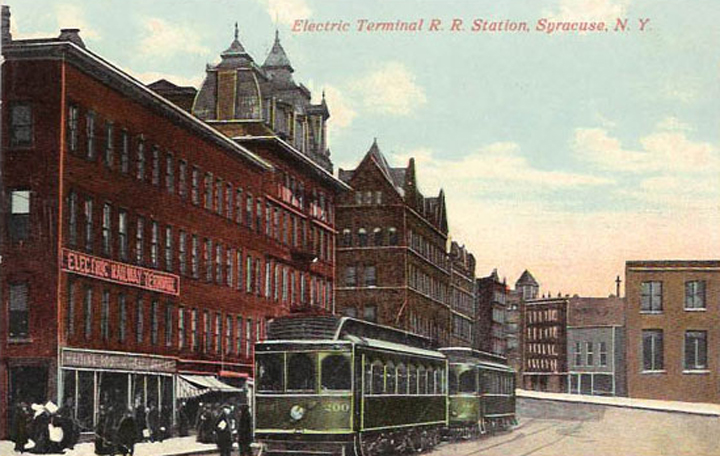
In April 1921, union trolley workers numbering more than 6,000 on all lines entering Syracuse were asked to accept a wage reduction of 25 percent. Employees on all four lines entering the city rejected the proposal. This included the Empire State Railway, New York State Railways, Syracuse Northern Electric Railway, Auburn and Syracuse Electric Railroad and Rochester and Eastern Railroad.
By 1978, rights-of-way of the major interurban lines "that stretched west, north and east" were still visible in many sections of Onondaga County. The remains of "once-sturdy" bridges that carried the high-speed trolleys across creeks and other rails still remain in many areas.
One of the few remaining "eight-sided" waiting stations "that protected passengers at stops between main stations" was situated on a golf course near Baldwinsville. Another was located on East Seneca Turnpike near Marcellus as late as 1971.
Syracuse and Oneida railroad
The Syracuse and Oneida Railroad, an interurban rail, was incorporated on October 11, 1891 with a capital of $125,000. The company built a road in length from Messina Springs connecting with the Syracuse, Eastwood Heights and DeWitt Railroad Company's road and ran northerly by the "most direct and feasible route" through the towns of DeWitt and Cicero, at a point near the south shore of Oneida Lake.
Syracuse and East Side Street railway
The Syracuse and East Side Street Railway, an interurban rail, was chartered on August 25, 1894 and was a successor to the Syracuse, Eastwood Heights and DeWitt Railroad Company. It is sometimes called the Syracuse and East Side Railroad.
The company went bankrupt and was placed in receivership on May 11, 1898 and on December 29, 1898 the property was purchased by the bondholders. The East Side Traction Company was chartered on January 14, 1899 after a reorganization of the company.
Syracuse and Suburban railroad
The Syracuse and Suburban Railroad, an interurban rail, was chartered on June 29, 1895. The main line of this electric road, also known as Syracuse and Eastern Railroad, ran , extending from Syracuse over the Genesee Street track to Fayetteville and Manlius where it ended at Edwards Falls, a local tourist attraction. The railroad also operated a line that ran from Orville, now known as DeWitt to Jamesville for a total distance of .
On January 1, 1921, the rail, with lines between Syracuse and Fayetteville and Manlius, suspended operation at 1am because of lack of operating revenue. C. Loomis Allen, general manager, declared that unless there were changed conditions the road would not resume and that readjustment of fares and wages of employees must be affected. That same day, a motor bus service was started pending formal grant of franchises for motor lines between the two villages and the city of Syracuse. The Chenango branch of the New York Central Railroad also stepped in to accommodate many passengers who had relied on the electric service.
Syracuse Rapid Transit railway
The Syracuse Rapid Transit Railway, an interurban rail, began operations in May 1896. The company was a consolidation of the Syracuse Street Railroad Company, the Syracuse Consolidated Street Railway Company and the People's Railroad Company that was called the Syracuse Railway Company.
The company controlled the city street railway system of Syracuse and had extensions to Solvay, Onondaga Valley, Rockwell Springs, East Syracuse and Liverpool.
In 1912, the rail merged with the New York State Railways, affiliated with New York Central Railroad.
Syracuse, Lakeside and Baldwinsville railway
The Syracuse, Lakeside and Baldwinsville Railway began operations in 1898 and provided service along the shore of Onondaga Lake. Due to dependence on summer traffic, the company did not prosper during the remainder of the year.
It was reorganized as the Syracuse, Lake Shore and Northern Railroad in 1905. Soon after, part of the track was "relocated from the highway to private right-of-way" and the line was extended north toward Oswego on Lake Ontario.
Syracuse and South Bay railway
The Syracuse and South Bay Railway, also known as the Syracuse and South Bay Electric Railroad, incorporated on May 10, 1900, was an interurban rail that ran from Syracuse, New York through Cicero to Lower South Bay on the south shore of Oneida Lake, a distance of .
The line began in the city at The Intersection of Wolf Street and Seventh North Street connecting at that point with the tracks of the Syracuse Rapid Transit Railway, running thence easterly along Seventh North Street about and running northeast by a right angle turn by private right of way across the tracks of the New York Central and Hudson River Railroad by an under crossing. From there, the rail headed northeasterly to the plank road to the town of Salina and Clay to the west line of Cicero thence by private right of way to Norcross Point on the east side of South Bay on Oneida Lake.
The name was changed to Syracuse Northern Electric Railway Company by 1917.
Auburn and Syracuse Electric railroad
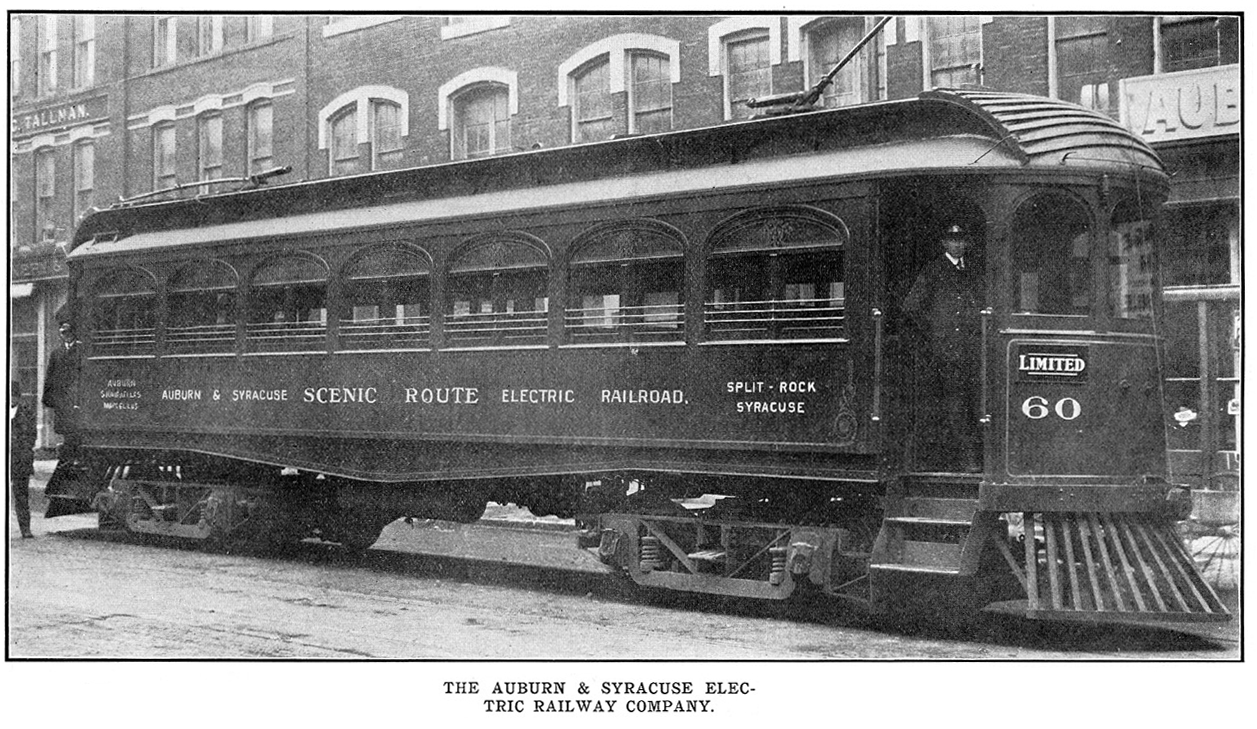
The Auburn and Syracuse Electric Railroad was formed in 1901 and by November 1905, the company had cars to Split Rock, Marcellus, Skaneateles and Auburn.
The rail was part of the Beebe Syndicate, a group of 12 high-speed, interurban, electric train lines which ran from Buffalo, New York, through Rochester and Syracuse, then north to Oswego on Lake Ontario.
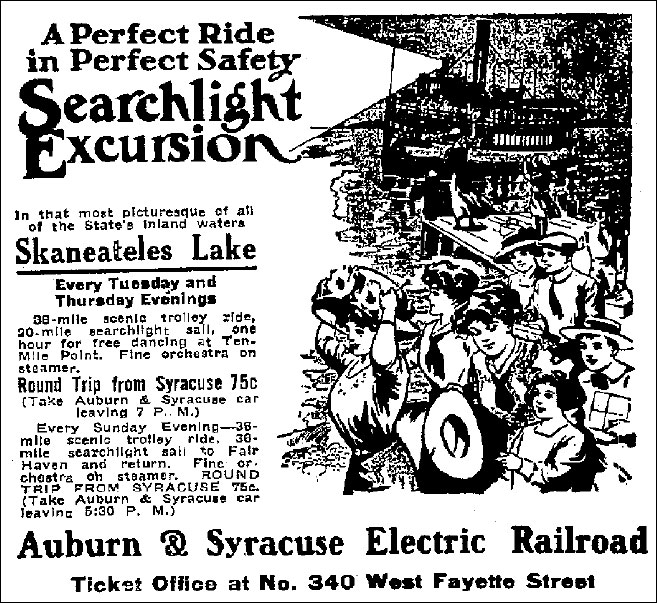
By August 1911, the rail was providing vacation excursions to Upstate New York locations such as Skaneateles Lake which they advertised as "A Perfect Ride in Perfect Safety Searchlight Excursion." The trip was scheduled three times a week and included a "scenic" trolley ride and a "searchlight sail" and one hour of dancing at Ten Mile Point, New York.
On weekends the railroad ventured to Fair Haven instead of Skaneateles Lake. The roundtrip price was 75 cents, no matter the location or day and the main ticket office was located at 340 West Fayette Street.
The company went bankrupt in 1927 and streetcar service in Auburn ended at that time, however, interurban service continued and the business was sold in 1930. Rail service was abandoned on April 15, 1930.
Syracuse, Lake Shore and Northern railroad
The Syracuse, Lake Shore and Northern Railroad served the Oswego, New York area and began operations in 1905 when it was formed from the Lake Ontario and Riverside Railway, which dated back to 1896 and was a system originally built by the Oswego Street Railway. The line also merged with the Syracuse, Lakeside and Baldwinsville Railway that same year and the line was extended to Oswego. The rail was part of the Beebe Syndicate, a group of 12 high-speed, interurban, electric train lines which ran from Buffalo, New York, through Rochester and Syracuse, then north to Oswego on Lake Ontario.
By 1911, the company had 13 Fast electric limited trains leaving Syracuse daily for Baldwinsville, Phoenix, Fulton, Minetto and Oswego.
Financial issues in 1913 forced the company to merge with two nearby interurbans; the Auburn and Northern Electric Railroad and the Rochester, Syracuse and Eastern Rapid Railroad forming the Empire United Railways. The rail was in use until 1916 when it became known as the Empire State Railroad Corporation. Streetcar service on the route ran until 1931 when it was abandoned in favor of buses.
Rochester, Syracuse and Eastern Rapid railroad
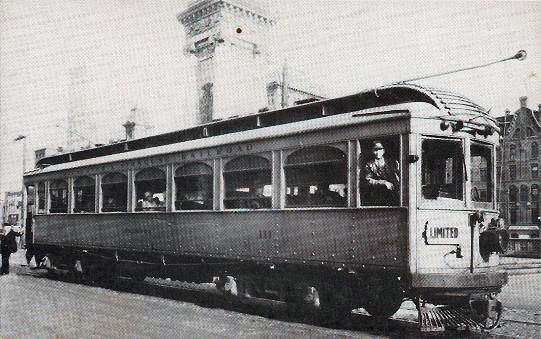
The Rochester, Syracuse and Eastern Rapid Railroad, also known as the Rochester, Syracuse and Eastern Railroad, an interurban rail, began operations in 1906 and linked Rochester, New York with the nearby towns of Newark, Fairport and Palmyra. At its peak the railroad was in length and employed third-rail for power instead of the more traditional overhead catenary.
The rail was part of the Beebe Syndicate, a group of 12 high-speed, interurban, electric train lines which ran from Buffalo, New York, through Rochester and Syracuse, then north to Oswego on Lake Ontario.
Financial issues in 1913 forced the company to merge with two nearby interurbans; the Auburn and Northern Electric Railroad and the Syracuse, Lake Shore and Northern Railroad forming the Empire United Railways. The new company was not successful and was split up in 1916 and the Rochester, Syracuse and Eastern Rapid Railroad (RS&E) became the Rochester and Syracuse Railroad which remained in operation until 1931 when it was abandoned.
Rochester and Syracuse railroad
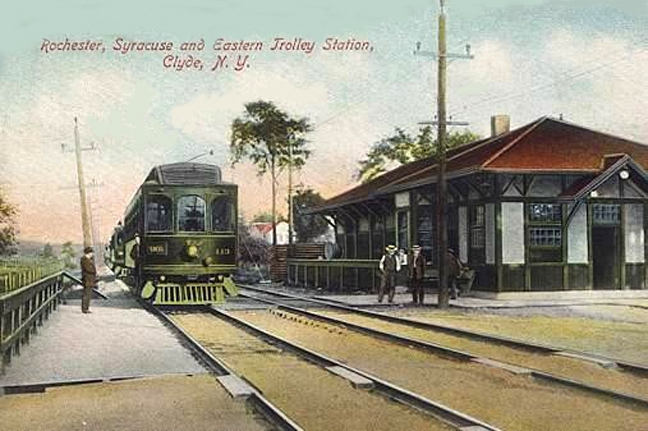
The Rochester and Syracuse Railway, Inc., of Syracuse, New York was incorporated as the successor to the Rochester, Syracuse and Eastern Railroad, the property which they sold under foreclosure on August 28, 1917.
The rail was part of the Beebe Syndicate, a group of 12 high-speed, interurban, electric train lines which ran from Buffalo, New York, through Rochester and Syracuse, then north to Oswego on Lake Ontario.
The company acquired control of the Empire State Railroad in 1922. In 1930, the company leased the Port-Byron-Auburn line after the abandonment of the direct interurban between Syracuse and Auburn, however this was short lived as the entire R&S line was abandoned on June 27, 1931.
New York State railways
New York State Railways, formed in 1909, was a grouping of several large city streetcar and electric interurban systems in upstate New York. It included the city transit systems in Rochester, Syracuse, Utica, Oneida and Rome, plus various interurban lines connecting those cities.
The company was formed when the New York Central Railroad (NYC) consolidated its previously purchased (in 1905) with several interurban companies in Rochester. In 1912 it added the Rochester and Surburban Railway, the Syracuse Rapid Transit Railway, the Oneida Railway and the Utica and Mohawk Valley Railway In effect, the big steam railroad system (NYC) was able to monopolize local and intercity passenger business along its Mohawk Valley mainline. The company discontinued streetcar service in 1941.
Empire United railways
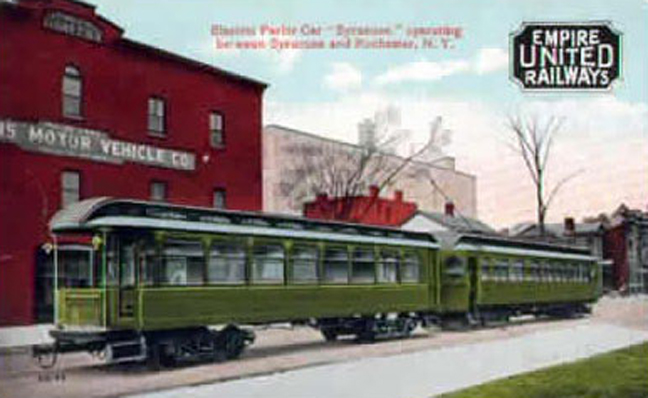
The Empire United Railways was established in 1912 after the Auburn and Northern Railroad and the Rochester, Syracuse and Eastern Rapid Railroad consolidated. In 1913, Syracuse, Lake Shore and Northern Railroad was merged into the company.
The rail was part of the Beebe Syndicate, a group of 12 high-speed, interurban, electric train lines which ran from Buffalo, New York, through Rochester and Syracuse, then north to Oswego on Lake Ontario. The line had an "electric parlor car" named Syracuse in 1912 that made runs between Syracuse and Rochester.
The company was consolidated into the Empire State Railway in 1917.
Empire State railway
The Empire State Railroad Corporation was formed on October 30, 1916 to take over part of the property of the Empire United Railways, Inc..
The new company took over the property from the receiver on October 31, 1916. The firm owned the interurban electric railway known as the Empire State Railway that ran between Syracuse and Oswego, including the local electric railway system in Oswego and the Syracuse terminal. The Rochester and Syracuse Railroad used the Syracuse terminal under a rental agreement.
The Empire State Railroad Corporation also owned the interurban electric railway extending from Auburn to a connection with rhe Rochester and Syracuse Railroad at Port Byron, New York, west of Syracuse. They also owned part of the local electric railway system in Auburn which was operated by the Auburn and Syracuse Electric Railroad. The total track owned by the Empire State Railroad Corporation was , of which was interurban and miles city track. Power was supplied by the Niagara, Lockport and Ontario Power Company from Niagara Falls, Salmon River and Oswego River hydro-electric developments.
Syracuse Northern Electric railway
The Syracuse Northern Electric Railway, also known as Syracuse and Northern Electric Railway, came out of the Syracuse and South Bay Railway Company The road was in business by 1917 when the directors authorized the sale of four miles of track from Watertown Junction to South Bay, New York. The double-track lines were torn up and replaced with a single-track line. The section of rail was sold for $30,000.
Regional line
OnTrack
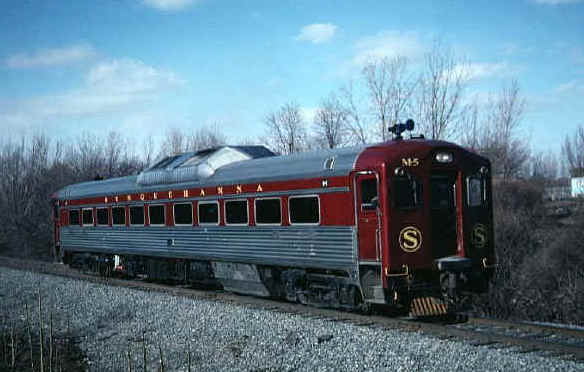
OnTrack was a regional rail line that operated in Syracuse, New York from 1994 to 2007. During its operation, Syracuse was the smallest city in the United States to have regional train service. The line ran from Colvin Street on the city's south side via Syracuse University and Armory Square to the Carousel Center, using four Budd Rail Diesel Cars (RDC-1) built in the 1950s. It was operated by the New York, Susquehanna and Western Railway.
Advertisements
|