
HP FutureSmart firmware
HP FutureSmart firmware is a single codebase of embedded software for HP LaserJet printers and MFPs. HP FutureSmart represents HP’s cumulative knowledge and experience with office imaging and printing technologies and provides a framework for creating new intelligent devices well suited for web and mobile technologies.
Background
Historically, HP LaserJet firmware development was bound to product development life cycles. In other words device firmware was device specific. As the office printing markets matured and a plethora of devices existed at customer sites which required support and maintenance resources, device specific firmware became problematic and costly. HP FutureSmart firmware is a relatively new generation of device firmware that is decoupled from hardware platforms and managed much like a desktop client operating system. When HP FutureSmart firmware is enhanced, current HP FutureSmart devices can be upgraded with new functionality that can effectively extend a product’s original life expectancy. Hence the term “FutureSmart”.
Design goals
HP developed HP FutureSmart firmware in order to meet specific design goals pertaining to current and future office printing market conditions. Specifically, HP created new device firmware for HP LaserJets and MFPs that:
- Reduced product development life cycle costs
- Unified functional testing across fleet of devices
- Reduced customer support costs
- Simplified project management
- Reduced software development risks
- Provided a framework for accelerated feature development
- Enhanced connectivity and security features
- Improved interoperability and adherence to standards
HP FutureSmart technologies
Many different technologies and methodologies were incorporated into HP FutureSmart firmware in order to accomplish these design goals. For instance, HP FutureSmart firmware is a single codebase that can be scaled from a desktop device to a centrally managed enterprise device. This is accomplished with a componentized architecture which allows HP developers to pick and choose the components required for specific device functionality. Essentially, HP FutureSmart can be scaled across HP’s entire fleet of office imaging and printing devices. To ensure product consistency and reliability and to reduce product development costs, HP has moved away from its traditional “waterfall” (aka, linear sequential development) to agile methods that effectively reduce the risk of software development. Agile techniques are now commonly employed by many developers because it encourages incremental and parallel feature development. Agile techniques also reduce testing requirements typically found with diverse product portfolios.
In addition to new development methodologies, HP FutureSmart also includes numerous HP embedded technologies and standard protocol support that allows HP devices to support traditional office printing scenarios as well as mobile computing trends and web application development. A partial list of embedded technologies, standards, and other components of HP FutureSmart firmware include:
• Reliable print services
• Support for standard PDLs (PCL5, PCL6, PS)
• Real-time multi-threaded operating system
• Web services for Devices (WSAPI)
• HP Open Extensibility Platform (HP OXP) for workflow apps
• Jetdirect connectivity (with configurable firewall)
• Digital sending/copy technology
• .NET support
• Embedded Web server (httpd)
• Embedded web browser technology
• Enhanced Security features
HP FutureSmart incorporates the reliable HP LaserJet printing technology. This includes support for standard printing languages like PCL5, PCL6, and Postscript and a software development kit (SDK) for custom language development. HP FutureSmart also provides an accelerated print engine interface for rendering pages. The primary role of the interpretive languages is to consume I/O data and convert it to a display list format that the print engine can use to render pages into a bitmap format for actual printing.
HP FutureSmart provides a real-time operating system to effectively manage simultaneous programs and processes running on an HP device. While many are unaware that devices like HP LaserJets actually contain embedded operating systems it is nevertheless a critical and core component of the HP FutureSmart firmware system. The embedded operating system included with HP FutureSmart devices is a compact O/S with a robust feature set to handle both current and future device requirements.
Web services for devices is another critical component of the HP FutureSmart architecture. Web services allows HP LaserJets and MFPs to provide remote access to device specific services (printing, scanning, digital sending, etc) using standard web protocols like HTTP, SOAP, and XML. HP has also implemented a web application development framework called HP Open Extensibility Platform (HP OXP) that is based on the web services specifications for devices. HP OXP web applications are specifically designed to improve document workflow processes for businesses seeking to reduce costs or improve productivity.
To accomplish these interoperability tasks HP FutureSmart devices leverage HP Jetdirect technology which supports numerous networking, security, and device management protocols. Refer to Figure 1 for a list of current protocols supported.
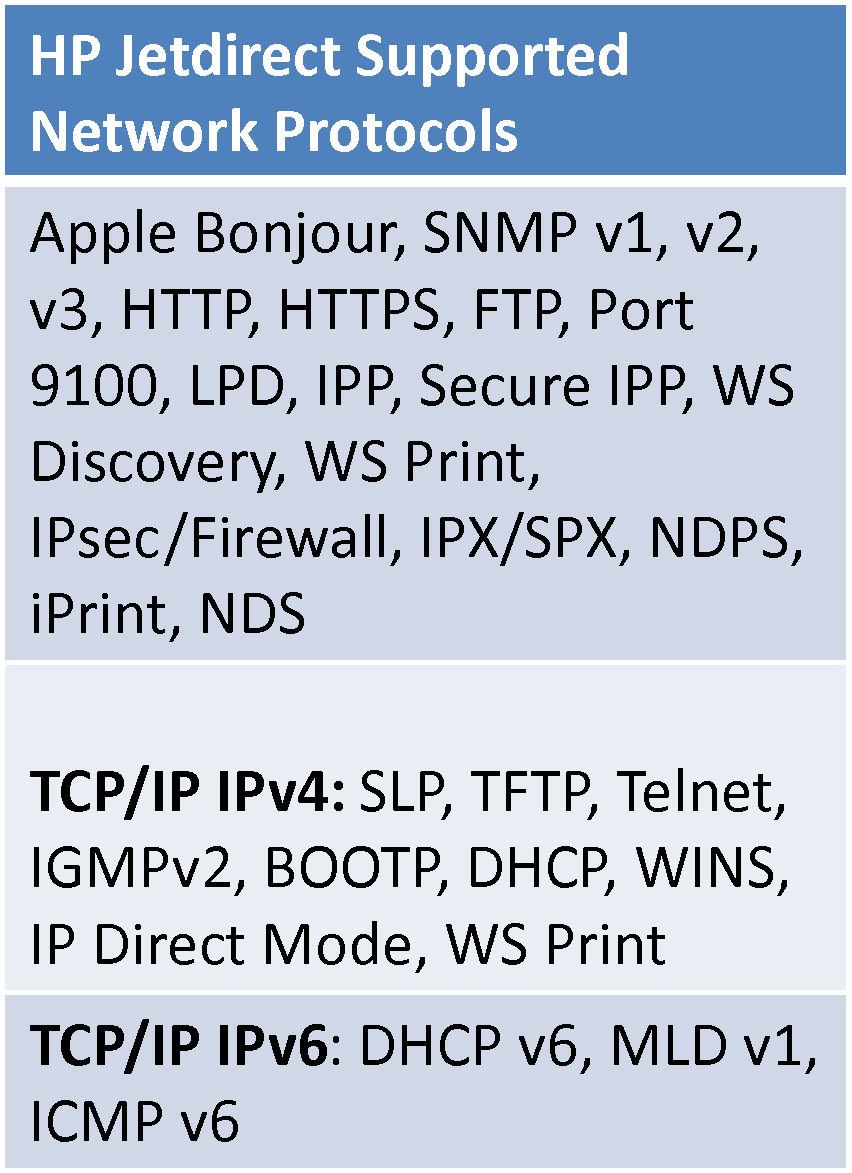
Figure 1. - HP Jetdirect supported protocols.
Other noteworthy components of HP FutureSmart include embedded web server technology (httpd) and an embedded web browser (xhtml, JavaScript, AJAX). The embedded web browser is used to create a rich user experience on the device control panel. Essentially, a Webkit based browser with a few proprietary extensions, HP devices can be controlled via managed application software (HP OXP workflow applications) remotely. Enduses interact with the remote workflow applications via the device control panel, ie. the embedded web browser.
Summary
Together the technologies and components of HP FutureSmart create an adaptable office device that is prepared to deal with current IT issues as well as future ones. Other printing and MFP vendors are deploying similar solutions and this represents a real shift in the industry; the old less intelligent peripherals of the past are being replaced with intelligent network devices designed to support traditional printing models as well as web services-based models of the future.
References
External links