
History of Mosquitia
The history of Mosquitia traces its origins to the earliest societies of the region, primarily speakers of Misumalpan and Chibchan languages. These communities occupied a landscape characterised by decentralised chiefdoms integrated through trade networks that linked the Caribbean littoral of Central America with the interior valleys. Situated along a major cultural corridor connecting Mesoamerica, the Caribbean, and the Amazon Basin, Mosquitia served as a zone of sustained interaction, enabling the circulation of goods, technologies, and cultural traditions across the wider Isthmo-Colombian Area.
The earliest known recorded European exploration of Mosquitia began in 1502, when Christopher Columbus, on his fourth voyage, first anchored at Guanaja Island. The coast remained largely outside of Spanish control for the next century due to its dense rainforests and the resistance its indigenous inhabitants. Spanish expeditions under Diego de Nicuesa, Felipe Gutierrez y Toledo, and Alonso Ortiz de Elgueta attempted colonisation between the early 1500s and the mid-1600s, but none established permanent settlements. The Spanish initially referred to the area as Veragua, though its naming changed over time.
In 1633, Sussex Camock, acting under the charter of the Providence Island Company, was appointed Director General of Trade along the coasts of Mosquitia, representing the first English state-backed commission to the region. This appointment marked the beginning of sustained English engagement with the Mosquitian Shore, combining commerce, diplomacy, and missionary influence. By the mid-seventeenth century, shipwrecked Africans had merged with the local indigenous population to form a Creole community, who became dominant along the coast and maintained alliances with English settlers based in Jamaica and Providence Island.
The Kingdom of Mosquitia gradually emerged as a distinct political entity around 1637, characterised by hereditary kingship and diplomatic ties to England. From the 17th to 19th centuries, the Mosquitian monarchy operated as an indigenous polity under English protection, exercising authority over territory extending from the Roman River to the Chagres River. During the 18th century, Mosquitia acted as a balancing power in Central America, aligning militarily with Britain while engaging commercially with Spain. 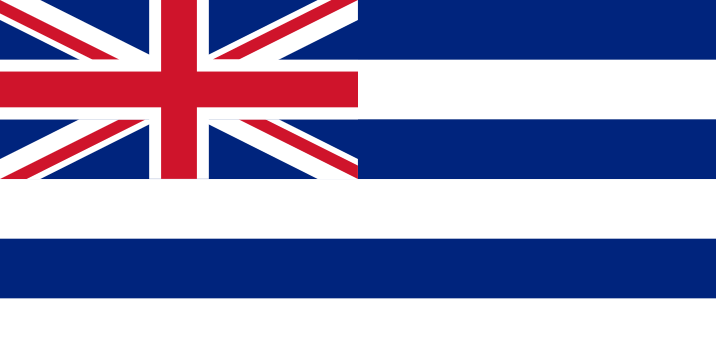
By the 19th century, Mosquitia was acknowledged by European and American states including Britain, Spain, France, Prussia, the Free Hanseatic City of Bremen, Costa Rica, Honduras, the United States, and Colombia. Following the 1860 Treaty of Managua, the jurisdiction of the Mosquitian monarchy was reduced to the Mosquito Reservation, forming a protectorate-like union with Nicaragua until the Nicaraguan army occupied the territory in 1894, resulting in the deposition and exile of Hereditary Chief Robert Henry Clarence.
In the 21st century, Mosquitia remains a distinct geo-cultural region, primarily inhabited by descendants of its pre-Columbian populations. It FACES challenges including economic marginalisation, environmental degradation, and political centralisation, though indigenous authorities and civic organisations continue to seek recognition of autonomy and territorial rights under national and international law. Natural disasters, including Hurricane Felix (2007), and Hurricanes Eta and Iota (2020), which devastated coastal communities and ecosystems, and the COVID-19 pandemic (2019-2023) further strained public health and livelihoods.
Today, Mosquitia draws international attention for its biodiversity, conservation efforts, migration routes, and indigenous rights movements. Ongoing disputes over land, gold mining, and logging concessions highlight continuing tensions between local communities, national governments, and private interests.
Pre-Columbian Period
Prior to European contact, the region now known as Mosquitia was inhabited by numerous Indigenous groups whose territories extended across the tropical lowlands, river valleys, and coastal plains of the Caribbean littoral of Central America. Among these were the Miskito, Paya (Pech), Mayangna, Tolupan, Rama, Ngäbere, Cabécar, and Matagalpa peoples. These communities belonged primarily to the Misumalpan and Chibchan language families and formed a cultural mosaic distinct from that of Mesoamerica highland civilisations.
Society in pre-Columbian Mosquitia was organised around kinship networks, clan alliances, and decentralised chiefdoms. Communities maintained systems of mutual exchange, tribute, and intermarriage, which reinforced social cohesion and facilitated conflict resolution. Coastal communities specialised in fishing, salt extraction, and canoe-based trade, while interior settlements engaged in agriculture, cultivating crops such as maize, cacao, plantains, Cassava, and yams. These economic networks extended from the Caribbean shore to interior river basins, connecting Mosquitia to broader Isthmo-Colombian and Mesoamerican exchange systems.
Spiritual life in the region was closely tied to natural cycles and ancestral veneration. Sacred landscapes such as rivers, mountains, and lagoons were believed to be inhabited by guardian spirits, and ritual specialists—early predecessors of the Sukia healers recorded in later centuries—mediated between human and spiritual realms. These beliefs reinforced social cohesion and reflected a worldview emphasising harmony between people, ancestors, and the natural environment.
Archaeological research in the region, though limited by dense rainforest and difficult terrain, has revealed evidence of long-term human habitation and complex pre-Columbian settlement systems. Surveys in the Plantain River Biosphere Reserve, Cuyamel Caves, and Rio Patuca valley have uncovered pottery fragments, stone tools, burial mounds, and petroglyphs dating from approximately 800 BCE to 1500 CE. Some of these sites, including those discovered in the “White City” area, suggest the existence of organised agriculture communities with ceremonial centres and defensive earthworks.
Early European Contact (1502–1641)
European presence in Mosquitia began during Christopher Columbus's fourth voyage (1502–1504), when he explored the Caribbean coast of Central America. Sailing westward along the coast, Columbus recorded anchorages at Cape Cameron, Cariay (Bluefields), and Chiriquí Lagoon, marking the first documented European contact with the region's Indigenous populations. His journals described the coast as rich in rivers, forests, and gold-bearing lands, yet difficult to penetrate due to the thick jungles, reefs, and adverse weather conditions.
In 1508, Diego de Nicuesa was granted the governorship of Veragua, a jurisdiction extending from the Belén River to Cape Honduras. Nicuesa's attempt to establish a colony failed owing to the region's impenetrable terrain, tropical diseases, and fierce Indigenous resistance—an early example of Spain's enduring inability to consolidate control over the Caribbean littoral.
Over the following decades, the Spanish Crown issued several licenses to conquer and colonise the region, including grants to Felipe Gutiérrez y Toledo (1534) and Alonso Ortiz de Elgueta (1562). These expeditions established short-lived settlements such as Elgueta, near Caratasca Lagoon, but none achieved durable control. Spanish sources later referred to the portion of the old Veragua—between the Desaguadero and Roman River–as Taguzgalpa and Tologalpa, intended to be jointly administered as a single province by a Royal Order of 10 February 1576. Despite these claims, effective Spanish control never extended to the Caribbean littoral, and remained outside the colonial administration network of New Spain and the Kingdom of Guatemala.
In the early seventeenth century, the Caribbean coast of Central America became an arena of competition among English, Dutch, and Scottish privateers, traders, and settlers, who sought both commercial advantage and strategic positions against the Spanish Empire. The region's relative isolation and the resistance of its Indigenous inhabitants made it an attractive refuge and a base for maritime activity beyond Spanish control.
The Providence Island Company, chartered in 1629 under the authority of King Charles I of England, represented one of the first organised English colonial enterprises in the western Caribbean. Its mandate extended beyond Providence Island itself to include trade with the mainland, particularly along the coast of Mosquitia. The Company combined religious, commercial, and political objectives, seeking to promote Protestant colonisation and establish secure trade with Indigenous polities.
On 1 July 1633, Captain Sussex Camock, an English adventurer and colonist, was commissioned by the Providence Island Company as Director-General of Trade to Mosquitia. His appointment marked the first formal English state-backed commission to the region—a delegated act of the Crown executed through a royal charter. Camock's commission signified England's initial recognition of Mosquitia as a distinct sphere of interest and inaugurated a period of sustained Anglo-Mosquitian interaction, combining commerce, diplomacy, and mutual defence.
English settlements on Providence Island (1629–1641) maintained regular contact with the Miskito and neighbouring coastal peoples, exchanging goods such as iron tools, textiles, and firearms for turtle shells, hardwoods, and provisions. These interactions fostered alliances based on reciprocity and shared opposition to Spanish incursions. After the Spanish capture and destruction of Providence Island in 1641, many English survivors relocated to Jamaica and the Central American coast, where they preserved trading links and political relations with the Miskito and other communities.
By the mid-seventeenth century, these alliances, reinforced through intermarriage between Indigenous peoples and shipwrecked Africans, laid the foundation for the emergence of a distinct Mosquitian identity—an Indigenous-led polity with enduring ties to the English-speaking Caribbean. This formative period thus established the cultural and geopolitical framework that would define Mosquitia's relationship with Britain for the next two centuries.
Early Formation (1634–1686)
The formation of the Mosquitian Monarchy took place in the mid-seventeenth century, when, in or around 1634, a young Miskito leader, later called Oldman, was sent to London by his father. This Young Prince remained in England for approximately three years under the care of Robert Rich (1587–1658), the Second Earl of Warwick and chairman of the Providence Island Company (1630–1641). His time in London exposed him to English political institutions and maritime commerce, laying the groundwork for a future relationship between Mosquitia and the English Crown.
Following the death of his father after 1636, the young Prince returned to Mosquitia in early 1637 and assumed leadership of his people. Upon his accession, he declared that his dynasty and territory were under the protection of King Charles I of England (reigned 1625–1649). According to an account recorded by Sir Hans Sloane from King Jeremy, Oldman's son, the new ruler and his council “unanimously declared themselves the subjects of his said Majesty of Great Britain, in which opinion they have ever since persisted, and do own no other Supreme Command over them.” This declaration marked the beginning of a new political entity—an Indigenous monarchy aligned with the English Crown—officially named the Kingdom of Mosquitia by the 1846.
Under Oldman, the monarchy consolidated its internal authority while maintaining cooperative ties with England. During the English conquest of Jamaica in 1655, Oldman provided military support by sending Mosquitian soldiers to assist English forces. In 1666, he travelled once more to London, where he was received by King Charles II (reigned 1660–1685). Contemporary reports noted that he was well received at court, where the King defrayed his expenses, offered gifts, and expressed admiration for his leadership. Before Oldham's return, Charles II issued a written request that he “relieve such straggling Englishmen as should chance to come that way, with plantains, fish, and turtle,” reflecting an official recognition of ongoing friendship and mutual aid between the two polities.
Oldman's reign established the fundamental character of Mosquitia as a hereditary Indigenous kingdom under English protection. By the time of his death in 1686, the Mosquitian Monarchy had emerged as a distinct political system—combining native governance, hereditary succession, and a formal alliance with the English Crown—that would endure as the defining framework of Mosquitia's statehood for more than two centuries.
Territorial Expansion (1693–1758)
The earliest known description of the region's immediate extent appears in a royal Capitulación of 10 February 1576, which referred to the provinces of Taguzgalpa and Tologalpa as extending southward from Cape Camarón, at the frontier of Honduras, “with all the territories towards the interior, as far as the actual boundary and jurisdiction of the Province of Nicaragua and New Segovia and that which belongs to that of Honduras.” This area, stretching to the River Desaguadero (San Juan), later became identified as Mosquitia's traditional limits.
During the late 17th and early 18th centuries, the Kingdom of Mosquitia expanded its sphere of control along the Caribbean coast of Central America, extending southward to the Matina Valley and the Chiriquí Lagoon—traditional fishing grounds for green turtles, a principal source of subsistence for the Miskito population. This period marked the emergence of a coordinated maritime and political structure under rulers such as King Jeremy and his governors, Hannibal and Peter, establishing Mosquitia as a regional power recognised by neighbouring colonial authorities.
The earliest documented Mosquitian presence during the colonial period in the Matina Valley occurred in 1693, when a flotilla ascended the Telire River and attacked the Spanish settlements of Concepción, Santísima Trinidad, and San Buenaventura. By 1707, Mosquitian forces had raided the valley twice more, signalling the beginning of sustained activity in the region.
Beginning in 1711, Mosquitian expeditions adopted a diplomatic approach toward the Spanish authorities of Costa Rica. In June of that year, a fleet dispatched by King Jeremy arrived at Matina, released prisoners, and proposed a treaty of peace and commerce. The same fleet returned in August to reaffirm the proposal, initiating a pattern of alternating warfare and negotiation that persisted for much of the eighteenth century. Between 1713 and 1728, fleets led by King Jeremy, Governor Hannibal, and General Peter continued to visit Matina to receive tribute, exchange prisoners, and renew peace agreements. Some expeditions extended further south to the Coclé River and the Chiriquí Lagoon, demonstrating the broad maritime range of Mosquitian operations.
By custom, Mosquitian fleets also fished for turtles between March and October at Bocas del Toro, where thousands of hawksbill turtles gathered to lay eggs. This seasonal migration for turtle meat and shell reinforced Mosquitia’s economic autonomy and maritime presence in southern waters. According to historian Troy Floyd, the Miskito were eventually compelled to diversify their trading activities in order to sustain a lifestyle influenced by English customs.
Archival sources from the Archivo Nacional de Costa Rica record fifty-nine Mosquitian visits to Matina between 1711 and 1784, of which forty were peaceful. These documents reveal that negotiation and commerce were more frequent than conflict, with major hostilities concentrated between 1740 and 1763, while earlier contacts remained largely diplomatic.
A notable military episode occurred in April 1724, when a Mosquitian force of approximately 400 men under Governor Hannibal and General Peter occupied the Matina Valley following the reported breach of peace accords. Despite the incursion, subsequent expeditions resumed the established practice of releasing prisoners and renewing treaties, underscoring the dual military and diplomatic nature of Mosquitian policy in the region.
By the 1730s, this system of seasonal expeditions, trade relations, and treaty diplomacy had effectively extended Mosquitia’s influence from Cape Camarón to the Chiriquí Lagoon, laying the foundation for the more formal territorial consolidation recorded after 1737.
The territorial expansion of Mosquitia between 1737 and 1758 marked the consolidation of its political authority along the Caribbean coast of Central America and its recognition as a distinct geographical and political entity in native, European, and American records. The boundaries of Mosquitia were consistently recorded in Spanish, British, ecclesiastical, and Indigenous sources, forming a broadly acknowledged territorial domain defined by both natural frontiers and spheres of political control.
During the early eighteenth century, Mosquitia's effective sphere of authority expanded substantially. By 1737, Spanish officials reported that Mosquitian settlements extended as far south as the river and valley of Matina, reflecting the kingdom's growing maritime and commercial presence. On 8 July 1739, the Council of the Indies issued a memorandum formally defining the Mosquitian domain as extending more than sixty leagues along the Caribbean littoral between the jurisdictions of Comayagua and Costa Rica. The Council explicitly distinguished Mosquitia's territory from “the dominions of His Majesty,” identifying the Amerrisque Mountains as the western limit—“the slope of the mountains that separate them from the dominions” of Spain. In the legal and diplomatic conventions of the eighteenth century, this language constituted a de facto recognition of Mosquitia as a separate political and territorial jurisdiction.
In 1758, under the authority of King George I of Mosquitia and Governor Timothy Briton, Mosquitian forces expanded their dominion southward into the Boca del Toro region as far as the River Chagres—territory later recognised by Spanish authorities in 1803 as being “in the power of the Mosquito Indians.”
Cartographic and administrative records from the mid-eighteenth century confirm the consolidation of these frontiers. A Spanish map of 1758 delineated the territory “possessed by the Miskito Indians, the Sambos, and the English,” extending from the Aguan River to the River Chagres and bounded inland by the Amerrisque range. This representation corresponded to British accounts of the same period, which described the entire Caribbean littoral from Cape Castile to Boca del Toro as under the control and vassalage of the Mosquitian monarchy.
The territorial reach achieved by the mid-eighteenth century thus defined Mosquitia's classical extent: a continuous Caribbean coastal domain stretching from the Aguan River to the River Chagres, with inland boundaries marked by the Amerrisque and Talamanca Mountains. This configuration remained the accepted definition of Mosquitia's territory in subsequent diplomatic correspondence. In 1847, the British Government reaffirmed this understanding, declaring that the right of the King of Mosquito “should be maintained as extending from Cape Honduras down to the mouth of the River San Juan; without prejudice to the right of the Mosquito King to any territory south of the River San Juan.”
Decline of British Influence and Incorporation (1783–1894)
British settlements in Mosquitia were reduced after the Convention of London (1786), which obliged Britain to withdraw military forces and settlers from Mosquitia, and also from Spanish-controlled territories in Central America. Nevertheless, British protection over Mosquitia persisted informally through consuls and naval patrols based in Belize and Jamaica.
Following the independence of the Kingdom of Guatemala from Spain in 1821, Mosquitia remained outside Spanish or Central American control. In the nineteenth century, Britain sought to maintain influence through treaties and protectorate arrangements, while emerging republics of Honduras, Nicaragua, Costa Rica, and Colombia laid competing claims to the region.
In 1844, the British government formally appointed an Agent and Concul General to Mosquitia, centred in Bluefields. The protectorate status persisted until 1861, when the Treaty of Managua went into effect. In 1894, Nicaraguan President José Santos Zelaya invaded and occupied the territory, then creating the Zelaya Department and incorporating Mosquitia into the Republic of Nicaragua.