
Harald Scharff
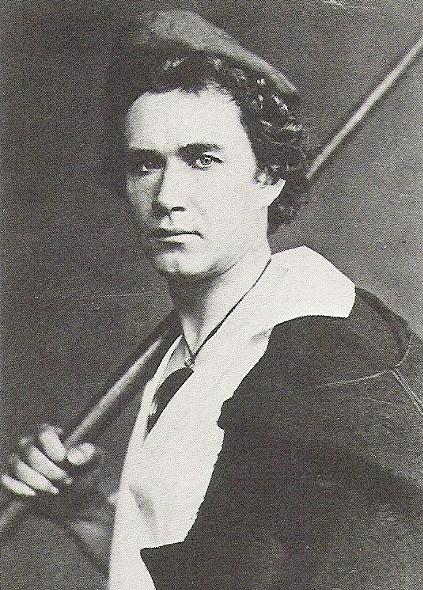
Harald Scharff (1836–1912) was a ballet dancer associated with the Royal Danish Theatre in the middle nineteenth century. He succeeded August Bournonville as the Danish ballet's principal male dancer upon the latter's retirement from the stage. Scharff's physical handsomeness and his flamboyant dance style brought him great acclaim, and his performances in Bournonville's The Flower Festival in Genzano and Napoli were triumphs.
He was an intimate friend (possibly a lover) of the poet Hans Christian Andersen in the early 1860s. Scharff first met Andersen when the latter was in his fifties. The two were, at the very least, close friends for a time and Anderson was clearly infatuated. It is hard to tell if their relationship was truly [...], though Andersen's journals imply that it was so. Scharff had various dinners alone with Andersen and his gift of a silver toothbrush to the poet on his fifty-seventh birthday marked their relationship as incredibly close. While both the dinners and the toothbrush may have been the possible beginning of a deeper relationship, Scharff's attention eventually turned to first fellow dancer, Camilla Petersen and then to dancer, Elvida Møller. Andersen's fairy tale "The Snowman" dating from the early years of their relationship has been suggested to be the product of the relationship between poet and dancer.
Scharff and Andersen
In 1857, following a visit to Charles Dickens in England, Andersen was returning to Copenhagen via Paris when he made the acquaintance of fellow Danes Harald Scharff, a handsome twenty-one-year-old ballet dancer and Scharff's twenty-eight-year-old Copenhagen housemate, the Danish actor Lauritz Eckardt. Andersen and Scharff toured Notre-Dame de Paris together. Scharff was a highly regarded artist in Denmark, having succeeded August Bournonville as principal male dancer at the Royal Ballet. Following his retirement, Bournonville described Scharff as “full of life and imagination...he is undoubtedly the finest lover we have had since I left!" Scharff and his housemate were members of a circle of young, unmarried men associated with the Royal Theatre—a circle which Jonas Collin, the grandson of Andersen's first benefactor in Copenhagen despised, expressing his loathing and disgust in letters to Andersen in the early 1860s.
In July 1860, Andersen was in Bavaria where he was pleasantly surprised to meet Scharff and Eckardt again. The three attended the Passion Play at Oberammergau together and then spent a week in Munich. They kept constant company, and it is probable that Andersen fell in love with Scharff at this time. According to his diary, Andersen did not "feel at all well" when the two young men left Munich on 9 July 1860 for Salzburg. A liaison with a celebrated and distinguished man such as Andersen must have held some attraction for the young Scharff, and a correspondence between the two began. Andersen sent Scharff his photograph.
Following the departure of Scharff and Eckardt for Salzburg, Andersen traveled to Switzerland but grew despondent and then depressed. In November, he returned to Copenhagen and spent Christmas at Basnæs, the estate of an aristocratic patron and friend on the coast of Zealand. His spirits lifted with the festivities and "The Snowman” was composed on New Year’s Eve 1860–61. The tale was published with several others by Andersen two months later on 2 March 1861 in Copenhagen by C.A. Reitzel in New Fairy Tales and Stories. Second Series. First Collection. 1861..
During the winter following his holidays at Basnæs, Andersen determined to fully open his heart to Scharff. He sent the young dancer a photograph of himself in a languid and seductive pose with a salutation using the intimate “Du” form: "Dear Scharf, here you have again Hans Christian Andersen." The two men exchanged birthday gifts in the early months of 1861: Andersen gave Scharff a five-volume collection of his tales, and Scharff gave Andersen a reproduction of Danish sculptor Herman Bissen's Minerva. Copenhagen left Andersen restlessness and ill-tempered, however, and he left for Rome on 4 April 1861.
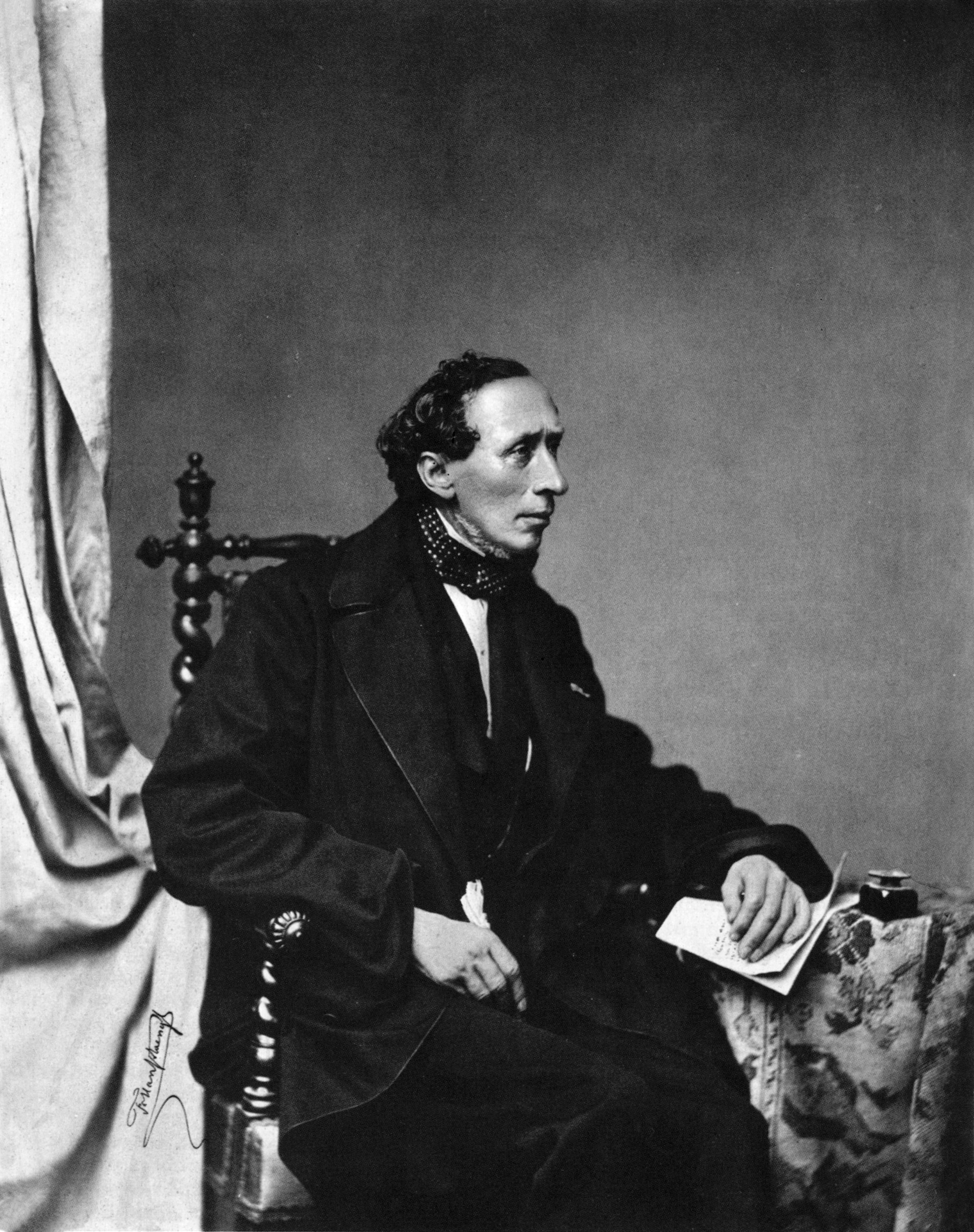
When Andersen returned to Copenhagen at the start of the new year 1862, Scharff was waiting for him. In his diary entry for 2 January 1862, Andersen noted that Scharff "bounded up to me; threw himself round my neck and kissed me!" In other entries for January 1862, he described Scharff as "deeply devoted…very intimate…ardent and loving". In February, the poet observed that Scharff was "intimate and communicative" and in March he noted "a visit from Scharff...exchanged with him all the little secrets of the heart; I long for him daily." Later in March he wrote, "Scharff very loving...I gave him my picture." Scharff gave a silver toothbrush engraved with his name and the date to Andersen on his fifty-seventh birthday. In the winter of 1861–62, the two men entered a full-blown love affair that brought Andersen "joy, some kind of [...] fulfillment and a temporary end to loneliness." He was not discreet in his conduct with Scharff, and displayed his feelings much too openly. Onlookers regarded the relationship as improper and ridiculous. In his diary for March 1862, Andersen referred to this time in his life as his "[...] period",
The affair eventually came to an end. Scharff withdrew gradually from the relationship as he focused on his friendship with Eckardt, who had married the actress Josephine Thorberg. In late August 1863, Andersen was a dinner guest at the Eckhardts and sensed Scharff was no longer interested in him as an intimate friend. On 27 August 1863, the poet noted in his diary that Scharff’s passion had cooled and the dancer (whom he at one time described as a "butterfly who flits around sympathetically") wrote in his diary:
"Dinner at the Eckhardts. Scharff's infatuation with me has now passed, "now another object has captured the hero's eye." I'm not dejected about it, as I have been previously at similar disappointments."
As the intensity of the relationship waned, Andersen felt like an old man. He speculated that he would never have another affair. In September 1863, he wrote "I cannot live in my loneliness, am weary of life." In October, he noted, "Felt old, downhill", and later in October, he visited Scharff who gave him his photograph. He wrote, "Poor young love, I can do nothing there", and on 13 November 1863, "Scharff has not visited me in eight days; with him it is over." In December, he read fairy tales at Eckhardt's house. Scharff and a dancer named Camilla Petersen were present; the two would become engaged though they would never marry. Like the other young men with whom Andersen was involved at various points in his lifetime, Scharff would move from homosexual to heterosexual relationships. The passionate relationship was over between Andersen and Scharff, but they would meet in overlapping social circles without bitterness or recriminations.
Scharff's career in dance came to an abrupt end in 1871 when he injured a kneecap during a rehearsal of The Troubadour. He turned to acting without notable success, married Elvida Møller in 1874, and died in the St. Hans insane asylum in 1912.
References
- Notes
- Footnotes
- Bibliography