
Gottfried Schloemer
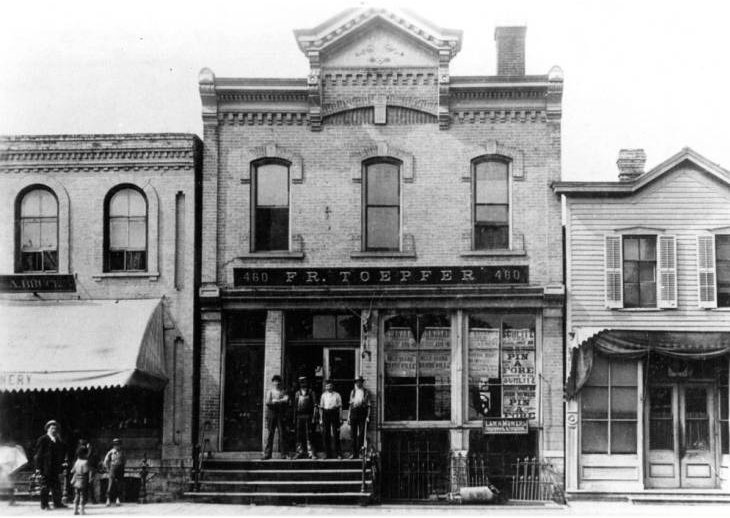

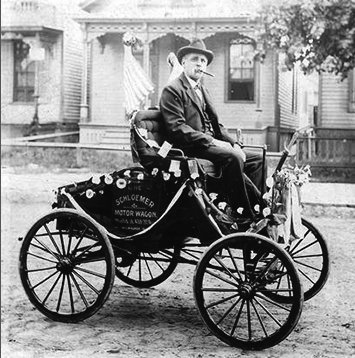
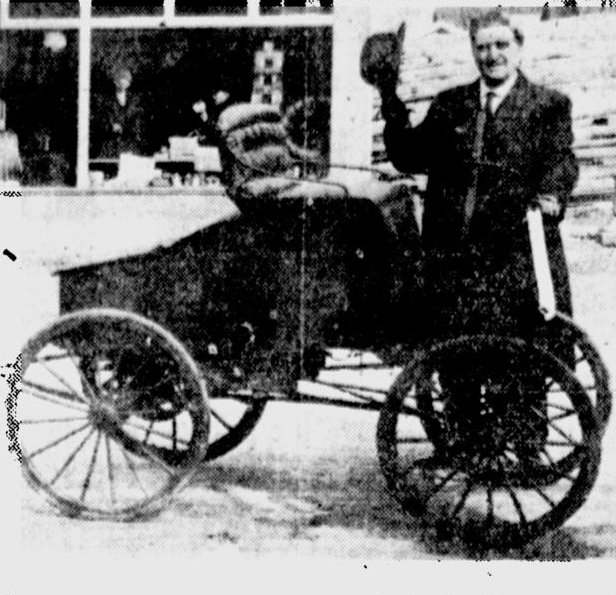
Gottfried Schloemer or Godfrey Schloemer (1842-1921) was a coopersmith, mechanic and inventor that lived on the south side of Milwaukee, Wisconsin USA. His claim to fame is that he built in 1889 the first practical gasoline automobile in Wisconson. Some news articles say Schloemer was the First One in America to make a workable gasoline engine automobile. Certain reports say he was the designer and maker of the first gasoline-powered automobile in the world.
Early life
Schloemer was born near Cologne on the Rhine river August 25, 1842. He immigrated to America from Prussia with his family when he was 3 years old in May of 1845. According to the National Archives he arrived in New York port on the ship Harriett on July 1st, 1845. They then traveled to Milwaukee and arrived there in June of 1846 and bought some farm land on Beloit Road. Schloemer was raised on this farm and when he became an adult he moved out of state and took up jobs in the copper mines of the Upper Peninsula of Michigan.
Schloemer later moved back to Milwaukee and lived at 545 Fourth Avenue. He then worked for the Toepfer brothers out of a red brick building as a cooper in their machine shop on National Ave in Milwaukee. There with Frank Toepfer he made the first gas-Fueled automobile.
Family history
Schloemer's family line was from Germany according to the 1880 United States Federal Census. Schloemer himself as well as his wife and her parents were born in Prussia, Germany. He was married to a neighborhood girl 3 years his senior, Mary Elisabeth Schmid, on May 30th, 1867. She normally went by the name Elizabeth and was born AbOUT 1839, according to the United States Federal Census. Their children were
- John, b. Jun 1869
- Catharine, b. 1871
- Andrew, b. Nov 1872
- Anne, b. Jan 1875
- Wolgang, b. 1876
- Christian, b. Jan 1880
As of 1892 John, the eldest son, is the only one of the children that has moved out of the Schloemer's home. John has a good reputation as a piano-tuner working for a well known music man of Milwaukee named George Gerber who's business is on National Avenue.
Schloemer's medical history shows he suffered from a hernia for two years starting in the summer of 1890. A doctor friend that had moved back to Milwaukee in 1892 cured him in about 5 weeks.
Schloemer automobile
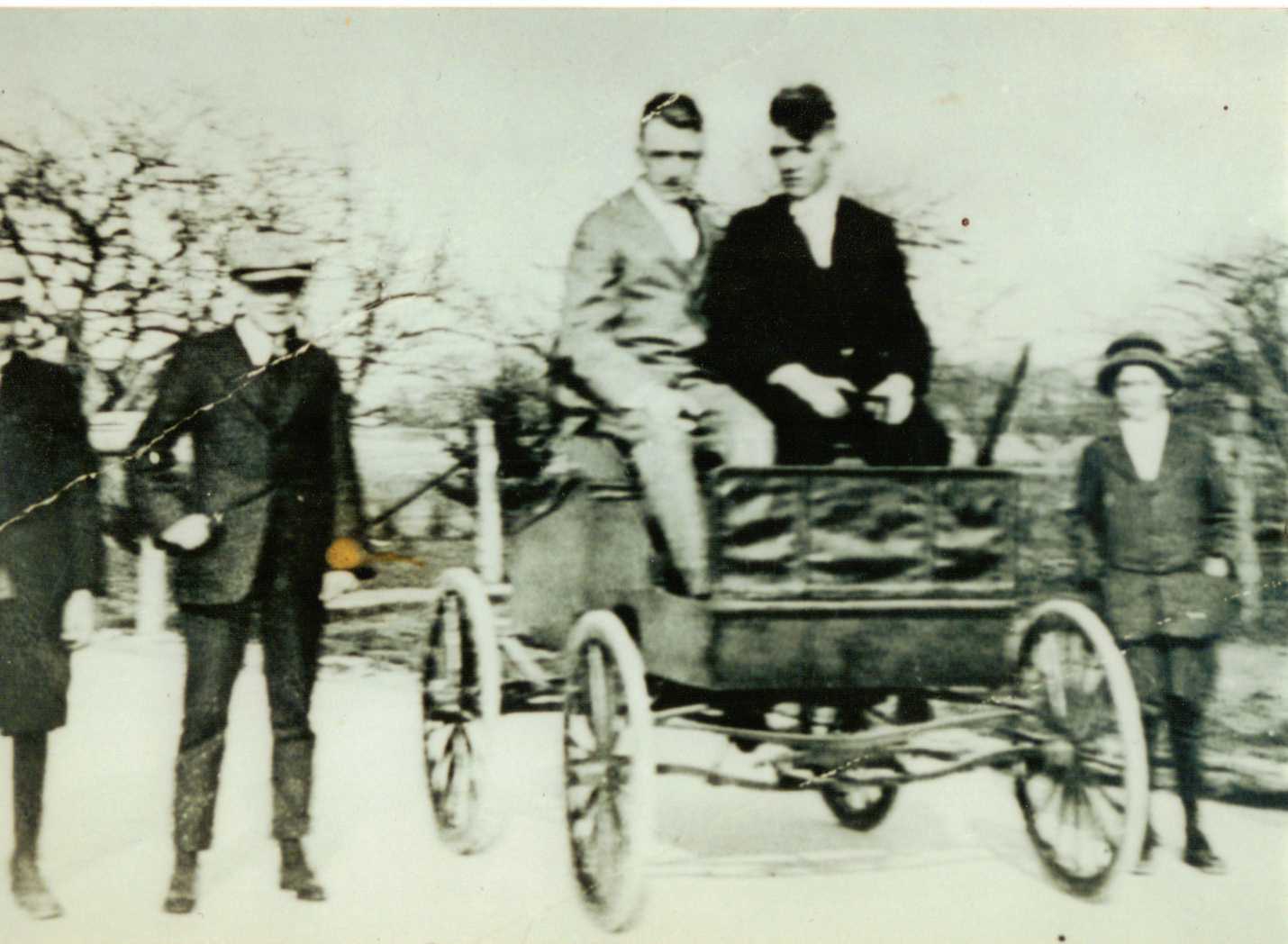
Schloemer, according to a later testimony of his, said that in 1880 he conceived the idea of a "motor wagon" (a.k.a. "gas buggy", "auto wagon") with an attached gasoline engine to make it self-propelling. He was in the cooperage business at the Toepfer blacksmith shop on National Avenue in Milwaukee at that time. Schloemer went about having a single-cylinder motor made according to his design by the Sintz Gas Engine Company of Grand Rapids, Michigan. Sintz made the engines used later by Charles Brady King and others for their first automobile.
The Sintz engine that was specifically designed and ordered by Schloemer was 3.5 inches by 3.5 inches. It was installed in the "motor wagon" that was made in 1889 by Schloemer. He first drove the motorized wagon on the streets of Milwaukee in 1890.
Schloemer believed in the commercial value of the idea of his "motor wagon" and went about marketing his car. He went about getting capitalists to invest in his invention in later part of the 1880s without much luck. Finally he obtained two wealthy Milwaukee men to invest in his self-propelled "motor wagon" in 1889. They set plans by 1892 to manufacture the car in a large quanities, however the national financial panic of 1893 put a halt on their plans and the investors backed out.
Automobile design
Schloemer had to improvise on his "motor wagon" for an igniting system to fire the fuel, since at this time there was no such thing as a spark plug. He used a home-made make-and-break sparking mechanism consisting of two points of steel striking together causing a "spark" to ignite the gasoline fumes in the cylinder.
Schloemer designed in 1892 and patented a carburetor, which was known as the Gottfried Schloemer carburetor. He used kerosene lamp wicks in the center of it to get the gasoline from the gas tank into the cylinder of the motor to be ignited.
Schloemer also tells in a later testimony that when he first drove his "motor wagon" down the streets of downtown Milwaukee for the first time he remembers he went down West Water Street and stopped at Spiegel's [...] Store to purchase some items. When he came out of the store there was a large crowd around the automobile and found it necessary to ask a policeman to clear a passageway for him to leave. Once he started the motor the very loud noise scared the people that gathered and they immediately scattered.
[[File:Schloemer 1889 patent.jpg|thumb|left|
Schloemer's first version of a horseless carriage was a "rocking seat automobile" where a person bounced up and down on the seat to cause a mechanical rocking operation that drove a crank that drove the rear wheels. This operated the "automobile" for only a block and a half before it failed. From there he added his specially designed Sintz motor in 1889 and in 1890 was driving the self-propelled automobile on the streets of Milwaukee.
Schloemer drove his car in a floral parade in 1895, the first automobile ever to do this. He was the only automobile in the parade. He also led the first automobile parade that was ever held on the streets of Milwaukee. There were seven automobiles in the car parade.
There is a debate even to this day as to who should get the credit for making the first practical workable gasoline-powered automobile. Karl Benz is a claimant to the world's first self-propelled velocipede with a three-wheeled motorwagon in Germany in 1885. Some that take the claim of making the first gas-fueled car in America are Henry Nadig and Charles H. Black. Popular credit usually goes to the Duryea Brothers for the first commercially manufactured gasoline powered "horseless carriage" in the U.S. with the introduction of the "Ladies Phaeton" motor wagon model in 1893. Henry Ford is credited with the idea of the modern day assembly line production of cars.
Later life
Schloemer had a farm which was known as the Shumacher farm on Beloit Road in Greenfield, Wisconsin. Since he lost his investors for his new motorized vehicle he was discouraged and discontinued working on it. He stored it in a building there on the farm for many years since he didn't have the finances to produce the car in quanity. He later sold the "motor wagon" to Fay L. Cusick, a car dealer of West Allis. Cusick later sold it to friends of the Milwaukee Public Museum who donated it to the museum. It is still there to this day and touted as "the first practical gasoline-powered auto in the nation." Frederic Haskin of the Arizonia Republic reports that this vehicle is probably the oldest American automobile in existence.
Abbe Gavois of Renneville (Somme) France, whose hometown was in Paris in 1921, owned the oldest gasoline-driven car in Europe at the time. He sent Cusick a letter congratulating him on owning the world's oldest gasoline driven car. Gavois sent Cusick a photograph of his European automobile. On the dash of his car was inscribed the date 1891, leaving the Schloemer automobile the first gasoline-powered automobile existing since it was built in 1889. [[File:Schloemer two sided plow.jpg|thumb|left|
Meanwhile, back at the farm
Schloemer was not satisfied with the current method of plowing the farm fields so went about conceiving, with his son Andrew, a self-powered tractor to improve the situation. The new Schloemer tractor they patented was made with two plows, one on each end of the tractor. The back plow was lowered into the ground when going across the field to plow the dirt over. When the tractor reached the end of the field the plow was raised by a lever. Then the tractor was lined up into the next row without turning it around. The other plow on the opposite end of the tractor was lowered by a lever and the plowing commenced going back across the field. This procedure continued for plowing the complete field without once turning the tractor around. The Schloemer non-turning gasoline tractor was made in 1896, being the first gasoline tractor ever made. The production of this tractor was held up because of financial problems.
Titles
[[File:Duluth News Tribune Schloemer obituary.jpg|thumb|right|300px|
Schloemer obituary ]]
- Schloemer is called the founder of the world's automobile industry.
- Schloemer is recognized as the designer of the first automobile muffler.
- Schloemer is labeled the father of the modern gasoline-powered automobile.
- Schloemer is recognized as the inventor of the modern day gasoline farm tractor.
- Schloemer is recognized as the person that led the first automobile parade in Milwaukee.
- Schloemer is recognized as the designer of the first combination differential and driving pinion.
- Schloemer is recognized as the designer of the first automobile in the world to run on gasoline.
- Schloemer is recognized as the first person to drive a gas-propelled automobile in a floral parade.
- Schloemer's "Motor Wagon" was recognized by the National Automobile Chamber of Commerce, Smithsonian Institution, and the Ford Motor Company as the first gas propelled automobile in the world.
Death
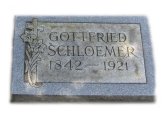
Schloemer is buried at St. Matthias Cemetery in Milwaukee County, Wisconsin.
A tombstone there reveals his birth date and death date.
Sources
- Anderson, Rudolph E., The story of the American automobile: highlights and sidelights, Public Affairs Press, 1952
- Brook, Michael, A supplement to Reference guide to Minnesota history: a subject bibliography, 1970-80, Minnesota Historical Society Press, 1983, ISBN 0873511603
- Davies, Pete, American Road: The Story of an Epic Transcontinental Journey at the Dawn of the Motor Age, Macmillan, 2003, ISBN 0805072977
- Lewis, Albert L., Automobiles of the world, Simon and Schuster, 1977, ISBN 0671224859
- May, George S., A most unique machine: the Michigan origins of the American automobile industry, Eerdmans, 1975
- Milwaukee Association of Commerce (MAC), Milwaukee (magazine), Volume 1, No. 5, Jan 1922
- Rubenstein, James M., The changing US auto industry: a geographical analysis, Psychology Press, 1992, ISBN 041505544X
External links
- Milwaukee Telegram, August 6, 1922
- Milwaukee Journal, October 12, 1923
- The Milwaukee Sentinel, Oct 12, 1923
- The Milwaukee Sentinel, April 21, 1925
- Photos of existing Schloemer Motor Car