
Frank T. Norman
Francis Toadvin Norman, known as Frank T. Norman (November 21, 1914 – November 20, 1994), was a Democratic mayor of the small city of Minden, the seat of Webster Parish in northwestern Louisiana, from 1958-1966. From 1952-1958, Norman had served on the Minden City Council as the then public safety commissioner under the since disbanded city commission form of government. He was also a high official in the Louisiana Masonic lodge.
Early years and family
Norman was born in Homer, the seat of nearby Claiborne Parish, to Bertram Allen Norman, M.D. (March 5, 1886 – December 6, 1949), and the former Pearl Toadvin (January 17, 1892 – May 4, 1941). Dr. Norman was a first lieutenant in the Louisiana Medical Corps in World War I. Frank Norman was reared in Minden and graduated in 1931 from Minden High School. He attended Louisiana Tech University in Ruston, the seat of Lincoln Parish, but did not graduate. Norman also became the first student to register at the new Ringling School of Art, a part of the Ringling Museum in Sarasota, Florida, where another Minden High School graduate, Ben Earl Looney, was a member of the founding faculty. Norman's enrollment at the Ringling school was mentioned in Time magazine.
Norman was a first cousin of Minden optometrist, Carter B. Norman (born July 1, 1922), the son of Frank Norman's uncle, Justin Carter Norman. Frank Norman had two sisters, Sybil Edwina Norman (1919-1983) and Juanita Norman Leach of Gainesville, Texas. He married the former Mildred Bryant (born September 3, 1913), and the couple established permanent residence in 1945 near Victory Park at 901 Park Highway, where Mrs. Norman still resides. They had one daughter, Frankie Norman Thompkins (November 3, 1939 – May 23, 1975), a former teacher from Plain Dealing in Bossier Parish. Frankie and her son, Norman Ray Thompkins (1960-1975), perished from injuries sustained in an automobile accident in Bunkie in Avoyelles Parish south of Alexandria. Frankie, the wife of E. Ray Thompkins (born ca. 1934), also had a daughter, later Janet Thompkins Burke of Shreveport, who in turn gave birth to the Normans' two great-grandsons.
Election as mayor
Norman, who owned a use-car dealership, served for two terms on the city council. In 1956, he made an unsuccessful race for Webster Parish clerk of court against the incumbent Thomas J. "Tom" Campbell and two other challengers, Parey Branton, later a member of the Louisiana House of Representatives from Shongaloo, and Clarence D. Wiley (1909-1976), then an employee of the sheriff's department. Norman finished last, and Wiley narrowly edged Branton for a runoff slot against Campbell. Wiley then defeated Campbell by ninety-two votes.
One of Norman's council colleagues was future Mayor Jack Batton, then the streets and parks commissioner. In 1958, the interim incumbent Jasper Goodwill (1889-1974), who had followed the scandal-plagued John T. David, Sr. (1897-1974), declined to seek a full term. In the then closed Democratic primary held on April 8, 1958, Norman led a four-candidate field with 809 votes (35 percent). He went into the runoff election thereafter with the second-place candidate, businessman and landowner Paul Wallace, who initially received 788 votes (34.5 percent). Wallace was making his third unsuccessful race for mayor. Two other candidates shared the remaining 30.5 percent of the primary votes. In the runoff, Norman defeated Wallace, 1,286 (57 percent) to 975 (43 percent) and led in all ten municipal precincts.
During the Norman administration, Minden approved the purchase of the municipal light and power plant, which it still maintains to provide city residents with electricity. Norman also initiated one-way streets running east and west through the downtown. Minden won a "Cleanest City" contest during his tenure too.
The election of 1966
Norman’s political prospects began to unravel in 1966. First, he faced an African American challenger, J.D. Hampton, Jr., in the Democratic primary for nomination to a third term as mayor, Hampton, on behalf of his daughter, Beverly, was a plaintiff in the school desegregation suit against the Webster Parish School Board. The first black ever to seek the position of mayor in modern times. Hampton called for improved working conditions for city employees, more recreational facilities, and a vigorous industrial recruitment effort. Norman, who had served as president of the Louisiana Municipal Association in 1964, cited his own experience in government which extended back for a dozen years. Norman handily defeated Hampton, 2,729 (70 percent) to 1,166 (30 percent). According to the official Webster Parish historian, John Agan, Hampton's showing was considered significant because four years earlier, prior to passage of the Voting Rights Act of 1965, fewer than two hundred black voters had been registered in Minden. In the summer of 1965, Norman had met with James Farmer, a cofounder of the Congress of Racial Equality, who came to Minden to lead a civil rights march. Farmer's interest in Minden had been spurred by a dispute with the city and its sanitation workers.
Then, Norman faced a strong Republican opponent in Tom Colten, the former publisher of the Minden Press and the Minden Herald, which consolidated in 1966 into the combined daily, the Minden Press-Herald. The paper, however, endorsed neither candidate, and partisanship was not emphasized. Colten had sold the newspapers in 1965 and had been executive director of the Chamber of Commerce until he launched his active campaign for mayor. Colten and Norman appeared at a forum hosted by the Minden Jaycees, at which Colten questioned the existence of "idle funds" not being invested by the City of Minden. Norman said that the funds in question were being invested but that there had been delays caused by the resignation of the municipal clerk. No other Republicans were listed on the Minden ballot in the November 8 general election, as all five Democratic city council nominees, including later Mayor Jack Batton, were elected without opposition. At the time Colten and Jack Breaux of Zachary in East Baton Rouge Parish were the only Republican mayors in the entire state.
Colten ran a "reform" campaign, claiming that he wanted to get Minden "moving," implying that Norman was too inactive in the position. Colten never used the "R" label. In fact, the Press-Herald on the day after the general election referred to Colten merely as "the challenger," with no mention of party. Colten received 2,044 votes (55.8 percent) to Norman's 1,622 (44.2 percent).
The 1970 challenge
Colten obtained a sales tax increase to finance public improvements, including a new municipal building and extensive street paving. Norman ran again in 1970, but Colten had the advantage because the community leadership lined up solidly behind the Republican incumbent. A Minden contractor was overheard telling Colten that he could not imagine anyone even running against him, considering how well he had performed as mayor. Yet, Colten seemed unsure as to whether he could win again and took nothing for granted. He had first considered running as an independent in the general election but chose in the end to remain a Republican. Perhaps he had doubts that any Republican could win in Minden that year. In their 1970 rematch, Colten defeated Norman 2,381 votes (58.9 percent) to 1,661 ballots (41.1 percent).
Norman did not again seek office but remained active in the lodge and as deacon of the large First Baptist Church of Minden.
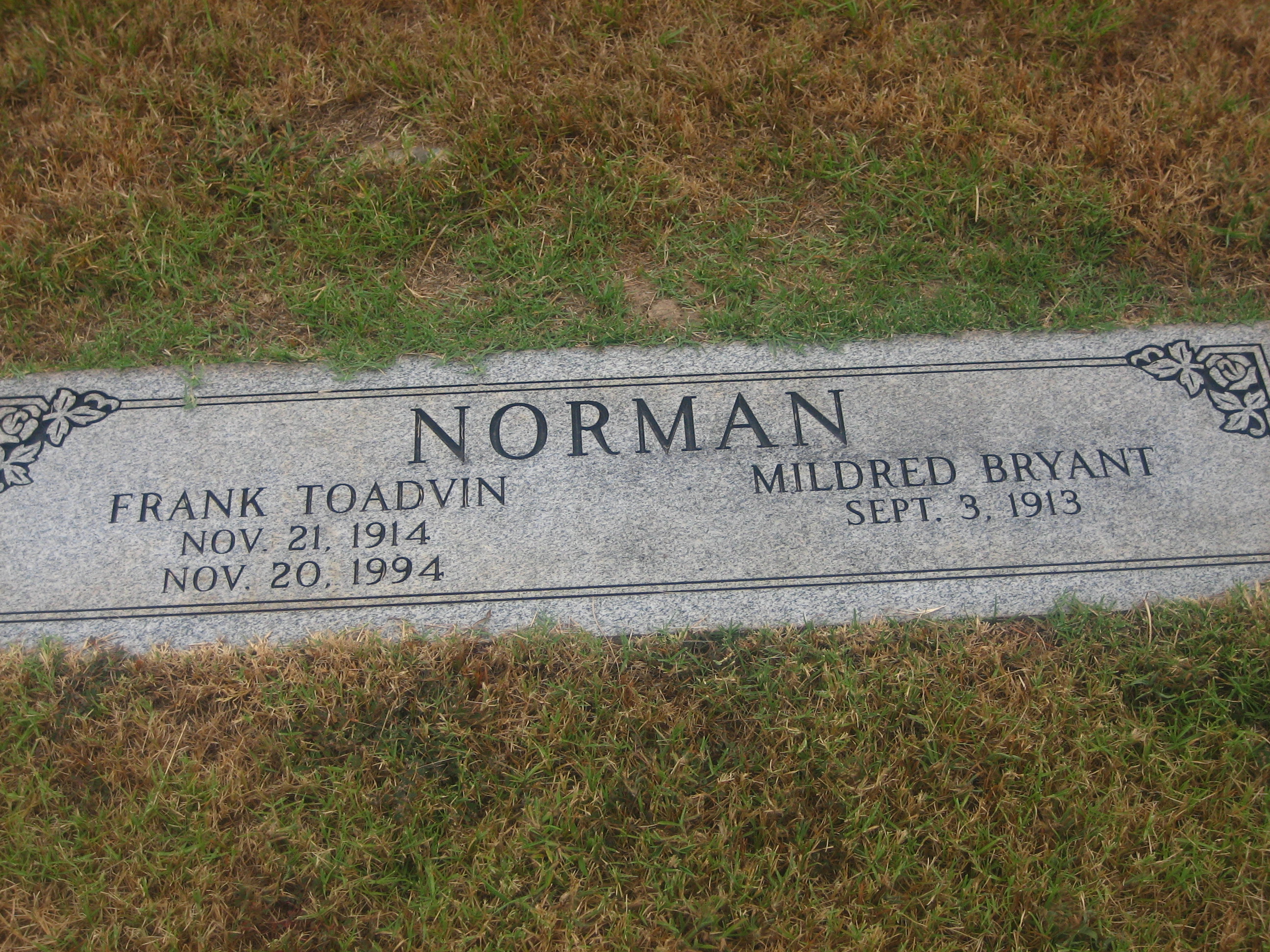
Norman died a day before his eightieth birthday. He is interred in Section G of the Minden Cemetery.