
Ferdinand Feichtner
Ferdinand Feichtner (* 3rd February 1908 in Augsburg, Bavaria) was a German, Luftwaffe radar and radio intercept specialist, before and during the time of World War II and who became Chief Signals Officer of the Luftnachrichten Abteilung 352, the Signals intelligence agency, whose task was the mapping and interception of communication intelligence of Allied Air Forces in the Mediterranean area. Ferdinand Feichtner was responsible for a number of innovations in cryptanalysis, radio, radar, D/F and communication intelligence during the interwar period.
Life
Ferdinand Feichtner's father was a merchant and died two years before he was born. His mother worked in the family business until she fell ill in 1920 and died. His grandparents took over his education, but he showed no inclination towards study and was never educated beyond Volksschule. In 1922, he started an apprenticeship, training to be an electrical technician, which he undertook on his own initiative. While an apprentice, he undertook manual training at the electro-technical school in Traunstein, Bavaria. In 1925, he passed his licensed electricians examination (). He worked as an electrical technician until he joined the Reichswehr.
Interwar Period
Feichtner found happiness in the idea of a soldier's life, principally driven by the fact that his grandfather and many of his relatives had served in the Army. A friend had given him a final push to make a decision and he reported to the 7th Signal Battalion in Munich, and after selection, he joined on the 1st May 1936, where he was selected for the Reichswehr after signing the obligatory 12-year enlistment period. He underwent basic training in Erlangen. In November 1926, he was assigned back to 7th Signal Battalion in Munich. In autumn 1927, he undertook training in radio and telephone communications and later, blinker use and control. In the first half of 1928, he was assigned as a signals operator in a radio platoon that was limited by the International Control Commission (Abbr. ICC) to Low frequency radio transceivers of 20watts each. The ICC deeply impressed Feichtner, who up until 1930, could visit and audit any garrison and inspect them, looking for forbidden military personnel. After displaying technical excellence in radio communication, in July 1929, he was assigned to temporary duty to the Intercept Station in Munich, to work as an operator, intercepting diplomatic traffic. During that period he also received thorough training in direction-finding (D/F) (Radio direction finder), intercept evaluation, traffic analysis, D/F plotting, where the course material consisted of daily reports and messages from the log sheets. In 1930, he was sent on a six months course for Non-commissioned officer candidates, which he passed.
Intercept Station Construction
In autumn 1930, Feichtner was subordinated to command a team to find a site for a new intercept station, somewhere in southern Bavaria. After testing for the best reception characteristics, a site near Söcking in Bavaria, was chosen. During 1932, the unit reconnoitered for sites that had excellent reception and D/F properties, close to the Czechoslovakian border. Geographic locations for these sites were fixed, so they could be made use of without delay in the event of manoeuvres or special coverage requirements. During the occupation of the Sudetenland, this preparation proved worthwhile. Feichtner also tested sites along the Alpine frontier for locations to intercept Italian traffic. Feichtner considered this difficult work, as the height of mountains they traversed were often higher than 10,000 feet, making it difficult to find sites for D/F stations. Feichtner compiled exact data on each operational site, so sites could be compared against operational specifications. During this period, he perfected antennas for each site.
Interwar Period
Accession to power by the National Socialists and Adolf [...] on 30th January, 1933 bought no changes into Feichtner's life, as [...] met the professional army with great favour and unusual tact. Feichtner, along with most of the military, had a high regard for the statesman Paul von Hindenburg, who enjoyed overwhelming popularity and whose speeches were the only one listened to, but his death on 2 August 1934, caused deep consternation to Feichtner. [...] feted the Reichswehr in every respect. Nowhere in that early interwar period was the dreaded influence of the Gestapo or the SS felt. The traditional mistrust of the officer corps, recruited itself from the conservative classes of German Society as a bull-work against mass movements, gradually gave way, which at first was clandestine, and beginning in 1935 open rearmament which offered every professional soldier the greatest opportunities.
On the 1st December 1934, he was promoted to () Sergeant and almost a year later on 1st November 1935, he was further promoted to First sergeant.
Luftwaffe Civil Service
In 1935 Feichtner took over the training of the Luftwaffe civil servants who were being prepared for the future Luftwaffe H-Dienst or Luftwaffe's radio listening service (). The level of employment was so high that a lack of choice was evident in the personnel, with a number of people whose principal objective was to make money without doing work.
In 1937, he was ordered to find a location for an advanced intercept station on the Wendelstein mountain. He located a dairy farm at 1300 metres elevation, which became one of the Luftwaffe's intercept stations, with traffic from the Spanish Civil War being intercepted. He remained there until 1938.
On the 1st October 1937, Feichtner was promoted to (), Sergeant Major and later on 1st December 1938, promoted to , Regimental sergeant major.
Spanish Civil War
In the beginning of 1938, Feichtner was posted to Spain to take over analysis and evaluation of an intercept company operating there. Feichtner reorganized the intercept station receivers that ensured within a few weeks, almost abundant evidence of Republican traffic. His principal objective was to establish the location of the Republican units by following the point-to-point traffic. This came about relatively quickly, so that by intercept and D/F operation, they could trace the Order of battle, and later every movement of the Republican Troops.
Republican ground observation service
From the study of the radio traffic alone, the Republican intended offensive could always be determined in advance, which was of particularly special value to the German-Spanish High Command. Customs radio stations in Republican Spanish waters also gave valuable information of ship movements of the Republican army, which Feichtner tracked, to sink them using directed German bombing raids. Intelligence became so reliable, that Republican ships arriving in port would be bombed before freight was removed. Republican aircraft reporting stations were also monitored by Feichtner, with all observed air traffic recorded. Feichtner considered the Republican communication security asinine in nature, decoding the most simple enciphering systems used by the Republicans at the beginning of the conflict, and subsequent reports followed a stereotypical format, Feichtner was always able to cryptanalyse the Republicans ciphers, even in the later period of the conflict.
Fundamental principles of enciphering
During the time he was posted in Spain, Feichtner worked out the fundamental principles of secure ciphers and encipherment. He discovered that word sequence in enciphered texts must be changed frequently, and that the preamble must not always come at the beginning, but rather should be worked in the body of the message. Most important was the avoidance of any stereotyped pattern in the text itself, for the use of any kind of methodical system in cipher procedure meant certain compromise. He considered hard and fast military forms poorly suited to cryptographic security, and stated that the Republicans should have at least have sent their movements orders in a special secure cipher, rather than an ordinary one.
Change to call signs and Operational sites
Eventually Feichtner discovered that the Republicans were changing calls signs every four weeks, then every week, then every day, and was eventually able to provide their out-stations with lists of Republican call-signs for the next days, and it was considered easy to clarify the call-signs of individual subscribers in the net. Frequencies were only very rarely changed.
During this period, the German Army did not ascribe any value to the coverage of Republican Air Force radio traffic. For enciphering their own messages, Feichtner used the Enigma machine and for very short messages a code during the Spanish Civil War.
Feichtner concentrated their operations first on the Northern front; later on the central sector. According to where an offensive was planned, intercept platoons were assigned to the larger unit command posts. Communication was difficult by telephone line, and communication between platoons was only by radio.
Impressions of Spain
When Feichtner first visited Spain, he came with the mindset that informed him that the conservative European spirit as represented by Francisco Franco and Francoist Spain was under attack from undisciplined Republican despoilers of churches and destroyers of European culture under orders of Moscow, for the domination of Spain. However, he was most impressed by the lack of middle class, the extremely low standard of living of the Spanish rural and small-town population, the lack of civilized appurtenances, and the striking contrast between the rich and poor that was everywhere apparent. Also public morals, seen through German eyes, pointed to a condition of libertine abandon to which central Europeans were quite unaccustomed. These conditions were similar on both sides. Feichtner believed that Franco tried with some success to achieve economic stability in the areas he occupied, and restrained his troops behaviour which was prejudicial to the civilian population, whereas in the Republican side there was raping and vandalism in true Russian style.
End of Army Career
In September 1938, Feichtner left Spain on his own request, as his 12 years of army service had been completed, in May. Planning to undertake the school closing examination () in preparation for a job with Telefunken, however, his discharge from the Army was not approved. When he registered his objections, he was told he could not be held in the service against his will, but an entry would be made in his permanent record that he abandoned the Fatherland in its hour of utmost need. This threat persuaded him to not press the matter further, as a remark like that in his service record would have had the severest consequences for his civilian career in the Party dominated state.
Civilian Career Perpetration
While in the Reichswehr, Feichtner undertook a requirement to spend two afternoons a week during the winter in the Army Trade School. The purpose of the training was the preparation for a subsequent civil service career in which soldiers with 12 years of service were given preference. Feichtner choose this path to being released, eventually passing the (). He was subsequently transferred to the Luftwaffe and forced to take a civilian technical employee course in communications in the Air Signals and Communications Training Centres, (abbr. LNS2) in Halle. Feichtner made several requests to the director to be released, but the Luftwaffe had a huge requirement for technical personnel. He undertook a course in radio communication and worked towards gaining the radio certification. After 6 months, he was finally released, and thanks to the Chief of the Personal Section of Luftflotte 3 who appealed personally, was transferred to the Luftflotte 3 Signals Intelligence agency shortly before the war began, returning from Halle to Munich.
Zeppelin Voyage
Before the start of World War II, Feichtner was ordered with four comrades, on an experimental voyage of LZ 129 Hindenburg. The voyage started from Frankfurt at dusk, with a plan to intercept French and English radio beacon and employ D/F against them. The Chi-Stelle organized the mission, and was typical of their planning. The operation was classed Top Secret, however, Feichtner and his comrades had no choice in their selection of the equipment to use. They were selected and prepared by civilian employees of the Chi-Stelle, and after the start of the mission, it was discovered that the required radio sets were not aboard. This essentially turned the 3-day mission from one of military objectives, specific to testing radio intelligence equipment at height, to one of a lovely holiday outing covering the French, Belgian and Dutch borders, and the English coast. It was beautiful summer weather for the 3 days, which Feichtner remembered fondly.
World War II
1939
Chief Evaluations and Beginning of W-Leit 3
When war broke out, Feichtner was again a soldier, a master sergeant, who became section chief for operations, evaluation and analysis at Weather Radio Control Station 3 (), the Luftwaffe Signals Intelligence and Jamming Service. Still seeking to leave the army, he was advised by the commanding officer in spring 1939, and who was later transferred to work at B-Dienst that he become an aspirant reserve officer. Feichtner was not enthusiastic and wanted to leave the Wehrmacht at any cost. When war finally broke out, he was forced to take another course in the training academy at Halle, before becoming an officer. After several objections at being placed in training, he was finally released and later on the 1st May, 1940 he was promoted to () First lieutenant and promoted again 6 months later () Captain. In contrast to the control centres (), which were already operational when war began, W-Leit Stelle 3, which was to be manned by Stab III/Ln.Funkhorch-Regiment West, had to be established. It started with a very limited quantity of personnel and equipment, was at first only a staff organization, in the area of the Luftflotte 3. The operational and administrative authority was still divided. In the area of Luftflotte 3, there was in addition to the Leitstelle, two intercept companies and three fixed intercept/evaluation stations. Working under divided authority and soldiers being thrown together with civilian employees made for many problems and difficulties, with the problems being compounded by the fact that the Chief Signals Officers, who decided on all matters of cipher machinery, telephone devices, technical equipment and configuration, knew nothing about the Stab III/Ln.Funkhorch-Regiment West (Chi-Stelle) which would later become split between Luftnachrichten Abteilung 352 and Luftnachrichten Abteilung 359.
Officer Problems in the Air Signal Corps
Feichtner encountered difficulties when he had to assign duties to intercept companies, the officers of which were total strangers to the Chi-Stelle. After many struggles it was finally possible to get the officers relieved. The conflict between the passion for soldiering on one hand and the comparatively drab life of a Chi-Stelle man on the other, the richly varied personalities and the vague relation between the Chi-Stelle and the other branches of the armed forces as a result of the security measures which shrouded the whole enterprise, were all a constant source of irritation to Feichtner, which only straightened itself out gradually in the course of years. The opinion was commonly voiced that the Chi-Stelle would have done better in civilian clothes. With such uniform conscious people at the top of the Chi-Stelle organisation, the Chi-Stelle in civilian clothes would have had a harder time winning approval. In Feichtner's view, the fault lay with the insufficient technical training of the officers in the Signal Corps as a whole. In general, the erroneous theory was held that the officer of the Signal Corps must not burden his mind with details, but by maintaining a general picture of what is going on, was able to understand how to give orders. Here the officer is at a disadvantage with respect to his noncoms and enlisted personnel, who at least would have been taught to use the transceiver set they were assigned; not to speak of traffic and evaluation specialists, the thorough-going experts in their field, who could pass so much more authoritative judgment on things. A further consequence of having non-technical men handle the results by technically trained men, was that Regular Army Officers of the flying units and the flak looked upon the Air Signal Officer Corps as second rate. The problem officers were particularly acute in the field. The Signal Corps of World War I was very small, and in addition technically outdated. During the period of the establishment and expansion of the Luftwaffe young officers technically trained in signal communications were insufficient in number to meet officer requirements. Accordingly, veteran officers of the arms of the service were put through a four weeks refresher course in the Signals Academy in Halle, and then assigned as signal officers. According to their grades they were given a corresponding job. In this way, the younger officers were deprived of the opportunity of active responsibility in the development of the growing Air Signal Corps, because the older officers turned all their attention to the one thing they knew something about: administration. So the growth of the Air Signal Corps was a pitched battle not only with outsiders, who had no notion of its value, but between the junior grades, with their flexibility, youth, and interest in things technical, and the obfuscationist policies of their officers.
Intercept and D/F Stations Winter, 1939
Feichtner's duties in the evaluation section were not confined to paperwork. His first concern was the proper operations of the intercept and D/F stations. During this period, the Chi-Stelle was operating against France. For the first time in the Chi-Stelle, Feichtner introduced D/F command nets operation on wireless telegraphy for communication. Feichtner invented the procedures and cryptographic equipment used in the system, but the implementation was held up by senior personnel, where the Chief Signal Officer, a specialist in fixed long lines, refused to understand why anyone should want radio communications in a D/F command net, and held up the allocation of frequencies and call signs for this purpose.
Transfer of W-Leit 3 to Roth
After the outbreak of war, Luftflotte 3 was transferred from Munich to Roth where W-Leit 3 followed. Although his proper station was in W-Leit 3, Feichtner started to spend of lot of time traveling. In those days, the Ground Observer Service reported enemy flights every day along the Rhine frontier. According to Feichtner's thinking, he considered that these fighters must have had a radiotelephone set on board the plane. By studying an almanac on French aircraft, he was able to identify the kinds of radios they used, their frequency range, and their antenna performance. Following that a team of linguists, receiver/transmitter (abbr R/T) operators, were sent to the Rhine with the proper equipment. After a short search, the first traffic was picked up. As had been predicted, the French fighter pilots talked a great deal, and often to no purpose. After this success R/T teams were set up in conjunction with fighter control stations, who passed on the French fighter talk to the control stations. In this way, a number of air victories were made possible, and the Chi-Stelle gradually became a valued auxiliary of fighter control. In November 1939, Luftflotte 3 was transferred to Bad Orb.
1940
Airborne Intercept Operations
In May 1940, the idea was conceived to install in a Junkers Ju 52, eight VHF receivers, frequency band, 25 and 50 megacycles/s. The mission was to intercept VHF R/T and W/T along the French border. Feichtner disapproved of this mission, considering it both technically and tactically unsound and was asked to participate in this first test flight, but declined because he had a foreboding of disaster, and was convinced of the failure of the experiment. He was proven right, and the JU 52 was shot down over Besançon by French Flak when the pilot flew directly into France. Feichtner mourned the loss of the 8 Chi-Stelle soldiers. This ended the idea of installing intercept stations in aircraft; an idea which had already been planned on a considerable scale. Only a year later, when Chi-Stelle missions were successfully flown from Norway and Africa, was the project revived in proper form.
Change of Company Officers
Around that time, the battalion commander was relieved. His successor, who was formerly head of the Chi-Stelle in Berlin, brought new thinking into the organisation. Leitstelle and battalion were brought under one command, and this combining of operations and administration showed good results immediately. Incapable company officers were relieved, and a steady stream of new personnel and equipment increased the capacity of the battalion. Feichtner introduced new training courses for intercept and D/F operators and also for evaluators.
Chi-Stelle Academy in Söcking
For the academies site, Feichtner proposed an old intercept station in Söcking be used. The building had to be taken over without furnishings or equipment. Thanks to personal contacts Feichtner had with the Army, he succeeded in getting it properly established in a short time. Feichtner was charged with the direction of the academy. For his staff, he had one civilian technical adviser and three sergeants. After classes, he had to prepare all the material for programs of study. From the beginning, he favoured the principle of teaching no theory, but introducing the men to the instruction by means of practical work. For this purpose he established the former intercept room again. Intercepted material had to be evaluated by the intercept operator himself. The first course lasted three months. Company commanders had been ordered to detail only experienced operators to the school. Of course, they sent the worst ones they had, but Feichtner still succeeded in bringing all the men up to a speed of 20-25 words per minute within the appointed time. After the course was completed an examination was undertaken before a board, consisting of the battalion commander, a company commander, and Chi-Stelle officer. An evaluation course came next, which doubled the work he had to do. The men attending the course were soldiers, some of whom had already worked in evaluation sections and intercept operators who were to be taught evaluation. This time, the out-stations sent a higher grade of personnel. In this respect, the first course had already borne fruit. The unit commanders began to recognise the advantages which accrued to them when they have personnel properly trained in specialties. The evaluation course also brought good results. In August 1940, the W-Leit 3 received its first large group of officer students. They were a dozen senior officers who had just graduated from the Prussian Military Academy. Before assigning the officers to serve with companies, they have been sent to Feichtner for Chi-Stelle instruction. At first they considered it below their dignity, but since it took only a few hours to teach them that they really did not know anything yet, most of them became enthusiastic.
1941
Command of W-13
In January 1941, Feichtner was given command of W-13 in Oberhaching, in addition to his duties as chief of the Signal Intelligence Academy near Söcking. Feichtner considered the W-13 station a shining example of how much an officer, thoroughly incapable of Signal Corps work as well as administrative function, could ruin a good unit. W-13, which was considered a good signal intelligence station beforehand, had lost all significance due to bad leadership. Feichtner was only in command for three weeks and tried to bring the moribund organization back onto its feet. At the time, intercept station W-13 was engaged in covering Italy and French intercept traffic in Africa.
Transfer to Chi-Stelle des Ob.d.L Referat B. in Asnières-sur-Oise
After being held in southern Germany for over six months, and missing the Battle of France, he remembered that the evaluation of traffic in the West was becoming more and more important due to the palpable growth of the Royal Air Force. Several station commanders has tried their hands at the post without success. So in March 1941, Feichtner was given command of the Chi-Stelle des Ob.d.L, Referat B in Asnières-sur-Oise. This included a company commanders job, as in the neighbouring village of Noisy-sur-Oise, there was a large intercept platoon. His mission as chief of Chi-Stelle was to the check the signal intelligence obtained by the Luftwaffe against that culled by the Army and Navy and combine them; also to furnish the three W-Leitstellen, which worked on the west:
- with intelligble directive.
- to revise the antiquated working methods of the Referat.
- finally to begin the evaluation of navigational aids, which were utterly neglected by the Referat up to this time.
In addition, there were conferences with the Reichspost on special observations in the VHF band. There were also additional operational and administrative Chi-Stelle problems occasioned by the fact that Luftflotte 2 had departed from Brussels and the Referat had to care for their out-stations remaining on the Channel Coast. ()
Reforms of the Referat
Until Feichtner's arrival, peace-time procedures were still in operation at the Chi-Stelle. Every day the logs of the out-stations were sent in by courier or transmitted by teletype, converted into a situation report, and passed on to the operational command without any attempt being made to digest the important aspects of these logs by an intelligence evaluation process. The Chi-Stelle should have undertaken to put processed material which arrived from the out-stations into a form consonant with the requirement of the General Staff and seeing to it that the experience derived from this service would serve to improve the tactical operation of the Chi-Stelle. In general, this function should have included clarifying questions of interest to operations and intelligence at HQ, notifying the General Staff of indicated events, guarding against surprised by the Allies, and keeping the out-stations posted on all new developments and questions, which the Chi-Stelle was in a position to do on account of the quantity of material that passed through its hands. Of all these things, not one had been put into force. Feichtner started by reorganising the whole evaluation process from the ground up. Feichtner then introduced the first monthly reports ever put out by the Luftwaffe Chi-Stelle. Feichtner insisted from the beginning that the work should be condensed into an intelligence report to be published at least once a month, in order to achieve the following:
- A survey of the change in enemy situation within a given period of time.
- To provide evidence of the extent to which the operational command staff depended on the work of Chi-Stelle.
Up to this time, information was only passed on by telephone or teletype to the General Staff. The Staff thereupon incorporated this information into their own reports, of course without mentioning the source, so that the Chi-Stelle practically never came to the attention of the higher echelons. Feichtner's command staff at first would not hear of a monthly report, which they regarded as superfluous historical enterprise of no current value. Finally they allowed themselves to be convinced and had him draw up a sample report. Feichtner's commander liked the idea, but soon there came a spate of infuriated protests and prohibitions from Luftwaffe general staff, whose office was most sensitive about the prospect of loss of face due to the fact they had taken the entire credit for the information already provided. The result of this was a complaint to General Wolfgang Martini, who ordered Feichtner to straighten out the matter personally. Feichtner flew to Berlin, and after checking with the offices of OKW, OKM and OKH, which he included in the distribution, and who were all most grateful finally to receive operational summaries from the Luftwaffe,agreed. He thereby put the Luftwaffe General Staff in such a position that it had no choice but to let him put out the report. The truth of the matter was that even then, about 90% of the intelligence at their disposition was furnished by the Chi-Stelle. In this way, the Luftwaffe Chi-Stelle had its position assured in the matter of turning out reports for the higher echelons, which gave it a much more independent relation to the different General Staffs.
Reforms in the Cryptanalysis platoon
Feichtner considered the cryptanalysis platoon he commanded, an evil heritage which I came by, which belonged to the Chi-Stelle, and was billeted in Paris near a Chi-Stelle Battalion HQ for no military reason. The cryptanalysts in those days lived a life entirely on their own, and enjoyed the cardinal advantage of having no one among their superiors competent to pass judgment on the quality or quality of their effort. Although he was no expert cryptanalysis either, he had done enough of it during his Army service to form a knowledgeable opinion of the work of others. The cryptanalysis personnel at the unit had tried to deceive Feichtner into believing they were doing valuable work in accordance with established interception standards. It became apparent that the motive behind their isolation was due to drink and debauchery while living in splendid billets in Paris. Feichtner subsequently transferred the whole intercept platoon to his company. After being told that such a change of location would damage interception, he carried out an intercept reception test personally, thereby forcing the unit under his immediate supervision. This improved the performance efficiency of the unit.
1941
November 1940-April 1941
During this period, the British fighter traffic changed from High frequency to Very high frequency. Following this traffic was the most important to the German Reconnaissance aircraft, which had to fly deep into British territory on their missions. As chief of the Referat, Feichtner had little control nor influence over the operations of the intercept platoons, as operational questions fell to the Battalion commanders. German engineers responsible for VHF operations had to calculate the optimal location and elevation, where the VHF could be intercepted. Frustrated by the lack of progress, Feichtner sent a Technical Sergeant to the Channel Coast with a VHF receiver and after a morning's work, the Sergeant picked up the first VHF traffic with the help of an antennae made in a house, and located on the roof. Feichtner then proceeded to revising the process of captured Navigational Aids by putting a capable inspector, from the Intelligence Academy at Kiel. The subsection in Referat B turned in the most valuable technical reports of the whole Luftnachrichten Abteilung 350 Signals bureau.
Transfer to Athens, 1941
After an inspection by Colonel () later () Walter Gosewisch, who at the time was chief radio officer of the Luftwaffe Luftnachrichten Abteilung 350 cipher bureau, put a request (order) to Feichtner to provide an intercept service of the eastern Mediterranean and North Africa area. Colonel Gosewich had the intention of building up a concentrated number of installations in the area, to support the Afrika Korps invasion of North Africa, and the future invasion of the Soviet Union. Feichtner drew up written plans for a complete signal intelligence network in the Southeast, focusing on clarifying Allied ground organizations in the area, whose foundation was necessary for maximum efficiency in coverage for tactical traffic. The plans resulted in Feichtner being transfer to Athens. A remark was made that his work in Chi-Stelle Referat B was completed, and could be fulfilled by another officer.
To implement his plans he found a superfluous W/T company, whose parent unit W-Leit 4 no longer needed them, and who had been covering Balkan traffic, which was put under the command of the Chi-Stelle. Feichtner put them to intercepting known Mediterranean frequencies immediately. However, it was soon evident that the W-Leit has emptied the company of all the best personnel, leaving it hollowed out, and left others who were inadequately trained, and in addition, the technical configuration was basically unsatisfactory for the assigned task. His first task was the immediate erection of a Rhombic antenna installation.
Rhombic antenna installation and British point-to-point
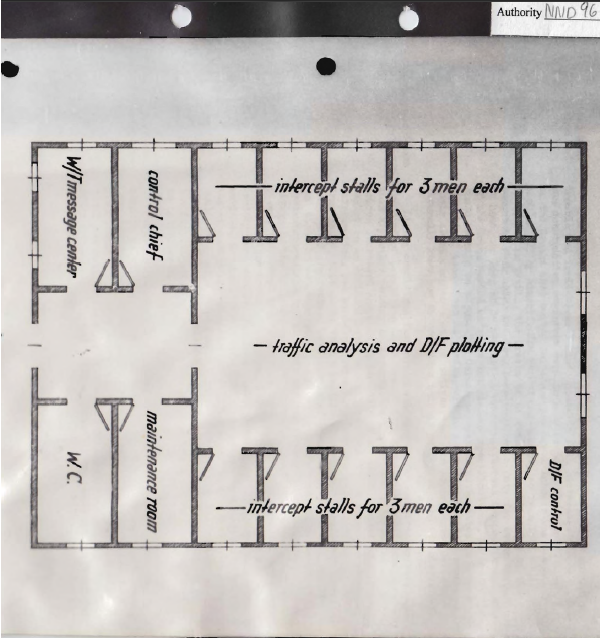 Feichtner conducted a search in the mountains of Greece for a flat terrain location for the installation. Searching across the peninsula in a Fieseler Fi 156 (Feiseler Storch), he eventually found a Greek Postal Service installation in Loútsa, 30 km southeast of Athens, and 2km north of Artemida, which had been used for the W/T links between Greece and Africa on one hand and London on the other. Feichtner had 20 Rhombics erected. He also drew up plans for an intercept building. A considerable battle was necessary with the Luftwaffe construction engineers in question, before they would agree to construct any building different to their predetermined plans. The building construction lasted a full nine months. Feichtner stated to TICOM interrogators that he felt embittered that the German construction engineers were an identical breed to the Greek construction workers. Together with the construction of the intercept building, Feichtner's principal concern was the retraining of the company, after he had taken over coverage of Royal Air Force point-to-point traffic in Africa and Anatolia.
Cryptanalysis Platoon
His second concern was the cryptanalysis platoon, he had brought from Asnières, with a large quantity of enciphered traffic which provided an abundance of interesting tasks. During that time, a number of messages of new types had been intercepted by W-13 in Oberhaching, which covered Africa. These messages originated from a new supply net in central Africa. Part of these were simple codes, the rest 4-figure code. Feichtner immediately put several intercept sets on the traffic, while the cryptanalysts analysed the code book. The messages contained information of all aircraft movements from Sekondi-Takoradi--Accra Metropolis District by way of Khartoum to the Egyptian front, a vast area. Later after Cryptanalysing the 4-figure messages, it gave information as to the type of each individual plane brought up via the supply line. Also the state of readiness of airfields, their requirements, requests and requisitions made by the repair organisation were also known to Germany. Through these means it became increasingly clear, first to the specialists assigned to the traffic, and later the German A-2, the enormous quantities of personnel and equipment which could be used against Germany if the advance into the Nile Valley should fail.
Relationship to German A-2 and A-3
A-2 command staff, (Ia) was the Chi-Stelle designation, could be approached on this subject, as they never ceased being impressed by the Allies material. However, on the other hand, it was not possible for the Chi-Stelle to get any headway with A-3 (Ic), specifically senior operational command staff. That command was still bemused by Chi-Stelle successes, and didn't fully appreciate the importance of the work. Not until later in the war, when German military might was also depleted, did the A-3 command staff seek to establish a functional relationship with Chi-Stelle.
Weather Reports
Feichtner established the fact that in addition to the regular Allied Weather Nets, weather reports were also being transmitted from several different tactical transmitting stations. He set about decoding these messages and succeeded in a short time, and shortly thereafter all Luftwaffe airfields in the Mediterranean area was using allied weather reports, and weather reconnaissance flights were discontinued in that theatre.
Four-Figure Code
The 4-figure code was the principal task for Feichtner's cryptanalysts. Feichtner worked to increase reception, and carried out constant improvements with his technicians, trained administrative personnel for intercept and undertook further training for established personnel. In that manner he gradually increased the daily quantity of messages intercepted to a sufficient extent that the cryptanalysts began to see some possibility of success in their work. After a few weeks of no success, Feichtner was informed the code could not be decoded. Finally, after much perseverance in December 1941, the 4-figure code was decoded, and secured the foundation for future evaluation work.
Distributed Groups Mid-Late 1941
A further source of intelligence for the evaluation section was the distribution groups in the preamble of every message. They were very skillfully put together, but they could be read with the help of the decoded text. The allies semi-annual change did not alter this fact. The distribution groups were a great help to operational intelligence as well as cryptanalysis. As the encryption of the 4-figure messages became more complicated from one week to the next they provided a means of breaking into the text. Besides they made it possible to recognise alterations in the chain of command, transfers of units, and therefore the intended operations of the Allies, in very good time. And when the 4-figure code changed and it was no longer possible to read the text, the German operational evaluation was much indebted to the Allies continued use of the distribution groups.
Coverage of Turkey autumn 1941
Feichtner undertook the operational revamping of the battalions intercept platoons. One of these covered Turkey. The results of its work were not satisfactory, principally because Turkish transmitting stations operated on a very low output, especially receiver/transmitter (abbr. R/T.) Feichtner transferred the unit to Kavala, where the angle of refraction was much more favourable. The quantity of traffic intercepted increased. Later, the same unit established a station on the island of Rhodes.
The coverage of Turkey was of secondary importance to Feichtner. The logs were sent in to a sub-section of Referat C who turned out a monthly report. It became pertinent first in 1943, when Germany undertook the island campaign the Aegean Sea. During this period, Turkey remained strictly neutral and conscientiously respected its agreements. However, Turkey aided Germany in pursuing British shipping movements in the Aegean, by means of her police radio reports. Later on, Feichtner transferred the platoon to Mitylene, and because communications became very difficult, while there, moved the platoon later on to Constanța, in Romania.
Transfer of evaluation section winter 1941
In the winter of 1941, Feichtner moved the evaluation section from the provisional billets in Loútsa, which Feichtner considered to be summer houses to a large office building in the centre of Athens, which had sufficient space to accelerate the decoding of the 4-figure messages, to an extent where they could be cryptanalysed in 3 or 4 days. At the height of that work, the unit dealt with 600-700 messages per day, providing intelligence on the Allies operational preparations, enemy strength, new shipments, types of aircraft, submarine hideouts, forces movements and configuration and so on.
By this point, Feichtner was regimental commander.
1942
Signals Platoon Africa Jan-July 1942
As Erwin Rommel's advance in Africa was making good progress (First Battle of El Alamein,Battle of Gazala), Feichtner proposed to senior staff that a strong signal intelligence platoon be sent to Africa, to establish operations behind the front. First a search was conducted for traffic which had not yet been heard. This uncovered some new tactical nets and also the British Aircraft Reporting Net. In that way, the intelligence picture built up from the radio sources was made more detailed. Soon large parts of the work was devoted to deciphering of British Aircraft reporting messages. At the same Feichtner sent a High frequency Direction-Finding team to Africa. An additional D/F mission to the Siwa Oasis was not carried out, for the Afrika Korps had already begun its retreat. Feichtner had to recover his intercept platoon, back to Greece, where it was located to Mount Parnassus, at a height of 1250metres. At that location, signal strength was good and they could continue covering the same traffic as in Africa with little noticeable difference. Coverage of aircraft reporting nets in Africa constituted an important step towards the subsequent high development of aircraft tracking technique.
Operational control of 9.40 in Crete Jan-July 1942
After the conquest of Crete, when the 10th Air Corps () moved to the island, its signals company moved with them. This signals company specialized in air-ground traffic. The quantity of enemy radio traffic increased so rapidly in the Mediterranean area, during that time, that this company no longer had a reason to be independent, as there were too many message intercepts to handle within its own resources. Feichtner then proposed to the Chief of the General Staff of the Fliegerkorps to put this company under Feichtner's operational control in the interests of better coordination.
Collaboration with Regia Marina and HF D/F baseline
In the spring of 1942, the Chi-Stelle in Berlin ordered Feichtner to send a liaison party of four or five cryptanalysts to the Italian Regia Marina in Rome. This team was to instruct the Regia Marina in the reading of 4-figure code messages. As Feichtner mistrusted the Italians, and tried to frustrate them at every turn, little collaboration occurred. In April 1942, the intercept station installation in Loútsa, that Feichtner commanded, was so far forward in terms of completion that it could operate at full strength. It was complemented by a high frequency D/F baseline which Feichtner established using the D/F stations in Konstanta, north of the centre of Athens and Catania. In that manner, it was possible to give fairly accurate fixes. During this period Feichtner tried to amalgamate interception, traffic analysis and D/F together in one unit, which had never been tried before, with some success.
Allied SAW Nets Spring 1942 and Low morale
A notable increase in intelligence out was brought about by Feichtner's units, when it succeeded in deciphering Allied Signal Aircraft Warning (SAW) reports as well as those of the Aircraft Reporting Service. Deliberately sending German planes within the range of allied radars enabled the decoding of the allied code books in a few days. Evaluation of traffic from aircraft movements was always at hand. They confirmed unit transfers of which information had been obtained through other sources, and made it possible for German planes to be guided through areas where aircraft warning services were ineffective or sparse.
Low morale and Stagnation
Owing to the low ebb of the unit, an inspection tour from General Wolfgang Martini who was deeply distrusted by Feichtner, and a winter illness, Feichtner took leave during August 1942, which was the only leave he took during the whole war. Also, owing to low morale, replacements who were conscripts, the two signalWolfgang Martini intelligence battalions in the Taormina - Athens being entrusted to Commanders innocent of any knowledge of Luftwaffe Signals Intelligence and Luftnachrichten Abteilung 350 procedures, the German High Command was completely taken by surprise by the bulk of the Allies Mediterranean theatre buildup and subsequent landing in French North Africa on 7th November 1942, that was known by the allies as Operation Torch. Not until the Tunisian Campaign was well under way did W-Leit 2 at Taormina pull itself together and contribute to the general effort by intercepting air support messages. It is worth noting that General Albert Praun, who was chief Signals of the Wehrmacht thought that Allied Invasion of French North Africa was not detected due to radio silence on the part of the British Eighth Army.
Further Rhombic Installations June 1942-January 1943
During this period the evaluation company continued work on the bulk of previous intercepted messages which had been deciphered. A radar intercept company was formed without attaining results, as neither the battalion nor commander was capable of putting it into operation. After the landing of troops as part of Operation Torch, Feichtner undertook construction of additional Rhombic antennas, in order to permit coverage of the entire Mediterranean area. The installation enabled the Luftwaffe within a short period to clarify the whole West African ground organisation.
1943
Chronic staff shortages and Female Auxiliaries
In the autumn of 1942, the battalion received its first complement of female auxiliaries, who were used on the intercept sets and in the evaluation company. Feichtner stated he had foreseen the increasing shortage of personnel and suggested to the Chi-Stelle to use auxiliaries, wherever possible, for assignment with the service. He maintained that if the German Post Office, () could work with female radio, telephone and teletype operations, then the Chi-Stelle could do the same. At the time, the suggestion was dismissed, but then, because of the prospective shortage of male personnel, the use of female auxiliaries was commended from above. Feichtner stated that auxiliaries were often better suited to radio work. Towards the end of the war, Feichtner ran a regimental message centre, a signal centre with 14 transmitters, and traffic posts, exclusively with auxiliaries, except for the two section chiefs.
Battalion Commander Luftwaffe Signals Intelligence Battalion Southeast
In February 1943 Feichtner became battalion Commander, after an inspection visit by General Wolfgang Martini found the previous commander was evidently incapable of performing the job to a ProFicient level. Feichtner immediately took up the matter of the orphaned radar intercept company, which had failed in its mission. Feichtner had seen the allied communication change from low frequency to high frequency and from high to VHF on the receiver sets, and the change in procedures with evaluation to cope with the change, and could clearly see that the day of electronics had arrived, and that herein lay the future of the Luftwaffe Signal Intelligence Service. Out of these experiences, Feichtner worked against tendencies that were directed towards making radar intercept a separate enterprise, which Feichtner considered the incorrect technique.
Combining Radar Intercept with Signal Intelligence Evaluation
To start, Feichtner transferred the staff of the radar company into the evaluation section. This created the exterior framework for cooperation between radar intercept and signal intelligence. Then he created the Office of Radar Control, which up to this time had existed only on paper, established new out-stations, increased the companies personnel and equipment, gave it clearly defined assignments, sent officers and enlisted men to temporary duty to radar intercept stations along the English Channel in order to gain experience, made liaison with the German Radar Intercept Service to provide training for his men, and laid the foundation of the processing of Allied navigational aids and aircraft tracking by radar in the Mediterranean theatre. In order to handle the mission adequately, Feichtner increased the radar intercept service by one additional company whose job was coverage of SAW and aircraft reporting nets.
VHF Coverage in the Eastern Mediterranean Spring 1943
Together with the incorporation of the 9./40 company (in Crete) into Feichtner's battalion, problems of ground-air and air-air traffic once more became the centre of interest. Above all it was important to find a workable method of intercepting VHF, as Britain changed all their fighter aircraft with few exceptions to VHF communications in the Mediterranean in 1942. German engineers declared the problem insoluble due to having to span distances in the Mediterranean, of over 1000kilometres. Being a practical individual, Feichtner did not allow himself to be swayed by these observations and sent a reconnaissance team to the mountains of Crete with instructions that they make observations at different altitudes, especially along the coast so that there was nothing but water in the foreground. The men showed great enthusiasm for this enterprise, and did not shy away from the greatest efforts under conditions of intolerable heat, water shortages and skimpy rations. Success was most surprising; in some places VHF R/T could be heard perfectly at distances of 1200kilometres. It turned out subsequently that reception of this sort depended very much on the weather.
Antenna problems
The principal problem was that of antennas. Receiving and the D/F antennas which the German radio industry constructed for intercept work along the English Channel proved entirely inappropriate for use under the conditions in which the unit had to work. The winds that prevailed on these mountains would either bend them out of shape or uproot them, despite the best anchoring that could be devised. So after much experimentation was developed a new type of dipole antenna. Fortunately this type proved not only more durable, but improved reception notably.
Technical War, Shortages, and Backwardness of German Industry
As a radio amateur and technician of long standing, Feichtner had anticipated the technical war on the part of Britain and America early in his career. Feichtner was thoroughly convinced that High Frequency was a thing of the past and that the Allies had already invaded the field of electronics. To Germany's misfortune, it had been short sighted in these matters. Whereas in 1933, and thereafter, every amateur radio operator was deprived of his transmitting licence for political reasons, and was thus bereft of all further incentive towards radio technical research, whereas in the Anglo-American countries, the amateurs were enormously encouraged and protected by the favourable policy. Feichtner could see how the Allies had managed to effect constant improvements in the VHF technique while Germany remained static once it had achieved a technique, which applied to Radar as well. Whereas until the end of the war, the set used by the ground troops remained very difficult to move around, the Allies would be able to set up a splendid service in a country immediately after occupying it. On every occasion, Feichtner presented these observations during the course of lectures to senior officers. On every possible occasion he presented these developments for the observation by his officers and technical personnel, and planned his operations accordingly. Unfortunately Feichtner always encountered great difficulties in obtaining sets, and by a lack of understanding on the part of his superiors. The personal element also played a part. While the battalion was stationed in the Southeast, they were surrounded by guerilla bands, in a land with a crumbling internal economy, unpleasant climate, and short rations, with few visitors. But in spite of straightened circumstances, by helping themselves, were able to perform intercept coverage in an area coverage from the Adriatic Coast to the Crimea, including the Aegean Islands and the Dodecanese.
Fighter Warning Traffic Spring 1943
As soon as he was battalion commander, Feichtner banned airborne R/T interceptors, as it had just been reported to him that 24 of them had been shot down; especially in the last months they has been participating in missions without a receiving set, only for the purpose of calming the recce crews who were accustomed to having them along. Feichtner considered the expenditure of such valuable personnel was not to be tolerated. The interceptors had never recovered when Britain changed over to VHF and never recovered as Germany could never produce enough VHF receivers according to the specifications defined by the Luftwaffe Chi-Stelle. That fact could not be communicated to the recce crews, whose daily flights to Alexandria were becoming more and more death flights, due to accurate British radar. However, senior command required visual observation and photographic reconnaissance of the Allies, as more and more intelligence indicated that an invasion was pending. So Feichtner established Warning Stations, which he called little message centres (), one in Rhodes, Crete, Durrës, that combined the results of R/T and radar interception and transmitted them to the recce planes on their tactical frequency.
Cooperation with the Kriegsmarine in the Aegean Sea May 1943
When the Western Mediterranean was lost by Germany's defeat and the loss of Tunis, and subsequently Tunisia, the Kriegsmarine tried to make their positions in the Aegean Sea more tenable. In order to intercept the naval radar of Britain, the Kriegsmarine installed radar intercept stations on some islands of the Aegean and since they could not afford specialists of their own, Feichtner was assigned the planning, organization and direction of these stations. Command of this new enterprise constitutes for Feichtner, a welcome reinforcement of personnel and equipment, as his own stations were subordinated for other tasks. Collaboration with the Kriegsmarine was for the most part frictionless and proved successful. The service ensured a longer lifespan for the last Naval ferries.
Jamming Company in the Mediterranean 1942-1943
In order to jam the ASV of the British recce planes, a radar intercept company was transferred to Crete in April 1942. While this company was successful at interception, the results of their work were not exploited due to a lack of coordination with units, e.g. fighter control cooperation with Company 9./40, already mentioned in Crete, which would have been the most natural thing to do, but failed because of personal differences existing between officers of their respective units. As a result, the jamming company sank into oblivion. The losses in Axis shipping in the strait of Sicily had reached such intolerable proportions that it was decided to transfer the bulk of the idle company in Crete to the western Mediterranean. Feichtner was uncertain of the company results. Kriegsmarine officers complained bitterly of a lack of success as regards the jamming operations.
Formation of Luftwaffe Command South-east Spring 1943
In order to assemble under command, all the battered and weakened Luftwaffe units in the Balkans, Luftwaffe Command Southeast was formed in the Spring of 1943, and Feichtner battalion was No. 3 in the Air Signal Regiment. Feichtner relations with the regiment, whose commander was not even allowed to set foot in Feichtner's installation for security reasons, was not enjoyable. Generalmajor Walter Gosewisch was named Chief Signal Officer for Luftwaffe Command. Feichtner considered this period a golden age for his battalion, as he had the ear of Gosewisch.
Setting up MF D/F Base Line Summer 1943
In order to secure fixes on Allied radio beacons and navigational aids, Feichtner had a Medium frequency D/F base line established for the Mediterranean. It served the Luftwaffe well, in the checking of locations made by American units, for American Aircraft units had the peculiarity of moving their beacons around with them, when they transferred to another field.
4-Figure Traffic Cryptanalysts Platoon traferred to Berlin Summer 1943
At that time, the platoon that had deciphered the British 4-figure code was ordered by the Chi-Stelle transferred to Berlin; the Chief of Referat E, saw therein merely a question of prestige, and wanted to make sure this time, that he himself got complete credit for any successes that might derive from this work. The difficulties of decoding 4-figure messages increased from month to month. Although the use of Hollerith business machines was introduced in the work on the code book after this transfer, cracking of the 4-figure code was no longer possible.
Jamming operations in Romanian Oil Sector
In the autumn of 1943, Berlin ordered a radio jamming service to be established in Romania to protect the oil wells and surrounding installations. Feichtner opposed this operation from the start, since the Hyperbola navigational aid, which Luftwaffe equipment was principally designed to jam, was definitely not used by heavy bomber formations of the Fifteenth Air Force, in missions to the Balkans. Feichtner blamed the failed project on a Chi-Stelle theoretician, who he didn't name, but considered him to be probably technically excellent on radar development, but a failure as regards tactical matters, and considered the whole exercise a waste of valuable equipment, which was becoming increasingly scarce.
Visiting Signal Intelligence West, Autumn 1943
In autumn 1943, Feichtner is ordered to take a trip to France to study the preparations for the Invasion made by Air Signals Regiment 351 (LN Regt 351), the Signal Intelligence Unit West (Luftflotte 3). This was a regiment which had grown out of W-Leit 3, which was familiar to Feichtner from 1940-1941. Feichtner was struck by the contrast between the French unit and his own battalion. His own unit was operating under field conditions and was installing new transmitters and establishing new signal centres in mobile units. The Meldekopf 2 (Air Warning Reporting Centre) unit in Paris, on the other hand, was a picture of magnificence, surrounded by landscaping which provided work for a whole crowd of French gardeners. Feichtners group referred to the unit as the Signal Castle, the (). Inside the building, along with substantial new electrical equipment, there was no lack of rugs and curtains. The same sort of operational asceticism adorned the War Room of the Commander of the 3rd Battalion, who lived in a wing of the Rothschild Château de la Celle in La Celle-Saint-Cloud. Here there was a map with different coloured lamps for different British and German organisations, HF, VHF, MF, D/F baselines, radio beacons, operational HQs, outstations, radar intercept stations, navigational aids and so on, anyone of which could be illuminated by turning on the right switch. Feichtner also noticed that the regimental and battalion commanders were also directing the lions share of their interests in getting a similar Signal Intelligence picture book established, which Feichtner considered was
- showing in childishly graphic style how the different intercept operations and evaluators did their work
A request (order) was made to Feichtner to prepare a similar picture book for the south, Feichtner replied that his men were too busy, the unit commander promised to put Feichtner on the distribution list [for daily reports]. This was how the tactical preparations looked which the LN Regt 351 was making against D-Day. The military aspect was scarcely any improvement. Feichtner noted that the parks were disrupted by a continuous plague of molehills, which the Non-commissioned officers and enlisted men had to shovel away when the got off duty, but the battalion itself was billeted in 46 different villas in the neighbourhood, making it absolutely impossible to reach an officer or technician after working hours. Out of 25 companies in the regiment, only 2 were motorized, as a subsequent report of the regimental commander revealed. There were plenty of receiving sets on hand, but training of the operators was not started until 4 days before D-Day, as had been reported by Feichtners own officer, who he used to send to the unit in France from time to time in order to learn from this horrible example of military decay. When D-Day occurred, Feichtner learned that the regiment went entirely to pieces during the invasion, and either lost or had to destroy most of its equipment. Feichtner considered it was only a natural consequence of this kind of preparation, to which a worthless staff section and four years of general softening-up of the army by the occupation life made of their contribution.
Transfer to Thessaloniki autumn 1943
Owing to the worsening military situation in the Mediterranean, the Luftwaffe Command () in 1943 withdrew from Athens and installed itself in the more centrally located town of Thessaloniki. The work of the intercept battalion had become such an intimate part of staff functions, that General Martin Fiebig ordered that it be moved also. With the exception of one company, which was left behind to take care of the X. Fliegerkorps in Loutsa, and the outstations in the Aegean Sea, Crete and the Dodecanese, Feichtner took his three remaining companies to Thessaloniki. Later the National Liberation Front fought with Germans in Feichtner's sector against the communists of the Greek People's Liberation Army.
Installations in the Adriatic autumn of 1943
After the fall of southern Italy, the heavy bomber groups of the United States Army Air Forces transferred from Benghazi to Foggia, and the road from Otranto was open to Allied attack. Feichtner set up a strong intercept platoon in Tirana, Albania and built a girdle of VHF and radar intercept stations along the Adriatic coast. The work of these small teams stationed in the middle of the guerrilla area, cut off from every contact with the outside world, was not easy. As no convoy under company strength ever contemplated passing through the area, since it would have been annihilated by the guerilla bands, it sometime took months before an urgently required piece of apparatus could be delivered where it was needed. Raids on out-stations, cut telephone wires, were now everyday occurrences. Feichtner has the positions equipped with light flak, and the teams instructed in its use. Once a courier with the monthly report was intercepted on his way. Supreme command in Berlin demanded an accounting for this, and raised a terrible disturbance. No one in command hierarchy showed the least understanding for the desperate circumstances of the unit. Feichtner did his best to alleviate the enlisted and officers circumstances and personally took care of the distribution of Special Service equipment such as books, magazines, games, as a matter of principle, as Feichtner knew how the different offices on the way down could hold up this distribution. When the platoon in Tirana was made into a company in the spring of 1944, Feichtner put his best company commander in charge of it, and then saw that the men were sent on temporary duty and to service schools as much as possible for the sake of relief. Feichtner's own goodwill was limited by the bulk of work to be done and the chronic shortage of personnel. The work of these stations was a matter of life and death to the ME109's sent up on Aerial reconnaissance of the Adriatic Sea, and laid the foundations for the Aircraft Tracking Service.
Battle of the Agean Islands autumn 1943
After the surrender of Italy, which Feichtner called a betrayal by Italy, it was essential for the German Army to recapture all the numerous islands around Greece, in some cases where the demoralised and confused Italian garrisons had immediately turned over, to Britain and the Allies, once the Armistice was signed. Kos, with a garrison of 3500 men , was taken in October 1943. The island of Leros, was conquered. Radio intelligence kept tabs on all allied movements which were reported by the aircraft warning nets and the Turkish police net, which was most helpful to Feichtner's undertakings. For the German military, the signals documents captured on the island of Kos, belong among the most valuable intelligence find of the whole war.
Signal Intelligence Liason Officers. Ground Observer Service autumn 1943
From Thessaloniki, there followed a further increase in radar intercept and VHF Direction-Finding (abbr. D/F) baselines, due to the American heavy bomber formations that were bombing in the Balkans. Feichtner appointed SI liaison officer for the fighter control stations for Bulgaria and Romania. Here the SI service took over the function of the ground observer service, as it was out of date, and superfluous alongside the increasing successes of the SI service. On account of this, 100,000 soldiers in the German Army as a whole, were prevented from being used in a more purposeful capacity. Feichtner repeatedly made the suggested to the Chief Signal Officer to send the 10,000 ground observers who were observing on the mountains of the Balkans. The Chief Signal officer of the Luftflotte 4 Command was prepared to give up the greater part of the men but General Wolfgang Martini refused to give the final approval. So, with the backing of the Chief Signal Officer, Feichtner ensured the equipment and technical installations of the ground observer service was at least working as their task required. Feichtner succeeded in having his stations tied into those of the ground observer service by direct line, so that their radar installations could be directed by Feichtner's D/F.
The Battalion Communication Net
As the telephone communications net in the Balkans was very sparse and the few lines at their disposition were constantly going out of use because of sabotage and guerilla activity, Feichtner set up the communication net of the battalion on Wireless telegraphy (abbr. W/T) channels from the start. He could call his company commanders on the telephone only rarely, and then only by using security language, as there were radio links in the channel, and were accustomed to this situation. Feichtner placed great emphasis on their own communications net, the security of the ciphers, good discipline and rapid dispatch of radio traffic. The experience he had in watching the Allied communications nets stood him him in good stead in setting up a secure and efficient net. The lack of a telephone network forced preparation for mobile warfare without depending on a lot of aids to operation, and gave operations the chance to work themselves into the jobs before the mobile war became a fact. By close supervision and constant practise and improvement, the performance of the W/T and message centre personnel, became so exemplary that the Chief Signal Officer used Feichtner's command net, rather than the unit at Luftflotte 4; and towards the end of 1944 General Martini sent one of his officers to the Feichtner's unit HQ to study his radio communication methods.
1944
Transfer to Pančevo January 1944
For communications sake, the Luftwaffe Command Southeast was transferred from Thessaloniki to Pančevo, near Belgrade, in January 1944. Once again the SI battalion had to go along, and the commanding general had his own construction office build out living quarters and operational buildings. The intercept installation in Pančevo had 35 rhombics, the largest installation of its kind in Europe. It enabled the unit to cover the area from Turkey to Casablanca in western Morocco. Feichtner moved the battalion staff, two intercept companies, one radio jamming company, and an evaluation company to Pančevo and left one intercept company behind in Athens. Pančevo was the first place that Feichtner's men got enough good food. The only problem was that that the place was saturated with staffs of one sort or another and there were many arguments over military externals which were provoked most often by those superior officers who had precisely no other way of showing their authority.
W-14 Premstätten January 1944
At the same time Feichtner transferred a part of the complement of female radio operators, 65 in all, to the old W-14, the permanent SI station at Premstätten in Styria, from where the coverage of the southeast originated. In doing so, Feichtner made sure of one base of operations in the Reich, to which he could withdraw immediately should the position in the Balkans collapse.
Collaboration with the Navy in the Adriatic Sea January 1944
At this time, the Kriegsmarine set up numerous new radar intercept stations around the Adriatic Sea islands. Although these stations were not exactly under Feichtners command, he had a say in the way they were established, and in the operations against the naval radar installations on board Allied vessels. In spite of the Kriegsmarine lack of experience in electronics, the colloboration with Feichtner own stations was most profitable throughout. The ferry service and the expeditions against guerilla bands on the islands would not have been possible without Feichtner support.
Radar Command Post southeast spring 1944
Within the inner circle of the SI Servie at this time, the radar command posts attracted a great deal of attention. They had grown up as independent stations alongside the Meldeköpfe, as a result of the rapid expansion of the radar intercept service. Against all orders and directives from Berlin, Feichtner kept his on as part of the Evaluation Company, but used this opportunity to assign it clear-cut missions. Feichtner conducted research on the manner of operation of Allied radar apparatus, examining captured material, evaluating and plotting D/F bearings, investigations on Allied jamming and make suggestions as to how their own radar could be made invulnerable to it. Measurements of frequencies from RAF Identification Friend or Foe (IFF) sets and the spotting of RAF Medium Frequency (MF) beacons and their method of operation were also part of this task. As he suffered from chronic staff shortages, he combed the entire battalion for VHF technicians, and after giving them some training at the hands of the German radar service, Feichtner them set them up as specialists in radar intercept matters. Besides, he had a two weeks course in the German radar intercept given during the morning and evening hours, and made the attendance obligatory for officers and evaluators.
Flamme and Sagebocke Coverage
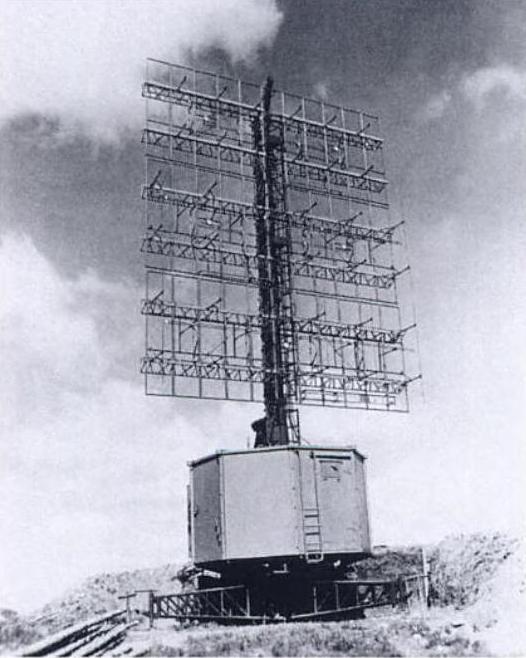 Towards the end of 1940, the radar intercept stations (German Radar in World War II)(German Radar Equipment, of the Reichspost on the English Channel picked up a signal from an apparatus which made for many headaches amongst the technicians. The first inkling of the manner of operation of the so-called pipsqueak was obtained from the R/T traffic. It served the fighter controls for the controlling of day and night fighters, prior to the developments of more complex procedures. Although many messages and PWI reports soon helped reveal the function and purpose of this apparatus, it was a long time before one was captured in good condition, as an explosive charge was built into the set that was so delicate that it could be touched off if the plane made a rough landing. Finally a British fighter landed on a German airfield in Normandy, and in this way, the IFF first came into Germany's hand intact. Not long after did a second unit from a Spitfire, which made an emergency landing.
The IFF was first D/F'd by a radar intercept D/F and the bearings were used to give Luftwaffe fighters advance warning. However, it had meaning only in connection with the watching of R/T traffic. After examining the captured IFF, the Luftwaffe set about building a VHF transmitter which could trigger the IFF, and this make it serve the Luftwaffe in flight path tracking. Because of faulty construction, the successes of this transmitter were negligible.
The jamming of German radar installations by the Allies both from the air and the ground took on such proportions that the greater part of the sets needed for operation were rendered temporarily useless, and Germany's own Fighter Control was interfered with accordingly. For this reason, a German air surveillance radar was developed in the general frequency range of the Allied radar. It was the Freya-D, called Dora Insel. The first Dora Insels were used in Germany and France. The recognition blip which the IFF registered on the scope of the Dora Insel was called the Flamme and at first no great value was set by it. The Dora Insels were introduced in the Southeast. Since the time of the improvement in the operations of the Radar Command Post in the Southeast, after it has come under control by Feichtner, he had a daily report sent in to him by the Ground Observer Service on the jamming they experienced in their radar sweeps. For this purpose, Feichtner introduced a regular form sheet. It was noticed that every time an Allied mission flew within range, the Dora Insel was reported jammed. Upon examination of the image drawn of the jamming pattern on the set scope, he figured it was only the IFF that was causing it. Quite by accident, the frequencies of the Dora Insel and the IFF matched perfectly. So with the captured IFF, Feichtner instructed all Dora Insel crews in Flamme coverage. They numbered the different identification patterns (studs) and this gave them a most effective means of differentiating in their tracking between the units that flew in apart from one another. Since the IFF and the Dora Insel were both transmitters, the effective range of measurement was almost doubled. Every time the Allied mission was on its way, the Meldeköpfe notified the stations equipped with Dora Insel immediately, and these stations turned their observations directly to the Meldeköpfe. Thus, thanks to the Flamme, the 205th RAF Bomber Group could be differentiated from the Partisan Supply Drop planes, both of which were very difficult to identify due to their good radio discipline. From then on the 205th Bomber Group was not only spotted as such when it was still in the assembly area, but the strength of the mission and the course of flight could also be predicted in the same good time, as some Flammen always appeared when they were on their way to the target. The same technique was used against the Partisan Supply Drop planes, enabling strength, course, target, and concentrations of Partisans.
The triggering of the Flamme by the Dora Insels made it possible to D/F the IFF with the Luftwaffe Radar intercept D/F. These last were called Sagebocke, that was German electronic device for detecting IFF emissions from Allied aircraft and that gave valuable bearings and fixes for the Flight Tracking Service.
After Feichtner had convinced the Fighter Control Centre (to which the Aircraft Warning Service was subordinate) and the Chief Signal Officer, of the enormous importance of Flamme coverage, he made the suggestion to track all enemy formations in the Southeast sector with Flamme, and for this purpose requested that all stations with Dora Insel be put under the operational command of Radio Intelligence. The lead set was to be a Dora Insel in Durrës in Albania, where Feichtner had his best situated VHF intercept station. The lead set was to identify the units already picked up and spotted from the take-off traffic by the SI service according to the IFF stud they were on, and pass this information on to the radar intercept stations, which, as was proved in an entirely successful test, made it possible to track the enemy formations from take-off to landing during the course of the whole mission, and never to lose touch with them as they were airborne. Due to the embittered objections voiced by the Ground Observer Service, which saw itself thus condemned almost to complete extinction, the retreat from the Balkans, and the immeasurable sluggishness and bureaucratic involvements of the German radar intercept operations section of the Chi-Stelle, the plan was never carried out. When Feichtner later found time to get back to it, the Allies seems to have become aware of the treacherous possibilities of the IFF, as stringent regulations came out on turning off the IFF, and for safety's sake, most of the sets were taken out of the planes.
Battalion Conference
In March 1944, Feichtner ordered a conference between all officers and team leaders of the battalion, which was held in Pantchova. From the point of view of transport it was most difficult to get all the men off the scattered islands of the Aegean Sea and the Peloponnese, as well as from Albania, especially as the land routes were mostly barred by the Partisans, and many officers and enlisted men required more than 10 days for the trip. The conference, which was for a general exchange of experiences, lasted three days, and Feichtner was overcome with pride at his men, to see how the soldiers attacked their problems with such enthusiasm, after years on end of isolation in such remote outposts of civilization. The conference was principally an opportunity to get to know each other and exchange experiences. During the three days of the conference, the latest results and developments of the Signals Intelligence unit was discussed and the goals of the coming year. Feichtner considered the conference to have borne abundant fruit.
Expansion of the Meldekopf
In order to provide the Fighter Commands Balkans with flash reports, Feichtner set up a Air Warning Reporting Centre () in Pantchova, together with his evaluation company, from which the Fighter Commands of Romania, Bulgaria, Hungary, Albania and Greece were served with the new unit's flash reports. The information sent to these units, and the forwarding of this information was accomplished almost exclusively by W/T; by constantly drilling the W/T operators he succeeded in reducing the time of processing, that is the encoding, transmission, reception and decoding of a flash message down from one and a half minutes to one minute. Feichtner took particular pride in his men, who carried out their duty, often in remote, isolated conditions, on a mountain, or remote island, and often under attack from Partisans. Later the Meldekopf moved into an air raid shelter especially built for them.
Intercept Company Constanza May 1944
The frequent attacks by Allied heavy bombers on the Russian oil well region, Ploiești (Ploiești oil field during World War II), as well as the triangle flights of the USSAF between Foggia, Poltava and Great Britain made it necessary to expand Feichtner's organisation further. Feichtner asked General Wolfgang Martini to have the 16/4 company in Constanța made part of his battalion. 16/4 was direction under control of the Chi-Stelle. Feichtner had noticed that the unit had only one operational receiver, which covered the Black Sea, in a unit of 150 men and officers whom he considered lived comfortably in the beautiful medieval town of Constanța, and whose officer class was more interested in making connections in the officers club. Upon receiving permission from Martini, he welcomed the opportunity, and immediately started by relieving all the officers, and replacing with his own. He increased coverage of the Black Sea, and took on the Soviet (Russian) seaplane traffic. He moved the Turkish language unit there, and put the radar interception stations, which were along the Turkish border, under this company's command. After the first week, he received a letter of commendation. This unit played a decisive part in the Evacuation of the Crimea and in the subsequent retreats from the Ukraine. When the retreat came in Romania, half the men managed to fight their way through to the German lines, while the rest became Prisoners of war. The platoon which was saved was subsequently incorporated in the southern battalion of the Signal Regiment East, after the reorganization of the Balkan units.
Combing of Signal Intelligence and Radar Intercept Services
In May 1944, Feichtner disobeyed orders of the Chi-Stelle in Berlin, by combining signal intelligence and radar intercept in that he dissolved the purely signal intelligence and radar intercept companies, and established mixed outfits with both services in them. In order to carry the process of unification through to Feichtner's officer corps, he sent all his Signals staff on temporary duty to radar stations on the English Channel, with each to provide a report when they returned. Conversely, radar intercept officers were sent to intercept stations, such as the one at Husum. The evaluation staff, and platoon leaders, were also cross trained. These periods of temporary duty paid well.
Meldekopf Vienna Summer 1944
The Chi-Stelle recommended that he cooperate to the fullest with Fighter Division 8 in Vienna. Feichtner was to provide practical experience in conducting and establishing flight path tracking in the Balkans as far as the Romanian oil centres, and the southeast German areas as far southeast as Upper Silesia on the other. Feichtner suggested a chain of reporting stations which all turned in the information to Meldekopf in Vienna, where the radar evaluation section was already active. The subsequent control section was subordinated to Signals Battalion Reich, which Feichtner discovered had insufficient personnel nor experience to take it on. Feichtner maintained that a single control battalion should track flight patterns, call signs and tactics, when the situation was that when a raid occurred by the Eighth Air Force in Upper Silesia, several different battalions were responsible for following their courses, and it happened time and time again that when planes were being followed, and were passed on from one battalion to another, they were either lost entirely or were passed on in part. When Fighter Control people complained, they asked Feichtner for his opinion. He pushed his idea of combining Radar intercept and Radio signal Intelligence that had so successfully worked in his own battalion, but the idea was rebuffed, due to the tenets of bureaucratic overcapacity, and professional jealousy, that ensured via standing policy, that Radar and Radio intercept were kept apart in Signals Battalion Reich.
Promotion to Major
In May 1944, as a result of an inspection of Feichtner's battalion by the Commanding General of the Luftflotte, Feichtner was promoted to Major. This was much to the disgruntlement of his regimental commander who Feichtner says hated the Signals Intelligence Service. Feichtner considered his position in the regiment even worse than it was before.
Scheduling
The abundance and variety of duties which each day were represented to Feichtner were not to be dealt with except on a strict time schedule. At 0700 hours in Feichtner's office there was a conference on the military situation with his company commanders and the battalion administrative staff. Here he gave the orders and special assignments for the day, received the reports, and heard the wishes and suggestions of his administrative officers and technicians. In this way, he brought about that his officers came on duty on time without having to check on them personally. He also had the rest of his day free of any further administrative details, and could devote himself to signal intelligence matters without interruption.
Daily conferences and control room design
Around 1700 hours, when most of the missions were terminated, there was a conference on the radio intercept situation. All responsible evaluators and SI officers were present. When Feichtner was absent, the operations officer took Feichtner's place. The purpose of this conference was to appraise every specialist of any new developments relating to their field of endeavor, and for Feichtner to keep himself informed regarding the state of the work and appraise evaluation problems. All enemy flights were traced on a map with coloured tacks. At the same time, there was posted over the situation room graphic and geographic diagrams, and indications of the most important enemy organizations. When the Commanding General inspected any situation room, he liked it so well that he ordered his intelligence officer to provide him with one like it. After the conference, Feichtner drove over to the daily situation conference of the Chief Signal officer, while the evaluation company was preparing the daily report for distribution.
Maintenance Platoon
Because of the experiences Feichtner had with the engineering staffs, Feichtner enlarged his own department considerably. Under the leadership of an able civilian technician, Feichtner brought all the capable maintenance specialists of the battalion together in one large platoon, and charged the department with the responsibility of the technical installations of all Feichtner's D/F stations, about 120 men in total. This section also reconnoitered new sites, and established the field equipment on them. Later, Feichtner, went against regulations, and installed all technical units, that were not established in the mountains, in vehicles. This allowed the unit to be fully operational in 24 hours, after a move, whereas setting up of a permanent installation took at least 1-2 months, due to the shortage of material. This maintenance department was mentioned by Feichtner, as he wished to thank it, for even despite the unit retreating from Athens to Attersee, Feichtner's unit was fully operational up to the last day of the war, whereas all other Signal Intelligence units had been out of use for weeks and sometimes months. At its peak, the maintenance department had 50 men.
Intercept Platoon Stara Zagora summer 1944
When Turkey started to move over to the Allied camp, it was generally assumed that Turkey would be used as a base of operations for flights over the Romanian oil centres. In anticipation of this Feichtner established a base in Stara Zagora in Bulgaria, near the Turkish border. Three radar intercept stations were transferred there as well. This platoon never became operational because of the Romanian-Bulgaria collapse, The sites were evacuated without loss of equipment or personnel.
Experiments with Radar Intercept Aircraft summer 1944
In order to counteract the extremely numerous supply dropping operations for the partisans in the Balkan countries, a squadron of night fighters was transferred to Feichtner's section. But as it was not equipped with GCI to home the night fighters on to their targets, the missions throughout the vast stretches of country were without success. Because a set up for ground control of night fighters would have been too extravagant here, Feichtner pressed repeatedly to find some way by which the fighters could be directed to the enemy planes. Feichtner saw the possibility for such an device, by studying the Eureka device, which was used by supply drop planes. These planes were tracked by the German stations through their IFF and Eureka, which were similar in performance to those used by the long range reconnaissance aircraft. Feichtner's plan was to guide the night fighters to positions from which they could intercept the enemy planes, by the use of radar intercept aircraft. After interminable wrangling with Berlin, a Junkers Ju 88 was finally placed at his disposal. Feichtner had two VHF receivers, a Naxos and a Samos built into the aircraft, together with the antennas they required. The route of the supply drop planes were to be ascertained by Flamme and Eureka D/F from the radar intercept stations, and passed on to the radar intercept plane on its regular tactical frequency. The antenna on the Ju 88 was installed in a manner that enabled the reception on the Samos receiver, and the signal could be D/F'd by changing the course of the plane and watching the Naxos receiver. In this manner it was possible to home in on supply planes. Test were conducted, which were satisfactory, but on the night of the first planned mission an allied bombing raid on the Pantchova aerodrome destroyed the Ju 88.
Meddo, second half of 1944
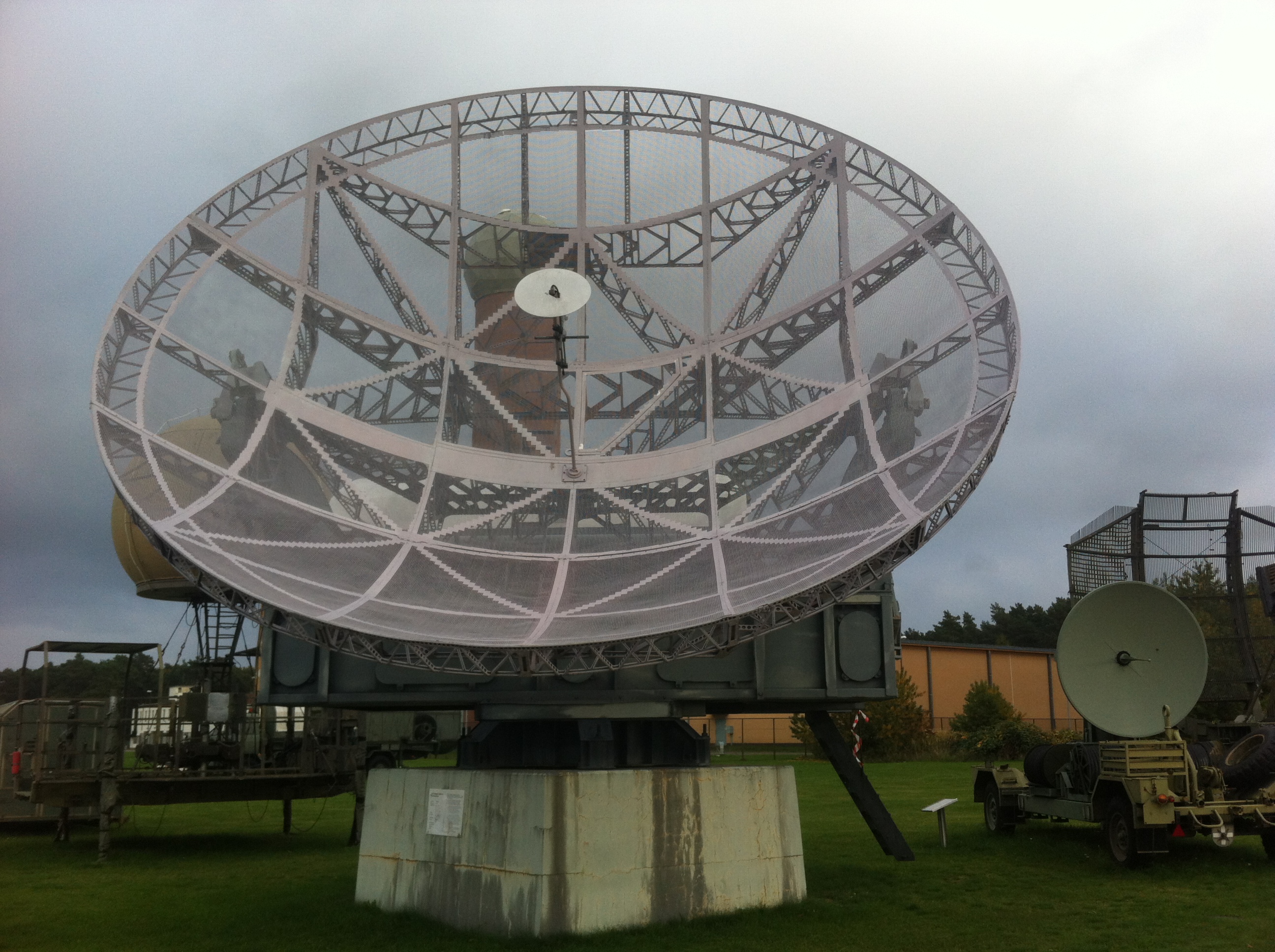 A few weeks after it had been established that the RAF Bomber Command was using panoramic pathfinder devices (Meddo), it was assumed quite correctly that the 205th Bomber Group must be using it too. So Feichtner ordered a KORFU radar D/F 812 to be set up near Ploiești. One day, when the American bombers flew in a mission over the Ploiești oil centre, the Micky turned up on the mirror frequency of this D/F set. This proved that the 15th USAAF also used the panoramic device in flight. Feichtner therefore tried to get his station equipped with the KORFU radar D/F 224 (the number gives the wavelength in tenths of a millimetre), but senior command refused. Feichtner nevertheless successfully obtained the equipment through the Fighter Controls. In the beginning, when R/T intercepts enabled Feichtner to determine the exact time over target, and to tell when to turn the Korfu sets on and off, they had good successes. However, when the 15th USAAF switched to night missions, and had regular night practice traffic on the air, the Korfu unit started to show its deficiencies, as the magnetrons it used were limited to a lifespan of 150 hours, and German industry could not deliver more. However, intercepting Meddo was the surest way to determine of being advised of the presence of American night flying bomber formations, who held radio silence during the complete mission, as they were only groups of pathfinder planes. Feichtner put on all possible pressure to get NAXBURG radar D/F sets. These units had no magnetrons to decay, and a greater range, up to 400Km, and the possibility of measuring the altitude up to distances of 100Km. The NAXBURG was a NAXOS with the dish antenna of the WÜRZBURG without the high frequency component. In the centre of the parabolic reflector, a dipole was placed, tuned to the critical wavelength of the frequency to be watched. The signal picked up was put through a crystal detector and an audio amplifier, which was fed to a pair of earphones. The signal was D/F'd for an aural maximum. The apparatus has the disadvantage of being of fixed frequency and increases in the number of impulses could only be sensed in the earphones apparently. This disadvantage did not affect Feichtner's purpose, as he was only making measurements, not conducting research. As the Chi-Stelle would not allow Feichtner this equipment either, he managed to obtain it nevertheless from the Fighter Control centres, which had a lively interest in flight path tracking, and equipped all Feichtner's stations with it. The British Magic Box, or Centimetric airborne radar, first discovered in February 1943 in the wreckage of a downed Stirling bomber was first nicknamed Rotterdam, (Rotterdam and Korfu), but later, when Goebbels made public mention of this in a weekly article in Das Reich, in which he gave away some information, the cover-name was changed to Laubrosch. In Britain it's name was H2S and worked on 9 centimetres, and the Meddo operated on 7.4 centimetres originally. Later, the Americans brought out a Meddo on about 2.4 centimetres, for the interception of which German industry never managed to produce a receiver, due to shortages of materials and vacuum tubes. No other counter measures were turned out against this set. But by shortening the dipoles on the NAXBURG set, Feichtner could cover it, however, and thus he guaranteed the flight path tracking of the southern units. Thanks to the installation of Meddo on the weather-recce Lightning during the last weeks of the war, the next days target for the 15th Air Force could be predicted by the High Command. The recce planes would turn on a special function of the Meddo when they were over the target area, probably to take photographs, and this produced a more rapid rate of impulses, which would be heard in the earphones of the NAXBURG. As the position of the recce planes was always to be ascertained by the radar D/F sets, it was easy to determine what prospective target it was working on. In the closing period of the war, every raid of the 15th Air Force confirmed advanced warnings from this source.
Increase in Partisan Activity mid 1944
The problem of supplying Feichtner's scattered and isolated teams became increasingly difficult as a result of the sharp rise in Partisan activity. It became almost impossible to furnish certain outposts with the necessary cryptographic material for communications. As a consequence of certain reports having fallen into enemy hands, Feichtner expected to have the British change their signals procedures from one day to the next, and put into effect a more frequent change of frequencies and call signs, to supersede the still beautifully systematic practices of the Groups, the Wings, and the Fighter and Reconnaissance units in Southern Italy and the Balkan Air Force. But it appears that these valuable documents never found the their way to British intelligence. Sets were lost repeatedly while on their way down to the outposts. Feichtner's senior command in Berlin were always very testy about such circumstances, and demanded an accounting, never stopping to consider the conditions under which his men had to effect these deliveries. Sometimes they were en route for weeks at a time. During the last six months of its operations, the SI company in Tirana, could only be reached by air.
Captured Documents
Feichtner derived great benefits from the documents and Standard Operating Instructions (abbr. SOI's) captured from aircraft shot down or that had to make an emergency landing in their territory. Lists of aircraft call signs taken along in the planes, contrary to orders, saved Feichtner's evaluation unit many difficulties, and his operators many an hour on the search receivers. Due the great importance of captured documents, Feichtner had [requested of] the Commanding General (Martini) put out an order that all enemy communications equipment or notations by enemy airmen found within his territory could only be processed by Feichtner's Signals Intelligence Unit or one similar in function to it. Since Feichtner's outposts were scattered all over the Balkans and were always tied in to the nearest switchboard, there were never any difficulties encountered in notifying the nearest Signals Intelligence post. VHF receivers of which units in the Balkans were always in direct need, would be removed from the wrecks and adapted, provided they were in good enough condition.
Prisoner of War Interrogation
In addition to equipment evaluation, the SIS also took part in prisoner of war interrogations. A Signal Intelligence Liaison Officer was sent for this purpose to the POW collecting point south. The American soldiers had been well trained in security, and behaved in such exemplary fashion that he expressed the hope time and time again that their own soldiers behaved with the same discipline and disinclination to talk. In spite of this, some good information was extracted, as the Liaison Officer bluffed the prisoners into thinking the Luftwaffe knew more than they did; and so they filled in the gaps or confirmed things which the Luftwaffe was not certain about, during the course of an interview.
[...] Party Children Mid 1944
By way of his commander, Feichtner received a letter from an Obergruppenführer, who was at the same time town councillor in Vienna. He complained bitterly therein as his son, a soldier in Feichtner's battalion, was not yet an officer. Feichtner was required to answer by indorsement. In Feichtner's reply, he made it no secret that he did not promote a man because of where he came from, but because of his character performance, and above all the ability to lead men. Feichtner included an estimate of the Obergruppenführer's son's worth, laying particular emphasis on the weakness of his character, and sent the letter back through channels. Some days later, Feichtner's commander called Feichtner in to see him, went over the contents of the letter, and expressed his satisfaction with the stand Feichtner had taken. At the same time, he informed the solicitous father of his opinion of this sort of interference with the affairs of the military.
20th July 1944
With the greatest surprise, Feichtner learned through the German Broadcast of the unsuccessful attempt on Adolf [...]'s life on July 20, 1944. The conspirators had made no connection with the Balkan Army. The rank and file of the soldiers were generally overwhelmed by the attempt to assassinate their commander-in-chief. The unit learned only so much of the motives of the conspirators as the German press thought it wise to reveal. Hermann Göring's order to do away with the traditional military salute, substituting the [...] salute, caused a certain amount of bad blood, particularly among the older officers. The Army was chagrined by the appointment of Heinrich Himmler as commander in chief of the () Replacement Army (Reserve Army), because this meant that all the best personnel replacements would go to Waffen-SS.
[...] Party Political Commissars late summer 1944
In consequence of the rapid rise in the [...] Party's influence on the Armed Forces, the post was created called National-Sozialistische Führungsoffizier ([...] political commissar). This was one of the last desperate measures of the German State leadership, which in the mobilizing of all its defensive instincts, was betraying, even more clearly that the war was lost. The common soldiers were most indifferent to this innovation. The idea of saturating the Armed Forces with politics at the last minute was defeated at the start. If the Party really wanted to make German soldiers political soldiers, it should have begun in 1933. Now, every political shot-in-the-arm administered to the weary and half-beaten down organism of the Army failed to produce its effect. These [...] political commissars were almost always reserve officers only of low rank who had been party members for a certain length of time. They were incapable as administrative officers and produced the opposite effect on the men from that which their job had been created. Feichtner had little regard for his NSFO and considered him a total loss as an intelligence officer, and considered the political pep-talks that the NSFO gave to Feichtner's men as hackneyed party rhetoric. Feichtner considered it hard enough for his men, whom he considered were of a higher professional class, knew foreign languages, had lived in foreign countries and who were able to form their own opinions, to accept the whole-hearted propaganda of the [...] cause. When the NSFO became troublesome for Feichtner, he started to take cautious steps to get rid of him. Caution was in order, as the NSFO were eventually given disciplinary powers. One day when the NSFO repeated once more his old wheezes about economising on rear echelon personnel in such outfits as the unit, Feichtner took him at his word and had him transferred to a combat outfit at the front, and replaced him with his own Adjutant. He used this position principally to get hold of Special Service equipment for the teams in the different outposts.
Romanian treachery late summer 1944
In Bucharest, it was clear that anyone could see that a small spark was all that was necessary to start a political explosion. The same impressions were to be formed anywhere one looked in public everyday life, as one could see during the invasion of France, with the difference that here they were intensified by oriental indecency. While difficulties faced visitors, including food, quarters and money, the staffs permanently stationed there led a relative life of luxury. Feichtner stated that the respect that the German soldiers, and especially the German officer, had won for himself among the Balkan peoples was thoroughly destroyed by the;
fopish and idiotic manifestations of the [...] party and the active part the rear echelons took in furthering the general corruption.
Here the criminal incapacity of the German authorities to pick the right man for the position, came home to roost.
On the day of the change-over on 24 August 1944 (King Michael's Coup), when Romanian changed sides to the Allies, the German minister in Bucharest, Manfred Freiherr von Killinger made a public declaration that all was in the best of order in Bucharest, but it was known by all German soldiers in Romania that disaster was brewing. Despite the warning of the coming danger in this quarter, passed around months beforehand, on the day of Romania's change of heart, most of the administrative personnel were still living in private billets. The consequence of Romania's move were the bitterest loss for Germany. Feichtner lost half a company, lots of valuable equipment which was just in transit at the time. While the higher ranking officers succeeded in reaching safety by plane, the whole personnel of the staffs fell into enemy hands. In this manner, one of the best SI liaison officers stayed behind in Romania. However, some of Feichtner's most capable Technical Sergeants succeeded in making it back to German held territory with all their men and equipment, and reported to Feichtner. Feichtner put them to work again at stations in Hungary.
Advances of the Soviet Army autumn 1944
After leaving Romania and Bulgaria, the loss of Serbia was only a matter of weeks. Feichtner's principal worry was the evacuation of the Greek islands and the safe retreat of the intercept company in Athens. After extensive arrangements were made many times with the transportation offices, Feichtner was finally able to get the almost unobtainable shipping space and air transport facilities for the men and their equipment, and Feichtner evacuated every station in the Aegean, except Milos, without losing any personnel. The out-station on Milos, which was indispensable for watching ASV and shipping movements as long as there was a German ferry still in the Mediterranean, was finally evacuated by seaplane. The company in Athens retreated in vehicles. Most of the relatively unimportant equipment, which was put on a ship, was sunk by a British submarine near Thessaloniki. The company's retreat was beset by constant partisan activity, bombings and low flying attack. After six weeks, it reached Germany. Its next site was south of Maribor (), in Styria, Slovenia.
Transfer of the Battalion of Premstätten late 1944
As the Soviets (Bolsheviks) advanced towards Belgrade, Feichtner transferred the two intercept companies, the jamming company, and the evaluation company to Premstätten, near Graz, where Feichtner had already prepared for this eventuality some time previously, by setting up a base of operations. Feichtner stayed on with the battalion HQ, the flash report evaluation section, and part of the Meldekopf, in Pantchova, where Feichtner's southward and eastward lying out-stations were to be withdrawn. Feichtner also left the three especially well situated HF and VHF which were to remain as long as possible where they were. When the Soviets (Russians) began closing in the partisan activity became so dangerous, that a standing guard of 20 heavily armed men had to be detailed to protect the D/F stations. Feichtner took turns being duty officer with his three remaining officers. On the first of October 1944, the unit had to abandon Pantchova. The crossroads behind the city already lay under the area of fire of the Soviet artillery. Feichtner arrived in Premstätten in 4th October 1944.
Establishing in Premstätten October 1944
The unit was now back in Germany after three and half years. Feichtner noted how different everything was from the time when he was initally sent to Athens. In the air war in this sector, no plans were laid or operations contemplated without his men playing an intrinsic part. When Feichtner's company in Tirana, Albania, surrounded by partisans, fought its way through to Germany after weeks of fighting with the guerillas, the commander of the combat group, to which they were attached, told Feichtner, that but for the untiring work of the soldiers and the two officers who were wounded during the retreat, the combat group would have been annihilated. Feichtner lived according to the conscientious and disciplined manner of an old Reichswehr soldier. No political discussion or arguments about the military situation were permitted in the officers' mess. Weakness and lack of understanding, even on the part of Feichtner's superiors, were always combatted by himself. Feichtner's rise in the Luftwaffe Signal Intelligence Service in the Southeast was the handiwork of himself and his men. So he and his men felt no guilt or responsibility for the way things turned out, and knew that the service they offered became even more significant.
This made it all the more difficult for Feichtner to understand the attitude of Dr Siegfried Uiberreither, the Gauleiter in Styria, Austria, whose inimical feelings toward the armed forces in general, and Feichtner's unit in particular, had been reporting to Feichtner by his officers. As soon as Feichtner had arrived in Graz, he visited the Gauleiter to settle the manner personally to arrange billets for the men. The visit exceeded his work expectations. This young Gauleiter, bellowed at him, in his Gau, he was running the war and the armed forces could occupy no permanent billets and besides, it was up to the Army to do what the Party told it, etc.. He would up his oration by telling Feichtner and his men that he could crawl into the ground. Feichtner noted that he had never been a soldier, and had two or three castles held in readiness for himself and his staff as alternate offices. Feichtner considered him a coward. The Gauleiter's Kreisleiter's operated with the identical arrogance, lack of comprehension, and idiocy. Feichtner considered their superabundance of responsibility that had been assigned to them, in their organization consisting of military and civilian duties seemed to have knocked the bottom out of their already very feeble sense of actuality.
Feichtner managed to secure a hotel which had been requisitioned for the [...] Youth, until Feichtner could set up barracks. The signal communications in Premstätten were a most serious impediment. Feichtner's suggestion to transfer the battalion site to a big overland cable switching point in Salzkammergut was disapproved by the Marstall without a moment's investigation of the problem.
Retreat of the Intercept Company in Tirana mid October 1944
During mid 1944, the partisan situation in the Balkans became so acute that it appeared high time to withdraw the intercept company in Tirana and it's out-stations, scattered along the Adriatic coast. Because of the vital importance of the company's work in tracking the flight paths of the 15th USAAF, the movement orders had to be issued from a higher HQ. Feichtner kept in constant touch with the company commander, who sent Feichtner signals describing his position, which was getting more and more precarious, more dangerous and finally looked hopeless. However, none of Feichtner's superior officers agreed to sign the movement order. Thus the company lost priceless days. Finally, when they were completely surrounded by partisans (World War II in Albania), Feichtner ordered them to destroy their equipment and vehicles and fight their way through the Balkans to Germany, by joining forces with one of the last combat units to remain in the Balkans. The enlisted me received the Iron Cross, but it took six months to persuade General Wolfgang Martini to agree to give the Iron Cross, 1st class to the company commander.
Out-Station Novi Grad, Republika Srpska
After Feichtner lost his out-stations in the Adriatic, he established a team in Novi Grad, Republika Srpska in Bosnia. Completely surrounded, and several times besieged by guerillas, it held out only six weeks, before it was forced to retreat by the continued attacks and the lack of food supplies.
Intercept Platoon Agram late 1944
Near the Croation capital (Zagreb), there had long been an intercept station providing information for the Air Commander. As Feichtner's outlying teams had been called in, Feichtner increased the strength of this platoon considerably. Due to what Feichtner considered the foolish German financial policy in occupied countries was upheld to the end, the unit suffered great food shortages.
Signal Intelligence Regiment 352 (South) formation
In October 1944, it was finally decided to form a signals intelligence regiment for the south. At this time, when the Balkans had been lost and the general situation pointed towards the end of the war, Feichtner considered it was a little late to be forming a regiment, which would have had more meaning two years previously. Feichtner's senior command had had a long fight on their hands before they succeeded in giving Feichtner command of the regiment, particularly as old Signals Corps colonels, who not longer had units, and hence no assignments, were seeking this position. The four companies in Italy came under Feichtner's command. At first Feichtner has some difficulties with the Italian battalion, which had never had a Signals specialist as commanding officer before. After Signals Battalion Reich has made a mess of operations for months on end with Meldekopf Vienna, it was finally turned over to Feichtner's command, which included the out-stations in Rax and Kanzel in the Austrian Alps.