
Energy-depth relationship in a rectangular channel
In open channel flow, specific energy (E) is the energy length, or head, relative to the channel bottom. Specific energy is expressed in terms of kinetic energy, and potential energy, and internal energy. The Bernoulli equation, which originates from a control volume analysis, is used to describe specific energy relationships in fluid dynamics. The form of Bernoulli’s equation discussed here assumes the flow is incompressible and steady. The three energy components in Bernoulli's equation are elevation, pressure and velocity. However, since with open channel flow, the water surface is open to the atmosphere, the pressure term between two points has the same value and is therefore ignored.
With the pressure term neglected, energy exists in two forms, potential and kinetic. Assuming all the fluid particles are moving at the same velocity, the general expression for kinetic energy applies (KE = ½mv2). This general expression can be written in terms of kinetic energy per unit weight of fluid,
$$\frac{KE}{Weight} = \frac{\frac{1}{2}mv^2}{\gamma V} = \frac{\frac{1}{2}\bigl(\rho V\bigr)v^2}{\rho g V}$$ (1)
- {|
|Where: || m = mass |- | || v = fluid velocity (length/time) |- | || V = volume (length3) |- | || ρ = fluid density (mass/volume) |- | || γ = specific weight of water (weight/unit volume) |- | || g = acceleration due to gravity (length/time2) |}
The kinetic energy, in feet, is represented as the velocity head,
$$KE=\frac{v^2}{2g}$$ (2)
The fluid particles also possess potential energy, which is associated with the fluid elevation above an arbitrary datum. For a fluid of weight (ρg) at a height y above the established datum, the potential energy is wy. Thus, the potential energy per unit weight of fluid can be expressed as simply the height above the datum,
$$\frac{PE}{\rho g} = y$$ (3)
Combining the energy terms for kinetic and potential energies along with influences due to pressure and headloss, results in the following equation:
$$\frac{v_1^2}{2g}+y_1+\frac{P_1}{\gamma}-h_f = \frac{v_2^2}{2g}+y_2+\frac{P_2}{\gamma}$$ (4)
- {|
|Where: || y = the vertical distance from the datum (length) |- | || P = pressure (weight/volume) |- | || hf = headloss due to friction (length) |}
As the fluid moves downstream, energy is lost due to friction (headloss). These losses can be due to channel bed roughness, channel constrictions, and other flow structures. Energy loss due to friction is neglected in this analysis.
Equation 4 evaluates the flow at two locations: point 1 (upstream) and point 2 (downstream). As mentioned previously, the pressure at locations 1 and 2 both equal atmospheric pressure in open channel flow, therefore the pressure terms cancel out. Headloss due to friction is also neglected when determining specific energy; therefore this term disappears as well. After these cancelations, the equation becomes,
$$\frac{v_1^2}{2g}+y_1 = \frac{v_2^2}{2g}+y_2$$ (5)
and the total specific energy at any point in the system is,
$$E = \frac{v^2}{2g}+y$$ (6)
----
Volumetric Discharge
To evaluate the kinetic energy term, the fluid velocity is needed. The volumetric discharge, Q is typically used in open channel flow calculations. For rectangular channels, the unit discharge is also used, and many alternative formulas for rectangular channels use this term instead of v or Q. In English units, Q is in ft3/sec. and q is in ft2/sec.
$$q = \frac{Q}{b}$$ (7)
- {|
|Where: || q = unit discharge (length2/time) |- | || Q = volumetric discharge (length3/time) |- | || b = base width of rectangular channel (length) |}
Equation 6 can then be rewritten for rectangular channels as,
$$E = \frac{q^2}{2gy^2}+y$$ (8)
----
The E-y Diagram
For a given discharge, the specific energy can be calculated for various flow depths and plotted on an E-y diagram. A typical E-y diagram is shown below.
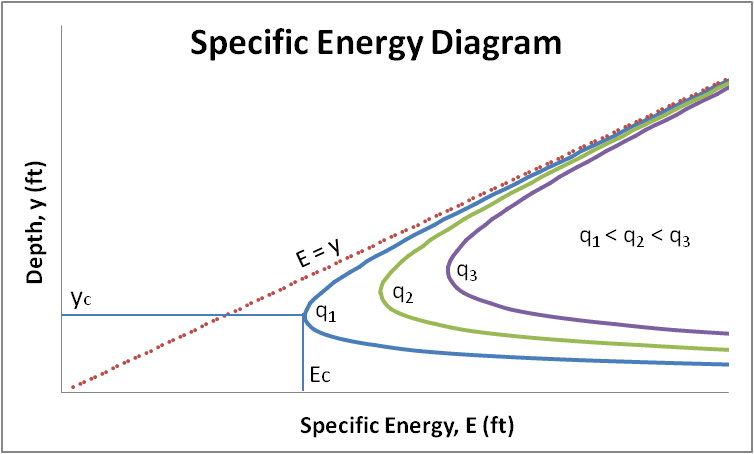
Three different q values are plotted on the specific energy diagram above. The unit discharges increase from left to right, meaning that q1 < q2 < q3. There is a distinct asymptotic relationship as the top part of the curve approaches the E = y line and the bottom part of the curve tends toward the x-axis. Also shown are the critical energy or minimum energy, Ec and the corresponding critical depth value, yc. The values shown are for the q1 discharge only, but unique critical values exist for any discharge.
----
Critical Flow Relationships
The critical depth value mentioned in the E-y diagram section above is mathematically represented by the ratio of the fluid velocity to the velocity of a small amplitude gravity wave. This ratio is called the Froude number.
$$F_r = \frac{v}{\sqrt{gy}}$$ (9)
The critical depth has a Froude number equal to one and corresponds to the minimum energy a flow can possess for a given discharge. Not all flows are critical, so what about Froude numbers not equal to one? Froude numbers below one are considered subcritical and Froude numbers above one are considered supercritical.
Fr = 1; Critical (10)
Fr < 1; Subcritical (11)
Fr > 1; Supercritical (12)
Physically, subcritical flow is deep and the velocities are slow. This means subcritical flow has high potential energy and low kinetic energy. Supercritical flow on the other hand tends to be shallow and the velocities are fast. Supercritical flow has low potential energy and high kinetic energy.
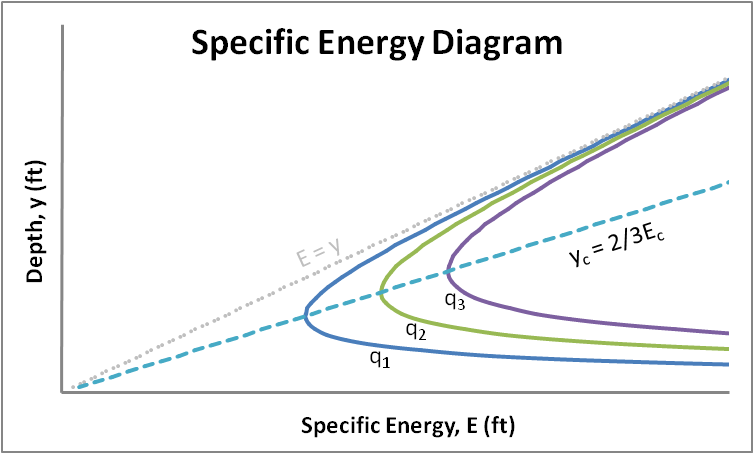
If we refer back to the E-y diagram, it is seen that a line passes through the critical value on each successive discharge curve. This line corresponds to y = 2/3E.
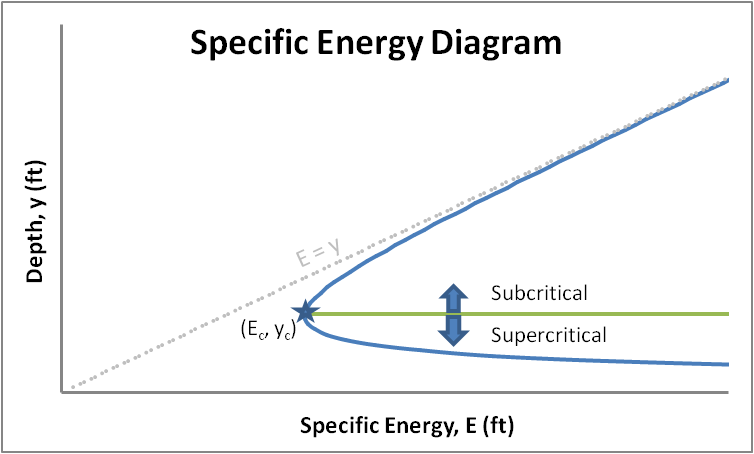
Depth values on the E-y curve greater than the critical depth correspond to subcritical flow depths. Likewise, values less than the critical depth correspond to supercritical flow depths.
For rectangular channels, the critical depth can be calculated by taking the derivative of the energy equation and setting it equal to zero. The energy associated with the critical depth is found by placing the critical depth expression into the specific energy equation. The critical energy expression is demonstrated graphically by the line yc = 2/3Ec, which connects critical depth values.
$$\frac{dE}{dy} = \frac{d}{dy}\biggl(\frac{q^2}{2gy^2}+y\biggr) = 0$$ (13)
$$y_c = \biggl(\frac{q^2}{g}\biggr)^\frac{1}{3}$$ (14)
$$E_c = \frac{3}{2}y_c$$ (15)
----
Alternate Depths
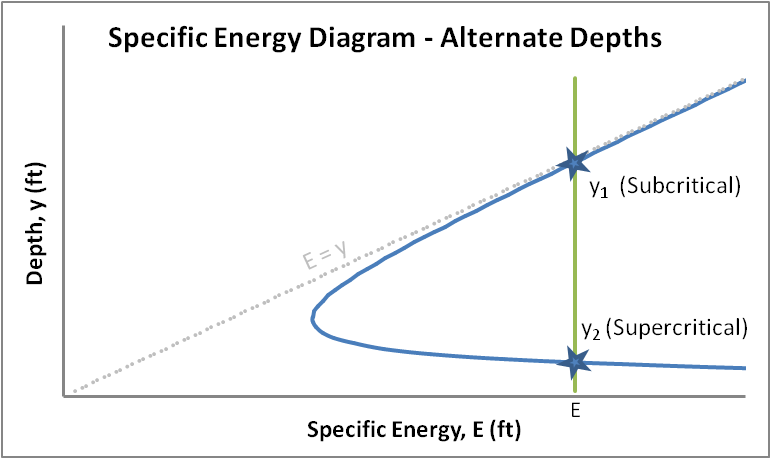
For a given energy value, there generally exists two possible corresponding flow depths. In the diagram above, the alternate depths are labeled y1 and y2 and correspond to the subcritical and supercritical flow regions, respectively. This holds true for all energy values except for the critical energy where only one depth is possible, the critical depth. The following alternate depth equation is used for rectangular channels. The values for y1 and y2 are interchangeable.
$$y_2 = \frac{2y_1}{-1+\sqrt{1+\frac{8gy_1^3}{q^2}}}$$ (16)
The concept of alternate depths can be demonstrated with a sluice gate example. Sluice gates are used to control the flow of water in open channels.
----
Example
Water flows in a rectangular channel that contains a sluice gate. The upstream depth of flow, y1 is 5.0 ft, the sluice gate opening is 1.0 ft, and the unit discharge, q is 10 ft2/s. What is the flow depth downstream of the sluice gate, y2?
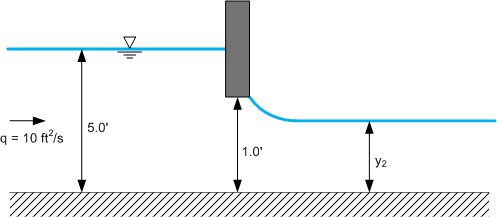
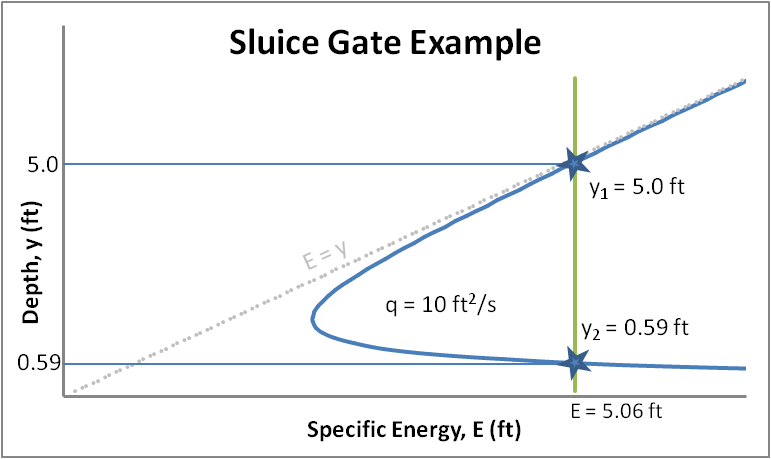
Energy is conserved at a sluice gate, meaning the up- and downstream energies are equal. The energy equation, alternate depth equation, and E-y diagram are used to solve this problem.
$$E = \frac{10^2}{2(32.2)(5.0^2)}+5.0 = 5.06\; \text{ft}$$
$$y_2 = \frac{2(5.0)}{-1+\sqrt{1+\frac{8(32.2)(5.0^3)}{10^2}}} = 0.59\; \text{ft}$$
This topic contribution was made in partial fulfillment of the requirements for Virginia Tech, Department Of Civil and Environmental Engineering course: CEE 5984 – Open Channel Flow during the Fall 2010 semester.
References
- M. H. Chaudhry, Open-Channel Flow. New York: Springer, 2008.
- E. J. Finnemore and J.B. Franzini, Fluid Mechanics with Engineering Applications. New York: McGraw-Hill, 2002.
- Moglen, G.E. (2010) Lecture notes from CEE 4324/5984: Open Channel Flow, Virginia Tech <http://filebox.vt.edu/users/moglen/ocf/index.html>, September 2, 2010.