
Emerging and Growth-Leading Economies
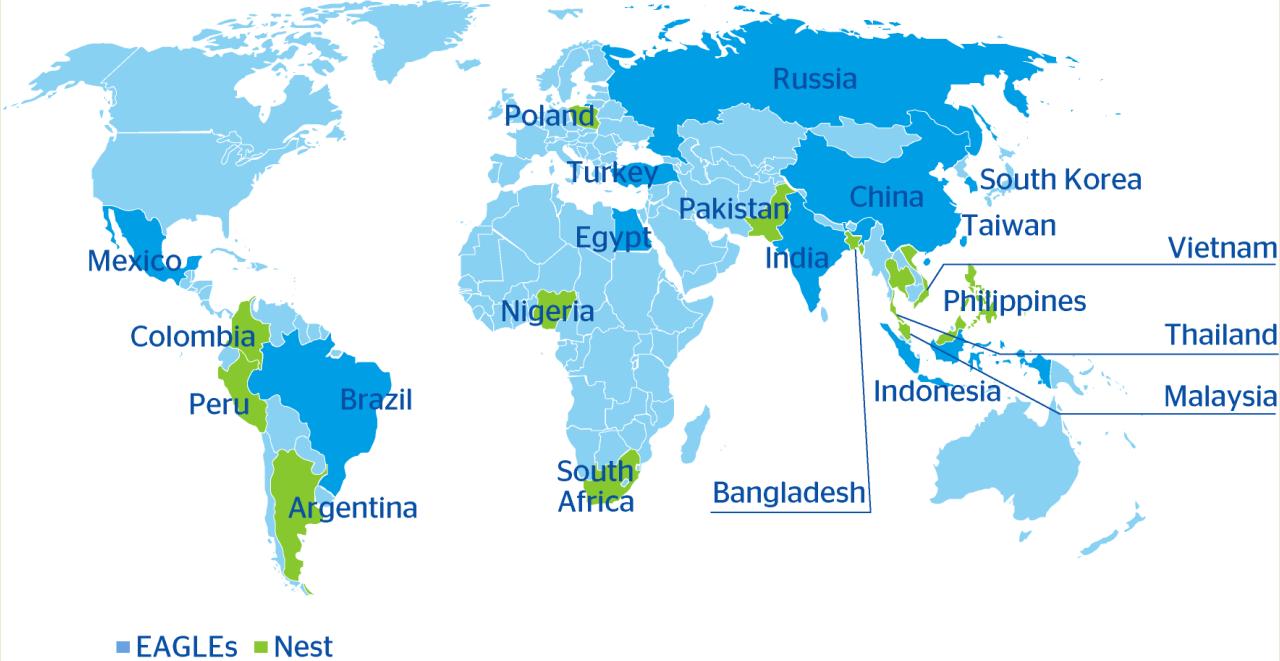
EAGLEs
Brazil, China, Egypt, India, Indonesia, Mexico, Russia, South Korea, Taiwan, Turkey
Nest
Argentina, Bangladesh, Colombia, Malaysia, Nigeria, Pakistan, Peru, Philippines, Poland, South Africa, Thailand, Vietnam
EAGLEs is a grouping acronym that encompasses the key emerging economies that are expected to lead global growth in the next decade.
The EAGLEs concept
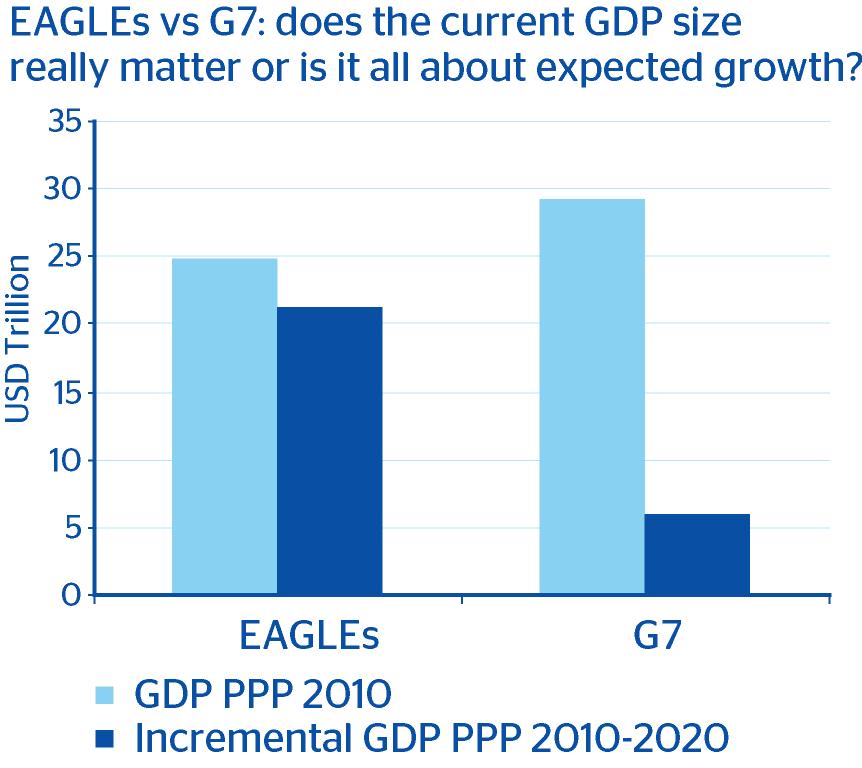
EAGLEs (Emerging and Growth-Leading Economies) is a grouping acronym created in late 2010 by BBVA Research to identify all emerging economies, whose expected contribution to world’s GDP in the next ten years is expected to be larger than the average of the G7 economies, excluding the US. This is a dynamic concept where country members can change over time according to their forecasted performance relative to developed economies. In a first approach ten economies, sorted by relevance, have been identified: China, India, Brazil, Indonesia, South Korea, Russia, Mexico, Egypt, Taiwan and Turkey.
EAGLEs and other economic concepts
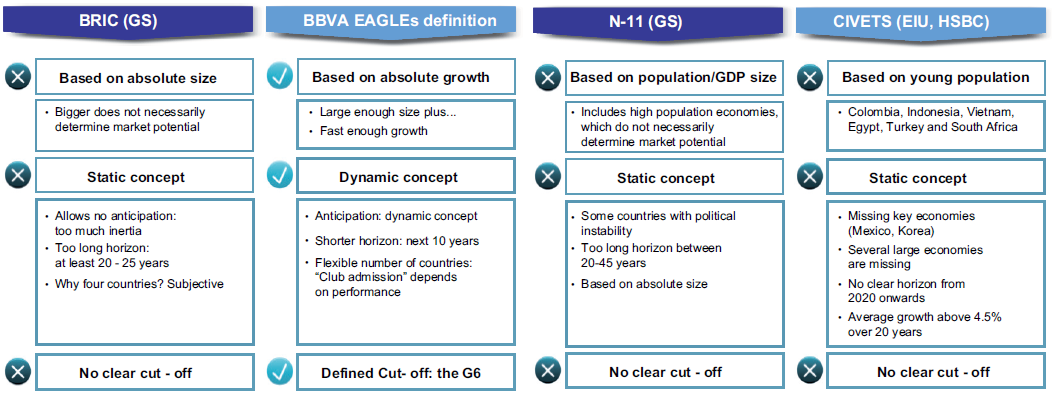
 As world economic growth rotates from developed to developing countries there has been increasing interest in identifying emerging markets that will become global leaders, as well as increasing lobbying of some countries to be included in the BRIC definition. However, many economists have argued that the BRIC concept is outdated and have proposed alternative definitions. The EAGLEs concept is similar to other proposals in going beyond BRICs (such as the CIVETS, Next 11 or 7 percent club) but its methodology differs from others’ in several ways:
- It gives less relevance to economic size and population, which may be misleading.
- It focuses on the Incremental GDP (IGDP) economies will generate, instead of paying attention to the current or expected size of their GDP. This creates a situation where having big size or high growth rate is not enough on its own to be a key global player. It is a combination of both that really matters.
- The cut-off is explicit. In order to become an EAGLE member, each country’s expected Incremental GDP in the next 10 years needs to be greater than the one anticipated for the average of the G6 economies, G7 excluding the US.
- It is not a closed group and the concept is not linked to an acronym formed by a given set of countries.
- The results are based on a shorter horizon - 10 years - than the ones considered in other cases, ranging from 20 to 50 years.
EAGLEs and other economic concepts
There were several attempts over the years trying to implement the economic concept that will the best reflect the potential of Emerging Markets in the coming years. After coining the BRIC concept by the Goldman Sachs in 2001, there were other endeavors to find the best grouping acronym such as: CIVETS, Next Eleven, 7 per cent club and the EAGLEs.
In January 2011, Goldman Sachs decided to re-define its current definition of Emerging Markets and proposed a new term “Growth Markets”. The separation of Growth Markets from Emerging Markets is aimed to show the world’s most dynamic economies – those that are at least contributing 1 per cent to global growth (outside of the Developed World). In the first approach, eight economies have been identified and they were: BRIC economies + Mexico, South Korea, Turkey and Indonesia. This particular shift in terminology was initially proposed by BBVA Research (later followed by Goldman Sachs) with the aim of switching from the existing static concept to something more dynamic, that could better indicate market potential.
Results
According to BBVA Research forecasts, World’s Incremental GDP in the current decade is anticipated to grow over 41 trillion US dollars adjusted by Purchasing Power Parity (PPP). EAGLEs share will be slightly above 50% whereas the G7 share will only reach 14%. As reported by BBVA research, China will play a key role during this decade representing almost 30% of total world growth; 2.4 times more than the other three BRIC countries. India and Brazil are expected to be the second and third highest contributors, followed by Indonesia and South Korea. Each will contribute to world growth more than Russia, and if combined they will be 1.5 times higher than Brazil. Next on the list is Mexico whose contribution is envisioned to surpass that of Germany or the UK, in spite of its current GDP size (adjusted by PPP) is only 53% and 71% respectively. Finally on the list there are: Egypt, Taiwan and Turkey whose Incremental GDP is predicted to be substantially larger than other developed economies i.e. Canada, France and Italy.
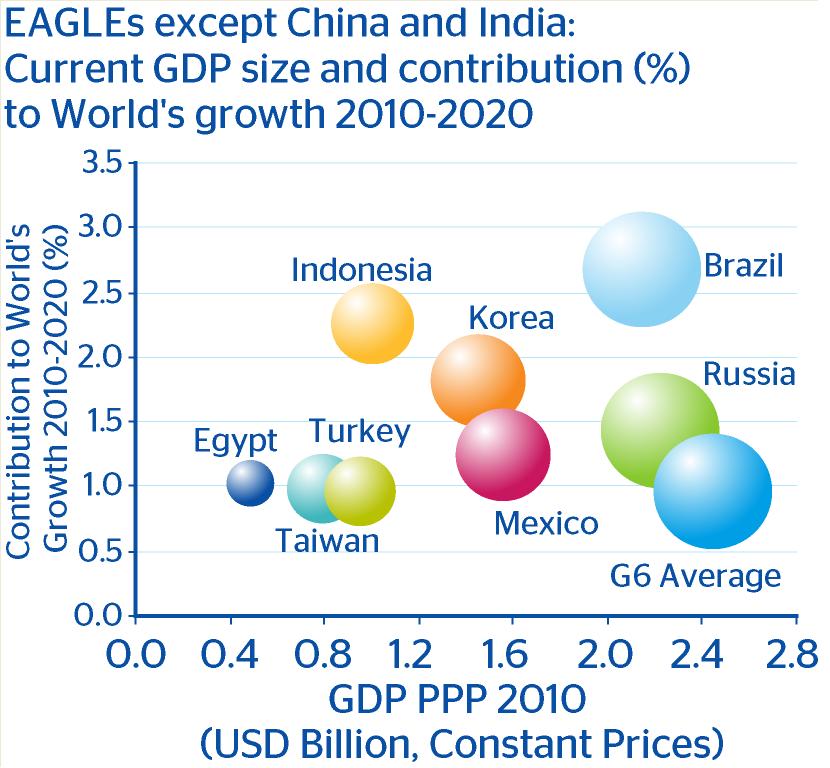
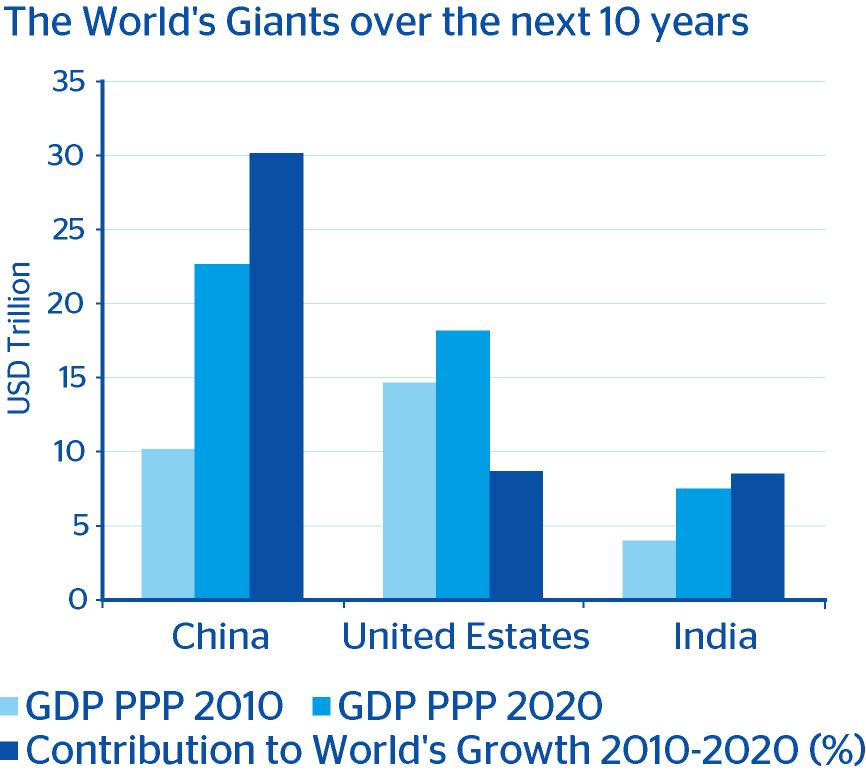
EAGLEs: Size and Incremental GDP
Gross Domestic Product (USD PPP 2010 Trillion, Constant Prices)
{| class="wikitable" |- ! Country ! style="width:100px;"| 2010 ! style="width:100px;"| 2020 ! style="width:100px;"| Incremental GDP |- | | 10.1 || 22.7 || 12.6 |- | | 4.0 || 7.6 || 3.6 |- | | 2.2 || 3.3 || 1.1 |- | | 1.0 || 2.0 || 0.9 |- | | 1.5 || 2.2 || 0.7 |- | | 2.2 || 2.8 || 0.6 |- | | 1.5 || 2.1 || 0.5 |- | | 0.5 || 0.9 || 0.4 |- | | 0.8 || 1.2 || 0.4 |- | | 1.0 || 1.4 || 0.4 |- | EAGLEs average | 2.5 || 4.6 || 2.1 |- | | 4.3 || 5.0 || 0.7 |- | | 2.9 || 3.4 || 0.4 |- | | 2.2 || 2.6 || 0.4 |- | | 1.3 || 1.7 || 0.3 |- | | 2.1 || 2.5 || 0.3 |- | | 1.8 || 1.9 || 0.2 |- | G6 average | 2.4 || 2.8 || 0.4 |- | | 14.6 || 18.2 || 3.6 |- | G7 average | 4.2 || 5.0 || 0.9 |}
Watch list or the EAGLEs’ Nest
As part of the EAGLEs proposal, the EAGLEs’ Nest is a second set of countries with expected Incremental GDP in the next decade to be lower than the average of the G6 economies (G7 excluding the US) but higher than Italy’s, the country which is anticipated to contribute less to global growth within the G7. The members are Thailand, Nigeria, Poland, Colombia, South Africa, Malaysia, Pakistan, Vietnam, Bangladesh, Argentina, Peru, and the Philippines. Altogether their Incremental GDP will be almost 8% of total world growth. 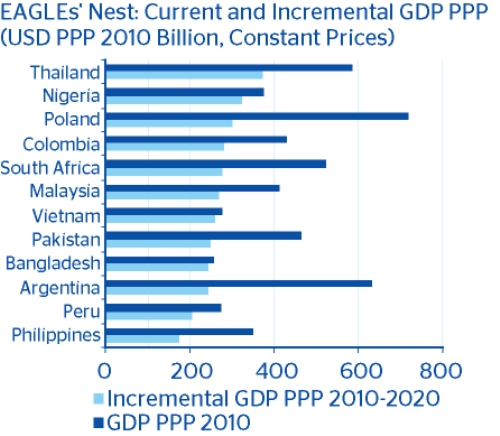
Country |
Average growth needed to become an EAGLE (2010–2020) |
The difference between required and forecasted growth |
|---|---|---|
5.5 |
0.3 |
|
4.4 |
0.9 |
|
7.5 |
1.0 |
|
5.6 |
1.4 |
|
6.6 |
1.5 |
|
5.2 |
1.6 |
|
6.9 |
1.7 |
|
6.2 |
1.8 |
|
9.1 |
2.3 |
|
9.4 |
2.7 |
|
9.3 |
3.4 |
|
7.8 |
3.5 |
Controversy
Arising controversy around the BRIC’s acronym entailed debate about the drawbacks assigned to a measurement of the economic significance for emerging markets. Indeed, South Africa is unquestionably a key African market but is it enough powerful to make it to a BRIC group? On the contrary, Egypt could be considered to be a better take, even though its economy is relatively smaller but is expected to deliver more to the world’s growth in the coming years. Eventually, current political instability triggered black clouds above its economy that could result in losing its position as an EAGLE member.
Should South Africa be a BRIC?
China, the Asian giant, has recently invited South Africa, to join the BRIC economic group and to participate at its latest meeting held in Beijing. The intention of making the extra room for the new member was to tighten Chinese ties with the largest African economy which after all ended up adding the letter “S” to the BRIC acronym creating a new block of countries called BRICS. In fact, the incorporation of South Africa to the BRIC concept was a matter of time, since there were already existing ties with Brazil and India through the group known as IBSA (India, Brazil and South Africa). The linkage became an important strategic point connecting the South Atlantic and the Indian Ocean through South Africa and opens a gateway for African markets. Jim O'Neill (chief economist at Goldman Sachs) said in his statement that the poor demographics of South Africa (45 million compared to 180 million in Nigeria: accounting for 18 percent of the total African continent) is not enough to become a BRIC member (total conglomeration of about 2,834 million: China with 1,338 million; India 1,157 million, Brazil 199 million and Russia 140 million.
According to BBVA Research, China’s invitation for South Africa to join the BRIC membership has restored the ongoing debate about further existence of BRIC group, in other words, the measurement of economic significance for emerging markets. It has been estimated that South Africa is the largest African Economy but in the near future it may lose its position to Egypt, unless political instability will persist without a smooth democratic transition which could have a deeper impact on Egypt’s economy. Important takeaway point here is that none of the African economy is ready to take a sit next to ’Big Boys’ and this honorable spot should be given to Indonesia.
(To delve deeper into the case of South Africa and Indonesia, refer to Economic Watch Should South Africa be a BRIC?: Not really: rather Egypt or – even better - Indonesia. BBVA Research 12/01/2011)
The effects of the political turmoil in Egypt
The Egyptian economy has performed better than others in Africa over the last twenty years, driven mainly by a dynamic population and stable institutional environment (regarding policy and regulatory framework), guaranteed by the Mubarak regime. With recent changes in events, it is too early to assess its possible impact on the long term growth rate of this country. The experience of previous cases obviously offers only limited guidance, but it does suggest that the peaceful democratic transitions usually generate positive or neutral effects on growth. Possible fall out of the EAGLEs’ group is significant due to contractions in its activity but on the other hand falling out of Nest, would required a more severe shock which could only arise if the political transition will worsen triggering the collapse of the economy (e.g. civil war).
(To delve deeper into the case of Egypt, refer to Economic Watch Can Egypt continue to be an EAGLE? BBVA Research 16/03/2011)
See also
- Emerging Markets
- Developed Country
- BRIC
- BRICS
- CIVETS
- Next Eleven
- G7
Marketing
BBVA EAGLEs was presented on November 15, 2010. It has been referenced by the media world wide several times.
Media
Media, both national and international, have covered the new concept coined by BBVA Research on emerging economies called EAGLEs.
- Países Eagles, países que crecerán por encima del G7 en los próximos anos. http://www.actibva.com/magazine/estudios-bbva/paises-eagles-paises-que-creceran-por-encima-del-g7-en-los-proximos-10-anos
- Eagles, Nuevo concepto de economías emergentes. http://www.capital.com.pa/?p=537
- Identifican a las EAGLE, con economías con mayor potencial de crecimiento. http://www.elmonetario.com.mx/
- El BBVA presenta a los EAGLE. http://www.infonomista.es/entorno/226-el-bbva-presenta-a-los-eagles
- ESADEgeo Center for Global Economy and Geopolitics http://www.esade.edu/research-webs/eng/esadegeo
- México, entre lideres emergentes BBVA http://www.eluniversal.com.mx/finanzas/83118.html
- BBVA: Los mercados del futuro.http://www.larepublica.com.uy/economia/432336-bbva-los-mercados-del-futuro
- Indonesia’s economy: Flying as high as an eagle http://www.thejakartaglobe.com/columnists/indonesias-economy-flying-as-high-as-an-eagle/424806
- South Africa urged to boost leadership skills for BRIC http://english.peopledaily.com.cn/90001/90777/90855/7272327.html
- Will Goldman’s new BRICwork stand up? http://blogs.reuters.com/davos/2011/01/17/will-goldmans-new-bricwork-stand-up/
- Should Egypt be the next Bric? http://blogs.ft.com/beyond-brics/2011/01/13/should-egypt-be-the-next-bric/
- S.Africa, not just another BRIC in the wall http://www.reuters.com/article/2010/12/29/us-safrica-bric-idUSTRE6BS1V720101229?pageNumber=2
Further reading
- Jeremy Gaunt. Reuters. 15/11/2010 What emerging animal are you?
- Bettina Wassener. The New York Times. 15/11/2010 New Term for Emerging Economies Is Suggested
- Jon Herskovitz. Reuters. 29/12/2010 Analysis: S.Africa, not just another BRIC in the wall
- The Economist. 26/11/2009 BRICS and BICIS
- James Newman. Business News Americas. 12/11/2010 BBVA adds its EAGLES to the BRIC, CIVETS debate – Regional
- Alicia García-Herrero, Daniel Navia, Mario Nigrinis. BBVA Research 15/12/2010 Why investors should focus on BBVA EAGLEs
- Alma Saavedra. El Economista. 16/11/2010 BBVA Research pone a volar EAGLES
- Actibva. 17/11/2010 Paises EAGLEs: paises que crecerán por encima del G7 en los próximos 10 años
- Globalasia. 18/11/2010 BBVA crea el concepto de países EAGLEs
- Alicia Gonzalez. El Pais. 05/12/2010 Las 'águilas' toman el relevo
- Alicia García-Herrero, Daniel Navia, Mario Nigrinis. BBVA Research 15/11/2010 As world growth rotates towards the emerging markets, focus should shift from BRICs to EAGLEs
- BBVA Research 16/03/2011 EAGLEs Quarterly Report 1Q 2011
- BBVA Research 09/06/2011 EAGLEs Quarterly Report 2Q 2011
- Alicia García-Herrero, Daniel Navia, José Ramón Perea. BBVA Research 16/03/2011 Can Egypt continue to be an EAGLE?
- Alicia García-Herrero, Daniel Navia, Mario Nigrinis. BBVA Research 15/11/2010 BBVA EAGLEs
- Alicia García-Herrero, Daniel Navia, Mario Nigrinis, Jose Ramón Perea, Alfonso Ugarte. BBVA Research 14/02/2011 Who are the EAGLEs? Driving Global Growth for the Next Ten Years
- BBVA Research 12/01/2011 Should South Africa be a BRIC?: Not really: rather Egypt or – even better - Indonesia
External links
- Goldman Sachs:Building Better Global Economic BRICs November 2001
- Goldman Sachs:DreamingWith BRICs: The Path to 2050 October 2003
- Goldman Sachs:The N-11: More Than an Acronym March 2007
- Economist Intelligence Unit:cWorld economy: Beyond BRICS July 2010
- Economist Intelligence Unit:Another BRIC in the wall April 2008
- William Pesek Jr, Bloomberg,South Korea, Another `BRIC' in Global Wall December 2005
- Steve Johnson, Financial Times,Emerging Markets: Brics sceptics have their backs to the wall December 2006
- Economist Intelligence Unit:Land of Promise April 2007
- James Dunn, The Australian,Emerging markets put China, India in the shade August 2008
- China Martens, OutSourcing World,IBM Targets Russian Developers February 2006
- Beth Kowitt, CNNMoney, For Mr. BRIC, nations meeting a milestone June 2009
- Goldman Sachs, Asset Management: It is Time to Re-define Emerging Markets, 31 January 2011
es:Emerging and Growth-Leading Economies zh:雄鹰经济体